Generation Z 212 – The Conscious and Combative Youth of Morocco
We hereby share an unofficial translation of a note from La Cause du Peuple on the youth protests in Morocco.
Generation Z 212: a conscious and combative youth that carries within it the aspirations of an entire people, alive forever!
For too long, Morocco has been quietly seething… with years of accumulated misery as a result of the high cost of living that stifles modest incomes, the dilapidation of hospitals whose plaster walls are crumbling like autumn leaves, the day-to-day abandonment of public schools to private interests, mass unemployment, a veritable hemorrhage that shatters the dreams of young people and the people, and the exploitation of subcontracting companies that squeeze and exhaust workers. Morocco, therefore, is a country whose people are suffocating but turn their faces away so as not to cry out… until the day when the cry of anger exploded.
In Agadir, in front of a public hospital that had breathed its last symbolic breath, young people from a generation that had been described as “virtual,” “alienated,” and “politically indifferent” stood up. They chanted slogans proving that digital technology is not necessarily a form of isolation but can become a formidable weapon when used properly. A single spark on September 14 was enough to ignite the flash of truth across the country: the problem was neither a dilapidated service nor an isolated hospital, but rather an entire policy designed to push the poor toward giant clinics that have built their fortunes on the fragility of Moroccan bodies, taking advantage of a rent-seeking system that plagues all sectors.
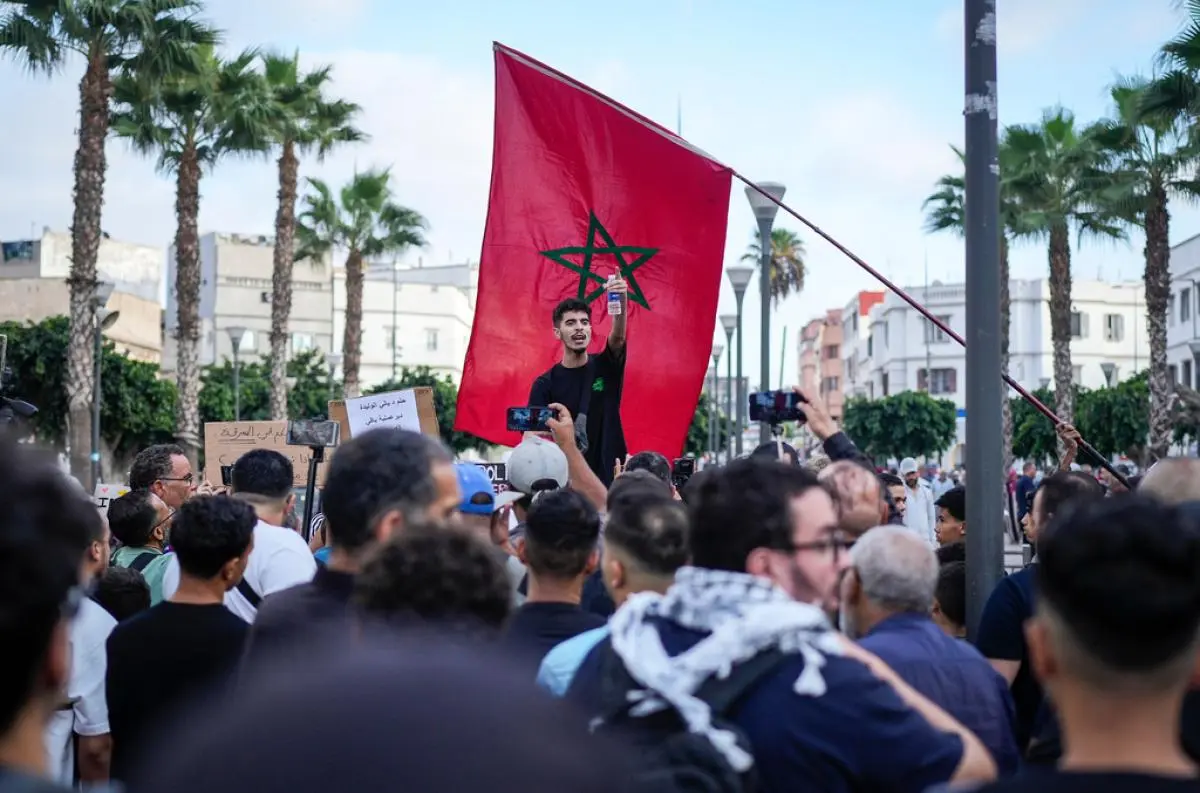
The cry of Agadir rang out like a slap in the face of silence, shaking the entire country… In Taounate, Oujda, Marrakech, Casablanca, Rabat… in the Rif, the Souss and the villages that drink dust instead of water, people took to the streets, not at the call of a party or a union, but driven by pain, hunger, marginalization, and exploitation. With marches climbing mountains, slogans crossing plains, chants defying the cars of big cities… A genuine anger, forged not in newsrooms but in empty stomachs.
From this profound labor of birth came Gen Z 212, a generation born on phone screens but which discovered that the street is the natural extension of the online world. A generation that saw the Al Haouz earthquake reveal the fragility of the State; a generation that saw water taken from villages to be given to large farms; a generation that saw repression chase away all forms of protest. A generation whose consciousness was shaped by drought, the high cost of living, overcrowded classrooms, lack of healthcare, exorbitant drug prices, and wages that are not even enough to cover transportation costs…
When this generation emerged, the labor movement was exhausted, bound by laws prohibiting strikes and by union leaders who had bowed down to the State to such an extent that their role was reduced to glossing over defeats, sharing photos of meetings with officials, and feeding off employers’ banquets. When the union fell, young people from the working classes rose up without support or experience, but with indomitable determination. They rose up because everyday life itself had become a form of permanent repression.
They chanted their first slogan: “We don’t want the World Cup… Health and education first!”
It was a clear statement: official propaganda would no longer deceive them or make them forget the suffering experienced far from billboards and targeted communication capsules. And when, a few days later, the movement demanded the government’s resignation, it was not to call for a new face, but to expose the heart of the dysfunction: a system that changes governments so that everything remains the same.
When they addressed their demands to the highest levels of power, they were putting their last illusions to the test. And as soon as the October 10 speech proved to be devoid of any real response, a new awareness swept through the movement: the crisis is structural, and change does not come from supplication or appeals, but from conscious and organized conflict.
As the protests spread, groups of young people from the most marginalized communities entered the scene. These were individuals shaped by poverty, violence, and imprisonment, who carried stones of anger rather than slogans. The regions of L’Kliaa and Aït Amira exploded like long-contained volcanoes with legitimate violence, responding to the material and moral violence of the State; violence born of marginalization and not of a desire for destruction. And everyone understood that this country could only be governed by repression for so long.
The movement was suppressed, hundreds of young people were arrested and demonized by the media as usual. But something profound was happening: a political consciousness sown at lightning speed by real-life experience. Young people entering politics through its grandest gateway: the streets, which have always weighed heavily on the balance of power. Young people testing the limits of real power and re-raising the question that the regime believed had been buried since 2011: who really governs? For whose benefit? And by what right?
Gen Z was not a carbon copy of February 20. Perhaps less clear politically, but more radical in the depth of despair from which it emerged. A generation that wants neither superficial reforms nor new high commissions of inquiry, but wants to breathe the air of freedom, dignity, and a life whose future is not besieged on all sides.
The most significant impact was felt on the left of the political spectrum, which suddenly found itself confronted with an immense youthful energy, unlike anything experienced in the past, with young people demanding a radicalism that had become impossible to ignore. The unions were then faced with a historic choice: to become true instruments of resistance or to be abandoned by history.
This movement represented the most dangerous challenge the regime had faced in years: the return of politics for a generation that was said to be indifferent. Suddenly, debates about the mechanisms of power, the distribution of wealth, capitalism and dependency, and radical alternatives became a daily occurrence in Moroccan cafés, on Discord, and in shared spaces.
Young people have reclaimed their confiscated right to anger. And those who reclaim their anger begin to take back control of their historical destiny and influence its course.
Today, we are faced with a generation that no longer accepts empty promises, that does not believe that “stability” means silence. A generation that sees itself as an extension of the uprisings in other countries, from Asia to Madagascar, that sees Palestine as the global symbol of resistance, and understands that the battle is not only local, but an international class conflict whose boundaries are being drawn on the ground.
Perhaps the streets have temporarily calmed down. Perhaps the slogans have been silenced… But the fire that has been lit will not be easily extinguished. This homeland, crushed by the policies of dependent liberalism, is now seeing its most daring and youngest children raise the flags of struggle once again.
Gen Z was not a passing fad but the beginning of a new chapter in the history of a people who resist every day from where they are. Those who thought that young people would never return to the streets have discovered that the streets have taken root in them and will never leave them. So, on December 10, 2025, they decided to return, to take to the streets with the same slogans and songs, but with a keener awareness, a deeper understanding, and genuine loyalty to the martyrs of dignity who fell at L’Kliaa, as well as to the hundreds of political prisoners languishing in the regime’s prisons.
The slogan “We don’t want the World Cup… Health and education first!” was joined by two other central and decisive slogans: “Freedom for all political prisoners” and “Justice for the martyrs of L’Kliaa.”
This was also to remind the class repression machine that murder, prison, heavy sentences, and defamation will only fuel a rebellious youth determined to intensify the struggle for a new and possible Morocco, where dignity, justice, equality, and redistribution of wealth for the benefit of the people reign supreme.