On the Protests in Bolivia
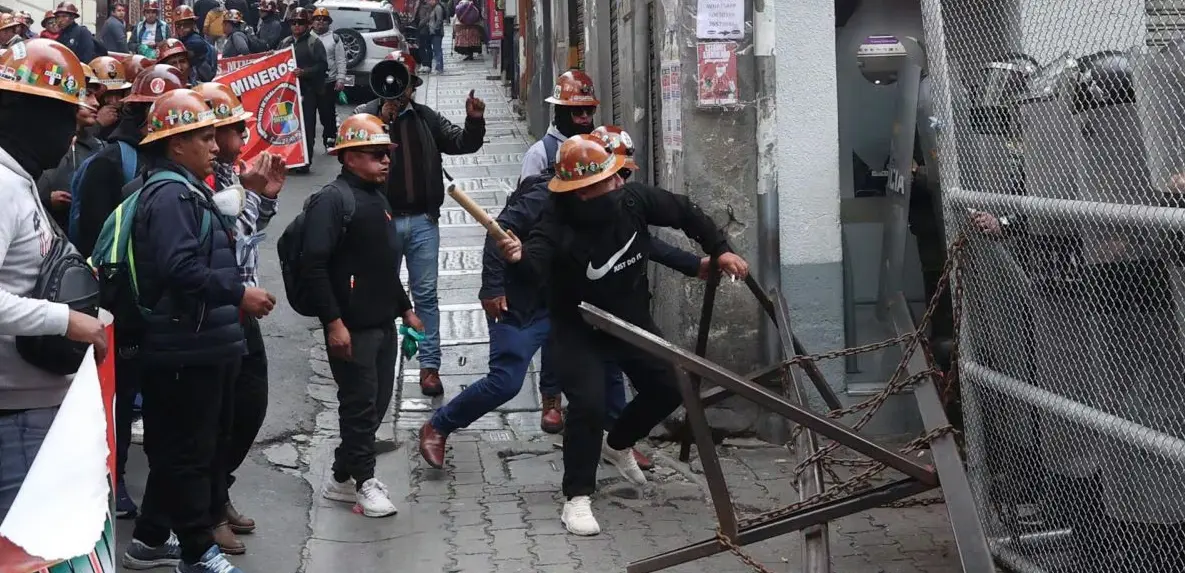
Featured image: Union members face the police in La Paz, capital of Bolivia. Source: EFE/ Luis Gandarillas
On Monday, January 12, the newly appointed government led by Rodrigo Paz announced an agreement with the unions to repeal Decree 5503, which included numerous measures against the Bolivian people and which has been rejected by the Bolivian masses with numerous demonstrations since its announcement. The struggle had lasted 25 days and had blocked the entire country, with more than 70 highway-blockades and even occupations of economic spaces of strategic interest. The highway-blockades were lifted after the agreement.
Rodrigo Paz won the Bolivian electoral farce of 19th of October of 2025, and he was appointed president on the 8th of November. In these elections, both candidates, Rodrigo Paz and Jorge Tuto Quiroga, “represented the comprador faction of the Bolivian big bourgeoisie.”, as the Association of New Democracy – Germany (Nuevo Peru) explained.
Thus, a change from the bureaucratic faction represented by the MAS to the comprador faction was needed. Soon, the Decree 5503 was enacted, which, among other things, eliminated subsidies on hydrocarbons, causing an 86 percent increase in gasoline prices and a 160 percent increase in diesel prices. The government claimed that the measure was necessary to address Bolivia’s fiscal deficit of 9.2 percent of gross domestic product (GDP), amid a declaration of “economic emergency” that enabled the executive power to implement some measures immediately.
The decree included other key measures such as facilitating rapid foreign investment, including strategic investments and the blatant sale of the country’s resources to imperialists, with no requirements other than the control that the State itself wished to impose. A fast-track approval procedure was created, allowing strategic investments to be approved within a maximum period of 30 days. Priority was given to investments in sectors such as mining, including lithium, as well as metallurgy, hydrocarbons, energy, electricity generation, agribusiness, etc.
The Bolivian people immediately rose up against this decree, with a main role of the coca growers’, and especially the main workers’ union, the Bolivian Workers’ Union (COB), which very quickly became the main character of the protests. Thus, miners, factory workers, peasants, teachers, and other groups joined the demonstrations. The struggle of the masses grew, powerful demonstrations took place and the protesters even occupied a public oil facility belonging to Yacimientos Petrolíferos Fiscales Bolivianos (YPFB) when the strikers decided to paralyze operations. At the same time, dozens of blockades have taken place throughout Bolivia, with major disruptions at the entrances to Cochabamba, Oruro, and La Paz, where barricades cut off strategic points, demonstrating the combativeness and know-how of the masses in the struggle. Nuevo Perú shared a report from Bolivia that pointed out how these blockades directly targeted the economic interests of the comprador bourgeoisie, radicalizing the struggle throughout the country.
The COB had as a banner of struggle the repeal of Decree 5503, and in particular the reversal of the fuel subsidy cuts, stating on several occasions that the protests would not end until the decree was completely repealed. However, the COB leadership met on the night of Tuesday, January 13, signing behind closed doors the so-called “Supreme Decree 5516,” thus repealing Decree 5503 and reinstating the main measures that had been annulled by the latter decree. Thus, this new Decree 5516 maintains the elimination of fuel subsidies, which was a main banner of struggle for the Bolivian masses and used by the leadership of the MAS and the COB. At the same time, the 0% tariff on imports of machinery and productive inputs is maintained, thus exacerbating the imbalance caused by exporting raw materials and importing high value-added products, which accentuates the semi-colonial character of the country. The government’s austerity measures in terms of public spending on various social services also remain in the new decree.
On the same day, the 13th, the Bolivian State claimed that the roads were cleared. The executive secretary of the COB, Mario Argollo, shamelessly stated: “We have succeeded in defending the interests of the Bolivian people as a whole, of the vast majority. We can proudly say that we have fulfilled our duty and achieved our goal.“ Few believed this, and in fact he had to publish a video denying that ”the leadership had received money or sold out.” For their part, the coca growers, led by Evo Morales, have rejected Decree 5516.
As if this were not enough, following the protests, the government rushed to condemn the use of dynamite in protests and to imprison those who use it in demonstrations. This practice is common in many demonstrations, and in fact, the use of dynamite is not clearly or specifically regulated by law. At the same time, the so-called “anti-blockade law” is pending, which was proposed on December 15, 2025, before the Plurinational Legislative Assembly. This law seeks to punish blockades, classifying them as a crime and imposing prison sentences on activists and combative trade unionists, therefore seeking to cut the democratic right to protest.
However, this new criminalization of the struggle and the betrayal of the union leadership have not prevented workers in other sectors from continuing the fight. For example, health workers in Santa Cruz are continuing their struggle against the unpaid wages they face. Urban teachers in La Paz have explicitly rejected the new Decree 5516 and have called for mobilizations.
Thereby, what the workers’ seller leadership of the COB made, was to sell the spilled blood of the Bolivian masses and transform the main banners of struggle into rags. While the masses took to the streets every day, on the streets of La Paz, on the highways of the entire country, and they occupied economic infrastructure, once more the traitors have sold them for a plate of lentils. However, this struggle has shown again the potential of the Bolivian people, who can put the State on its knees, push it back down and deal serious blows to the interests of the ruling classes.