AND Editorial – There is Only One Path to Sovereignty for Venezuela and its People
We hereby share an unofficial translation of the part on Venezuela of an editorial published on the 1st of February by A Nova Democracia (AND).
The “hydrocarbon reform” started by Delcy Rodriguez’s interim government at the end of January, just over 20 days after the kidnapping of President Nicolás Maduro (and First Lady Cília Flores), represents a warning sign for the forces of Venezuelan national resistance. It will liquidate the State monopoly on oil, which represents the economic pillar of the Bolivarian project, as a result of the blatant direct imposition of Yankee imperialism, a situation admitted by the interim president Delcy herself.
This is not the only compromise: the sale of Venezuelan oil, whose almost exclusive buyer is now the US, has its revenues determined by the Yankee imperialist government itself, under the command of the right-wing extremist Trump. There is also the Yankee demand that the interim government cut ties with China and Russia as a condition for lifting all imperialist sanctions on the country. Given Yankee military control of all Venezuela’s external sea lanes by its hordes in the Caribbean and the Pacific and the concentration of powerful military assets throughout the area, a condition that remains unchanged even after the criminal and rapacious kidnapping of President Maduro to the empire’s headquarters, Venezuela cannot break the Yankee intervention siege in one fell swoop.
It is imperative to note that Venezuela has been facing this complex situation for almost a month now, in a paradoxical position. At the same time, it is resistant in maintaining the Bolivarian regime supported by the majority of its people, and mixed with an attitude of active collaboration with Yankee impositions in economic plans and even in certain political issues. This situation express a weakness in the cohesion of the regime itself, in its senior leadership of State structures, which undermines unity with the popular masses willing to resist in defense of the national sovereignty and their legitimate aspirations for social change. Collaboration with the Yankee government and calls for the “normalization” of daily life openly affect the potential and expansion of popular mobilization, on the one hand, and, on the other hand, discourses of non-acceptance of “orders from abroad” directed at the proletariat (assembly of workers of the State oil company PDVSA) with the resistance that keeps the militias and popular “collectives” armed, are an expression of this mixture. This paradox objectively reveals that there is a struggle, not very clear, over which position will consolidate in the direction of the Bolivarian regime: whether it will favor the position of national resistance or that of national subjugation, the latter touted by the pragmatism of the regime’s survival at any cost, in general and, particularly, in placing all hopes in the “limited sovereignty” of “protective” relations with other imperialist powers (Russia and China) – exactly as the Chavist regime had been maintaining, and which the Yankee attack laid bare all its fragility, with these powers merely stammering vague diplomatic protests so as not to harm their greater interests.
Faced with the complex situation in Venezuela, the immediate task of all internationalists is to strongly denounce imperialist aggression, increase their combat against it, especially Yankee imperialism, giving full support to the interim government, but warning about the limits it faces so that the masses remain increasingly vigilant; and to support the initiatives of revolutionaries in forming the Maoist proletarian vanguard, which, as it develops, will provide a steel backbone for the anti-imperialist and anti-fascist united front in the country. The duty of the current interim government to the Venezuelan nation and people is to defend the homeland, sovereignty, and self-determination, and it will have even greater support than it has had from the majority of its population and from the oppressed peoples and countries of the world who fight imperialism, because it will move and attract others to the anti-imperialist struggle, even in the imperialist countries themselves. Only in this way will the patriotic national cause progress, as long as it increases its confidence in the popular masses, commits itself to their permanent mobilization, promotes the military organization of the masses, and relies on them for a protracted war, the only way to sustain on the ground the positions of active defense of national sovereignty and the realization of the main popular demands. Thus, expanding and strengthening the united anti-imperialist, anti-feudal, and anti-fascist patriotic front to isolate the pro-imperialist reaction and the traitorous fifth columns of the homeland. Only in this way can the democratic path of new democracy be established, moving the world to support its cause of national liberation.
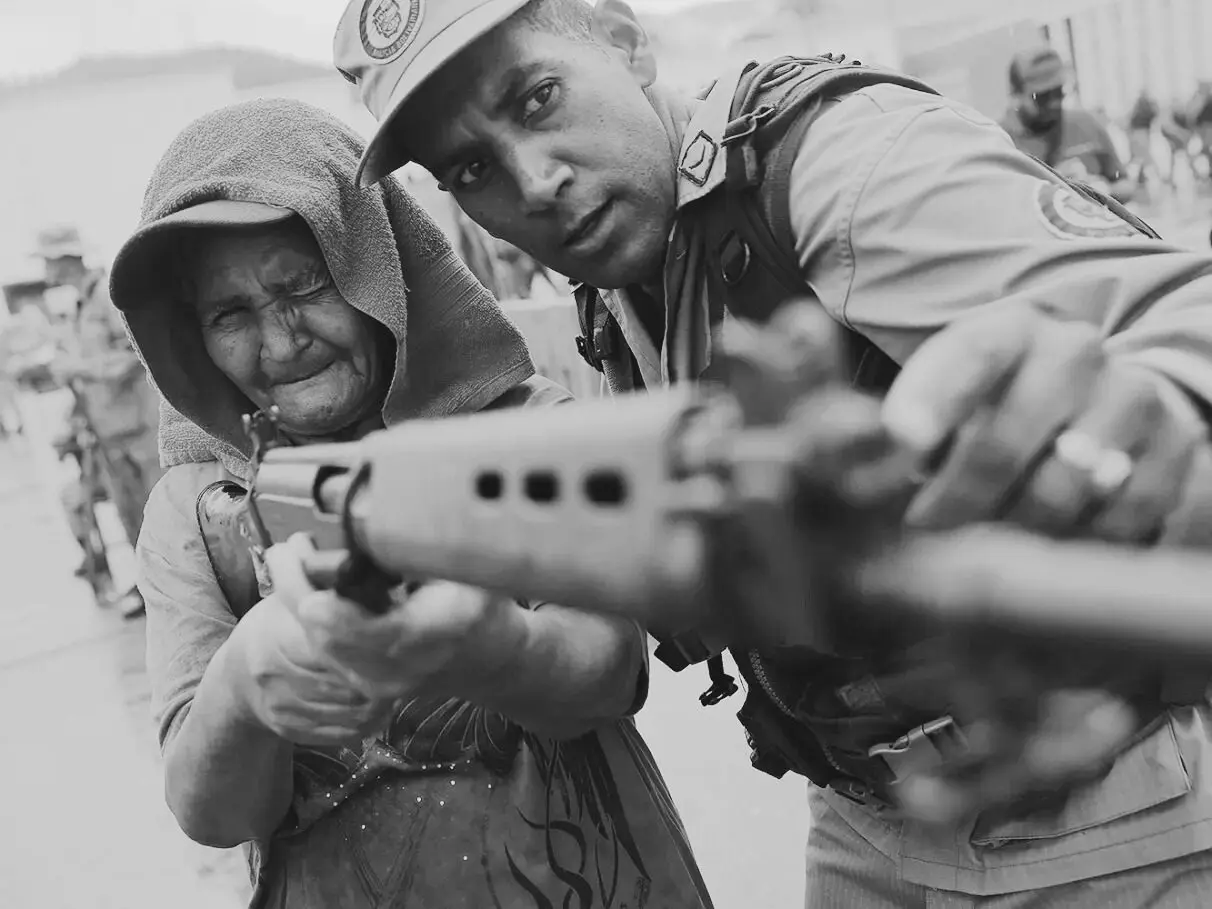
Furthermore, it is clear that compromises, under certain conditions, are necessary and must be made, provided that they are relative, transitory, and subordinate to the strategy of national liberation in order to serve it with effective preparation of conditions in which the enemy can be confronted in well-determined strategic stages, from defense, through balance of forces with the enemy, until reaching the transition to a full offensive. That said, the concrete commitments that the interim government has made are walking a fine line of collaboration with the aggressor on the economic front and are counterproductive when they lead to the demoralization of the forces of national resistance, the mitigation of the anti-imperialist momentum of the broad masses, and to emptying of meaning the already established organizations of the Bolivarian militias and the “collectives” (armed community movements). Even if the regime intends to radicalize when political transition comes up for discussion, if no progress is made in preparing the masses and the united front, it will inevitably lead to demoralization of the national cause, which will render small reforms worthless. There is an urgent need in Venezuela for the broad mobilization of the armed masses. If the regime’s approach is confirmed as simply seeking stability at any cost, which would translate into very high costs, as the reforms already underway demonstrate, it would be extremely dangerous, to say the least.
Internationalists should not ignore that the interim government, due to its objective class character, rests on interests that seek stability in order to realize their monopoly profits and, therefore, flirt with collaboration with Yankee imperialism under certain conditions. This is true of any big bourgeoisie, which would not consider it a “sin” to act as internal support for an aggressor, accepting its terms, as long as they are granted the stability and conditions necessary to also earn monopoly profits from the export of oil and other primary goods, even if only as crumbs from the maximum profits of the international financial oligarchy, provided that there is no loss of territory and formal independence. With the regime maintained, then, these sectors become even more vacillating.
Not without reason, the Yankee operation was accompanied by abundant promises to bring “prosperity to the Venezuelan nation” – read, to the local ruling classes, regardless of their affiliation or not to Bolivarianism, so that patriotic, pro-national resistance positions would be isolated. Therefore, the decisive issue is the mobilization of the popular masses and the growing elevation of their military organization, starting from the already existing popular militias and “collectives,” their expansion and elevation of their level. It is this dynamic factor that could impose the position of national resistance on the local ruling classes, economically committed to financial capital and tending toward political compromise with the aggressor. It is this strategy that will isolate those who place their hopes in limited “independence” through an agreement with the aggressor or even in the illusory exchange of imperialist masters (defenders of the theory of national subjugation as the only possible way out for the attacked nation). Only in this way is it possible to compel the wavering to resist, as the Communist Party of China did with Chiang Kai-shek and the Kuomintang in the context of Japanese aggression in 1937.
It must be widely publicized that the conditions for increasing resistance do not need to be created: they are, fundamentally, the general arming of the masses and greater coordination of the patriotic united front and its strengthening in the first phase, which can be achieved as the situation escalates, and the understanding that, in the current international situation, the decomposition of the general crisis of imperialism is such that the chances of success of its aggressions are increasingly undermined. If the interim government wants to preserve the sovereignty and dignity of the Venezuelan nation, it must place its deep and sincere trust in the armed masses of the militias and “collectives,” advance preparations to convert large units of the regular national army into guerrilla units with regular characteristics, and launch a resounding “no!” to the demands of Yankee imperialism. The US government would certainly launch new attacks and all sorts of sanctions and economic embargoes. But it cannot be ignored that, in the end, all Yankee attacks and measures would be severely limited in a prolonged process and even with immediate political restrictions: first, because the Yankee devils would tend not to send troops to the subcontinent—because that would produce enormous instability, which is deeply reckless and considered a key element in their political calculations—and also because, in this context of trade war between the US, the EU, and China, the economic breaches to be exploited provide vast room for maneuver. However, without any illusions about the other imperialists, and without falling into the temptation of believing that they are not imperialists. It is in the nature of monopoly capital never to become a Buddha, as the Great Helmsman warned.
It is essential for the success of the anti-imperialist cause that the current Yankee aggression be converted into a protracted war of national liberation. To this end, the independent intervention of the revolutionary proletariat is urgently needed, as it is the only class that can apply the revolutionary program of national liberation with the utmost depth and consistency, for the benefit of the proletariat, the peasantry, and the petty bourgeoisie, as part of the New Democratic Revolution.