Conflicts Escalate Between Big Landlords and Indigenous Peoples in Maranhão, Brazil
We hereby share an unofficial translation of an article published by A Nova Democracia on 13th of February.
The War for Land: Conflicts escalate between big landlord and indigenous peoples in Maranhão, Brazil
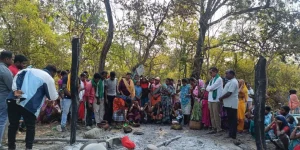
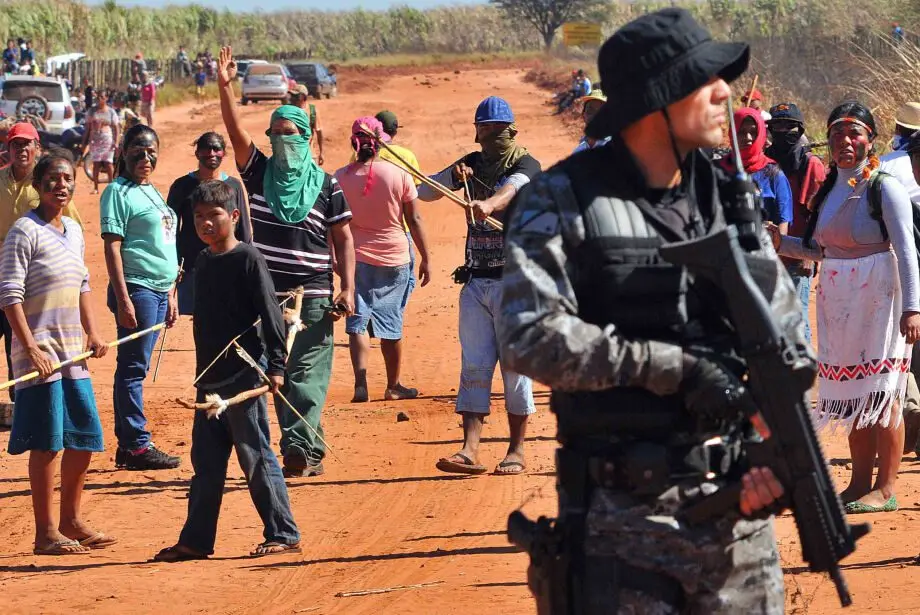
On February 10th, the Ministry of Justice and Public Security published, in the Official Gazette, official act nº 1.147, which formally authorized the deployment of troops from the National Public Security Force (FNSP) to the Governador Indigenous Land, in the municipality of Amarante do Maranhão. The deployment of National Force troops to the state of Maranhão occurs in a context of increasingly acute land conflicts in the Brazilian countryside, and especially in Maranhão, the national leader in occurrences of agrarian conflicts.
The deployment of troops, who are already operating in the region, stemmed from a recommendation by the Federal Public Prosecutor’s Office in an attempt to quell land disputes in the state. The pretext used is that the National Force will act in coordination with the Indigenous National Foundation (Funai), an entity with little or no prestige among indigenous communities. In 2022, the Awá-Guajá indigenous people denounced that the new coordinator of the Ethno-Environmental Front, Elton Henrique Sá de Magalhães, ordered Funai employees to set fire to a shed where the indigenous people were holding meetings in Maranhão . The attack was allegedly retaliation for his name being rejected for the coordinator position by the indigenous people, who expelled him with bows and arrows during a meeting on July 13th. On that occasion, after listening to Magalhães, about 50 indigenous people surrounded him and made it clear that they did not recognize him as coordinator.
Over the past few years, Brazil has seen land disputes in rural areas grow year after year. According to the Pastoral Land Commission (CPT), in 2024, 2,185 conflicts in rural areas were recorded, the second highest number of conflicts in the entire historical record of these conflicts, surpassed only by 2023. Maranhão alone, the state with the highest number of conflicts in Brazilian rural areas, accounted for 420 incidents, including 363 land disputes, 45 water disputes, 10 labor conflicts, and 2 land occupations. The previous year, this total was 210 incidents, demonstrating a vertiginous increase.
In terms of agrarian conflict numbers, Maranhão occupies first place, followed by Pará in second with 243 registered conflicts, and Bahia in third with 135 registered conflicts. However, for comparison, it is worth noting that the state of Maranhão corresponds to approximately 26% of the area of Pará and 59% of the area of Bahia. Another fundamental point to highlight is that the state of Maranhão has the largest number of remaining Quilombola communities, which suffered the most from the registered cases of violence. According to the CPT, 421 of Quilombolas have open land titling processes with INCRA (National Institute for Colonization and Agrarian Reform), although most are in the initial phase.
The cases of violence in the state of Maranhão are not merely numbers and legal proceedings. They have been closely followed by AND for years. In 2025 alone, we denounced the active participation of the Maranhão judiciary in the process of handing over part of the land of the Gleba Campina community to the Finger family of land grabbers. We also reported on the historic victory of the peasants in the dispute over the lands of the Nazaré latifundium, marked by extremely violent conflicts, documented in the film “Children of Gurupi,” released in 2024 by Daniel Moreno. We also reported on the denunciation that Caixa Econômica Federal (CEF), the National Bank for Economic and Social Development (BNDES), and CNH Bank are financing the invasion of the Bacurizinho and the Porquinhos Indigenous Lands, belonging to the Tenetehara-Guajajara people, by the big landlord company GenesisAgro S/A.