France: Interview with the National Coordination of CPES
We hereby share an unofficial translation of an interview published by La Cause du Peuple on the 8th of February.
We share an interview conducted with the National Coordination of People’s Committees for Mutual Aid and Solidarity (CN-CPES). Today, the CPES are present in more and more proletarian neighborhoods in France. They continue to grow in order to create a vast movement of popular struggle and resistance against parasitic landlords, state-led dismantling of housing projects, the widespread abandonment of public policies, and all the injustices suffered by popular neighborhoods.
Hello comrades, and thank you for your time. Could you start by introducing yourselves? When was the CN-CPES founded?
Thank you. The coordination group was recently formed on December 7 in Rennes. The day before, there was a large march to mark the tenth anniversary of the murder of Babacar Gueye, a young man killed by the police in the Maurepas neighborhood. Ten years later, the truth is still being covered up by the state, and the Truth and Justice Collective [Collectif Vérité et Justice] is still fighting for justice. Members of various CPES groups took part in this march, invited by the CPES in Rennes, and we met the next day to launch this coordination group.
The CPES are grassroots action groups organized by residents and workers in working-class neighborhoods. Here, there was a need to coordinate, because it is a model of organization that is bringing together more and more people across the country. What became urgent was to stop working in isolation and to build a dynamic that would give us the means to fight against the state’s plans, which are national in scope.
Regarding CPES, in which cities are they available? And since when has this been organized?
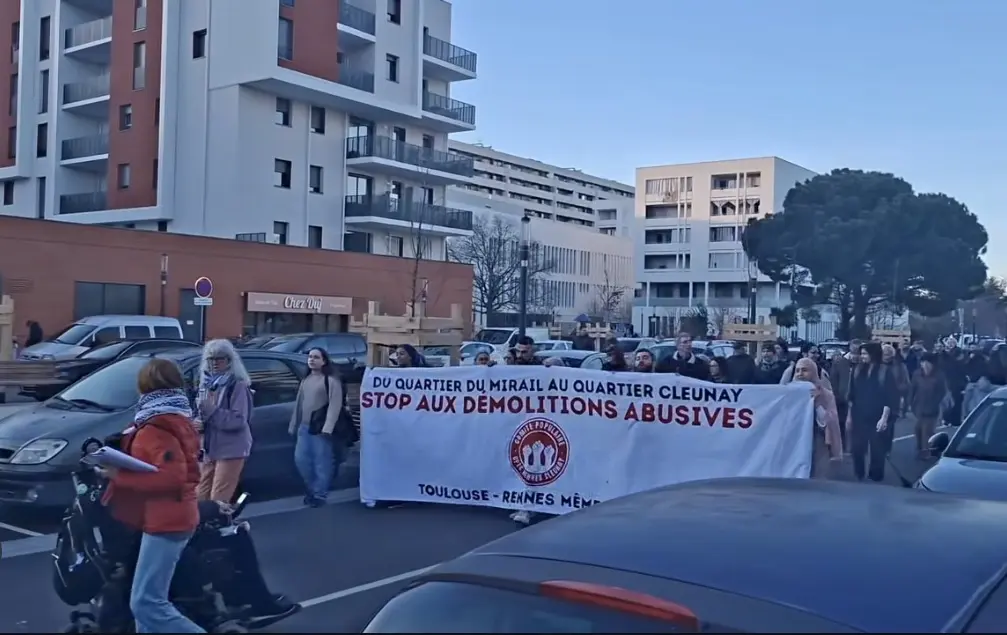
We currently have 13 CPES in ten cities. From north to south, these are: Lille with the Concorde district, Saint-Denis and Aubervilliers in the Paris region, the Villejean and Cleunay districts in Rennes, Malakoff in Nantes, Beaubreuil in Limoges, Croix Neyrat in Clermont, États-Unis and Mermoz in Lyon, Villeneuve in Grenoble, Le Mirail in Toulouse, and finally La Paillade in Montpellier.
The first CPES was founded in the États-Unis in April 2021, followed by the Mirail CPES in December 2023. The initial idea was to create a somewhat novel type of organization that would combine the daily struggle over living conditions and housing, particularly in terms of organizing against landlords and the municipality, with mutual aid among residents on everyday issues, while also looking further ahead by developing links with community organizations, unions, and other struggle organizations, so as not to remain “isolated” in the neighborhood.
In this sense, it is quite different from resident unions such as CNL or CLCV, even though we can work together; it is also different from a solidarity association that does not mobilize residents to fight and engage in a power struggle to achieve improvements. We also want to be completely autonomous, relying on our own strengths and the people in the neighborhood where we organize. For us, this is an important guarantee that we can maintain our freedom of action.
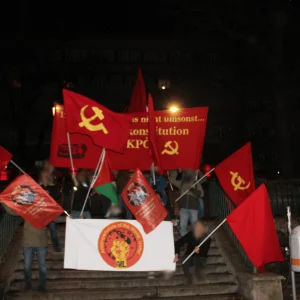
Originally, the name CPES (“Comité Populaire d’entraide et de Solidarité” or “People’s Committee for Mutual Aid and Solidarity”) was itself highly political. It is derived from CPSE, “Comité Populaire de Solidarité et d’Entraide” (People’s Committee for Solidarity and Mutual Aid), a form of organization set up by the clandestine Communist Party at the beginning of World War II to organize immediate mutual aid in areas such as food, health, hygiene, etc. at the beginning of the German occupation and to encourage people to build strong bonds of trust in preparation for the resistance.
The link between immediate solidarity and resistance is interesting. Do you believe that there is essentially a continuing relevance in strengthening the organization of residents around concrete issues in order to then move towards political action as such?
Absolutely. Basically, we are fighting hard on housing and urban planning, because these are hot topics with a national housing stock that has been deteriorating for 30 years. We have been paying rent for years, sometimes even to the point of having paid more money than the value of the housing itself, and then we find ourselves living in appalling conditions. Insulation, heating, pests, etc. It’s very real for us. Not only is it unpleasant, it’s degrading and humiliating. It really makes us angry.
What we want to show by organizing ourselves is that we are defending a simple principle: “We live here, we decide here.” This applies to housing as well as to everyday neighborhood issues such as health, education, leisure activities, and community ties. The heart of the problem is who decides, and for whose benefit. We are already being robbed at work with tiny wages, so the issue of rent, whether for a landlord or a property owner, is ultimately a double robbery. The central question remains who has the power.
That is why we are not fighting to “co-manage” public housing or to join citizens’ councils where “left-wing” town halls consult residents to make themselves look good. What we want in the long term is for people to organize themselves to make decisions in their own homes, because that is their right and because that is where all the problems of the community stem from.
Given this ambition, how do you plan to resolve the issue of collective organization?
The goal we have in terms of organization is to develop models for popular assemblies that work. Today, we already have interesting experiences of dozens of people from the neighborhood getting together and making decisions together in assemblies organized by the CPES. We are still in the early stages, so it remains focused on local issues or organizing neighborhood social events, but these are promising experiences.
Popular democracy is something that can be learned. When we make a decision, we ask ourselves how we can implement it, then we evaluate the results, and so on. In terms of form, there is also the challenge of involving as many residents as possible, despite work schedules, childcare issues, etc. The positive thing is that there are always answers, and that we learn by doing.
During the September 10 movement, we had our first interesting experiences with neighborhood assemblies that made concrete decisions about protest actions as part of a national mobilization. That’s how we found students, employees, and retirees together blocking a roundabout or a highway, then demonstrating in the heart of the neighborhood.
Two excellent examples of this are the mobilization in the États-Unis neighborhood in Lyon, with a huge popular demonstration in the heart of the neighborhood, and in Villejean in Rennes. In the latter neighborhood, the CPES called for several assemblies that brought together dozens of residents, and for the first time, a link was established between the CHU strikers, the students of Rennes 2, and the residents and associations of the Kennedy housing project, which together form the three main hubs of the neighborhood.
Behind this issue of countervailing power for residents, we have the excellent example of the mobilization of residents in the Alma-Gare neighborhood in Roubaix. After years and years of struggle and building up their bargaining power, it was the residents themselves who decided on the plans for renovating and building in the neighborhood, managing all important issues and the social life of the neighborhood through a system of weekly meetings. They founded a “popular urban planning workshop” (APU), which had to be consulted by the town hall’s urban planners, as well as a neighborhood management committee that could be called upon for any technical issues affecting residents. The link between young people, workers, and retirees was also central to the neighborhood’s dynamic, breaking down isolation and strengthening solidarity. This is a great source of inspiration for us.
Thank you for this presentation, which will be of interest to our readers. It is very informative. Indeed, this form of organization convinced our newspaper during our initial meetings, and we encouraged our readers and supporters to back the launch of residents’ committees. Can you tell us more about the need to launch national coordination today and what its objectives are?
Previously, there was no communication link between CPES. This was built through informal networks, without any regular connection. The advantage of coordination is that it organizes the sharing of experience on methods of organization and struggle.
The aim here is to launch a process to eventually build a solid national organization. We start from the observation that even behind local actors, town halls, and landlords, there are national decision-makers and, above all, financiers (if we can distinguish between the two). Mobilization at the local level is therefore not enough to achieve major victories, but only small improvements.
With regard to social housing and the development of so-called “priority” neighborhoods, the main national decision-maker is the ANRU, the National Agency for Urban Renewal. It is this agency, directly supervised by the Ministry of Housing, that allocates the budget for most of the renovations, and landlords and local authorities depend on its decisions. It is therefore a matter of national policy.
Coordination allows us to set our sights on future nationwide campaigns on living and housing conditions, which will be a real lever that we did not have until now. It will also be a strike force that will increase our impact on other issues tenfold, as would have been useful in the September movement.
Finally, we can already see positive aspects, as it takes the focus off the leaders of the various CPES, who have been meeting for several months and sharing their experiences in the field. The awareness of organization and of having the same interests is no longer limited to neighbors or people we meet every day. This has a big impact on the general state of mind and bodes well for the future!