MPP: ON THE NEW COUP D’ÉTAT THROUGH ELECTORAL FRAUD
We hereby share a press statement by the Peru People’s Movement shared on New Democracy Association – Germany (Nuevo Peru).
Proletarian of all countries, unite!
NEW COUP D’ÉTAT THROUGH ELECTORAL FRAUD
On February 17, a new parliamentary “coup d’état” took place in Peru against the reactionary president in office, José Jerí; the sixth of its kind in the last 10 years; an expression of crisis at the “top,” crisis in the politics of the ruling class; intensification of collusion and reactionary struggle spurred by the new electoral farce set for the upcoming April 12.
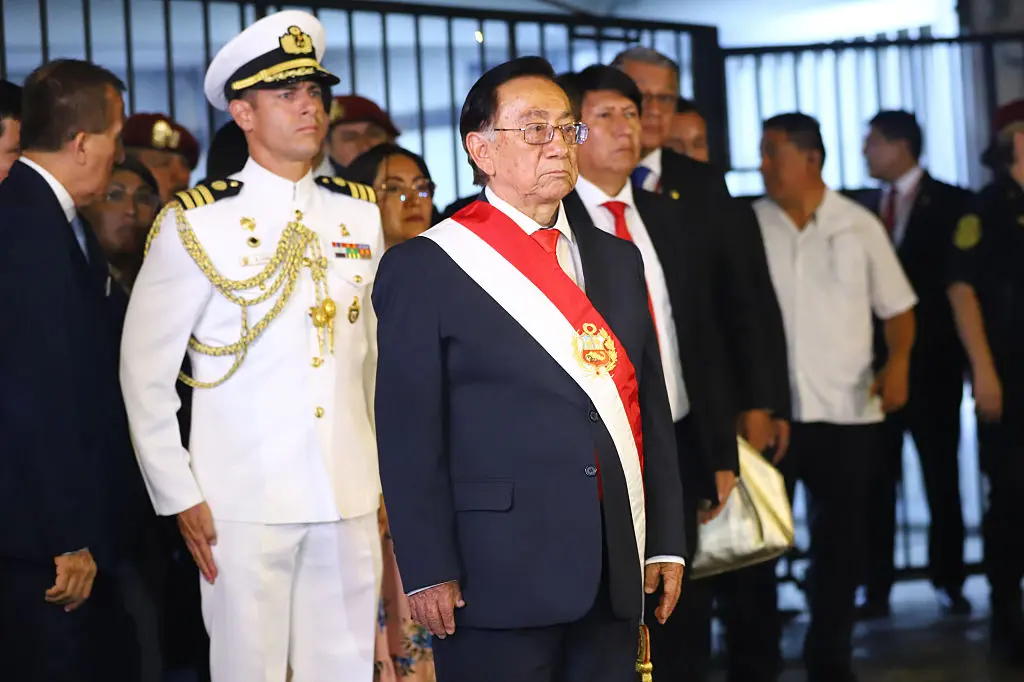
On February 18, Parliament elected José Balcázar as president of the Board of Directors, assuming the presidency of the Republic on an interim basis following the censure of José Jerí. Balcázar will hold the position until July 28, 2026.
The Peruvian State is a bureaucratic dictatorship based on an alliance between the exploiting classes: the big bourgeoisie (which is in charge) and the big landlords (under the command of imperialism). The replacement of authorities in the old Peruvian State takes place through elections or military or parliamentary coups. This allows us to see clearly the recent development of the political situation in the country.
The backdrop to what is happening in the reactionary camp is that the country is in a new electoral cycle for the replacement of authorities of the old Peruvian State: for president, vice president, deputies, and senators (a chamber that was eliminated after Fujimori’s “self-coup” in 1992) and which is being reintroduced with the upcoming elections.
The ousted José Jerí assumed the presidency of the Republic of Peru after Dina Boluarte was removed from office following a parliamentary coup; it should be noted that Fuerza Popular opposed the removal until th last moment; Therefore, Jerí’s appointment was interpreted as a compromise solution for the other forces in the conflict; Jerí was the right person to serve as a “fuse.” To put it more cryptically, Jerí’s appointment was “the product of a precarious congressional architecture” (Editorial “An interim presidency without pretensions of originality,” La República, February 18, 2026).
In the opinion piece “The Jerí symptom” by J. Bruce, La República, aforementioned edition, regarding the election of Jerí, we read: “…they put him in, not despite his skeletons in the closet, but precisely because of them. It was easier…to control such a weak character.” We clarify the idea: it was easier to replace him when the time came, as has now happened.
The way in which Jerí was removed from office also supports our thesis about the real motive behind the most recent coup d’état: to control the administration of the upcoming electoral farce with a figure of empty words and no power.
Jerí’s removal took place through a precarious reactionary consensus with no agreement other than the distribution of positions and seats, for which the constitution and legal norms for cases of vacancy of the president of the Republic were violated, proceeding to use the figure of “censure of the president of the Parliament’s Board of Directors.”
Reasons for the above: they did not have the required number of parliamentarians for the vacancy, which required 87 votes, so two-thirds of eligible members. And, if the vacancy procedure was carried out in accordance with the rules, in the event of obtaining the necessary votes, the presidency of the Republic would fall to the president in charge of the Parliament’s Board of Directors, Rospigliosi, a representative of Fujimorism.
El Comercio, aligned with Fuerza Popular, editorialized on the matter: “José Jerí fell because of his own mistakes, but Parliament has set a terrible precedent with this censure.”
The parliamentary coup that led to the appointment of the reactionary Jeri as president in October last year was motivated by the need of the reactionary parties, including revisionists and opportunists, to distance themselves from the murderous Dina government, the most reviled reactionary government in the history of the old Peruvian State, in order to gain electoral advantage in the April elections.
On this occasion, the real cause or motive behind the parliamentary coup is similar to what happened in the case of the removal of the murderous Dina; given that Jerí’s four months in office have been marked by scandals and failures and the parties are facing further electoral decline; However, now that a precarious reactionary convergence against Fuerza Popular (Fujimori’s party) has been achieved, the aim is to entrust this transitional presidency to the right person to control the electoral farce and manage electoral fraud.
As the editorial in the reactionary newspaper La República rightly points out in “An interim presidency without pretensions of originality” (Lima, February 18, 2026), we quote:
“On the eve of a fragmented election, control of the interim executive branch represents both an opportunity and a risk. Managing the transition offers the ability to influence, but also exposes one to attrition and an eventual electoral cost.”
The replacement of Jerí with the new interim president José Maía Balcarzer Zelada appears to meet the expectations of the reactionary parliamentary agreement, namely to control the electoral farce and its results and avoid the electoral cost of the presidential mandate.
Contrary to the intentions of its rivals in the reactionary contest, Fuerza Popular (FP) supported Jerí until the end and was the only party that voted against Jerí’s censure. With the parliamentary coup d’état complete, it loses its “ability to influence” the farce next April.
The representatives of FP attacked López Aliaga and his Partido Renovación Popular, as reactionary as FP, because they voted for the censure and then did not support the candidate favored by FP, María Carmen Alva (Acción Popular).
Thus, the reactionary political forces are positioned for the new electoral farce less than a month and a half before it is likely to take place.
The appointment of the new interim president José Balcázar is the result of the breakdown of the old State and its institutions, and the lack of genuine reactionary political parties: Balcázar offered himself on his own behalf and using third parties to head the administration of electoral fraud, assuming leadership of the old State and continuing the fascist, genocidal, and traitorous regime that began in April 1992 with the so-called “Fujimori self-coup.” The old State functions with the support of the State bureaucracy and the genocidal armed and police forces.
Balcázar has been appointed by a slim majority of votes, 66 in favor and 46 for his opponent, out of a total of 130 congressmen. The parliament is made up of representatives of various reactionary electoral groups, called “parties,” including the opportunists of “Perú Libre,” some rats from the LOD of the “Bloque Magisterial,” “Bloque Socialista,” “Castillistas,” and others.
The failure of the upcoming elections is pre-programmed, given the fragmentation of the electoral offerings, in which each seeks the benefit of factions, groups, and individuals behind the mask of more than 37 electoral acronyms that call themselves parties or fronts. All are at the service of one or another of the two factions of the big bourgeoisie at the service of imperialism. In reactionary elections, all the parties that participate in them are in favor of defending the order of oppression and exploitation.
J. Balcázar’s statements serve as a confession of what we affirm:
“We are no longer here to fight. There is no right or left here. That term was created by the French for the revolution; it has no ideological basis. Not at all. So, friends, I feel honored by your vote, and I believe we can tell Peruvians that it is possible to build a true democracy. Democracy is not working. If that democracy is not corrected, it will disappear in the future.”
“Balcázar assured that the economic model will remain in place and said that a lot can be done in a month because “it is not difficult to govern a country.”
In other words, it will continue to run “on autopilot,” that is, managed by the high State bureaucracy made up of officials serving imperialism and the big bourgeoisie.
“Guarantee the people that there will be a democratic and transparent transition, that there is no doubt. Maintain true pacification and ensure that we have ministries capable of fighting against citizen insecurity.”
“We are going to maintain the economic line; we are not here for experiments.”
The quotes in quotation marks are verbatim words from the first speech by this reactionary figure (Peruvian newspapers).
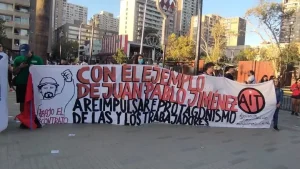
As for the masses: the demonstrations that have taken place, from mid-2025 to the present, show, on the one hand, the tendency of the masses to mobilize, becoming increasingly active in growing popular protests that express their rejection of the old State, its institutions, representatives, petty parties, and the ongoing electoral farce. And, on the other hand, it shows the reactionaries, revisionists, and opportunists’ attempt to drag them down the misguided path of voting and harness them to the old State’s bandwagon.
A change of president, a crisis at the “top,” a crisis in the politics of the ruling class. As on previous occasions, this new parliamentary coup against José Jerí Oré, who headed the fascist, genocidal, and traitorous regime inaugurated in April 1992, and his replacement by Balcázar expresses not only the acute crisis of the old and rotten Peruvian State, but also that of the regime itself.
To conclude, we repeat what we stated in October 2025, only changing the name of the reactionary leader:
The new government headed by the reactionary “Peacemaker Balcázar,” questioned for a series of functional and representational abuses, is only a change of horses in the fascist, genocidal, and traitorous regime. Therefore, this new government will be more hungry, genocidal, and traitorous than the previous one. It will seek to further align its government with the current government of Yankee imperialism, led by the ultra-reactionary genocidal Trump.
In this situation, the masses are under increasingly urgent pressure to resist the double reactionary attack, on the one hand, from the repressive forces of the Peruvian State itself, from the gangs of the “warlords” of the big landlords and big mining companies, plus a triple attack from the growing scourge of gangs of common criminals protected by the civil, military, and police authorities of the reactionary State.
Therefore, the current political situation is very bad for the reactionaries and very good for the revolution. It serves to advance the task of the general reorganization of the party and for a new leap in the incorporation of the masses into the People’s War. To get out of the current impasse and into an active People’s War.
Elections, no! People’s War, yes!
Peru People’s Movement
February 2026