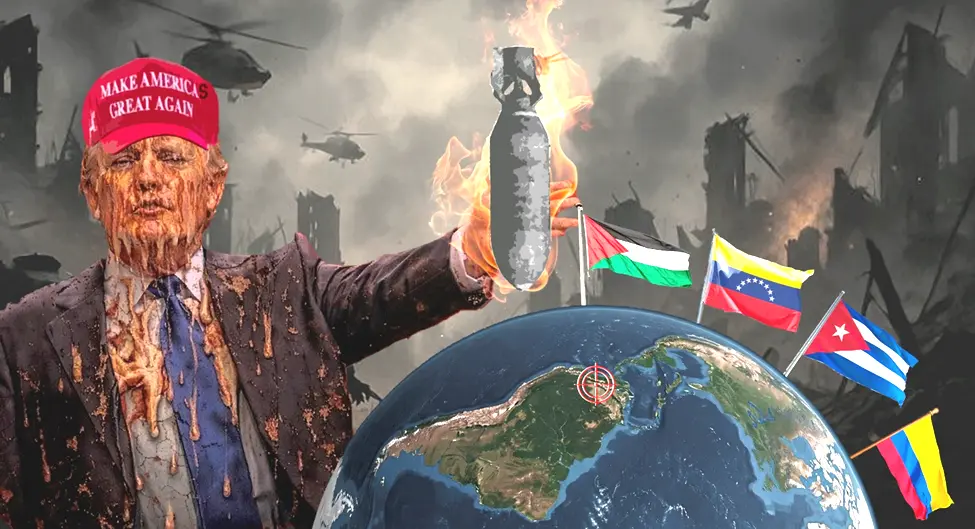
Times of War: Analysis of the New Security Strategy of U.S. Imperialism
We hereby share a translation we received of an article published by Nueva Democracia on the 10th of March.
The publication of the National Security Strategy (NSS) of November 2025 and its military complement, the National Defense Strategy (NDS) of January 2026, constitutes the explicit declaration of the war plans and restructuring of U.S. imperialism at a critical juncture of relative decline and systemic crisis. This strategy, without disguise, defines the main enemy in the defense of its hegemony and the dispute over the division of the world—China; establishes the main theater of a future war—the Indo-Pacific; secures the rear—the Western Hemisphere; demands vassalage from the “allied” imperialist powers of Europe and Asia; and seeks a reorganization of the domestic economy based on reindustrialization and military production, and of domestic politics based on combating the internal enemy on the road to fascism.
One must read beyond the political rhetoric of Trump, who shifts the blame onto his predecessors for squandering the hegemonic position of the United States, wasting resources, and placing the interests of the world and the principles of democracy above those of the United States. Imperialism is not an aggressive political choice adopted by some “rich” and “strong” countries led by greedy figures seeking to dominate “poor” and “weak” countries. Imperialism is the necessary result of the concentration of production and monopolistic and financial capital, the highest stage of capitalism whose main political feature is the division of the world into a handful of powerful countries that divide the world among themselves to extract superprofits, and a majority of poor and oppressed countries. Inherently, this economic system based on exploitation and on the dispute over territories and resources leads to crises, and U.S. imperialism, as the world hegemonic power, stands at the epicenter of this crisis.
Its economy is increasingly parasitic: manufacturing has lost 6.5 million jobs since 1979, its share of GDP has been reduced by more than half, and the manufacturing trade deficit reaches $1 trillion annuallyi. The data on U.S. mineral dependence speaks for itself: from 1954 to 2019, the number of minerals for which the United States relies on imports for at least 25% of its needs increased from 21 to 58ii . This is no coincidence, but rather the result of decades of deindustrialization and the outsourcing of production, driven by the very logic of monopoly capital in pursuit of higher rates of profit. The U.S. economy is becoming increasingly parasitic and less productive, leading to logistical problems and supply crises. On the fiscal front, public debt will reach 156% of GDP by 2055 according to the U.S. Congressional Budget Office (CBO), and could reach 250% if tax cuts are extended. The United States is the country with the highest public debt in the world.
Militarily, the Pentagon admits it lacks the capacity to command multi-corps operationsiii, that it would need to double the army to cover the brigade deficit, and that transatlantic reinforcement lines are vulnerable. Demographically, the population will begin to decline in 2033 without immigrationiv. Between 2022 and 2024, the U.S. Armed Forces spent more than $6 billion on recruitment and retention programs, according to the Associated Press, yet failed to meet recruitment goals. In 2023, the U.S. military had the lowest number of service members since before World War II and reported a substantial deficit in meeting recruitment targets, with approximately 41,000 recruits missing across its branches, according to official sources from the U.S. Department of Defense.
A general crisis of the imperialist system and a decline in U.S. global hegemony are the underlying problems, which explain Trump’s bossy character and the justification for his National Security and Defense Strategy.
The United States emerged as an imperialist power in the early 20th century and competed with the European powers for control of oppressed countries, displacing them from Latin America and establishing itself as a regional power. After World War II, with the European powers in decline, the United States and the Soviet Union—which had become a social-imperialist power after socialism ended there and capitalism was restored under Nikita Khrushchev—consolidated themselves as the world’s two superpowers, each with its own spheres of influence and nuclear capabilities. Today, they possess eight times more nuclear warheads than the next-largest nuclear-armed imperialist power, China. Following the Cold War and the implosion of the Soviet Union in 1991, the United States became the sole hegemonic superpower. Over the past three decades, successive administrations, whether Democratic or Republican, have sought to consolidate and expand this hegemony, attempting to “steal” other powers’ spheres of influence. Thus, the Middle East became the main battlefield: for control of oil, to displace European powers and Russia from the region, and for dominance over the land connecting the Asian, European, and African continents. Every war the United States has waged was fought for its hegemonic interests.
Therefore, when the National Defense Strategy states that the U.S. will “no longer be distracted by interventionism, endless wars, regime change, and nation-building,” it must be read as an admission of defeat. The NDS reveals that the U.S. strategy is to withdraw from the Middle East—an attempt that dates back to Obama—reducing its objective in the region to achieving stability and “normalization.” This means they failed to establish bases or consolidate power. Except for the Zionist entity of Israel, it can be said that the United States today counts fewer client governments in the region than at the beginning of its decades of war, and it accumulates growing disrepute among the Arab masses.
However, this strategic retreat from the Middle East does not mean that U.S. imperialism has abandoned the region or renounced the use of force. The war against Iran must be understood within this same logic. Washington seeks to close the Middle Eastern front in order to concentrate its forces on the principal contradiction of the current imperialist system—the dispute with China in the Indo-Pacific—but it attempts to do so while leaving behind new conditions of equilibrium favorable to its interests. The attacks against Iran, initiated on February 28, 2026 together with Israel, are based on the calculation that it is possible to decisively weaken the Iranian state, limit its regional influence, and force a correlation of forces that guarantees the stability necessary for the United States’ strategic withdrawal. However, this operation also reveals the limits of imperialism in its current phase, and it may well backfire. Far from quickly resolving the problem, the United States risks becoming bogged down in a costly war that consumes military, political, and economic resources, reproducing the same dynamic of attrition that characterized its interventions in Iraq and Afghanistan.
Strategic Retreat and the Fortification of the Rear
In classical military thought, a strong army advances and opens new war fronts; when it enters crisis, it closes fronts, consolidates positions, and fortifies supply lines. Late Rome stopped expanding and turned cities into fortresses. The Spanish empire of the 17th century shifted from conquest to protecting the silver route. Germany in 1944 prioritized maintaining railway lines over launching offensives. The United States follows the same logic today: “the war in Ukraine must end,” “the days when the Middle East dominated U.S. foreign policy, both in long-term planning and day-to-day execution, have fortunately ended,” “after years of neglect, the United States will reaffirm and enforce the Monroe Doctrine to restore American preeminence in the Western Hemisphere, and to protect our homeland and our access to key geographies throughout the region. We will deny non-hemispheric competitors the ability to position forces or other threatening capabilities, or to possess or control strategically vital assets, in our Hemisphere.” The NDS specifies: “We will guarantee U.S. military and commercial access to key zones, particularly the Panama Canal, the Gulf of America, and Greenland.” This is the “Trump corollary” to the Monroe Doctrine.
The invasion of Venezuela and the kidnapping of President Nicolás Maduro on January 3, 2026, after 19 weeks of military siege that had left 105 killings (today already 144) under false accusations of drug trafficking, is not an isolated event: it is the first bullet of this doctrine. The objective is not only or primarily Venezuelan oil, but to send a message to the entire region: the era of “negligence” has ended and strict obedience is the only option. The effectiveness of this policy of intimidation is evident in the rapid domestication of neighboring governments. Mexico, under pressure, has cut oil supplies to Cuba. Panama, yielding to Washington’s demands, has declared invalid the agreements with China regarding the Canal, surrendering strategic sovereignty. In Colombia, the government has agreed with the U.S. on a military offensive against “narco-terrorism” which in practice mainly translates into an intensification of the siege against guerrillas that still maintain armed struggle.
But the history of Latin America is not written only with the capitulation of its governments. On the shoulders of its peoples rests a long and combative anti-imperialist tradition that no decree or bombardment will extinguish. The domestication of governments is not the defeat of the peoples; it is confirmation that the struggle must deepen through other channels, and that anti-imperialist resistance in Latin America will continue to be, as it always has been, a task of the masses, not of their treacherous elites.
The Main Theater of the Future Great War
The National Defense Strategy states it plainly: “The Indo-Pacific region will soon represent more than half of the world economy. Therefore, the security, freedom, and prosperity of the American people are directly related to our ability to trade and engage from a position of strength in the region. If China were to dominate this vast and crucial region, it would be able to effectively block American access to the world’s economic center of gravity.”
To understand the essence of this strategy it must be read in light of history and the law of uneven development of imperialism. During the Cold War, the United States needed to approach China to concentrate its forces against the Soviet Union, taking advantage of its cheap—superexploited—labor and avoiding dividing its forces against other powers. When it became the sole hegemonic superpower after the Soviet implosion, it maintained this relationship of collusion with China to focus on laying the foundations of its dominance in the Middle East. But imperialist powers, including China, do not renounce their nature: China consolidated itself as a regional power and today is the one that most threatens U.S. hegemony. This is the inevitable consequence of inter-imperialist competition.
China, as a rising power, could not be satisfied with the subordinate role that the U.S. had assigned to it. The current crisis is therefore the result of the struggle over the division of a world already divided.
To contain it, the United States intends to militarily fortify the First Island Chain—a barrier stretching from Japan to the Philippines—with the aim of confining the Chinese Navy to the inner Asian seas and denying it access to the open Pacific. Taiwan is a key geographical piece that allows for opening or closing the passage to the Second Island Chain, which would serve as a rear base from which to deploy long-range weaponry. The strategy acknowledges that it cannot sustain this encirclement on its own, so it demands that its regional allies, Japan and Australia, assume the cost and risk of serving as the first line of defense. It imposes greater subjugation on the oppressed countries in the region, as evidenced by the establishment of new bases in the Philippines and the conduct of military exercises at strategic points such as the Luzon Strait. With regard to India, the United States is “cooperating” to strengthen its military, modernizing its armed forces and conducting joint exercises, as India, with its billion-strong population, is undoubtedly the U.S.’s preferred cannon fodder for a confrontation with China. In the May 2025 confrontation, following an attack in Kashmir, this new alignment was evident: the U.S. offered firm backing to India, while China led public support for Pakistan. Any narrative of defending democracy and Taiwan’s “sovereignty” falls apart, as the NSS acknowledges this by noting that “Taiwan offers direct access to the Second Island Chain.” The island is viewed by the Pentagon as an unsinkable aircraft carrier that must be denied to China, or alternatively, used as a bargaining chip in a grand pact that guarantees “strategic stability”—that is, the division of spheres of influence at the expense of the peoples of the region.
Stirring up the ‘allies’
Washington is demanding that its allies—especially the Europeans—take primary responsibility for their own defense and increase their military spending to 5% of their GDP, as they pledged at the Hague summit. The relationship it proposes is openly transactional: the allies must do their part, align their exports with U.S. controls, and accept a subordinate role in the new security architecture. But these allies, caught between the polarization of the U.S., China, and Russia, have no choice for now but to grovel before the emperor, as any attempt at real autonomy clashes with their military and economic dependence. However, this does not mean they are giving up their own imperialist ambitions. While bowing to Washington, the European imperialist states—France, the United Kingdom, Germany, etc.—are launching their own initiatives. They are exploiting the “Russian threat,” fueled by increasingly frequent drone incidents in Poland, Romania, and Denmark, to escalate their militarization and increase their military presence in northern, central, and southeastern Europe, subjugating the oppressed nations in this region. At the same time, they seek to establish or reinforce their own spheres of influence in other regions, such as the Middle East, quietly betting on a possible U.S. defeat that would open up room for them to maneuver. This dual nature—forced submission in the immediate term and strategic expansionist opportunism—defines these middle powers, which orbit the U.S. empire but dream of becoming the main butchers themselves, even though all of them are also immersed in their own process of decline, with stagnant economies and growing social unrest.
The case of Greenland reveals the hypocrisy and brutality of one of these intermediate powers: Denmark. While Copenhagen presents itself to the world as a defender of human rights and self-determination, its history as a colonial power over Greenland is written in blood, exploitation, and crimes against humanity. For decades, Danish imperialism subjected the Inuit people to a systematic policy of demographic extermination and social control. In the 1960s and 1970s, Danish authorities implemented measures as part of a state-sponsored campaign to reduce the birth rate and “modernize” the colony. This “IUD Campaign” affected approximately half of Greenland’s fertile women, causing permanent damage, infertility, and trauma that persists to this day. The goal was clear: to prevent the growth of the Inuit population from hindering Danish plans for economic exploitation and military control over the island. For more than three centuries, Denmark has colonized Greenland, imposing its language, religion, and culture, while despising its inhabitants and considering them “subhuman.” Today, in the face of Trump’s threats, the Danish government is rushing to send troops and assert its “sovereignty” over the island, yet refuses to include Greenlandic representatives in negotiations regarding their own future. Denmark is not an innocent minor ally; it is a full-fledged colonial power that, while groveling before Washington, seeks to perpetuate its domination over a people it has subjugated for centuries.
Economic restructuring at home and the groundwork for fascism
The National Security Strategy speaks of “reindustrialization,” of “restoring the defense industrial base,” of a “national mobilization.” The restructuring plan pushed by Trump promotes an aggressive tariff strategy to force industrial resurgence, the mobilization of the defense industrial base as the engine of reindustrialization—with over $300 billion in arms sales—and the demand that contractors like Lockheed Martin reinvest in productive capacity rather than buy back shares; and the reengineering of the global financial system through the implementation of the so-called “Mar-a-Lago Agreement,” which seeks to devalue the dollar to make U.S. exports competitive, tax foreign investments in Treasury bonds, and force allies such as Japan to commit hundreds of billions in direct industrial investment on U.S. soil. Among other measures, the U.S. government seeks to avert a new recession, which analysts constantly warn is breathing down its neck. However, all these measures serve to deepen the exploitation of the working class; the economy is becoming increasingly unequal, with the richest 20% of households accounting for more than half of national consumption, while the rest of the population faces persistent decline. According to the Bank of America Institute, nearly a quarter of households live paycheck to paycheck, spending more than 95% of their income on basic necessities with no ability to save.
But this mobilization of the industrial base does not occur in a social vacuum. It needs to align the American working class behind the interests of monopoly capital, replace class struggle with warmongering chauvinism, and prepare society to bear the burdens of a prolonged war: more exploitation, fewer freedoms, and despotic discipline. In this scheme, the persecution of immigrants serves a multifaceted and perfectly calculated function. On the one hand, it seeks to pit one section of the proletariat—the native-born—against the other, the immigrant, using chauvinism as a key tool to prevent class unity and win over the backward sectors and the labor aristocracy to the ideology of the far right, racism, and white supremacy. But there is an additional objective, equally crucial to the reindustrialization project: the creation of an army of super-exploited migrant workers, without rights and mired in constant fear of deportation, who are forced to accept the harshest working conditions, the lowest wages, and a total absence of union protection. On the other hand, Trump is betting on the destabilization of the constitutional order to impose an unprecedented absolutist presidentialism, not only vis-à-vis the other branches of government, but also with respect to the states and electoral contenders. The proof of this political calculation is evident: states governed by the Republican mafia, which have the largest immigrant populations, do not face anti-immigrant police operations with the same intensity as states controlled by the Democratic mafia, revealing that persecution is a tool of selective terror and internal domination.
This economic and political restructuring is projected onto its “backyard,” Latin America and the Caribbean. Ensuring preferential access to the strategic minerals needed to compete with China in green technologies and defense. The recent signing of a cooperation framework with Argentina to strengthen supply chains for critical minerals, or the shift by the new Bolivian government as it courtingly seeks U.S. financial assistance and investment in its lithium, are expressions of this new offensive. On the other hand, the aim is to reconfigure the continent’s industrial map under the logic of “friendshoring”—or the relocation of production to allied countries—using the USMCA as a weapon. More than 80% of Mexico’s exports depend on the USMCA, and Washington has already threatened to let it expire or renegotiate it in 2026 to force additional concessions. This scheme, at its core, seeks to deepen the exploitation of the region’s semi-colonies—their status as docile appendages of the U.S. productive machinery—so that it is the oppressed countries of the continent that pay, with their resources and sovereignty, the cost of the crisis in the North.
The Resistance of the Masses, the Anti-Imperialist Struggle; Preparing for a Prolonged Struggle
But where there is oppression, there is resistance. The Carnegie Endowment’s Global Protest Monitor states that “large-scale, highly political anti-government protests are multiplying in various regions.” In the last 12 months, more than 142 significant anti-government protests have occurred, many of them lasting for days or even months. These are clearly spontaneous outbursts of the masses that mark the development of the revolutionary situation throughout the world, albeit unevenly. This wave of popular uprisings is no coincidence: it is the inevitable response to the general crisis of imperialism, to super-exploitation, and to war.
The dialectic of imperialism as a “giant with feet of clay” is laid bare when its true nature is examined. On the one hand, it presents itself as an all-powerful creature, acts like a titan, and participates directly or indirectly in all world events. But this apparent strength hides a fundamental weakness: its power is parasitic, depending entirely on the exploitation of the peoples. That is why, when confronted by revolutionarily organized peoples, it reveals that it is sinking ever deeper into the mud generated by its own feet. It may bomb Caracas and kidnap presidents, but it is hardly capable of sustaining prolonged wars against the collective will of those who resist.
Imperialism has invested disproportionately in state-of-the-art weaponry and global projection—$13 billion aircraft carriers, fifth-generation fighter jets, hypersonic missile systems—but has neglected the ground forces necessary to seize and hold territory. This is the military manifestation of the law of uneven development and the decay of monopoly capitalism: an armed force hypertrophied in technology but anemic in its capacity for occupation and territorial control. Hence the analysis by U.S. Lieutenant Colonel Jared W. Nichols, chief of planning at the Joint Multinational Readiness Center (JMRC) in Germany, who, in his assessment of the war in Ukraine, states that “an aircraft carrier cannot capture and hold ground”v . Along the same lines, Major Brandon J. Schwartz of the Combined Arms Doctrine Directorate warns that transatlantic reinforcement lines are vulnerable, that the U.S. military structure is not prepared to command operations involving multiple army corps, and that it lacks the ground units decisive for battlevi . “Fortress America” is, therefore, a myth that the peoples of the world must expose and defeat, battle by battle. The intensification of the inter-imperialist conflict demonstrates that there are no permanent blocs or allies, but rather the unbridled division of the spoils among bloodthirsty powers. This strategic fragility of imperialism opens up an opportunity, but it also demands that the peoples remain vigilant so as not to lose their autonomy by subordinating themselves to one imperialist power or another.
The situation demands that revolutionaries prepare to steer the storms that are already underway. We must break with the illusion of “times of peace” and prepare ourselves subjectively and objectively for times of revolutionary storms. Historical experience is instructive: Hitler was not the cause of World War II, but the political expression of the needs of German monopoly capital in crisis. Likewise, Trump is not the cause of current imperialist aggression, but its necessary manifestation in the current phase of the system’s decomposition. The alternative is not to choose between one imperialist pole or another—between Yankee despotism, Chinese social-imperialism, or decaying European “social democracy”—between Milei’s chainsaw and Petro’s submission cloaked in anti-imperialist rhetoric. The only real alternative for the oppressed peoples of the world, such as Colombia, is the New Democratic Revolution toward Socialism. The old order rests on shifting sands; its collapse is a matter of time and revolutionary organization. The masses are already on the move; the task is to provide them with conscious leadership, a revolutionary program, and a strategy of struggle to turn the storms into revolution.
i U.S. Bureau of Labor Statistics.
iiMILITARY REVIEW—official journal of the U.S. Armed Forces. January–February 2025
iiiSchwartz, B. J. (2025). A Critical Link: The Field Army and Command and Control in LSCO. Military Review, U.S. Army Combined Arms Center
iv. Cohen, Rachel. “Top Air Force Recruiter Predicts Shortage of Maintenance and Security Personnel.” Air Force Times, April 7, 2023
v. Nichols, J. W. (2025). Meeting Mass with Mass: Why NATO Matters to the U.S. Army. Military Review, 105(6).
vi. Schwartz, B. J. (2025). A Critical Link: The Field Army and Command and Control in Large-Scale Combat Operations (LSCO). Military Review, 105(5).