FDLP-Ecuador: STATE OF EMERGENCY AND CURFEW, MORE WAR AGAINST THE PEOPLE!
We hereby share an unofficial translation of an article by the Defense Front of the People’s Struggle in Ecuador found in its webpage, published on 17th of March.
On March 15, 2026, a process of greater reactionary repression of the old State and expansion of the war against the people started.
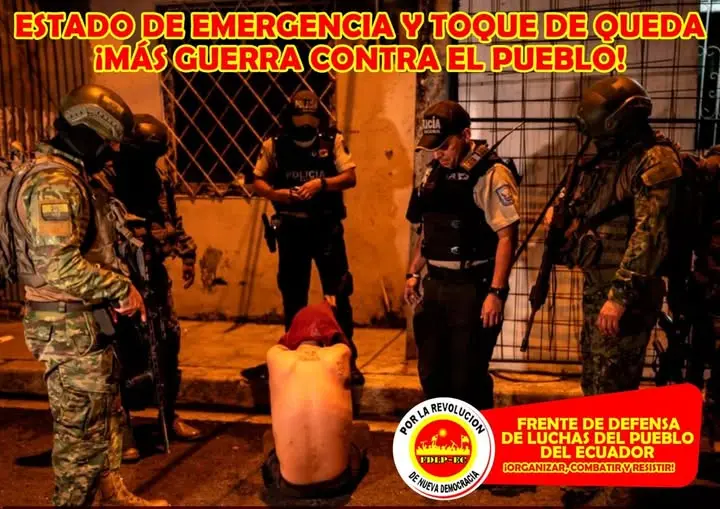
Noboa’s fascist and country-selling government extended the state of emergency and decreed a curfew in five provinces of the country; a leap in logic militarization, control and repression that the regime has been consolidating as its only government program.
From that day, in Guayas, Los Ríos, El Oro and Santo Domingo de los Tsáchilas, freedom of movement was suspended between 11:00 p.m. and 05:00 a.m., in application of Executive Decree 329, that reformed the state of emergency in force since the Decree 311. The measure was also based on a broader set of exceptional rules covering nine provinces and three cantons of the country.
What the regime proposes as a crusade for security is, in reality, a component of the military campaign established by the war criminal Trump, on the countries of this wounded America. A campaign that expresses ineffectiveness and becomes an open confession of the political impotence of regime. Noboa cannot, and will not, offer employment, health, social infrastructure nor security; based on a clumsy, dim and confusing narrative, he focuses on what he calls “security” and then decides to impose the murderous military agents, checkpoints, patrols and court threats.
The curfew falls on workers returning home late, on women who sustain life in precarious conditions, about young people from working-class neighborhoods, automatically turned into suspects, on drivers, vendors, peasants and residents who still have to move when the State orders them to remain immobile.
Specifically, these provinces are in a state of emergency, but not the declared by the government, but the one suffered by residents and peasants who are, literally, underwater, a result not only of the harsh winter, but also of the lack of infrastructure, sewage systems, drainage channels, etc. There, in the poor neighborhoods, the heat intensifies, along with mosquitoes and other pests. They generate endemic diseases, and yes, the masses, those with roofs of zinc or bijao leaves, they go out into the streets until late at night to not to suffocate from the extreme heat in their homes. Not anymore; they must submit to the precariousness in which they live because the government decided that everything should be criminalized.
The official alibi attempts to give all of this a technical appearance. Decree 329 itself states that, between January 1 and February 28, 2026, in Guayas, 31% of intentional homicides took place between 11:00 p.m. and 5:00 a.m., and in Los Ríos, 29% was also concentrated in that timeframe. The text acknowledges that in Guayas, of the 24 operations carried out in January, 58% were conducted at night, but only 22% produced “effective” results, such as arrests of suspects. Even with their own figures, the regime admits to use a huge repressive machine and a limited performance. But, instead of reviewing the failure of his strategy, he chooses a brutal solution: restricting the rights of entire populations. The state of emergency and curfew measures involve or affect 40% % of the total Ecuadorian population.
That’s the core problem. We’re not dealing with a security policy aimed at dismantling the structures of organized crime, its financing flows, its state and business protection network, nor their links with institutional corruption. We are facing a policy designed to occupy the territory, subjugate the people, and try to portray authority at any cost. That’s why the deployment is significant. The Army announced the mobilization of 30,000 military personnel at the start of this new phase, and the press reported on a combined force exceeding 75,000 personnel, including military and police. That doesn’t portray state strength; it portrays a decision to convert social space in a field of permanent surveillance.
The bitter part of all this, beyond the repression against certain gangs criminals, and the persecution of popular leaders, is that this display of strength does not arise from a clean slate either. It arrives in the midst of a deep institutional breakdown, with persistent reports of corruption, criminal infiltration, collusion between State agents and mafias, and a general degradation of the repressive apparatuses.
A few days ago, journalist Boscán released a photo clearly showing a police major, who is none other than the head of transnational crimes, an office linked to the DEA and FBI, along with three other officers, displaying the capture of a million-dollar drug shipment seized from a gang, to whom they sent the image as evidence of the blow against their “adversaries.” In this context, granting extraordinary powers to the same structures that carry suspicions of corruption and abuse does not mean effectively combating gangs. It means multiplying the scope for arbitrariness, selective revenge, discretionary use of force, and persecution against those who are bothersome.
The Minister of the Interior has publicly reminded that violating the curfew can lead to sentences of one to three years in prison, under the premise of disobeying legitimate decisions of competent authority as stipulated in Article 282 of the COIP. During the first night of the measure’s implementation, 253 arrests were reported in the four provinces under restriction. This is how this repressive campaign works: it does not resolve the structural causes of violence but quickly perfects the administration of excessive repression.
What is truly alarming is the attempt to convince us that all of this is normal. It is not. A country where exceptions and repressive campaigns become routine begins to lose sight of the seriousness of what is happening. The Constitution of the old State allows for states of emergency in certain circumstances but also imposes material, temporal, and control limits. The political problem lies not only in the formal legality of the decree but in the consolidation of a culture of governance that has made the restriction of rights, military presence, and social fear an ordinary tool of administration. When exceptionalism is repeated time and again, we are no longer facing a transitional response; we are witnessing a fascist power project.
The regime insists on presenting this path as the only possible one. Liars! It does so because it needs to instill the idea that outside of armed control, there is no way out, and it benefits from the people giving up on thinking that, additionally, they are precarizing work, increasing unemployment rates, deepening lack of healthcare attention, and handing over more territories to multinational mining companies. Militarization also serves this purpose: to conceal the bankruptcy of bureaucratic capitalism.
Therefore, the curfew should not be read merely as a security measure. The state of emergency and the curfew in Ecuador are not just a localized response to insecurity; they are part of Trump’s new imperialist script for America: treating our countries as war zones, imposing the logic of the internal enemy, and subjecting the people to permanent militarization. By declaring cartels as terrorist threats and expanding the tools of “counter-terrorism” and extraterritorial force, Washington pushes subservient governments like Noboa’s to tighten social control, restrict rights, and present the repression against the people as if it were a national salvation policy. Moreover, it is important to analyze that these measures carry another implicit message: obey, do not protest, do not rebel. The government and those in power need empty streets for their narrative to appear orderly. They need motionless neighborhoods so that obedience is confused with peace. They require a fatigued, fearful, and surveilled society to make protests seem like an anomaly and sell repression as a necessity.
But history has never been written solely by decrees. It is also written by those who refuse to accept humiliation as their fate. In the midst of this reactionary offensive, unions, workers, popular sectors, and the youth took to the streets on March 13 to protest against the government; obviously, there was brutal repression, but they could not demobilize the will to struggle, especially among the union members.
It is essential to counterpose to the repressive campaign of imperialism and the regime with organization, struggle, and resistance. We cannot allow the government to continue repressing, starving, and further precarizing the lives of the masses; nor can we remain timid or cowardly, endorsing “recalls,” those domesticated forms of struggle that disarm popular rebellion and chain it to so-called “democratic participation,” always within the confines of the political mobility imposed by the old State.
We must lose our fear. We must return to the streets, as it was done last week. We need to promote peasant and popular uprisings as a form of struggle, as a legitimate response to a fascist government supported by imperialism and weaponry.
LET’S STOP TO THE FASCIST GOVERNMENT OF NOBOA WITH ORGANIZATION AND POPULAR STRUGGLE!
NO TO THE CURFEW AND DECLARATION OF A STATE OF EMERGENCY!
NO TO THE PERSECUTION OF POPULAR FIGHTERS!
LONG LIVE THE STRUGGLE AGAINST THE MURDEROUS REGIME OF NOBOA!
LONG LIVE ANTI-IMPERIALIST STRUGGLE!
LONG LIVE THE RESISTANCE OF THE IRANIAN PEOPLE!
LONG LIVE THE RESISTANCE OF OPPRESSED PEOPLES AROUND THE WORLD!