AND and ABRAPO Denounce Constant Attacks on Peasants in Rondônia
Peasants in the Tiago Campin dos Santos area, where more than 600 families organized by the League of the Poor Peasants (LCP) have occupied land since 2020, reported attacks by armed men and the Military Police, which intensified after the “Operation Godos” by the Rondônia Public Prosecutor’s Office that sought to criminalize the movement. The AND Support Committee, accompanied by Brazilian Association of the People’s Lawyers (ABRAPO), visited the camp on November 23, 2025 to assess damage and collect testimonies. Here is a summary of those testimonies. The camp is located on land from the former NorBrasil estate, Rondônia. ABRAPO and CEBRASPO have announced another solidarity mission and a People’s Tribunal on March 28–29.
On arrival, the delegation heard numerous denouncements of Military Police actions. Peasants from the camp describe violence, threats and dispossession by the Military Police and armed groups serving João Martins, nephew of the big landlord Galo Velho. The Support Committee found reports of recent attacks and the criminalization of agrarian struggle promoted by former commander of the Military Police, Regis Braguin, who shared videos and statements against the LCP and the families.
Witnesses detail arbitrary BOPE operations, intimidation, threats against women and children, false accusations and persecution of families, who live in a constant state of terror, especially affecting children who cannot sleep.
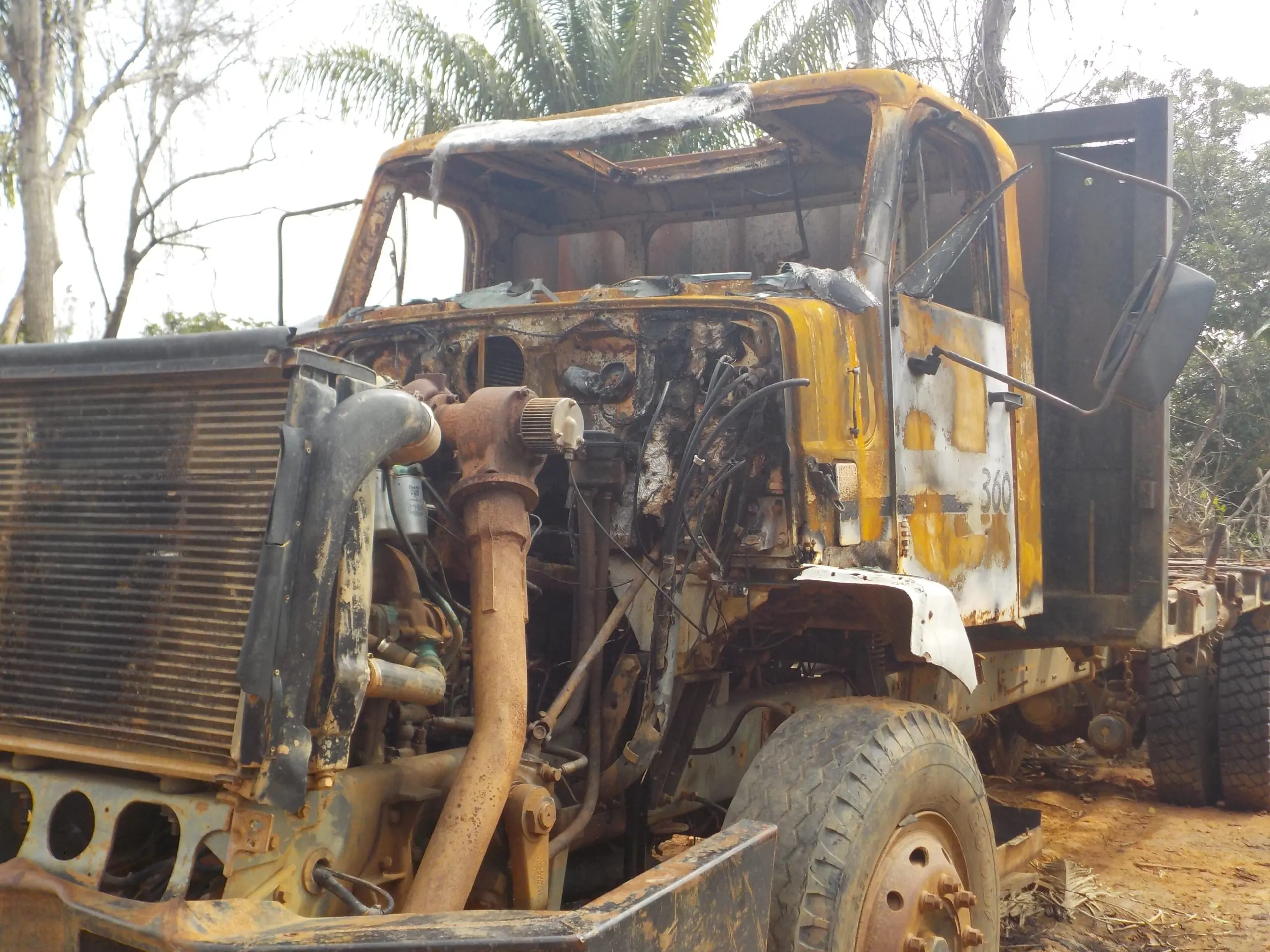
During the visit to the Tiago Campin dos Santos camp, peasants, the Support Committee and ABRAPO found devastation where the BOPE operation had taken place: burned huts, destroyed food and belongings, scattered toys and clothing. The peasants built a bridge to access the area and allow AND and ABRAPO to document the damage, but a pickup with goons approached and within ten minutes everyone had to flee; shots were fired during the retreat, though no one was injured then.
The peasants describe daily terror
This aligns with the daily environment experienced by peasants: “In relation to our daily life here, we are very oppressed. Sometimes, two or three times a day, a drone flies overhead. João Martins’ drone. It passed by yesterday. And our daily life here is very difficult. They are always shooting from over there towards here, and we have to hide. Because we don’t exactly know what to do in these situations. So what we do is hide. But that is our daily life,” recounts a peasant.
They point out that the “Operation Godos” and other maneuvers were used to criminalize them and justify repression; they accuse the former commander Braguin of spreading narratives that stigmatize families. “They talk a lot about ‘truth’ and ‘justice,’ but they act unjustly… they are working for the big landlord,” says another peasant.
They also remembered the peasant Elías, who was killed during the “Operation Godos.” Elías’ son recalled how they attacked the house while his brother was getting ready for work. More than 60 rifle shots hit the walls; Elías was shot in the chest and died instantly. His wife was hit by three shots in the abdomen and was seriously injured, hospitalized after hours of waiting. “We found out later that they were police. They shot first and then shouted that they were police officers,” says Elías’ son.
The teenage son also spoke about the violence he suffered when he was handcuffed by the police with his hands behind his back. “If I deviated from my path, they would hit me. They would slap me, punch me, hit me with the butt of a pistol. They would throw me to the ground and make me stumble,” he recounts. According to him, the police also threatened him psychologically: “They said they were going to torture my brother in front of me, that they were going to cut his throat if I didn’t say things that I didn’t even know.”
The police eliminated evidence such as security cameras, collected shell casings from the ground, and even moved the peasant’s body to be able to lie about the location of the crime, now claiming that he was killed in a bar and not at his home.
During the mission carried out on December 6, 2025, approximately 80 peasants reported similar abuses: raids on homes, schools, health centers, and businesses; insults, humiliations, and theft of belongings; consumption of products and looting of goods by police agents.
People’s Court of Rondônia
In light of these testimonies, it is clear that the violence reported is not an isolated case restricted to the conflict zones of the LCP, but rather part of a broader reality facing the poor peasants.
With the aim of making these denunciations visible and hearing directly from the affected parties, a People’s Court will be held to gather testimonies from peasants, indigenous people, riverside dwellers, and Quilombola communities about land conflicts in the state of Rondônia. The event will take place on March 28 and 29 in Porto Velho (RO) and seeks to bring together popular organizations, human rights entities, students, and democrats to listen to and support the struggle for land in Rondônia.
Upon receiving a visit from the Support Committee and CEBRASPO, a peasant stated: “I thank all the comrades who care about us and see the suffering we are enduring reflected in our faces, and do not label us as criminals… When you see an image like this, look at us: we are workers. We fight, we get up early, we milk the cows to send the milk to the city. Sometimes people in the city see us as drug traffickers, murderers. No. Here everyone is good people. No one here does the things they say.”