Development of Unity in the Struggle of Moroccan Textile Workers
We hereby share an unofficial translation of a note published by La Cause du Peuple on the struggle of Moroccan textile workers.
Moroccan textile workers in struggle: From individual battles to collective consciousness, toward movement unification and victory!
Tangier—a splendid city stretching between the waves of the Mediterranean and the rumbling of factories—is now back in the spotlight, writing a new chapter in labor history… A chapter written not with ink but with the sweat of workers, their resistance, and their anger, which gradually transformed into awareness and then into action.
In Tangier, the textile sector is no longer just an economic sector: it has become a stark reflection of everything that is crushed on a daily basis in the name of “exports,” “attracting investment,” “competitiveness,” and “competition.”
For years, the textile industry has been advancing in the city on the embers of precariousness, with wages that are not even enough to survive, undeclared work, ever-increasing pressure to boost productivity, which is breaking workers’ backs, and a total lack of safety controls, turning every workshop into a potential disaster zone.
It is therefore not surprising that the city has experienced so many tragic disasters: let us remember the drowning of 28 workers in 2021 in an underground factory after flooding, as well as repeated fires in the Al Majd industrial zone, particularly in October 2025; not to mention the exploitation of underage girls for 4 dirhams an hour in the sewing industry, accompanied by harassment of all kinds; not to mention the companies that abruptly stop paying workers’ wages for several months under the pretext of “late payments from international customers.”
In this land, which tests the workers’ ability to endure the intolerable on a daily basis, one of the most important workers’ battles has now begun: the battle of Namatex.
In November 2025, the Namatex factory abruptly closed its doors without warning. The result: no wages paid, no compensation offered, and no explanation given to the workers! The incomes of 450 workers were wiped out in a single stroke, as if years of labor and sweat were nothing more than a page in an exploitation ledger that could be torn out without remorse.
But the workers refused to be just another number in the register of victims… They broke their silence and took to the streets, moving from shock to struggle and occupation, from fear to confrontation. They stood in front of the foreign investor’s villa, not to beg, but to shout: “Our dignity will not be plundered as our work has been!”.
The closure was the spark that ignited organized anger, which spread like wildfire. The workers did not chant empty slogans, but demanded clearly defined rights:
- immediate payment of wages owed since production stopped;
- fair compensation for collective dismissal;
- respect for social rights guaranteed by labor law;
- protection of dignity and an end to abuse;
- refusal to treat workers as interchangeable parts that can be discarded as soon as profits falter.
What happened in front of Namatex echoes what happened in Meknes during the sit-in by Sicomec workers, where more than 500 workers were thrown out onto the street according to the same logic, with the same rhetoric: “We don’t need you anymore!”
There, as here, the bosses chose to resolve their crisis on the backs of the workers. And there, as here, the response was the same: occupation, refusal, unity, and struggle.
That is why we cannot talk about Tangier without mentioning Meknes, because the bosses have repeated the same scenario word for word, believing that the workers in each city would remain isolated, unable to understand that what is happening is not an “administrative closure” but a systematic and systemic policy aimed at fragmenting the labor force and preventing any collective power from confronting exploitation.
The Namatex workers understood the lesson and drew conclusions from this experience: when management lays off 450 workers here and 500 elsewhere, it is not only labor rights that are being trampled on… It is testing the capacity for resistance, struggle, and unity of the entire working class.
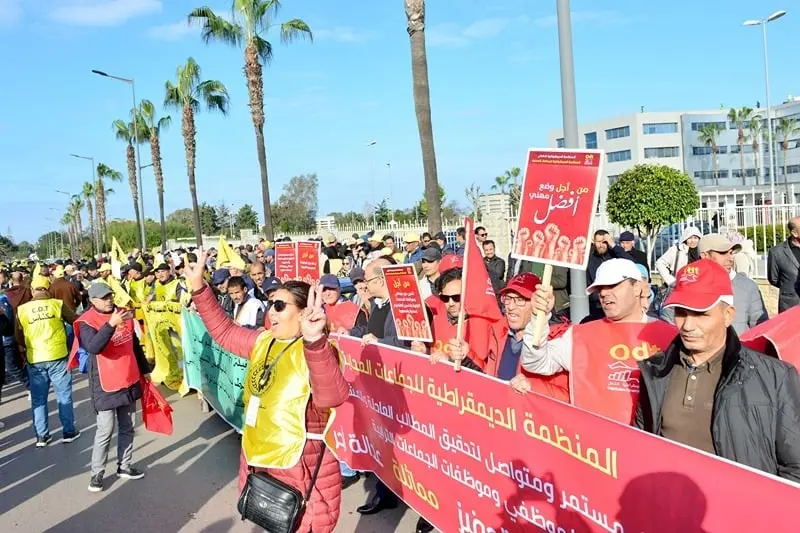
With the rallies in front of the factory, the occupation has become a real school of class consciousness: workers from other factories have come to support the struggle and share their experiences; some workers have discovered for the first time that what they are going through is happening elsewhere; families have understood that silence protects no one, and a new consciousness has been forged: our destiny is shared! So is our struggle!
In this context of open struggle, everyone understood that the most powerful weapon of the working class is not only protest but the convergence of struggles in order to break isolation and build a collective force that extends beyond each factory and each city.
The current battle is decisive because it tests the workers’ ability to:
- transform individual anger into collective struggle;
- expose the contradictions in the official discourse of “industrial modernization,” which in reality amounts to unlimited exploitation;
- remind people that the lack of oversight and social protection is not an oversight… but an orchestrated policy that leads to well-known tragedies such as deadly floods, repeated fires, and mass layoffs as soon as European markets tremble and falter;
- to develop a strong class consciousness from Tangier to Meknes and in connection with all the cities that will soon have to join the struggle.
The Namatex battle is not a passing episode in the history of the Moroccan textile industry. It is a mirror reflecting the face of the exploitative system and its investors, and a window through which the working class can see its future.
The victory of today’s workers is a victory for all workers threatened with dismissal tomorrow.
The issue is not just about wages… but about dignity.
It does not concern only 450 workers… but affects the entire working class.
It does not only concern Tangier… but affects every city where a factory is built and where every person is pressured to produce more and live less.
As long as unity grows, no force on Earth will be able to stifle the voice of workers when they decide to chant this slogan: “Never again will we allow ourselves to be crushed!”
The battle of Tangier and Meknes is not just a series of protests or sit-ins, but the beginning of a new consciousness: the working class can only protect itself when it protects its own, and can only triumph when it understands that its destiny is indivisible, despite all the diversity of its components.
Let us live up to our sacrifices! Let us spread the struggle and solidarity, and move forward together towards victory!