Spanish State: La Cañada Real on the front lines: “Our homes are ours”
We hereby share an unofficial translation of an article published by Servir Al Pueblo on the developments of the housing struggle in the neighborhood of the Cañada Real.
Correspondent in Madrid
Cañada Real Galiana is a neighborhood under construction, a neighborhood outside of urban planning regulations that the Madrid authorities (the regional government and local councils involved) have decided to wipe off the map and that its inhabitants, against all odds, refuse to abandon. A significant number of them, at least, refuse to accept the demolition of their homes and the forced relocation being promoted by the various administrations, a relocation carried out behind the backs of those affected and which, in any case, would only affect 20% of the families currently living in the different sectors of La Cañada, especially in the largest and most precarious sector 6.
Breaking media stereotypes: the residents of La Cañada are working-class families, not criminals
The settlement of Cañada Real began in the mid-20th century, when the country’s economic transformation meant that the old livestock trail, used annually during the transhumance in search of seasonal pastures, lost its function. During those years, families from various rural areas of the country and from the neighborhoods of Madrid from which they had been expelled began to settle in the Cañada. In the 1990s, the population increased considerably with the arrival of many Moroccan and Romanian families and, to a lesser extent, families from other Eastern European countries, Portugal, and Latin America, who settled mainly in Sector 6. This created a linear neighborhood about 14 kilometers long, divided into six sectors that cross part of the territory of the municipalities of Coslada, Rivas Vaciamadrid, and the capital itself (districts of Villa de Vallecas and Vicálvaro). Its population, largely made up of immigrants and Roma people, faces not only poverty and exclusion by the State, but also racism and stigmatization by institutions, politicians, and the media. With the growth of both industrial estates and urban areas in the city, Cañada Real has become a geographical boundary that clashes with the plans of State financial monopolies, which seek to continue expanding their real estate projects.
In a context of intense real estate speculation throughout the Madrid metropolitan area and in the midst of a housing crisis, the State, which is nothing more than a tool of these monopolies, has been developing a coercive policy of harassment and demolition against the inhabitants of La Cañada for several years now, with no other objective than to forcibly evict the entire neighborhood. This criminal siege against a population that is mostly living in poverty and extreme precariousness has consisted of denying them the most basic public services, even cutting off those that had been achieved in the past in one way or another, allowing the massive dumping of rubble next to their homes and, above all, seeking to completely isolate La Cañada through both physical and media barriers. Physical because the lack of access and public transport prevents free movement and in practice limits access to work, education, and healthcare for its inhabitants. Media because the media silences the struggle of La Cañada Real and only mentions it to criminalize it, linking it to drug trafficking and criminal activity in general, in order to justify the inhumane campaign of harassment. To this end, of course, they use all kinds of racist and xenophobic prejudices and foment hatred of the poor.
A neighborhood besieged by monopolies
As a result, residents in the most deprived areas of Sector 5 and, above all, Sector 6 are denied basic services such as drinking water (in part of Sector 6), garbage collection, and postal services. But the most serious crime committed by the State and monopoly companies was the complete cut-off of electricity supply in October 2020 to all homes in Sector 6 (the largest and most populated sector, where thousands of people live). After five long years of complete absence of electricity in sector 6 and partial absence in sector 5, there have been multiple cases of hypothermia and the deaths of several people, including a baby. The argument used by the State and the energy company Naturgy to cut off the electricity was that there were overloads on the grid due to alleged marijuana plantations. Currently, however, the drug market in the area has continued to develop without the State taking any new measures. Why, then, is the power cut still in place? No one has the slightest doubt that the aim is to force the population to abandon these areas of the neighborhood and continue with their policy of demolitions—often illegal and without prior notice—in order to take over the territory of La Cañada. Another argument used by institutions and companies to justify the eviction is that La Cañada is too close to the Valdemingómez landfill and incinerator, which would pollute the air, making it too unhealthy. However, this incinerator is just as close to the Pau de Vallecas neighborhood, and there are no plans to evict it. Once again, the State is demonstrating its hypocrisy by refusing to dismantle a facility that pollutes the entire city of Madrid, and which has in fact been denounced by the UN, in order to justify the eviction of La Cañada.
This inhumane population clearance is already being carried out by the local councils of Rivas and Madrid through a coercive and opaque rehousing plan for those residents who meet certain requirements established by the State and the demolition without alternative of those who are left out of the rehousing plan, which is approximately 80% of the residents due to the severe conditions imposed. These conditions include being able to prove that they have been living in the neighborhood since before December 2011 and not having rejected social housing in the last 10 years. Those who have been able and have agreed to be rehoused under these abusive conditions have done so without knowing in advance where and under what circumstances they would be rehoused, only to find that they were being sent to an area outside the city, in poor-quality housing or at a cost that is unaffordable for their economic situation, not to mention that these rehousing arrangements are not permanent and the social housing expires, perpetuating the problem for these people. There have even been cases where rehoused residents wanted to return to La Cañada and found that their homes had already been demolished. All this shows that the supposed rehousing plan is nothing more than a lie by the institutions that seek to divide the residents of La Cañada and thus pave the way for evicting the population and handing over the land to real estate developers. It is worth noting the high level of participation in this plan by the opportunistic Izquierda Unida (United Left) party, which has governed Rivas Vaciamadrid for decades, as well as numerous NGOs that operate within La Cañada and use their influence to promote rehousing.
The residents’ fight against evictions
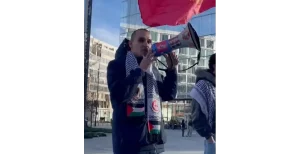
In response to this campaign of harassment, the masses of La Cañada have been waging a determined resistance struggle for years. To this end, they have been carrying out important mobilizations and actions, including the historic blockade of the Valencia Highway (A-3) with barricades in 2020, which saw significant clashes with the repressive forces of the State. On numerous occasions, the bulldozers that go to demolish houses in La Cañada Real are greeted with stones and find the residents resisting at the door. In April of this year, a protest demonstration took place against the Rivas Vaciamadrid City Council, which is responsible for sectors 4 and 5 of La Cañada. Dozens of residents from the six sectors marched under the slogan “Light, contracts, and a monitoring committee.” One of the residents attending the march—organized by the “Light for the Cañada” platform—told the press that “the Cañada must and will rebel.” It should be noted that women have always played a particularly important role in this struggle. Power cuts, lack of services, and lack of activities for children affect them in particular, as they tend to bear the responsibilities of the home and all the cultural forms of patriarchal oppression, which has led to intense organization by women for their rights and living conditions.
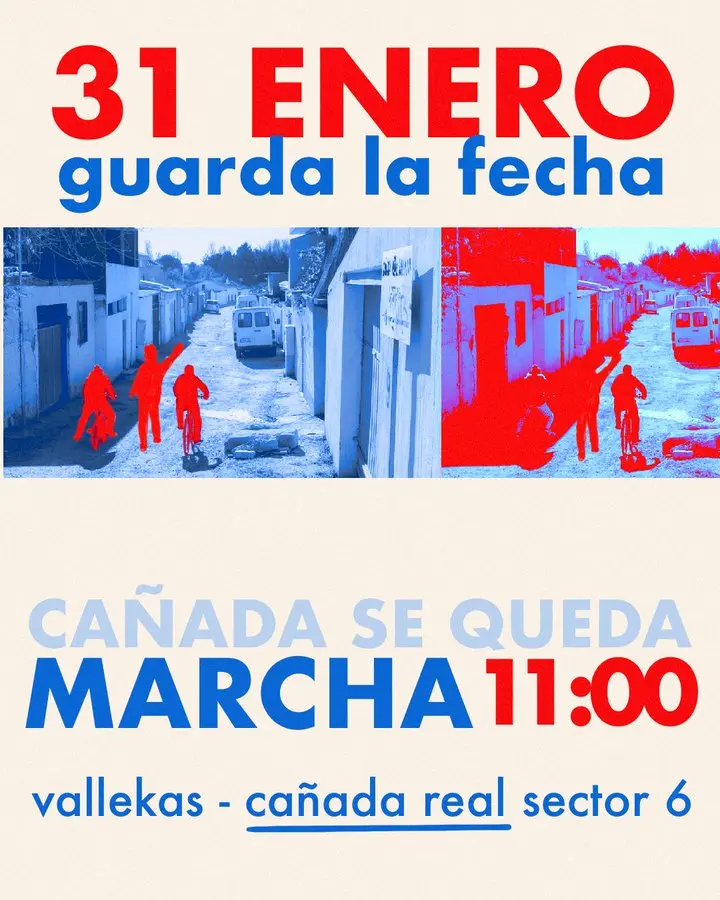
Now, the women’s association of Cañada Real Tabadol, the PAH of Vallekas, and La Laboratoria have launched a new support campaign, which numerous organizations and individuals are joining. One of the main actions will be a march connecting Cañada with the rest of the city on January 31, 2026. The people of Cañada have made the granting of the land on which they live their main demand, as they recognize that without resolving this issue, they cannot resolve all the other problems they face. To get their electricity and water back, to guarantee their right to health and education for their children, to stop the landfill and incinerator from poisoning the air and soil, they need a home, a community, and land that belongs to them and that they can fight for. In this way, they refuse to break their community ties and their structures of struggle to go from one temporary housing project to another, from one false promise to another. The residents of Cañada Real have taken a stand, decided to take their future into their own hands, and are calling for the support of social movements and the masses in the rest of the city and all other territories of the State.
Break the siege on Cañada Real!
Cañada stays!
Our homes are ours!
Defending our territory is defending life!