FDLP-EC: Old Power is Overthrown Through Struggle, Not Through Revocations or Bureaucratic Illusions of Similar Kind
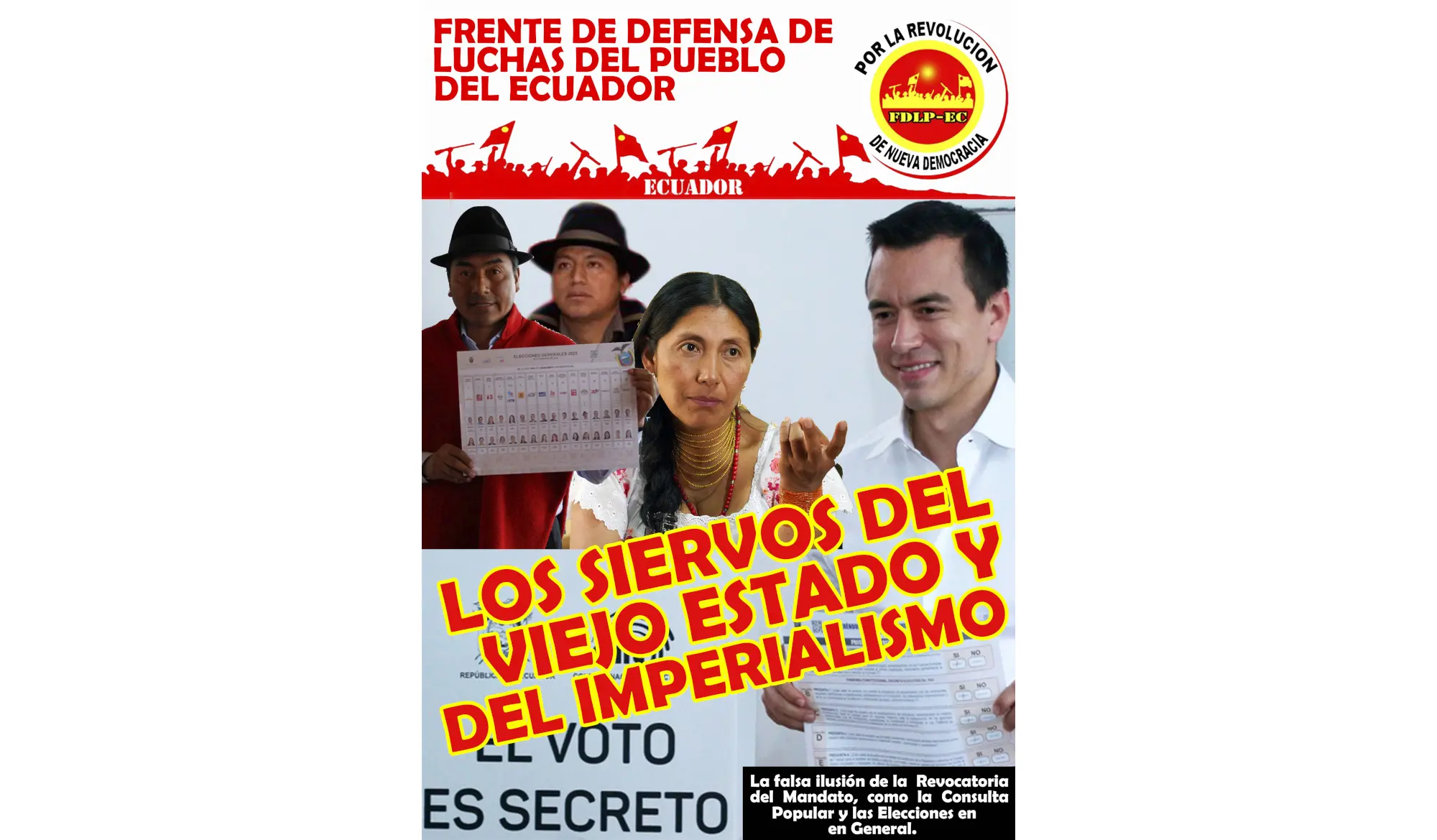
We hereby share an unofficial translation of the statement by the Defense Front of the People’s Struggles in Ecuador on the revocation attempt of the President, Daniel Noboa.
Thirsty for power and bureaucratic control over indigenous and peasant organizations, Leónidas Iza and his collaborators are positioning themselves in leading roles within part of this movement. We say “part” because the indigenous movement is not a homogeneous block and does not belong to any sole leader: it is diverse, contradictory, and ideologically varied. Therefore, there are many tyrants depending on the organizations, regions, and political inclinations of their leaders.
After the betrayal by Vargas, the then president of CONAIE (Confederation of Indigenous Nationalities of Ecuador), of the peasant and popular uprising – which storm center was in Imbabura – several indigenous and peasant leaders who felt “relegated” by the direction of the movement, but not by its bureaucratic diversion, sought to re-accommodate themselves in other structures, including parts of CONAIE, in order to transform them into their political platform.
On January 31, 2026, Iza was elected as the president of Ecuarunari (Confederation of Peoples of Kichwa Nationality) for the 2026-2029 term, presenting it as a “relaunch” after his previous failures and the wear and tear of his electoral circus.
The importance does not lie in his election to the presidency of Ecuarunari, but in the political line that he continues to repeat. From now on, there is no real break with opportunism, which has already shown its limits. Iza has not learned from his absurd and treasonous electoral adventure because he does not want to. Managing the apparatus and electoral calculations are more profitable than organizing and leading the peasant movement in its fundamental tasks – the struggle for land, the elimination of semi-feudalism, and other difficult-to-transfer tasks whose resolution cannot be found through bureaucratic means – that is, under the umbrella of bourgeois-big landlord legality.
When the struggle demands clarity, ideological coherence, and combativeness, they push the grassroots into an endless cycle that transforms indignation into tangled meetings and reformist euphemisms: today mobilization, tomorrow electoral ballot box, then gathering signatures, followed by “unity” with anyone, and in the end, negotiation.
Within the collapse of bureaucratic capitalism, the critical situation in which the masses live, amid terror, blood, unemployment, and negotiation of their fundamental rights – when the government offensive undermines work, the public health system, the Social Security (IESS), etc. – Pacha Terán, leader of the rotten Hoxhaist Unidad Popular – another expression of the bureaucratic, opportunist, and electoral lineage –, Marcelo Ushiña from FENOC, Guido Perugachi from FENOCIN, Luis Cimarrón from CONAIE, Guillermo Churuchumbi from Pachakutik, Hugo Bedoya from FUT, and Víctor Hugo Erazo from ANRE, among others of the same kind, have taken the position to drag the masses towards another constitutional experiment under the ragged flag of the mandate revocation following the failure of the indigenous movement leadership.
As if it were the only way possible, on February 9, 2026, Ecuarunari announced its intention to support the revocation of Daniel Noboa, even opening the door to joining forces with other sectors. As if the solution to the people’s problems lays in having someone in the presidency who addresses the petty-bourgeois nationalist attacks. They do not understand that those who hold the power are not the clowns in the presidency, but those who possess economic power.
This opportunistic legalism is nothing new, nor a strategy; it is the political expression fueled by reformist ideology with severe Trotskyist features, aimed at one goal, to bureaucratize the people’s organization and struggle.
The leaders of the indigenous movement – revisionists of the union movement and opportunists of the popular movement – are experts of the administration of dissatisfaction. They redirect the energy from the countryside, roads, squares and streets into the labyrinth of the old State, its timelines, its candidates and its wear and tear. Meanwhile, the regime, but mostly the old bureaucratic- big landlord State, remains untouched. The recent experience confirms this; in the popular consultation and referendum from April 21, 2024, despite the “Yes” winning in nine out of eleven proposals, the leadership sought to install the narrative of “defeat” over the government to win the narrative and to politically capitalize the adverse result. In 2025, on the consultation on November 16, when the “No” was imposed on four proposals addressed by Noboa and the National Electoral Council proclaimed the final results at the beginning of December, the same logic was seen again: struggle is exchanged for campaign, campaign for calculation, and calculation for leader repositioning by tyrants with personalities such as Ullco Colla or Malinche.
Today, months after the “No” won in the popular consultation, Noboa continues to do what he wants. He does not care about the Constitution and applies laws against it, transgressing it. Consequently, this type of struggle is as worthless as believing that Power can be conquered in the ballot box.
We are not questioning indigenous identity or the historical legitimization of the communities. We denounce opportunism of a layer of the leadership that parasitizes the collective prestige, struggle, and sacrifice and use it as trampoline: today “resistance”, tomorrow platform, today “uprising”, tomorrow agreement, today “popular term”, tomorrow internal share. Every time this leadership layer imposes, the real capacity of the masses to deal a blow not to the electoral and procedural surface, but to crucial issues – economic structure and power policy, semi-feudality, semi-colonialism, bureaucratic capitalism –, this capacity weakens.
The conclusion is harsh and simple. There will be no transformation from the means of the old State when everything is made to deactivate the struggle and recycle its leaders. If the same path is always taken, so will be the result: wear and tear, demoralization, and a new group of administrators of the conflict. The grassroots of the peasant movement must open their eyes: no delegation of dignity to professional leaders. It is organized and defended with organization, combativeness, and resistance under correct class leadership, which gathers those who should be gathered, without bending before the co-optation mechanisms of the regime.
Iza could not become president, nor had the economical resources of Noboa. If Noboa stays or goes will change little, very little, of the economical, political, and social situation for the broad majority. We cannot continue jumping from one reform to another; the peasant revolution, and in its core, New Democracy, is a necessity that must be prepared, organized, not from the spaces of a political movement that the old State gives us – elections, consultations, revocations, and all kind of electoral nonsense –, but from all these tasks that promotes violent revolution, that is, revolution in all its expression: Revolution!
DOWN WITH THE BUREAUCRATIC PATH, CONSTITUTIONALISM AND THE BOURGEOIS- BIG LANDLORD LEGALITY!
RAISE THE DEMOCRATIC PATH, WHICH IS THE PATH OF THE PEOPLE, THE PEOPLE’S WAR!
DOWN WITH THE LIE OF “COMBINING” FORMS OF STRUGGLE!
DOWN WITH OPPORTUNISM AND REVISIONISM!
LONG LIVE THE ANTI-IMPERIALIST STRUGGLE!