Brazil – AND Editorial: How to Prevent the Return of Bolsonarism by Adopting Bolsonarist Positions
We hereby share an unofficial translation of the editorial published by A Nova Democracia on the 11th of May.
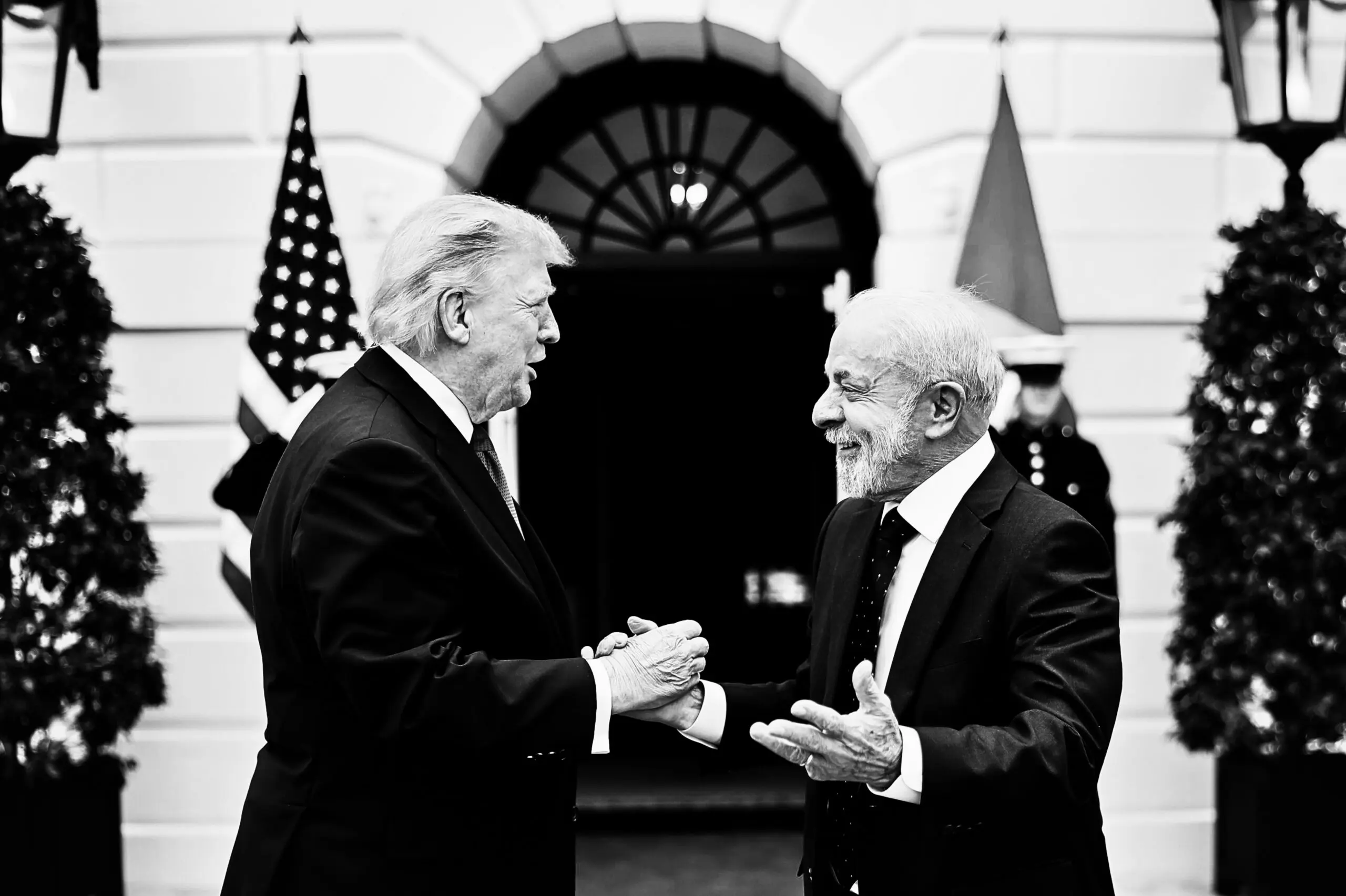
While in Washington, Luiz Inácio met with the cannibal Donald Trump at the White House. The media monopolies treat the meeting between the opportunistic leader and the Yankee ringleader as yet another chapter in diplomatic “normalization,” but the meeting’s agenda said it all: “combating factions” (a topic that, supposedly, was not addressed), trade tariffs, Pix, “rare earths,” and critical minerals. In plain English: the empire will dictate, and Luiz Inácio, eager for better electoral conditions, will find a way to comply. At stake are strategic resources, which are vital to the US contention with China, and the tying of the repressive apparatus of the old Brazilian State to US police, customs, and intelligence agencies (FBI, CIA, DEA, etc.), in order to make the institutions of the old Brazilian State—especially those of repression—increasingly vassal and subordinate to the “Great Satan.”
And, to put a veneer of appeasement on it, of course, a dash of “leftism”: Luiz Inácio asked the Nazi-Zionist organization to release the Brazilian pro-Palestinian activist Thiago Ávila.
It is no coincidence that the focus of the meeting was presented, in the advance release of the agenda, as “combating organized crime”—which Trump now insists on classifying as “narco-terrorism.” This is the code. Under the elegant heading of “cooperation,” presented as a way to avoid a greater evil, the opportunistic government is increasingly opening the floodgates—which are already open—to U.S. interference in police, military, customs, and intelligence matters. No rhetoric of “sovereignty” can justify such subservience (all the more so when the Brazilian president declares he had “love at first sight” with Trump, the architect of the genocide of the Palestinian people, of the aggressions against Venezuela and Iran, and of interference in our country—an act of absolute national humiliation). This, moreover, is fully in line with the new interventionist fervor of Yankee imperialism in the subcontinent, expressed in the new “National Security Strategy” of the “Trump Corollary,” that is, the U.S. ambition to reaffirm the Western Hemisphere as its backyard and establish Latin America in particular as a strategic base amid the debacle of reversing the sharp decline of its sole hegemony in the world—to this end, enlisting subservient governments to control borders, seas, trade routes, migration, drugs, and strategic resources.
Still on the subject of the so-called “factions,” it bears repeating—even though everyone already knows this—that “organized crime” is no stranger to the old State; it is embedded within it. Weapons, drugs, ammunition, money laundering, and contraband do not cross borders, ports, airports, military barracks, police stations, and customs checkpoints by some miracle. They pass through because there are so-called “public officials”—high-ranking officers in the police and the reactionary Armed Forces, the leadership of the Judiciary—from the lower, intermediate, and, above all, the higher courts—politicians of all stripes, the big bourgeoisie, big landlords, and all manner of sordid elements up to their necks in this machinery. In this context, the control of drug sales points by armed groups is merely the small-scale retail end of a massive, billion-dollar mechanism, whose exorbitant profits are restricted to those of “blue blood” who do not even need to wield firearms to exercise power. This is a macabre charade in which the centers of power within this old system of oppression and exploitation profit from such schemes while, at the same time, portraying them as a major threat to justify and carry out their insane and dirty war against the people in the favelas and rural areas—a war that results in mass incarceration and an escalating spiral of ever-increasing violence and crime. So-called “narco-terrorism,” as we have already pointed out, lies within the very old State that claims to combat it. The “war on gangs,” therefore, will be what the “war on drugs” has always been: a war on the poor. Repression falls upon the masses; impunity rises to the “top floors.”
Luiz Inácio knows this. But his thinking is purely electoral, and he is in no way concerned with the country’s major issues. In this regard, he is not unique: as a rule, all candidates think this way. In the 2026 elections, “public safety” is one of the areas where his government is most struggling with the public, and it is precisely the terrain exploited by the far right with the constant aim of numbing the masses with fascist demagoguery. To compete for votes with Bolsonaro supporters, without any moral or popular compass, the opportunistic government adopts the agenda they have imposed: more repression, more police integration, more emergency laws, more nods to US agencies, more kowtowing to Washington’s dictates. If the far right gains votes by proposing the revocation of fundamental rights and greater repression of the poor under the rhetoric that it is uncompromising toward “factions,” opportunism seeks to defeat the far right by precisely adopting its methods and rules. It believes that by imitating the far right, it will defeat it, and justifies this by arguing that it is better to defeat it by partially identifying with it, instructing the masses to identify with it, and applying what the far right itself would apply, than to allow the far right to win. The logic is, as can be seen, disturbing. Opportunism, thus, only paves the way for fascism, under the pretext of avoiding it. This was already taught 90 years ago by the great leader of progressive humanity and architect of the great defeat of fascism in history, the Great Stalin.
***
The same populist and vote-seeking nature is evident in the so-called “Novo Desenrola Brasil.” The indebtedness of Brazilian households is a cancer. In March, 80.4% of them were in debt, while, according to Central Bank data, debts already accounted for 49.9% of income accumulated over 12 months, and nearly a third (!) of monthly income was consumed by payments and debt restructuring. The causes of this indebtedness lie in deep-rooted issues that no government dares even to touch, because to do so would require shifting the economy away from its semi-colonial and semi-feudal foundations—that is, only the eradication of these foundations would serve the national interests and those of the people, which only a popular revolution can achieve.
It is well known that, among households, 30% of their income is tied up in debt and that, among the poorest households, debt accounts for 80% of their income; furthermore, on average, 80% of debt stems from credit card use, with 35 to 40% of household budgets spent on food and housing (on average). This demonstrates that household debt, especially among the poorest, stems from basic needs being financed by credit cards. It is poverty, the suppression of basic needs, financed by credit at stratospheric interest rates, that are the causes of indebtedness—and no government addresses this problem, because tackling it would mean challenging the fabulous monopoly profits of local comprador capital and the maximum profit of imperialist finance capital, which is out of the question for a lackey State and a government of the same ilk, which is treated as “leftist” by the liberal right, by the far right, by the entire official political world, embraced by all opportunism, and trumpeted by the media monopolies.
For those interested in votes, a measure that doesn’t solve the problem but appears to alleviate it by prolonging the agony is far more valuable, and that is the “New Workaround.” Right off the bat, it guarantees compensation to big business for debts that were already written off with State funds—money that could and should have been allocated not to banks, but to the struggling public health and education systems. Next, the politician of the moment hopes to gain votes off the situation, presenting himself as a “savior”; if debt then accumulates again: so much the better, it’s another opportunity for the next “savior of families” to emerge and win more and more votes. In fact, while the people go into debt to eat, pay rent, electricity, water, gas, and medicine, the four largest banks operating in the country posted a combined net profit of R$ 107.8 billion in 2025, and the opportunistic government’s new program will continue to please the banking elite.
***
In an attempt to improve its standing, the government is seeking to tie the activism of opportunistic organizations affiliated with the PT to its candidacy, and the weapon of choice is the bill that prohibits the 6-to-1 work schedule. The concern is far from being the working conditions of the working masses of the proletariat, especially its broadest and most marginalized layers, so much so that on the negotiating table is the expansion of the aberrant rule that “worker-employer” agreements take precedence over legislation, the expansion of “time banks,” the reduction of payroll taxes, and further precariousness in labor hiring conditions (more variable or intermittent work schedules). What matters is that the headline reads: “Government Ends the 6-to-1 Work Schedule,” since, according to an April AtlasIntel poll, 55.7% want the schedule abolished.
The class-based position on this issue is, first and foremost, to fight not only to end the 6-to-1 work schedule, but the entire “labor reform”—of which it is a part—approved by Temer and cemented by the inaction of this opportunistic government, a conscious servant of comprador-bureaucratic capital and a financial lackey. Separating the part (the 6-to-1 ratio) from the whole (the “reform”) allows the fire-extinguishers of the class struggle to take advantage of the proletarian class’s mobilization and sell it at the negotiating table in the mansions, presenting “concrete victories” that are, in reality, an illusionist’s trick, in which the government gives with one hand and takes away with the other without the victim noticing. Moreover, democratic, class-conscious forces must mobilize, politicize, and organize the proletarian class, using the ongoing mobilization against the 6-to-1 ratio as a springboard, and making their places of residence, work, and study the axis of all mass work, and build a broad movement to elevate the struggle against this specific ratio into a more comprehensive movement, step by step, aiming at the fight against the Social Security and labor “reforms,” for their repeal.
***
No doubt, Luiz Inácio will do whatever it takes to gain political capital for the election. He hands over “public security” to Yankee dictates; he hands over the indebted people to the banks, while attempting to manipulate them with the end of the 6-to-1 work schedule to maintain the same level of job insecurity; he hands over positions, funds, and budget amendments to the voracious “centrão”; he hands over the repressive agenda to the far right. All of this amid the strengthening of the “centrão,” a self-serving right-wing bloc entrenched in a corrupt Congress that, even when crammed with concessions, remains insatiable, always demanding more. The result is the opposite of what the opportunistic politician expected. Every concession to Bolsonarism—to no one’s surprise!—strengthens the far right and Bolsonarism itself, while they, under the auspices of the political boss Flávio “Rachadinha,” maintain their political and electoral offensive.