AND: Keiko Fujimori Hands Over “Security” to the Peruvian Armed Forces and Inaugurates Her Government in the Shadow of Her Father’s Fascism
We hereby share an unofficial translation of an article published by A Nova Democracia on 31st of July.
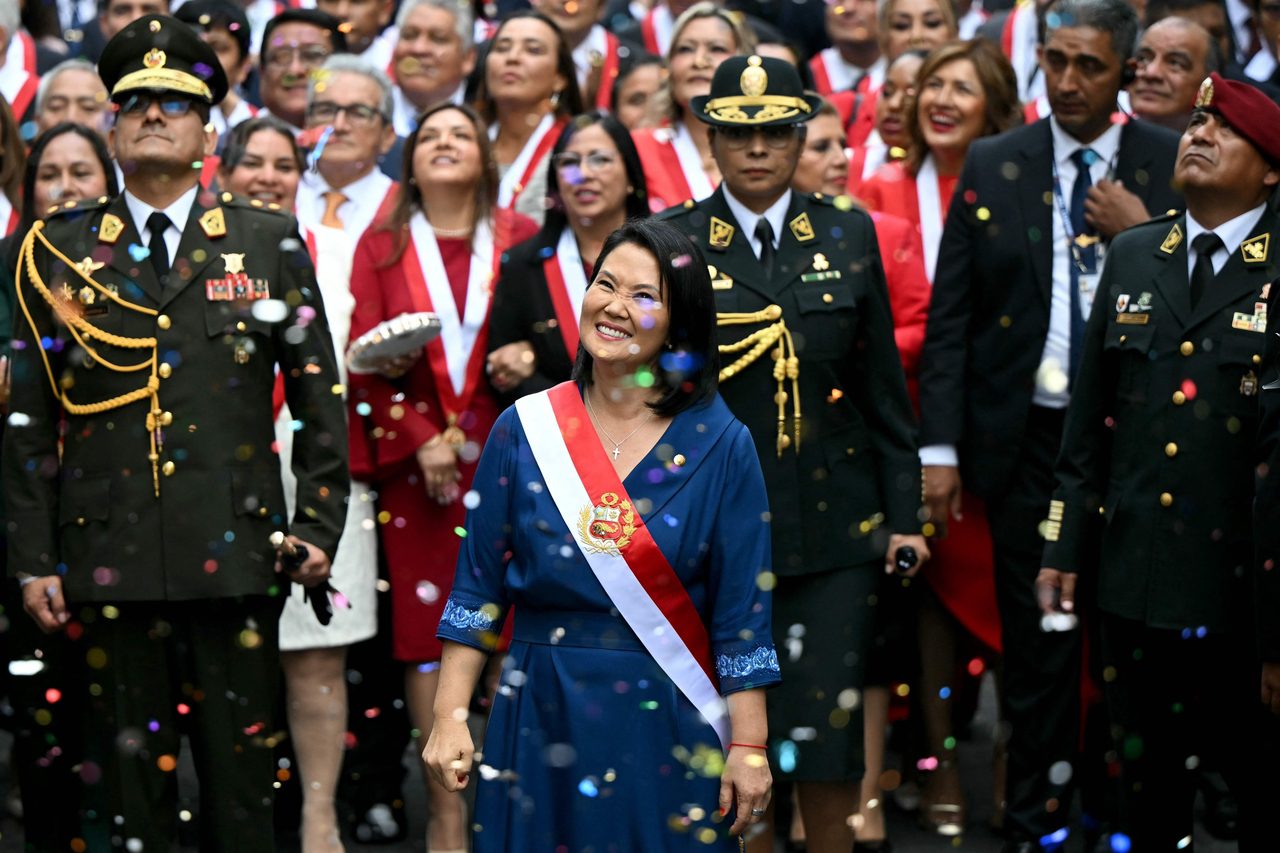
Keiko Fujimori, heiress to the tyrannical clan that plagued Peru for a decade, took office as head of the Peruvian government on July 28th, in a ceremony held at the Government Palace in Lima, after winning the election by a margin of less than 50,000 votes and with the backing of a fascist parliamentary bloc. Fujimori announced the deployment of repressive forces in the so-called “combat against crime,” the construction of a mega-prison, and the adoption of anonymous tribunals—measures that prompted opposition lawmakers to stage an immediate walkout within the very reactionary legal framework of the plenary session, carrying portraits of those murdered under the regime of her father, the genocidal Alberto Fujimori.
While the official ceremony took place at the Government Palace under tight security and institutional protection, hundreds of protesters and relatives of victims murdered by fascist violence in the 1990s gathered in a public square to vigorously reject the new administration. The forceful statement made by Raúl Samillán, president of the association of relatives of massacre victims, stood out when he told teleSUR network that Keiko’s rise to power represents an unacceptable setback and emphatically stated that “their hands are stained with the blood of our loved ones.”
In her first official speech before State officials and international guests, the main theme was reactionary militarization. Keiko Fujimori reaffirmed that Peru’s genocidal Armed Forces would assume control of “internal order” in areas under a “state of emergency,” replacing the police forces. Justifying the measure, the president declared bluntly—while attempting to give it an air of legality—that “wherever organized crime, drug trafficking, or illegal mining have seized control from the State, we will use all the instruments made available by the Constitution.”
The new government’s policy framework has also received the open endorsement of reactionary leaders in the region, such as Argentina’s Javier Milei and Paraguay’s Santiago Peña, as well as imperialist international credit rating agencies like Moody’s, which have praised the “macroeconomic predictability” favorable to “foreign investors,” a euphemism for imperialist finance capital.
Celebrating the stability for local and imperialist big capital, financial executive Luis Ramos at the LarrainVial brokerage firm, publicly stated that “the result represents an initial validation of the coalition model that sustains Fujimori’s governability and her ability to promote a legislative agenda favorable to the economic growth” of the business barons.
A cabinet under investigation and facing legal proceedings
The new configuration of the Peruvian parliament, which marks the return of the bicameral system abolished after Alberto Fujimori’s self-coup in 1992, revealed fierce disputes over control of the State apparatus. The reactionary Popular Force Party, led by Keiko Fujimori, won the presidency of the Senate under the leadership of Miguel Ángel Torres, while the reactionary opposition coalition secured the presidency of the Chamber of Deputies with the victory of Óscar Reto Otero. This clearly demonstrates the need for complex alliances and negotiations to sustain the so-called “governability” of the new Executive administration.
The sworn statements submitted by members of the Ministerial Cabinet led by Luis Galarreta revealed that several appointed ministers are facing legal proceedings and tax investigations for corruption and abuse of authority. The Prime Minister himself is under investigation for alleged crimes of money laundering, abuse of power, and organized crime, in addition to a history related to past electoral fraud, as indicated in official documents released by the Peruvian press. They are not the only ones facing problems with the “justice system,” inaugurating a government with a long track record of accusations and suspicions.
The murderous past of the Fujimori clan
The return of the Fujimori clan to power in the old Peruvian State inevitably brings to light the dark history of crimes and serious human rights violations perpetrated during the regime of Alberto Fujimori, a period in which the bloodthirsty death squad known as “Grupo Colina” operated under the protection of the old State, directly responsible for torture and massacres such as that of Barrios Altos and the brutal kidnapping, torture, and murder of students and a professor at the Enrique Guzmán y Valle National University, the famous La Cantuta.
An indisputable landmark in these allegations was reported by the democratic newspaper El Diario Internacional one year after the self-coup, in May 1993, under the headline “Fujimori’s Hitmen.” The article detailed the allegations made by Army General Rodolfo Robles, who revealed the existence of a special unit operating within the repressive forces since 1991 to kidnap, torture, and exterminate opponents under the false justification of combating the People’s War, led by the Communist Party of Peru (PCP).
The publication detailed that the paramilitary apparatus of extermination and terror operated directly under the orders of presidential advisor Vladimiro Montesinos and General Nicolás Hermoza Ríos. According to General Robles’s testimony, this macabre gang was directly responsible for the murder of 45 university students, one professor, and 16 other people in the infamous Barrios Altos massacre, which took place in November 1991.
The Barrios Altos massacre claimed the lives of workers from Ayacucho who were celebrating a popular festival, including an eight-year-old child who was cold-bloodedly executed. The government tried to cover up the crime by claiming it was an internal settling of scores, but reporters confirmed that the murderers used silencers and official vehicles belonging to the National Intelligence Service (SIN), which would later, in 2001, become the National Intelligence Directorate (DINI).
Another documented barbaric crime was the kidnapping and murder of nine students and one professor from the Enrique Guzmán y Valle National University—the famous La Cantuta—in July 1992. Troops linked to the Army Intelligence Service and the Intelligence Directorate raided the student dormitories in the early hours of the morning, forcing the students to lie on the floor before taking some of them away.
The kidnapped and missing students were identified as Bertila Lozano Torres, Dora Oyague Fierro, Luis Enrique Ortiz Perea, Armando Richard Amaro Cóndor, Robert Édgar Teodoro Espinoza, Heráclides Pablo Meza, Felipe Flores Chipana, Marcelino Rosales Cárdenas, and Juan Gabriel Mariños Figueroa, in addition to teacher Hugo Muñoz Sánchez. Their bodies were later found in June 1993 in four mass graves in the district of Cieneguilla.
The La Cantuta university campus had a history of strong politicization due to the humble and impoverished backgrounds of its students, who came from the country’s interior, which led the reactionary Fujimori regime to consider it a cradle of revolutionaries. The site suffered countless military raids, prolonged occupations, and strict control by armed troops, preceding the criminal massacre that later formed the basis for the historic judicial conviction imposed on the fascist Alberto Fujimori on April 7th, 2009.
The trail of blood continues to grow
The Colcabamba massacre, which took place in April, demonstrates the concrete scope of the Peruvian State’s new repressive policy. Five civilians were executed in the Puente Mellizo area, in the district of Colcabamba, by a patrol of the reactionary army that fired approximately 60 shots at a pickup truck during a counterinsurgency operation in the Valley of the Apurímac, Ene, and Mantaro Rivers (VRAEM), an area of strong revolutionary activity by the People’s Liberation Army (EPL), led by the PCP.
The Joint Command of the Armed Forces attempted to maintain the false narrative that the occupants were alleged drug traffickers who had attacked the soldiers, but the farce was debunked by forensic reports and witness statements. No weapons or drugs were found in the vehicle, and forensic tests indicated that none of the deceased had fired a firearm, highlighting the criminal nature of the attack against the poor masses of the region.
The attack was detailed by Jhonatan Águila, a survivor who pretended to be dead and witnessed the execution of the wounded at the scene. Águila overheard the conversation between Captain Luís Montenegro Pardo and his subordinates, reporting that the order issued after the initial shots was unequivocal: “Bring the bullets and throw them in the car,” confirming that the charade was staged to justify the murder of innocent people.
Another case, in the Ticuna indigenous community of Bellavista Callarú, located in the Loreto region of the Amazon, also denounced a violent operation by the Unified Command of Putumayo and Mariscal Ramón Castilla (PUMA) carried out at the end of July under the pretext of combating drug trafficking. Mayor Desiderio Flores reported on social media that the troops advanced through the territory and attacked residents, declaring that “the Army entered our territory, is murdering my people; murdered a child. We are not criminals, we are Indigenous people who protect the border.”