Brazil-AND: The Old State Mobilizes Reactionary Armed Forces to Ensure an Electoral Farce in Acre
We hereby share an unofficial translation of an article published by A Nova Democracia (AND) on September 9.
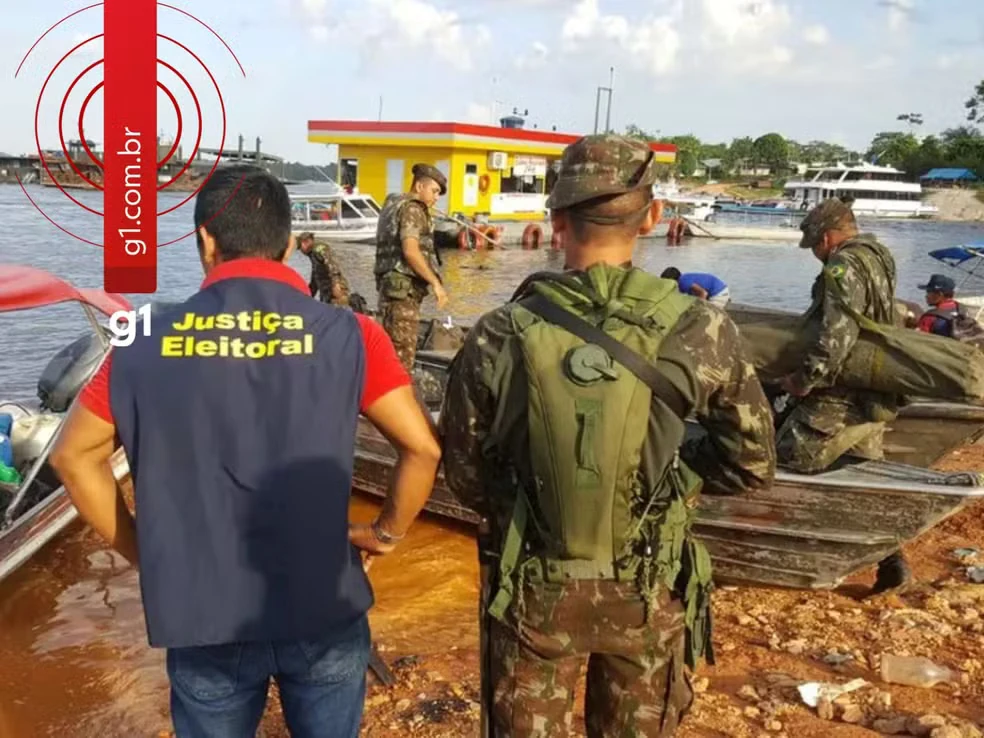
The request for security to ensure voting and vote counting comes on top of the military logistical support already planned for hard-to-reach areas. In Acre, this measure is taking place amid an expansion of the repressive presence and increased cooperation with Yankee agents in the border region.
On August 27, the Superior Electoral Court (TSE) authorized the deployment of federal forces during the first round of the 2026 electoral farce in Acre. The decision was unanimously approved and responds to requests submitted by the “Electoral Court” for the so-called Voting and Counting Guarantee (GVA), which allows for the deployment of the Army, Navy, and Air Force to ensure election security.
The requests cite as justifications the great distances involved, border regions, indigenous and riverside areas, difficulties of access, and the insufficiency of available resources for the security of the electoral farce. Agrarian conflicts, disputes between criminal factions, and a history of violence were also mentioned.
This measure differs from the logistical support already planned for the electoral farce. In July, the Ministry of Defense had announced that the reactionary armed forces would assist the “Electoral Court” in transporting ballot boxes, equipment, and contributing personnel to hard-to-reach locations, including Acre. The request approved on August 27 expands military participation to include security tasks and ensuring the voting and vote-counting process.
The use of the reactionary armed forces during the electoral farce is not a phenomenon exclusive to Acre. On the same day, August 27, the Superior Electoral Court (TSE) also authorized the measure for municipalities in Ceará, Piauí, Rio de Janeiro, and Tocantins. Later, requests were approved for Mato Grosso, Mato Grosso do Sul, and Maranhão. By September 8, at least eight states already had localities where the use of the armed forces had been authorized for the first round.
In the case of Acre, therefore, the authorization applies to a structure that already had military participation in the transportation of ballot boxes and teams from the “Electoral Court”.
Militarization under the guise of security.
The mobilization of troops for the electoral farce is presented by government institutions as a measure intended to ensure the smooth operation of the voting process. However, the presence of the Armed Forces in internal security activities cannot be analyzed in isolation.
In the Amazon, military and police action has been expanded under various justifications: border control, repression of the struggle for land under the pretext of combating organized crime, and “maintaining order.” In Acre, this process develops in parallel with the strengthening of repressive structures and increasing cooperation with foreign forces.
In August, AND revealed that agents linked to the United States Embassy visited investigative and law enforcement agencies in Acre. On the 10th and 11th of that month, the agents met with members of the State Public Prosecutor’s Office, learned about the work of the Special Border Group (Gefron), and discussed information sharing and new training programs. The delegation also toured border areas with Peru and Bolivia.
The presence of Yankee agents within the structures of repression and the growing use of the Armed Forces are two manifestations of the same movement: the increased militarization of the Amazon and the deepening of Yankee interference in Brazil’s repressive apparatus.
In an editorial published on August 31, AND analyzed this movement as part of the new phase of the preventive counter-revolutionary offensive underway in the country. Having exhausted the path of gradual military intervention after the 2022 military crisis and the events of January 8, 2023, the Armed Forces High Command (ACFA) seeks to expand the use of troops in counter-subversive warfare, especially under the banners of the “war on drugs,” the fight against “terrorism,” and the “retaking of territories.” In the Amazon, this process is directly combined with the plans of Yankee imperialism for interference in Latin America under the pretext of combating “narcoterrorism.”
The state of Acre covers 164,000 km² and has only 22 municipalities. According to the 2022 Census, there are 830,000 inhabitants scattered across an area that results in a population density of only 5.06 inhabitants per km². This territorial dispersion is directly reflected in the logistics of the electoral farce: the TRE-AC (Regional Electoral Court of Acre) itself states that it needs to serve riverside communities, indigenous villages, border regions, and locations that require air, river, and land transportation.
In the 4th Electoral Zone alone – which encompasses Cruzeiro do Sul, Mâncio Lima, Rodrigues Alves, Marechal Thaumaturgo, and Porto Walter – there are 143 polling places for approximately 116,000 voters. Of these, 42 are officially classified as hard-to-reach areas. Marechal Thaumaturgo has 12; Porto Walter, nine; Cruzeiro do Sul and Rodrigues Alves, eight each; and Mâncio Lima, five.
This problem is far from new. The Acre “Electoral Court” itself has had a specific resolution regarding “hard-to-reach areas” in the state since 2001, which was subsequently updated in 2004, 2008, and 2024.
In September of this year, the TRE-AC also announced the installation of satellite communications –primarily in riverside communities, isolated areas, and indigenous villages – to transmit the results of the electoral farce without requiring teams to retrace the most difficult routes. The operation also allows for more detailed monitoring of the region by the repressive forces of the old State.
Problems also persist on the highways. According to the National Department of Transportation Infrastructure (DNIT), by the end of 2025, only 62% of Acre’s federal highways were classified as being in adequate condition for traffic, even after R$ 337.3 million in maintenance and restoration investments that year.
On June 17, 2026, peasants from the Abib Koury side road in Bujari blocked the BR-364 highway to demand improvements to the rural roads. They denounced that the side road had been without maintenance for three years and that the conditions were so poor that the families themselves had already rented machinery to carry out the work.
On August 6th, dozens of peasants and extractivists once again blocked the BR-364 highway, this time demanding improvements to the side roads serving communities in the Canary and Antimary Settlement Projects, as well as better health and education services. With no solution in sight, residents once again resorted to using their own money to hire machinery and make the roads passable.
To ensure the electoral farce in October, the operation mounted by the old State mobilizes the “Electoral Court,” police forces, and armed forces, with aircraft, vessels, vehicles, satellite communication, and troops to reach locations considered difficult to access.
On the Bujari side roads, however, transportation difficulties have persisted for years. In Abib Koury, peasants reported three years without maintenance; in the communities served by the Antimary and PAE Canary side roads, families depend on these routes to get around, access services, and transport their produce. One peasant summed up the situation: “We have to pay for the machinery out of our own pockets because the Bujari City Government can’t manage to ‘build the side road.’ And it’s new machinery.” He added: “The mayor has been promising to build this side road since May.”

