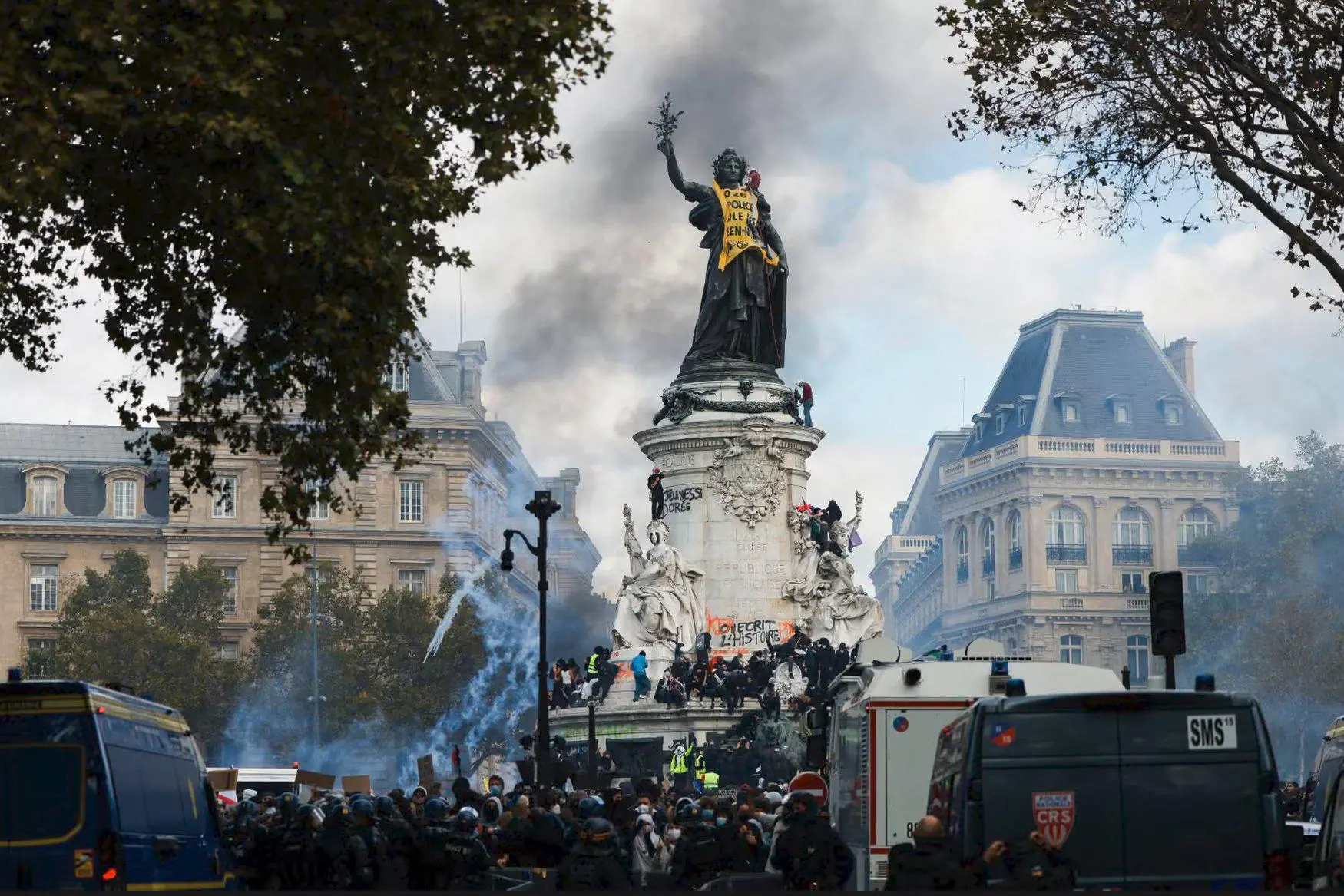
France – La Cause du Peuple: We Are Leaving the Contemporary Era
We hereby share an unofficial translation of an article published by La Cause du Peuple on October 20.
On October 17, anger roared. An immense and legitimate anger that had been building up over a decade of Macronism and decades of capitalist, anti-people policies by successive previous governments. On that day, the masses in France unleashed immense force and drove back the lines of armed men under the State’s command. We are leaving the contemporary era behind as a new era looms on the horizon, that of the great Socialist Revolution.
Never in the history of the past 80 years has such an uprising taken place. October 17 went far beyond the Yellow Vests movement, notably because the most oppressed youth of this country joined in the dance. The impact of this day will be immense on the morale and fighting spirit of the proletarian camp, as well as on the confidence in our class’s ability to take its destiny into its own hands. We must seize this crucial moment to further politicize our class and prevent nihilism from taking root.
This day marks the growing desire to break with the old methods of struggle, the days of slowdown strikes [translator’s note: in which the workers do not go on strike but work slower in a coordinated manor], which were announced in advance and negotiated, and protest marches that had been turned into leisurely strolls, far from causing any disruption to those in power or the economy, or crucially, the corporatist fragmentation of society organized by the bourgeoisie. Under this corporatism, everyone feels they belong not to a single class of the exploited, but to a specific social subcategory entirely distinct from the others: a trade, an age group. This mindset has been ingrained in the masses through the dismantling of labor laws, the fragmentation of common living and working conditions, and bourgeois media propaganda that constantly pits people against one another to fulfill the old adage – “divide and conquer.” All these means of division were swept aside for a single day by the struggling masses on October 17, so that, as the masses desired, the revolution could be attempted. On October 17, we were one: the camp of the oppressed rising up against the bourgeois dictatorship.
In small towns, major urban centers, and the countryside, the people rose up to overwhelm the bourgeois State through blockades, toll-free roads, spontaneous demonstrations, and even riots. Prefectures and city halls were seized! In Paris, protesters reached within 300 meters of the gates of the Élysée Palace, and possibly even closer! Such feats seemed unimaginable just a few days ago.
This explosion, with its insurrectionary overtones, could not have taken place without the brutal repression of the high school student movement that everyone has been witnessing for weeks. The attacks on public buildings, acts of vandalism, and clashes involved a multigenerational but resolutely proletarian crowd. October 17 also represents a strong desire for revenge, expressed from the very beginning, against a State that has not hesitated to maim its youth with complete impunity.
In the French colonies, particularly in Réunion and Guadeloupe, where the issue of the high cost of living compounded that of water supply, the masses showed the same fighting spirit as their class brothers and sisters in the Hexagon [translator’s note: mainland France, for its general shape], with the same uprisings and road blockades, which began three days before the official start of the mobilization. The name of the Caribbean collective “Nous las Palé” (“Tired of Talking”) further underscores this political maturation of the working class on a national scale, all the more so in the colonies, where the voice of the people carries no weight whatsoever, whether with local institutions or with their masters in the Hexagon.
As for the strategy of the government and the ruling bourgeoisie, it became clear on October 17. The big media had beaten the drum of October 17 for weeks in a suspicious manner, since the big media never reports on mass mobilizations in order to avoid encouraging revolt at all costs. Let us recall the Yellow Vests movement, the September 10 movement last year, or even the Great Uprisings following the murder of young Nahel, three situations in which the anger of the masses was palpable throughout France. Each time, the revolt erupted independently and in spite of media propaganda controlled by billionaires, who tried at all costs to minimize the impact of calls for mobilization.
In each of these uprisings, the masses organized themselves through personal networks, the uprising gradually gained momentum, as during the Yellow Vests protests and on September 10 (with numerous local general assemblies and roundabout blockades where people gathered and socialized), or was triggered by a shocking event (the video of Nahel’s murder), drawing on local networks (neighborhoods where people know one another). People organized in advance (through social media like Facebook and Snapchat, activist networks, and general assemblies). Once again, the basis for the anger was legitimate and widespread (demands regarding purchasing power, outrage over racism and organized poverty in working-class neighborhoods, exploitation, the trampling of democracy through Article 49.3, and the denial of election results).
October 17 saw no prior organization, except among young people during the high school student mobilization. And yet, October 17 surpassed all those other dates by taking over city centers and seats of power, places which normally remained untouchable due to massive police mobilization.
So how can such a disorganized movement outmaneuver the police’s well-honed defenses and tactics? As things stand, this represents a massive failure on the part of the political police’s intelligence services, as well as a complete lack of understanding of the situation in the country. Only 10,000 police officers were deployed on October 17, compared to 80,000 on September 10, 2025! Compared to the ratio of protesters to deployed police officers, this is a ridiculous figure (1:1 during the Yellow Vests Act 4 protests, 2.5:1 on September 10, 2025, and 22:1 for most of the day on October 17). The deployment did, admittedly, increase to 60,000 officers, but it is clear that the Territorial Intelligence Services completely failed in their duty.
Similarly, despite conditions that were highly conducive to mass arrests, as during Act 4 of the Yellow Vests protests (1 in 10 protesters arrested) in Paris there were only 60 arrests during the morning and around 250 by late afternoon (1 in 400 arrested throughout the day). There were numerous gathering points in Paris, listed on a website for the past two days and known to the prefecture. For the protesters, it was impossible to know where to go to join an unsanctioned demonstration, they had little communication with one another and were forced to scour the internet for recent videos of locations to head to. The Paris Prefecture monitored the entire city with two camera-equipped drones throughout the day and closely tracked the movements of the crowds.
In Paris, the police did nothing but cordon off and tear-gas the protesters until the entire République metro station was filled with tear gas at noon, before the start of the large, officially registered demonstration. At that point in the day, the police did not respond to projectiles being thrown by launching charges or making mass arrests, unlike what is standard at any other demonstration. Overall, they stood by and let things happen, ratcheting up the pressure by frustrating people with cordons and tear gas to heighten tensions. It was the same tactic in every city: the police were passive and appeared to have been instructed to “let the destruction happen.” At the same time, we witnessed a new wave of police brutality against unarmed protesters, the human toll of which remains unclear.
We will find out in the coming days whether the French government allowed this to happen as a political ploy to manipulate public opinion. The media rushed to report on broken windows and looted stores, completely ignoring the legitimate demands of the masses. It must be said that, in reality, what caused the greatest dismay and panic in the hushed salons of the bourgeoisie was the looting, which is the subject of constant media coverage. We saw this during the Great Uprisings of June 2023: despite the record number of direct clashes with the police or acts of violence against elected officials, it was indeed the looting that drew the greatest condemnation from the bourgeoisie, as well as the harshest blows of judicial repression. The expropriation of goods remains the ultimate sin, especially when it takes place right under the nose of the State, which is supposed to protect property (more precious to the bourgeoisie than human lives).
That very evening, the government woke up and sent out the poor city workers to the scene to make them work all night, simply for their propaganda campaign, to say: “Look, they’re breaking stuff and it’s the poor workers who have to clean it up.” As if they cared one bit about the workers. The absurdity reached its peak on the 8 p.m. news, where the broadcast pitted the “rioters”, described as individuals “wearing masks, dressed in black, and wearing goggles”, against the “peaceful protesters,” who were also shown wearing masks, goggles, and similar clothing. In reality, this is a ploy to divide the masses and give the impression that “rioters”, as they call them, are aliens from another planet, very different from “good citizens,” when in fact they are the people in revolt, united behind the same demands, the same anger, the same aspirations, and the same class interests. In reality, what is happening is that the proletariat is engaging in legitimate revolutionary violence.
The tactic of demonizing the “rioter” and the “ultra-left” activist is an old one, and it is the same tactic used to ostracize any individual deemed an enemy, as was the case with Jews, colonized peoples, and all immigrants, from Italians to Muslims, and today with revolutionaries such as communists and anarchists.
Solidarity between protesters and rebels reigned throughout the streets. To counter the effects of tear gas, used en masse by the police, everyone had taken the precaution of bringing along saline solution, milk, or extra surgical masks to share with others, strangers who were nonetheless comrades in the struggle. When one person fell, a dozen would rush to help them back up. That’s what the 17th was all about!
The uprising had its own limitations inherent to this mode of action. However, the masses demonstrated remarkable spontaneous organization, with a level of mobility and solidarity that set it apart from previous movements. It is certain that the masses have learned a great deal from the major social movements, uprisings, riots, etc., of recent years, experiences rich in lessons from both their victories and their defeats.
Insurrectionalism, the theory of the “Great Night,” according to which the people, acting in a disorganized manner, manage to seize power, is a strategic approach that has been superseded by the proletariat’s experience since the 19th century, yet it continues to resurface in the minds of a segment of the masses, who mistakenly equate the seizure of government buildings with the seizure of real power. Only a highly organized and experienced vanguard battalion can mobilize, politicize, and organize the revolutionary forces to secure victory. And it must be built around a correct ideology, one that is strategically up to date with the experiences of the international proletariat – Marxism-Leninism-Maoism. Despite this situation and these strategic errors, revolutionaries must stand with the people in all their battles, revolts, and revolutionary attempts, and we have seen red flags bearing the hammer and sickle parading through the streets of Paris and other major cities.
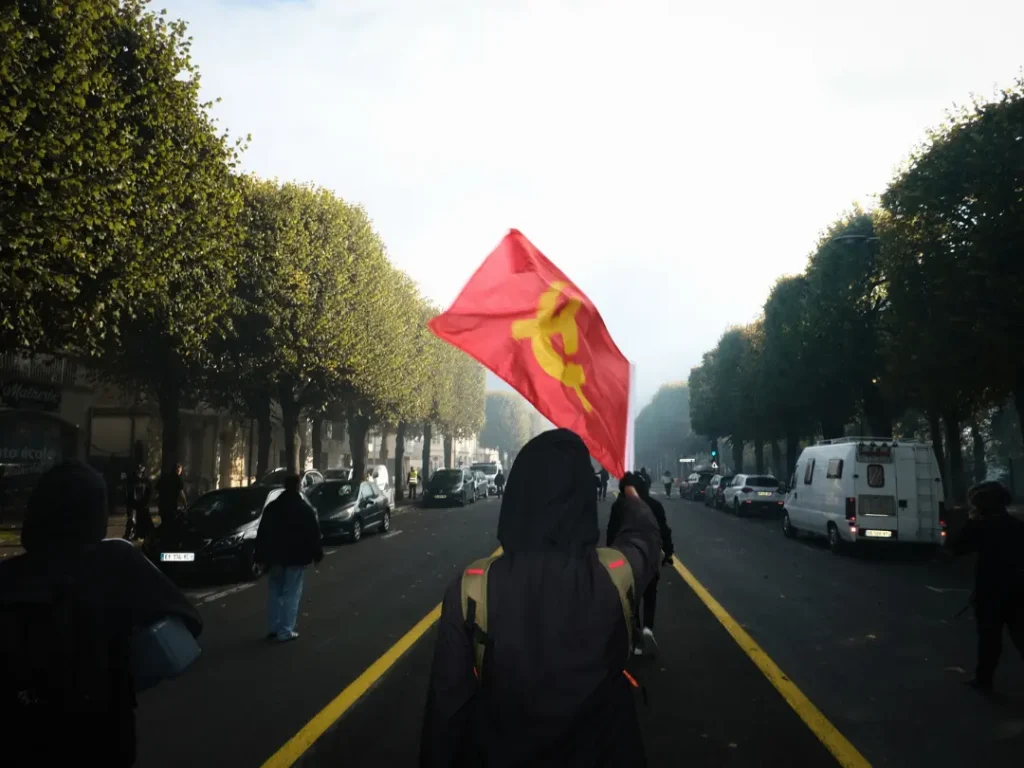
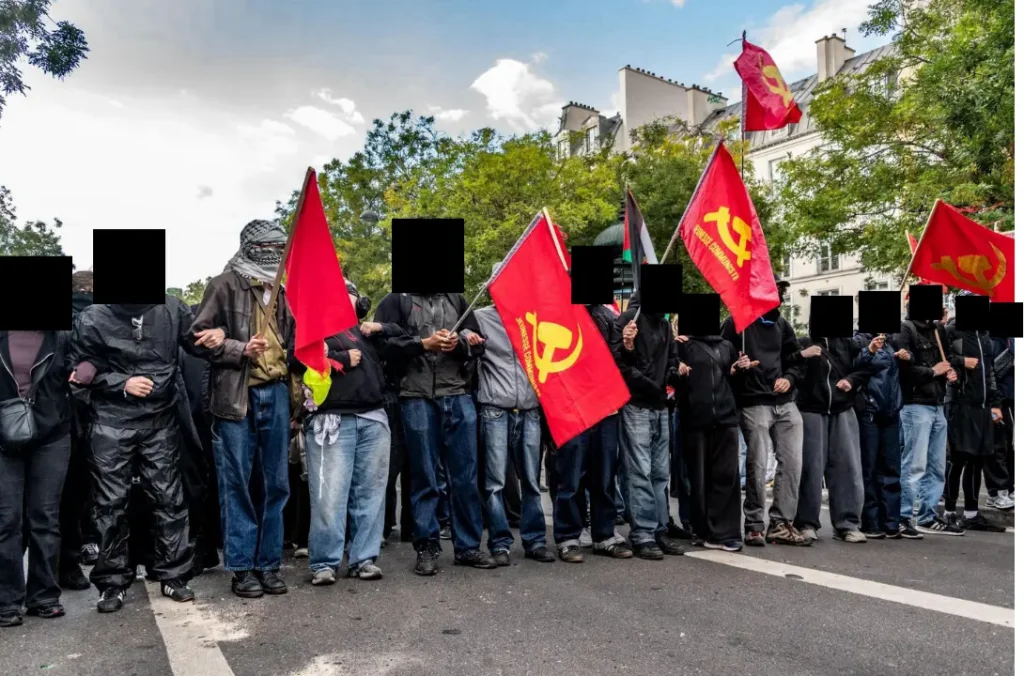
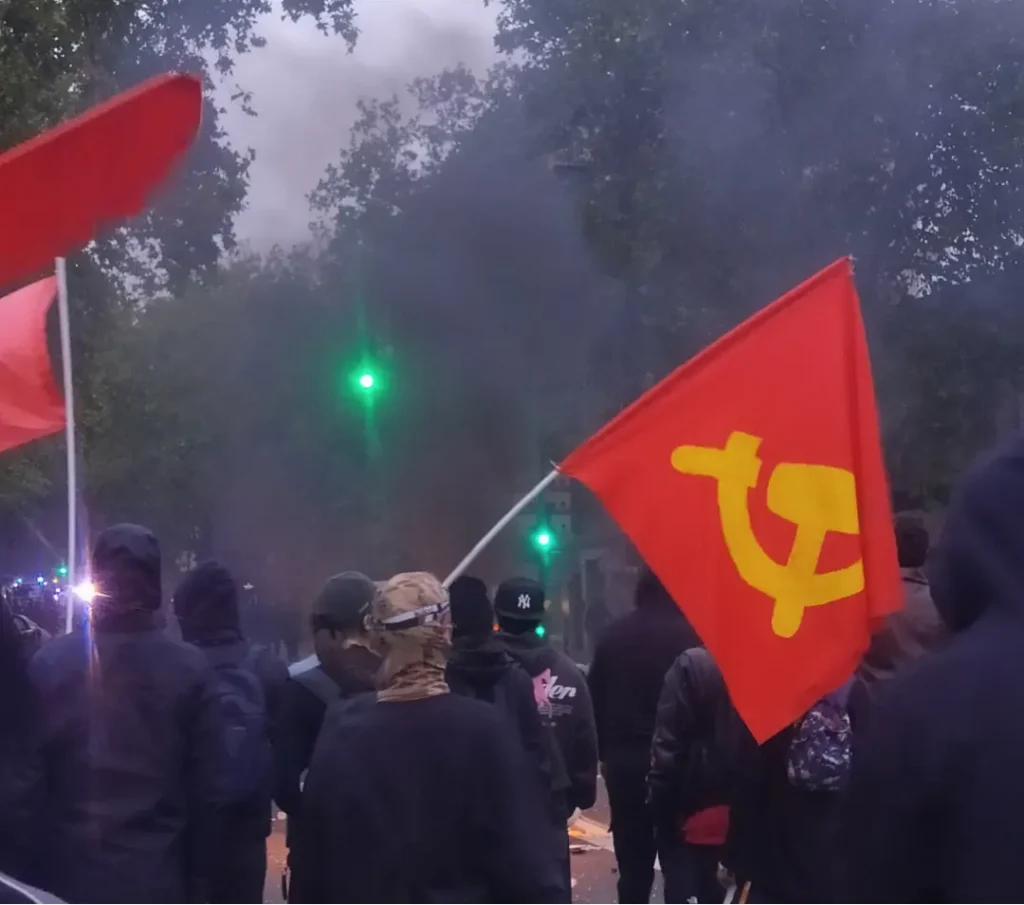
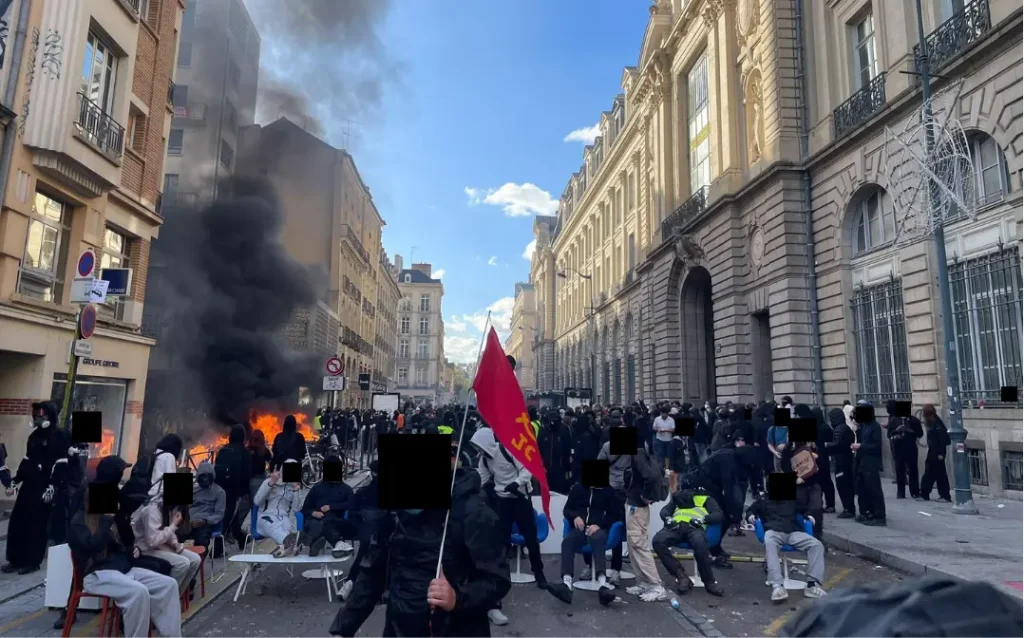
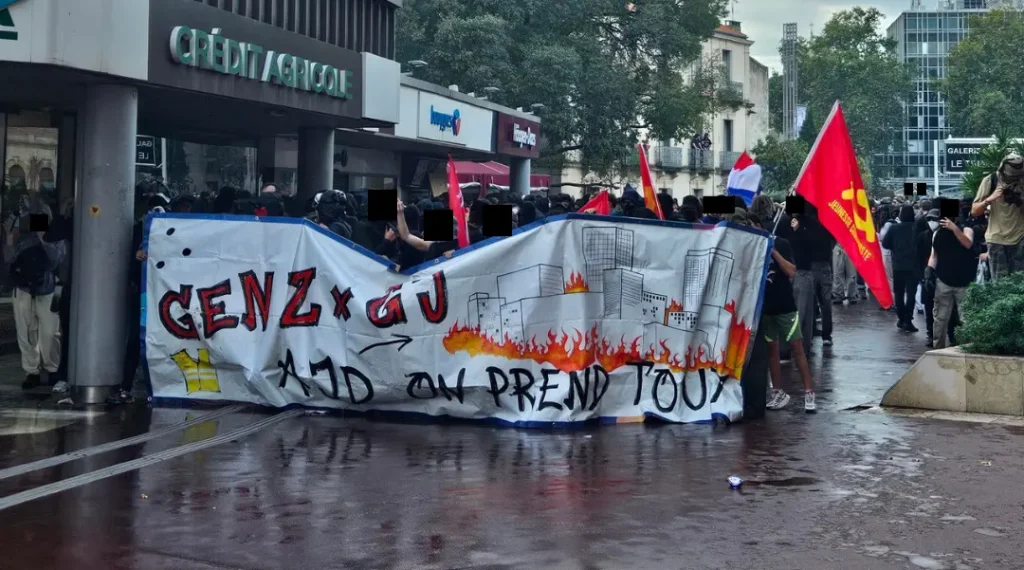
Now we are going to witness a series of measures designed to accelerate the shift toward reactionary policies, including a new law to prosecute people present at the scene of violent protests. Initially, the division of the movement into “dissatisfied law-abiding citizens” and “professional rioters” will serve to establish and expand exceptional measures to maintain order. Macron, our new Putin, is talking about banning protests. Nuñez, his watchdog, is already enforcing this in many cities. A series of local curfews is already being prepared starting this Monday, and they are already in effect in cities like Denain, as well as in some colonies such as Guadeloupe, for minors in Les Abymes and Pointe-à-Pitre. In Rennes, the inter-high-school and inter-university General Assembly was banned and dispersed under the pretext of a violent gathering. A telling illustration of the so-called priorities of the occupant of the Élysée Palace over the past 10 years. They may even attempt to dissolve revolutionary youth organizations, adding another layer of repression. These tactics are as old as the bourgeois State itself, but their intensity has varied depending on the stages of the crisis of imperialism. Today, we must prepare for a full-scale offensive by the reactionary State.
On the other hand, instead of supporting the anger of the masses, here again the Mélenchons, the Tondeliers, the Payans, and the Grégoires are completely distancing themselves out of fear of jeopardizing their comfortable seats in Parliament or at the Élysée, and out of concern for not endangering the capitalist system that they denounce in public but refuse to attack. They are calling for elections. While the people are demanding decision-making power for workers and yearning for the end of capitalism and the end of the bourgeoisie’s dictatorial rule, these figures are working hand in hand with Macron to stabilize and strengthen the system through reformism. These left-wing capitalists call for further pacification of the uprisings, but in a softer manner, throwing more crumbs to the proletariat in order, as Mélenchon insists, “to prevent a recession for shareholders.”
“If the Democrats fail to show that they know how to handle the situation,” “those at the center of the (violent) scenes feel as if they’re living in a semi-state of war,” “that those watching TV feel like everything is falling apart,” then “the temptation toward authoritarianism will be a major issue,” laments Emmanuel Grégoire, the Socialist Party mayor of Paris. “It wasn’t LFI [translator’s note: electoral party] that caused the destruction; that’s not true,” the mayor of Paris responds. “Maintaining order is the State’s responsibility. It was the State that was at fault (this weekend); it was the State that failed,” he exclaimed. “The reality is that we have a social movement that is spreading, and there is no political prospect for a positive resolution. As a result, the protests will continue,” he warned. Benoît Payan, the Socialist Party mayor of Marseille, asserts that “It is not only democracy, but the very foundations of the Republic that (were) undermined this weekend.” “When we are incapable of maintaining order in the world’s sixth-largest power, then yes, the question of the foundations of democracy is raised,” he added.
The liberal petty bourgeoisie is concerned about Bonapartist tendencies at the head of the State. Fundamentally, it remains committed to the bourgeois democratic framework, but above all to the stability of the State. Yet nothing is more unstable than a State in the throes of an ultra-reactionary plunge, for not only will it shatter the framework so dear to “progressive” bourgeois values, but it will also sweep its ideological proponents from the political scene. It has the experience of Weimar, but also, and above all, that of 1940, when the bourgeoisie did not hesitate, not only to hasten the debacle but above all, to set about thoroughly destroying the bourgeois democratic framework of the Third Republic. It knows that democracy is merely an adjustment variable that depends solely on stability, and that we are, more than ever, on the brink of this critical moment.
What we are saying is that today revolutionaries must redouble their efforts to relentlessly politicize and organize the masses who rose up on the 17th. Revolutionaries must prevent this revolutionary fervor from turning either into electoral reformism or into nihilism or fatalism that refuses to see the path to victory through organization. Furthermore, revolutionaries have a specific task in preventing the fascist tendency from gaining strength by reaching out to the revolutionary petty bourgeoisie and seeking out isolated segments of the rural proletariat.
The main point of this day is that October 17 demonstrated the revolutionary will of the masses in France. It exists, it is alive, and it is powerful. The proletariat in France is awakening from its slumber. It is ready to fight and recognizes the limitations of strategies aimed at reconciliation with capitalism. It embraces revolutionary violence as the only path to real change. Emmanuel Grégoire is right in asserting that this social movement will never be resolved from above. In reality, no matter how much Macron travels to all the tyrannical courts of the Gulf to offer guarantees and intensify repression, he will not change one simple fact: the masses no longer want a poor life; they no longer want a life reduced to the grueling consumption of basic necessities that are becoming increasingly expensive while wages stagnate; they no longer want to leave their homes at night with a knot in their stomachs when they pass a police car; they no longer want to hear either the deafening silence of the institutions or the sound of rubber bullets when they demand their rights; they no longer want to live with the idea that sending their children off to a distant war is now only a matter of time. October 17 is the purest expression of the outburst of anger among the majority of France’s proletariat, and primarily its youth. The masses of France want to live, and they have understood that the only path to life is struggle!
As a revolutionary newspaper, we see both sides of the contradiction in this mobilization. The State has launched a media sabotage campaign by highlighting the property damage. But what matters most is the transformation and maturation of our class during this great moment of class struggle. Gen Z is the generation of the crisis, and it will undeniably be the generation of the Revolution! The Revolution is possible. To become a reality, it needs its vanguard – the Communist Party.