YDG Interviews Jeunesse Communiste
We hereby share an unofficial translation of an interview by the New Democratic Youth (YDG) of Jeunesse Communiste (JC) published on November 11.
Interview with the Jeunesse Communiste (JC) from France
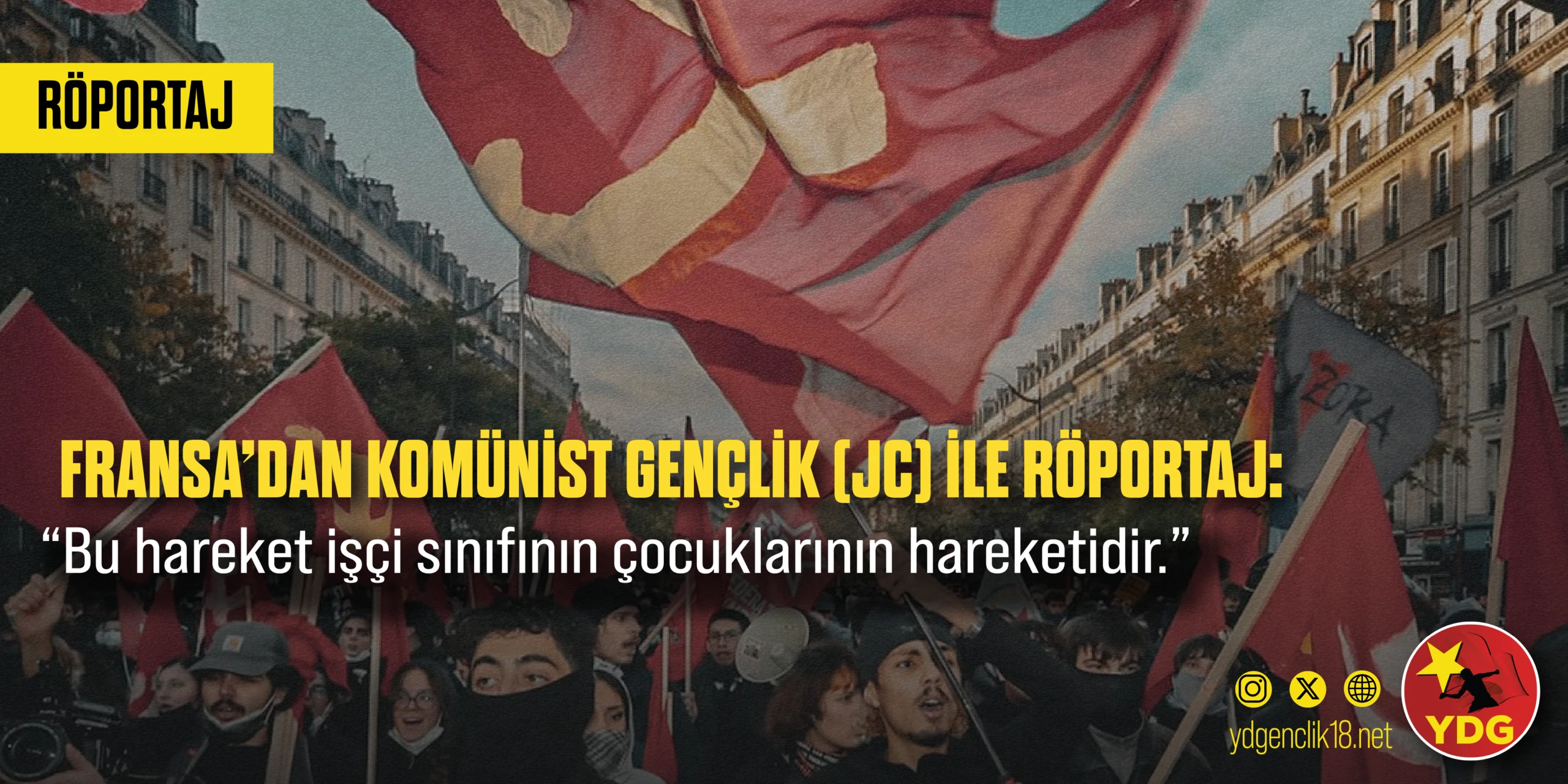
We are sharing with our readers the interview we conducted with the Communist Youth (Jeunesse Communiste) about the ongoing protests initiated by high school students in France.
1. In recent times, we have witnessed mass protests initiated by high school students. What were the reasons for these protests, how were they organized, and how did they spread?
The current movement in France began with boycotts in high schools. The first boycotts started in Saint-Denis, the poorest neighborhood in France, excluding overseas colonies. The first high school to call for a boycott is a good example: a school where our young comrades have been fighting alongside high school students for months to secure the employment of a school nurse. This example is unique, but not unlike others. Every high school has its own direct demands, such as hiring and budget allocation. The important point for us is this: the current movement did not arise spontaneously; it is the result of a long-running struggle in numerous high schools to achieve decent working and educational conditions.
In early September, teachers at several high schools also took action to defend their working conditions. Expressing our solidarity with their demands, and after realizing that no meetings, discussions, or signature campaigns were leading us anywhere, the Saint-Denis high schools, particularly S. High School, initiated the first boycotts that set an example across France.
2. What are the demands of high school students?
Since the beginning of September, the bourgeois media has been multiplying its assumptions and expressing its bewilderment at the demands they find difficult to understand. We have witnessed the panic of many politicians who cannot find demands they can respond to.
In reality, the high school students’ movement has two types of demands: direct economic demands and general political demands.
Each high school has its own demands, concrete and urgent problems that vary greatly from school to school. However, what fuels a rebellion of this scale are far broader political demands. The government doesn’t know what to offer in response to these demands and is struggling to de-escalate the situation. In fact, these are common ideas, demands that may seem vague at first glance; but the essence of the problem is always the same: change, an education that serves the people. The youth, more or less consciously, demand the end of the capitalist system, revolution. They don’t always express this with the same determination, and they aren’t always sure how to get there, but that’s always the conclusion they reach.
3. Can you explain the class composition of the people participating in the protests? Besides student youth, what was the level of participation from workers and other social groups?
The young people who are rebelling today are a unique generation. While previous generations experienced a long period of relative peace, we have experienced nothing but increasingly intense social movements. We were in primary school during the Yellow Vest movement; we were in high school during the Nahel events and the riots against pension reform. We grew up with the genocide in Palestine and the threat of war that endangers our future. This uniqueness is reflected in our methods of organization. Due to the current climate of repression, we cannot go into more detail on this. If we have to emphasize one point: it is necessary to establish dialogue, break the isolation of youth, and of course, create spaces for discussion and interaction.
In this context, we must absolutely reject a lie spread by bourgeois propaganda! This movement is the movement of the children of the working class. The high schools at the forefront are the high schools of the people’s neighborhoods; the children at the forefront are the children of the proletariat. The counter-insurrection policy currently being implemented aims to detach the uprising from its class. It is crucial that we do not fall into this trap.
Therefore, this movement has been closely linked to the workers’ struggle from the very beginning. Students at S. High School started the boycott to join their teachers’ struggle. Subsequently, the violence perpetrated by law enforcement sparked anger among a section of the working class, leading to numerous calls for strikes on October 6th. This convergence stems not only from that anger but also from unity around general demands voiced on a national scale.
High school boycotts are no longer the movement’s primary action. Calls for strikes are increasing. The anger of high school youth has rapidly spread throughout the country and to all age groups.
October 17th, a day of great mobilization, was in this respect very similar to the Yellow Vest movement that our country experienced in the past.
4. We see a militant approach being adopted in the demonstrations. Despite all the attacks, high school students in particular are taking over the streets and responding with legitimate methods of struggle. How is this resistance manifested, how is it organized, and to what extent does the JC play a role in the actions?
The French State has unleashed a large-scale counter-insurgency policy and an unprecedented repressive apparatus. In a month, we have seen as many arrests as in the entire Yellow Vest movement. At least a thousand people are already in prison, including minors and those with no prior criminal record. We must also mention the numerous injuries, particularly among our youth. These include Evan and two other youths, aged 15–17, who had their hands blown off by tear gas stun grenades; four youths, aged 16–17, who each lost an eye; and 15-year-old Eden, whose jaw was shattered by a tear gas grenade fired at close range..
Several organizations, including the Jeunesse Communiste, have been accused of instigating the movement and undoubtedly face the risk of being banned in the coming months. Many of our comrades were arrested simply for carrying our flag; since this is not yet considered a crime, they were brought to trial on charges of “assembling with the intent to commit acts of violence.”
The State’s aim is clear: to intimidate young people and disorganize them by any means necessary.
If that’s their goal, then our goal should be the exact opposite. We must organize and mobilize solidarity. We have already begun identifying the victims and organizing material and moral support so that our comrades and their families are not left alone.
However, we can say that the most important elements for the development, spread, and continuation of this movement are the following:
– Long-standing mobilization efforts centered around specific, direct demands.
– Propaganda and political education
– Developing spaces for discussion, meeting, and negotiation.
5. In your opinion, what do these actions initiated by youth in imperialist countries like France, Belgium, and Germany mean for the masses and workers, especially the youth?
These rebellions are the product of the development of class struggle. It is evidence of the crisis of imperialism that is deepening minute by minute, which can be shown as the only evidence if necessary. The subjective forces of revolution are everywhere and constantly developing.
On a world scale, we are in the strategic offensive phase of the world proletarian revolution, and France is following this development. We are talking about the offensive; because today capitalism has reached its highest stage of development, imperialism. This means that capitalism is doomed to a permanent and growing crisis. This crisis inevitably leads to cannibalism and war between imperialist powers.
As we lost our red base areas around the world (following the restoration of capitalism in the USSR and China), many say that all is lost, imperialism has triumphed. This means ignoring the cycles of restoration and counter-restoration; It means not believing in the invincible power of the proletariat as the rising class of history and that the real heroes are the masses. The masses never stopped fighting.
The situation in the world today is as follows: First of all, communists around the world have learned lessons from the class struggle. The proletariat’s worldview, its most powerful weapon, is deeper and more comprehensive than ever before. Its ideology is Marxism-Leninism-Maoism. Secondly, the masses struggle everywhere, always. This means that the subjective forces of the world proletarian revolution are stronger than ever. At this point it is important to keep in mind the uneven development of the class struggle and to relate the general to the particular. At present, the subjective forces of the revolution are relatively weak. On the other hand, objective conditions are suitable for developing the subjective factor. This is the duty of communists and revolutionaries.
6. These actions resonated around the world and inspired the international struggle of the people’s youth. On this occasion, what message would you like to convey to the people’s youth in Turkey, who are intensifying their struggle through the YDG?
First of all, we sincerely salute the comrades fighting in Turkey. The struggle of the comrades is an important shining torch for the masses around the world, especially at this time when the Erdogan regime is developing its policy of siege against the revolutionary and progressive forces in Turkey and the diaspora. Rather than the attacks of imperialism and its lackeys, what we should keep in mind is the intensification of class struggle and the justified rebellion of the masses all over the world. The bourgeoisie will always use the violence in rebellions as an excuse to alienate a segment of the population from us, even though we have common interests. The violence that youth are subjected to (in this context as well as in daily life) is legitimized by this disgusting propaganda.
As we write these lines, the bourgeoisie is trying to impose a leaden weight on the minds of the masses: the weight of pessimism, surrender and despair. Those who speak are told to remain silent, that it is dangerous to defend the proletariat loudly. Those struggling are told not to overdo it, that the risk of arrest is too great, and to stay home if demonstrations are banned. Organizers are told that they would be better off waiting, that they are doomed to failure and that all attempts are in vain. Those who stand up are told to sit down again, that history is over, that there is no choice but to choose between plague and cholera, that hope lies only in reform, that capitalism is eternal and that we must now adapt to it. The line of demarcation between those who will make a revolution and those who have given up on the revolution is clear. This is the demarcation line between a handful of Jeunesse Communiste who have taken up arms against fascism and those who have surrendered their weapons.