Norway – TFM: Norwegian fishing industry creates fish shortage in West Africa
We hereby share an unofficial translation of an article published by Tjen Folket Media on November 13.
The Norwegian salmon farming industry purchases salmon feed from West Africa to produce farmed salmon. This farmed salmon accounts for 14% of the fish used to make the feed. This leads to higher prices and a shortage of fish for the local population.
A report titled “The Blue Empire,” prepared by Foodrise, estimates that in 2020 the Norwegian fishing industry sourced fish oil produced from between 123,000 and 144,000 metric tons of fish from the waters off the coast of West Africa. This amount could have provided 2.5 to 4 million people in the region with enough food to meet their nutritional needs for one year.
There are only four major companies that supply nearly 100% of the feed for the Norwegian salmon farming industry: Mowi, Skretting, Cargill, and BioMar. All of them source fish oil from this area of the West African sea, but only Mowi reports its figures by individual region. In 2020, approximately 23% of the total amount of fish oil that Norwegian companies sourced from this region was purchased by Mowi, according to “The Blue Empire” report. Otherwise, these companies rarely share their catch and export figures with the public.
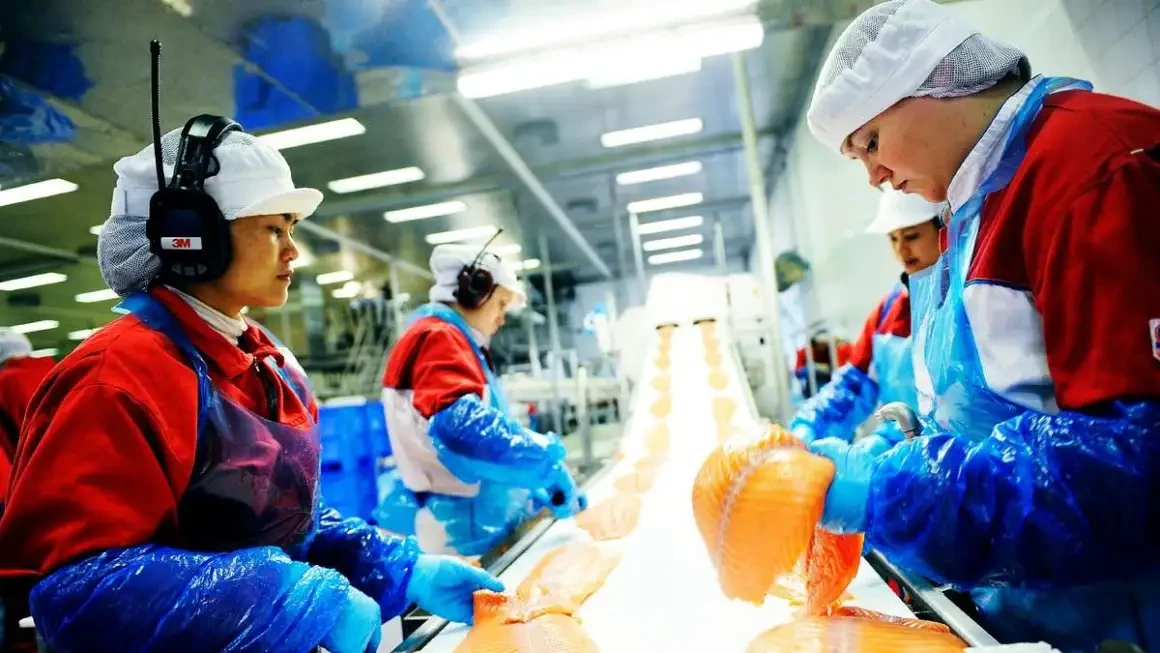
Wild fish are caught off the coast of West Africa and sent to local factories to be processed into fishmeal and fish oil. This is then purchased by these large companies, who turn it into salmon feed, which the Norwegian fishing industry buys. Another report titled “Fish in – Fish out: Ratios explained” estimates that 1,000 kilograms of wild-caught fish can produce enough salmon feed to yield only 140 kilograms of salmon.
This is hitting local small-scale fishermen and the local population hardest. Many of the small-scale fishermen now deliver their catch to factories, which turn it into fish oil and fishmeal, instead of selling it as food locally. According to NRK [Translator’s note: Norway’s public broadcaster] in 2021, 55% of all pelagic fish caught went to the factories. In addition to this, small-scale fishermen also have to compete with large fishing trawlers.
According to a local small-scale fisherman interviewed by NRK, the large companies have little respect for the quality and size of the fish, as well as the fishing quotas in the region. He further says that overfishing by these companies is creating a fish shortage, which together with increased fuel prices leads to increased prices for the local population.
The prosperity that exists in Norway is not created in a vacuum. Norwegian imperialism participates in the capitalist exploitation of oppressed countries and peoples, just like other imperialist countries in the world. This exploitation hits the poorest masses in the oppressed countries hardest. Tons of fish are turned into fish feed, only to produce a little more than one-eighth of the original fish stock. When laws and regulations are introduced, they either have little effect or are ignored by the companies.