Spanish State – Servir al Pueblo Editorial: Success of the General Strike – The Proletariat Shows it Does not Need the Union Bureaucracy
We hereby share an unofficial translation of an editorial by Servir al Pueblo, published on November 11.
In this article, we’ll discuss some lessons and aspects that we believe are important regarding the general strike that took place last Wednesday, November 11. To begin, let’s take a brief look at the key figures and data.
The Strike in Numbers
– Participation in the strike varied, with the highest rates in Catalonia (84%), Asturias (75%), and Aragon (70%), and the lowest in Extremadura (41%). By sector, participation was highest in the automotive industry (90%), at ports (90%), in the meat processing industry (85%), in waste collection (82%), and in the energy sector (75%). Auctions at the agricultural logistics markets in Madrid, Barcelona, Valencia, Zaragoza, Seville, Córdoba, and Málaga were either canceled or significantly delayed.
– Services and retail were the sectors with the lowest participation rates. Most businesses temporarily closed their shutters as mobile picket lines passed by.
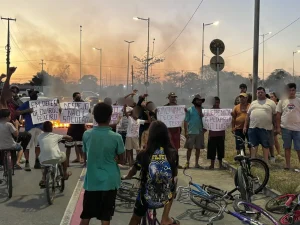
– More than 100 roads were blocked, including strategic routes such as the A1, A42, and M30 (Madrid), the AP7 and B22 (Barcelona), and the V21 (Valencia). Most of the roadblocks were in Catalonia.
– Passenger transportation was paralyzed for hours in major cities, particularly due to picket lines at the depots of the respective municipal transit companies and at metro and commuter rail stations. Of particular note was the shutdown of the Barcelona metro, which was out of service for more than 10 hours.
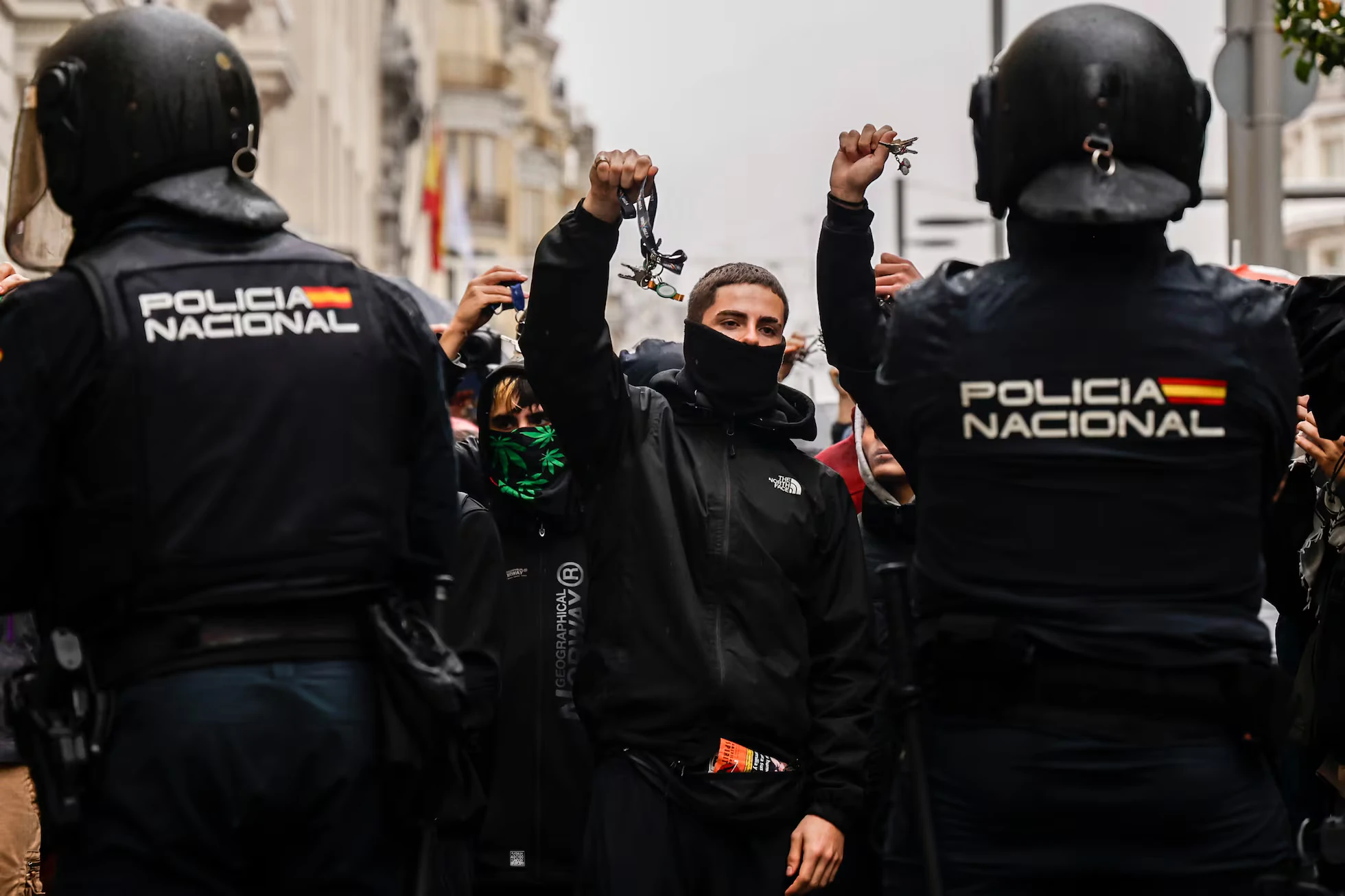
– More than 110 strikers have been arrested. A large number (at least 52) were arrested in Barcelona, mainly during clashes with the police on the night of the 11th. Hundreds have been injured by police batons, suffering severe bruises, broken bones, and broken noses; many have required medical attention due to pepper spray and/or tear gas.
– The joint demonstrations held this afternoon exceeded even the most optimistic previous estimates. In the three largest cities (Madrid, Barcelona, and Valencia), attendance totaled 400,000, 400,000, and 220,000, respectively.
A Strike Call Won Through Struggle
The call for a general strike was won by the proletariat. It was thanks to pressure from the working class – through its participation in the housing movement – that unions such as the General Confederation of Labor (CGT) called the strike. After the CGT announced at the Confederal Congress in Parla (Madrid) that it would call a general strike alongside the Tenants’ Union, it was only a matter of time before the other unions joined the call.
And so, just a few days later, the bureaucratic and yellow leaderships of the Workers’ Commissions (CCOO) and the General Union of Workers (UGT) joined the strike. After millions of people flooded the streets, the bureaucrats joined the strike because they feared that the outcry would undermine their legitimacy, which was already in tatters. But there was something that frightened them even more: that the strike would be a success nationwide and they would not have participated.
Let’s pause for a moment to consider “the problem of democracy.” Unai Sordo (CCOO) and Pepe Álvarez (UGT) always hide behind the argument that their unions are democratic, that they are made up of thousands of delegates, and that they cannot make important decisions without consulting their delegates and members. This allows them to act cautiously, always pursuing their interests as bureaucrats – specifically, bureaucrats who are part of the union leadership, consisting of full-time union officials and salaried union employees.
When something is in their interest, they act on it. When something isn’t in their interest, they play at democracy and claim they have to consult their rank and file (but then they don’t actually consult them, or they don’t mobilize their members for the consultations – which amounts to the same thing as not consulting them at all). This is the ABCs of how the bureaucrats who make up the union leadership operate: playing at democracy without democracy, all in the service of their specific interests as a labor aristocracy (interests contraryi to those of the working class), while trampling on the interests of the people along the way.
The Sinister Role of the Union Bureaucracy: Turning the Strike into an Electoral Spectacle in Favor of the Government
Suddenly, “the problem of democracy” ceased to be a problem, and in less than three days, the leadership of CCOO and UGT announced that they would call a strike. That alone was enough to reveal the sinister role that CCOO and UGT would play during the weeks leading up to the strike.
The bureaucratic leadership of these organizations did nothing to mobilize the working class. They didn’t even work to mobilize the majority of their Works Councilsii, delegates, and members. If anything was accomplished, it was not thanks to the leaders, but to the honest and selfless work of many union members who, due to all sorts of circumstances, have ended up in one of these two organizations.
In short, CCOO and UGT worked on a strike they did not want to join, but were forced to do so. They did not want to inflict the maximum possible damage on either the employers or the government. Quite the opposite: they defended them tooth and nail. Pepe Álvarez, the General Secretary of UGT, went so far as to say the following at a press conference a few days before the strike:
“There are people who ask us this on the street, too (…) ‘Why haven’t you gone on strike against this government in eight years?’ But let’s be real – does anyone really think we’d call a general strike against a government with which we reached a pension agreement—the one I’ve been explaining to you earlier? Does anyone really think we’d call a general strike against a government that – after extremely tough negotiations with them, in which 4 million men and women who had temporary contracts now have permanent ones – we’d call a general strike against? Are we going to call a general strike against a government that has raised the minimum wage by 66% over the past 8 years? “What the hell do they think – that we’re idiots?”
Pepe Álvarez admits—rather unwisely, it must be said—that they’ve been living off the government for the past eight years. He also admits that there’s no reason to go on strike because we have a good government with which we can negotiate. What a union leader Pepe Álvarez is, defending the very government that has cracked down hardest on union members by enforcing the Gag Law!
Unai Sordo, who has always been smarter than his counterpart at the UGT, has also defended the government, but in a more subtle way. In an interview with The Huffington Post, he said:
“Do you understand the suspicion this has generated? María Jesús Montero just said that this strike is against the opposition.
It’s not that it’s against the opposition. But the protest has to do with certain decisions, such as scrapping the housing decrees. Who scrapped the housing decrees? The very same people who voted against reducing the workweek. The very same people who are announcing that if they come to power, they’ll privatize the pension system and force sick people to go to work because they say they’re going to crack down on absenteeism. It’s not that the strike is against the opposition; it’s that the opposition insists on setting a deeply antisocial agenda every single day. We’re pushing back.
That said: this isn’t strictly a strike against anyone in particular. Spain is more than just a central government – housing falls under the jurisdiction of the autonomous communities. Major public services are managed by the regional governments. We mustn’t forget that this is a federal state, and that some people have been calling for a general strike against the government for eight years and are now getting upset.”
Let’s translate Sordo’s social-democratic gibberish: this isn’t a strike against the opposition, but the PP and Vox represent rentiers. By contrast, the government does not represent rentiers; therefore… we must support the government. Unai Sordo says the government doesn’t represent rentiers! What kind of world do we live in? Now we’re ignoring the tens of thousands of evictions that have taken place under this government. It’s worth remembering that Maricarmen, in the interview that aired after she was evicted from her home, blamed Pedro Sánchez as the main culprit for the housing crisis. And she was absolutely right.
However, it’s to be expected that the union bureaucracy would try to use the strike for electoral purposes. The bureaucrats have exploited, are exploiting, and will always exploit the people’s struggles. The key is to understand this so we can fight against them. You cannot build a powerful, combative union movement without fighting the union bureaucracy (and also all those who defend, support, and sustain it).
The general strike has been a success
The general strike has been a success. It has managed to bring industry, logistics, and transportation to a complete or partial standstill; but that is not why it is a success. It has also managed to bring millions of people (yes, millions, if we count all the cities) out onto the streets, mainly during the afternoon demonstrations. But that is not why it is a success either.
All of these are important factors, but they were not the decisive ones. The general strike was a success for one exclusively political – yet fundamental – reason: the proletariat has improved its organization, has stood up to repression, and is beginning to (re)discover that it is more powerful than the bourgeoisie. The proletariat – especially the militant youth – will draw lessons from November 11 and prepare for future struggles. It is not up to us, as a revolutionary and militant press, to draw these lessons, but rather to the revolutionary organizations of the proletariat. But we do want to offer three reasons why we believe this strike has given a boost to the development of the class struggle:
1) It has been demonstrated that the proletariat can organize a strike without the permission of the bureaucratic leadership of CCOO and UGT. The driving force behind the strike has been the militant unions, political organizations, and social movements.
2) The leadership of CCOO and UGT has been exposed as the bureaucrats, pacifists, electoral opportunists, and strike-breakers that they are. This helps to clarify – even more so, if that’s possible – the dividing line between the left and the right within the labor movement.
3) The level of militancy has risen in many cities and places where peaceful struggles were the norm. There have been episodes of mass violence in many places (in most cases, at the lowest level, in the form of self-defense against police repression, but there have also been more forceful actions). And if there is one thing the proletariat needs, it is to embrace revolutionary violence and banish the deeply entrenched bourgeois pacifism that does so much harm to the labor movement.
“Breaking with opportunism is inevitable and essential”
We place so much emphasis on union bureaucracy because it is impossible to build a strong, militant union movement with a solid base among the millions of proletarian masses of our people without opposing the bureaucrats of CCOO and UGT. There is no other way.
“One of the most common sophistries of Kautskyism is its reference to the “masses”. We do not want, they say, to break away from the masses and mass organisations! But just think how Engels put the question. In the nineteenth century the “mass organisations” of the English trade unions were on the side of the bourgeois labour party. Marx and Engels did not reconcile themselves to it on this ground; they exposed it. They did not forget, firstly, that the trade union organisations directly embraced a minority of the proletariat. In England then, as in Germany now, not more than one-fifth of the proletariat was organised. No one can seriously think it possible to organise the majority of the proletariat under capitalism. Secondly – and this is the main point – it is not so much a question of the size of an organisation, as of the real, objective significance of its policy: does its policy represent the masses, does it serve them, i.e., does it aim at their liberation from capitalism, or does it represent the interests of the minority, the minority’s reconciliation with capitalism? The latter was true of England in the nineteenth century, and it is true of Germany, etc., now.
Engels draws a distinction between the “bourgeois labour party” of the old trade unions – the privileged minority – and the “lowest mass“, the real majority, and appeals to the latter, who are not infected by “bourgeois respectability”. This is the essence of Marxist tactics!
Neither we nor anyone else can calculate precisely what portion of the proletariat is following and will follow the social-chauvinists and opportunists. This will be revealed only by the struggle, it will be definitely decided only by the socialist revolution. But we know for certain that the “defenders of the fatherland” in the imperialist war represent only a minority. And it is therefore our duty, if we wish to remain socialists to go down lower and deeper, to the real masses; this is the whole meaning and the whole purport of the struggle against opportunism. By exposing the fact that the opportunists and social-chauvinists are in reality betraying and selling the interests of the masses, that they are defending the temporary privileges of a minority of the workers, that they are the vehicles of bourgeois ideas and influences, that they are really allies and agents of the bourgeoisie, we teach the masses to appreciate their true political interests, to fight for socialism and for the revolution through all the long and painful vicissitudes of imperialist wars and imperialist armistices.
The only Marxist line in the world labour movement is to explain to the masses the inevitability and necessity of breaking with opportunism, to educate them for revolution by waging a relentless struggle against opportunism, to utilise the experience of the war to expose, not conceal, the utter vileness of national-liberal labour politics.”
Imperialism and the Split in Socialism, Lenin, 1916
Footnotes
i The interests of the union bureaucracy—as a labor aristocracy—are to maintain social peace within the Spanish imperialist state. In this way, they continue to live a comfortable life, detached from the problems of the true proletarian masses, and at the expense of imperialist exploitation of oppressed nations (bribes derived from monopoly superprofits). For more information, we recommend reading “Imperialism and the Split in Socialism” (Lenin, 1916).
ii A serious problem facing CCOO and UGT—a consequence of their union model and their eagerness to win union elections—is that there are many workforces they cannot mobilize (even if they wanted to) because the Works Councils are dominated by managers, the boss’s children, human resources staff, or simply careerists. Not only does this make it impossible to mobilize the workforce, but it also creates terrible publicity that works against the genuine unions. All of these types of people (managers, cronies, union stooges…) are considered valid candidates for union delegate by the union bureaucracy. Since their goal is not to organize and mobilize the workforce for better working conditions—and thereby raise class consciousness—but rather to secure as many delegates as possible to gain greater leverage in collective bargaining negotiations.