A Panel on Revolutionary Solutions Against Liquidationism Was Held in Zurich
We hereby share an unofficial translation of a report published by Union of Migrant Workers in Europe (AGEB) on November 23.
Partizan continues to organize panels in various European countries under the title “A Revolutionary Solution Against Liquidationism: Discussing the Kurdish National Question.”
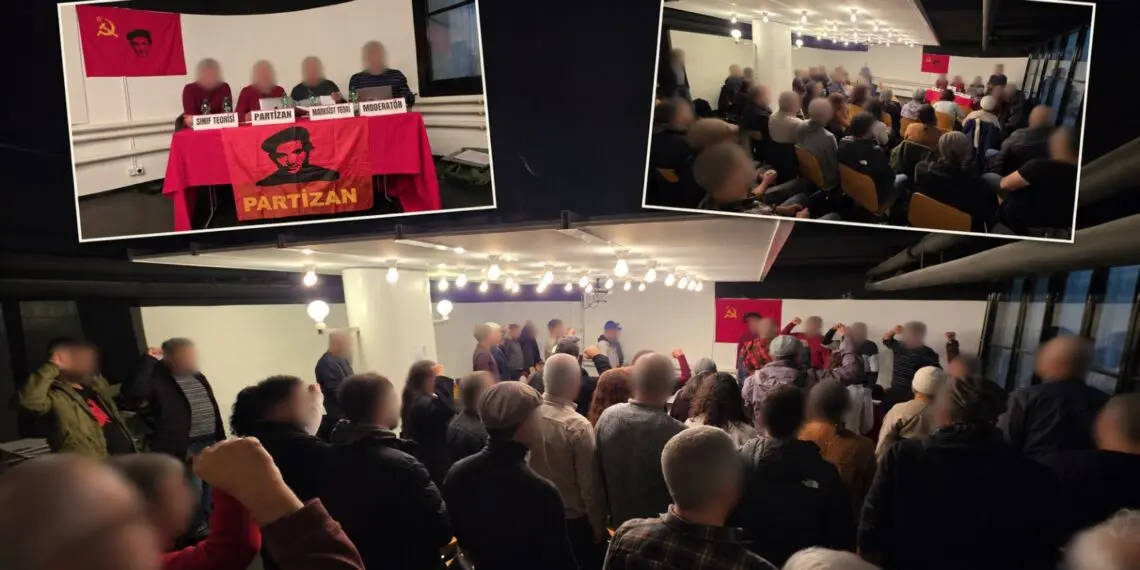
We are going through a period marked by escalating struggles, conflicts, wars, and regional tensions among imperialist powers, particularly as US imperialism attempts to destroy the Palestinian cause by utilizing its collaborator and puppet regimes, while simultaneously imposing nonviolent struggle on the Kurdish movement under the guise of “integration” led by the Turkish state. To discuss all these developments from a revolutionary perspective, a panel was held in Zurich on November 22, with the participation of Partizan, Marxist Theory (Marksist Teori), and Class Theory (Sınıf Teorisi).
The representative from Partizan spoke first at the panel. The representative stated that imperialist powers are experiencing a crisis of overproduction; unable to overcome this, they have turned to aggressive policies, and the struggle for markets continues to intensify. Emphasizing that the Kurdish issue cannot be considered separately from this process, the Partizan representative stated that the Turkish Republic is attempting to establish itself as a power in the region by capitalizing on this process and, in this vein, has launched the “Turkey Without Terrorism” initiative. He noted that US imperialism in particular, has implemented aggressive policies – including a policy of annihilation against revolutionaries, democrats, communists, and national liberation movements, and that a similar policy is being pursued in India, with these attacks targeting not only national movements but also revolutionary communists. The Partizan representative emphasized that the orientation referred to as “Turkey Without Terrorism”, from Tayyip Erdoğan to the head of the National Intelligence Organization (MIT) and the leader of the Nationalist Movement Party (MHP), is a very clear State policy, and that a process is being carried out in which Kurds are excluded and their democratic rights are not discussed. He stressed that in this process, the State is preparing for more aggressive attack policies; that the Turkish Republic has always engaged in negotiations whenever it could not cope with a situation, and that attacks have invariably followed.
Noting that the peace and reconciliation process of the Kurdish movement is not new and that it has evolved from a line that, from the 1990s to the present, advocated for an independent Kurdistan and the right to self-determination and could be described as a revolutionary national movement, to an armed reformist line that, after 1993, aimed for a solution within the system and sought a resolution through reforms – the Partizan representative stated that today, national democratic rights are not being vigorously defended, and that a process is being pursued without any expectation regarding national demands. He expressed that they view the call to end the armed struggle as a regressive stance, as there is no guarantee to protect the Kurdish people, and for this reason, they characterize the movement as liquidationist and reformist. However, they noted that they do not view the movement as capitulationist, because the national movement has not yet relinquished its national rights, while the Turkish Republic, with its stance of inaction, is prolonging the process and deepening the liquidationist trend.
The representative of Marxist Theory, who spoke next, stated that issues should be approached not with emotions and reactions but through the dialectical materialist method. He said that the Rojava Revolution and the uprisings had led to the formation of a Kurdish national will across the four parts of Kurdistan, and that the 50-year-long guerrilla struggle had been decisive in this process. Emphasizing that social traumas had emerged during the 50-year war and that the Kurdish question was the central agenda in all relations of the colonial State, the representative of Marxist Theory stated that the Turkish State had failed to crush the Kurdish movement through massacres and slaughter; that neither side had been able to defeat the other or break the other’s will; and that the movement’s will had been broken only with the breaking of Öcalan’s will. Drawing attention to the difference in the justifications that led to the formation of the current process compared to the 2013 “resolution process,” the representative of Marxist Theory stated, “In 2013, resistance and uprisings forced the Turkish State to the negotiating table, whereas today it is the imperialists’ regional calculations that have set the table.” He characterized the laying down of arms and the rejection of revolutionary violence as liquidationism, and emphasized the importance of a united anti-imperialist, anti-fascist front in Turkey through a united struggle in the streets against liquidationism.
Class Theory, on the other hand, noted that liquidationism today affects not only the national movement but also the international communist movement. It argued that liquidationism cannot be addressed solely in terms of laying down arms or in the specific context of the Kurdish national movement, and that the Manifesto for a Democratic Society aims for integration by asserting that the contradiction can be resolved through compromise. It stated that communists must unconditionally defend the right of nations to self-determination, but that this cannot be absolute, emphasizing that the main focus is the struggle against the system. A representative of Class Theory stated the following: “There is a situation that has come to light in this process: the ‘Framework Law.’ What is the difference between the Framework Law enacted in 1991 and the current one? Are we going to grapple with this, or are we going to discuss the situation of the national movement?” He noted that the Framework Law has no provision protecting the rights of the Kurdish people (KUH) and that revolutionaries must have a solution to this problem. The representative of Class Theory stated that Öcalan’s paradigm argues that philosophical contradictions can be resolved through compromise, that by disregarding the historical subject, it blocks the path to power for the oppressed through the “Third Way,” and that it aims for integration. He said that while they do not support the process as a method of struggle, they do support the attainment of certain democratic rights.
Following the presentations, the floor was opened to the audience. Lively discussions took place during this segment, as many people took the floor to share their comments and ask questions of the panelists. An announcement was made regarding a panel to be held on December 6 in Basel, organized by Partizan, Marxist Theory, and Red Flag. The event concluded with remarks thanking the participants and panelists.