Spanish State – Servir al Pueblo: In Defense of the Electoral Boycott (Part 1-4)
We hereby share a translation we have received of a series of articles published by Servir al Pueblo of the Spanish State. These articles and more related with this topic can be found in the submenu called “Boicot a la farsa electoral – 29N” on the webpage of Servir al Pueblo. We include below the link to the respective articles.
Introduction
The bourgeoisie has not wasted any time. From the very beginning, they are waging an intense election campaign for the general elections, which have been set for November 29. The proletariat must respond with the same determination and must launch a campaign to boycott the bourgeois elections – and, mainly, who must take the initiative are the revolutionary organizations that aim to be the vanguard of the working class.
Some steps have already been taken. Some organizations, such as the Revolutionary Committees or the Anti-Repression Movement of Madrid, have already publicly taken position for the boycott. It is expected that more organizations will join the boycott of this electoral farce in the upcoming weeks, although they will remain a minority compared to the massive tide of electoral opportunism.
And precisely, in order to combat this electoral opportunism which harms so much the working class movement and the struggles of the proletariat, we will write a series of articles to debunk the most common arguments raised against the boycott. We will organize them into four main sections:
1 – Voting for the least bad option does serve a purpose. Better a PSOE government than a Vox government
2 – The proletariat trust in the elections and is not ready to boycott them
3 – There’s no need to call for a boycott, but organize and struggle. Whether they vote or not, it doesn’t matter to us as long as they organize and struggle
4 – We must participate in the elections with “revolutionary” candidacies and use them as propaganda
Additionally, in our website we have added an own section on the bourgeois elections of November 29. To access it, simply hover your mouse over the “national” section of the navigation menu, and a submenu will open. This will make it easier for readers to find all articles and materials related to the electoral boycott.
Part 1: The Trap of Voting to “Stop” Fascism
The legitimacy of social-democracy is in tatters. It could not be otherwise, since Podemos, Sumar, Izquierda Unida, Compromís, EH Bildu, ERC, and the BNG – all those who claim to be part of the transformative left, who so far have transformed absolutely nothing – have limited themselves to managing the bourgeois State. They have defended the interests of the big capitalists against the workers. Their rhetoric says otherwise, but words are carried away by the wind. Facts are facts. They have implemented the decisions, measures, and reforms of the big bourgeoisie, of the Spanish financial oligarchy, and of the major monopolies in banking, construction, infrastructure, and energy…
Sumar is part of the government and shares responsibility for everything that Pedro Sánchez has done. The rising cost of living, the housing crisis, the blacklists targeting combative metalworkers’ unions, the continued existence of the “Ley Mordaza” [Translator’s note: translated would be Gag Law, a repressive law that expands the police’s authority] and the Immigration Law, continued membership in NATO, increased military spending, permissiveness (and collaboration) regarding attacks on education and public healthcare, weapons cooperation with Israel… and the list goes on and on, because if we were to continue, we would never stop. Podemos supported and formed part of the government for years. Given that Pablo Iglesias was Vice President and Irene Montero was a minister, it is both comical and regrettable in equal measure to hear them speak of the government as if it had nothing to do with them. Izquierda Unida, including the false PCE within the coalition, is much of the same. As for the pride expressed by EH Bildu, ERC, BNG, Compromís, and Adelante Andalucía that “we’ve done what we could,” it is nothing more than an admission that they are part of the oppressive machinery of the Spanish imperialist State. In what way has the life of the working class improved thanks to the actions of these regional/national Parties? In absolutely no way.
And although many people are aware that the “transformative left” doesn’t transform anything, they’re going to vote because they’re afraid of the rise of fascism. A fear, it must be said, promoted by the bourgeois media (because they want high voter turnout to legitimize bourgeois democracy) and by the social-democratic politicians themselves (because they know that if people don’t vote for them, their plan of living off the public purse will come to an end).
This is the “lesser evil” argument: vote for those who aren’t fascists (the lesser evil) to avoid fascism (the greater evil). Because “even though the current government and its allies are bad, they’re less bad than the others.” This argument is completely wrong. The process of the State’s militarization—the increase in repression, the spread of reactionary ideas, and the rise of fascism—does not depend on the government in power.
State System: Class Dictatorship
Let’s discuss the relationship between the State system and the government system. First of all: the claim that the State has always existed is a historical falsehood, a fact widely demonstrated by historical science – even by bourgeois historians and archaeologists. In fact, humanity has spent more time without a State than with one. The State emerged at a specific moment in human history, specifically when the first social classes were formed. As nomadic hunter-gatherer societies transformed into sedentary agricultural societies, a process of agricultural surplus accumulation took place. This surplus had to be stored, organized, and distributed in some way, and this provided the necessary economic basis for the simultaneous emergence – over a very long process spanning many generations and hundreds of years – of private property, social classes, patriarchy and monogamy, religious authority, and the State. This is masterfully described by Engels in “The Origin of the Family, Private Property, and the State” (1884) and has been confirmed by historical science. We repeat: this is not an opinion, but an objective fact confirmed even by bourgeois archaeologists from the most reactionary historiographic schools of prehistory.
The State is the product of the historical development of human society. The State is, above all, a political instrument of control and oppression used by the oppressor class against the oppressed classes. Thus, the slave-owning State – the first to exist in human history – was an instrument of the State owners against the slaves. The feudal State was an instrument of the feudal lords against the serfs. And finally, the function of the bourgeois State is to serve as an instrument of the capitalists (the bourgeoisie) against the proletariat.
Government System: How Class Dictatorship Is Applied
Government is something different. If the State system is a dictatorship of the oppressive class or classes that have power, the government system is the organization of this application of power.
For example, in Pharaonic Egypt, ancient Mesopotamia, or classical antiquity, there were different government systems. Classical Athens was a democratic republic where those considered citizens had the same rights and duties. Its rival, Sparta, was a hereditary monarchy with varying degrees of parliamentary government. Rome was a republic of military leaders, and Carthage a republic of merchants… to give a few examples.
We are condensing thousands of years of history, so the reader must forgive us for painting with a “broad brush.” Our intention is not to give a history lesson, but to highlight how, during the era of slavery, there were many government systems. However, all these varieties of government shared the same purpose and nature: to exercise the power of the slave-owners against the slaves.
In the current times, in the era of imperialism, the bourgeois State can take various forms of government: a bourgeois democracy, a military dictatorship, a fascist dictatorship… These are different ways in which the bourgeoisie organizes its class dictatorship, but it is always a bourgeois State. Today, we live under the yoke of the Spanish imperialist State (State system), with a bourgeois democracy (government system).
The army, the National Police, regional and local police forces, the judicial police, the Civil Guard, judges, prosecutors, and courts, police stations, prisons… All are part of the machinery of repression that is the State. And what about its government system? What about bourgeois democracy? It has its parliamentary system (the 1978 Constitution, a parliamentary monarchy, separation of powers), its national government with its upper and lower houses, its regional governments with their regional assemblies, the provincial councils, the city councils… This is how the great bourgeoisie organizes the exercise of power. This is how they organize themselves to crush the proletariat.
What can be voted?
The proletariat does not choose the State system: it does not vote on whether it wants to continue living under a bourgeois State. Nor does it vote on the government system: it does not vote on whether it wants to continue living under a bourgeois democracy. So… what does the proletariat vote for in bourgeois elections? The next bourgeois leader in office, who will occupy a seat and manage part of the imperialist State. Whether in general, regional, or local elections, what is being voted on is the next puppet who will exercise the power of the capitalists.
Imperialism promotes fascism throughout the world to prevent revolution
Dimitrov defined fascism at the Seventh Congress of the Communist International (1935) as the open terrorist dictatorship of the bourgeoisie against the proletariat. This definition was correct in its day and remains correct today. What does it mean that fascism is an open terrorist dictatorship? That the opposite exists—that is, the closed, non-open dictatorship, the one that cares about appearances. This non-open dictatorship, which disguises itself as democracy, is bourgeois democracy. Thus, we conclude that both the fascist dictatorship and bourgeois democracy are distinct government systems (forms of exercising power) of the bourgeois State (class dictatorship).
The bourgeoisie promotes fascism when it fears the labor movement. The imperialists know better than anyone that “the masses make history” and that they can do nothing against the revolution. That is why, when there is a threat of revolution on the horizon that threatens their dictatorship over the working class and the people, the imperialists promote all kinds of changes in the country to establish fascism. The system of bourgeois democracy suited them in a non-revolutionary situation; when a revolutionary situation arises, the imperialists need to shift the system of government from a bourgeois democracy to a fascist dictatorship.
If the tendency of the millions of oppressed and exploited is towards rebellion and organization—a tendency towards revolution—the enemy’s tendency is towards reaction and fascistization as means of preventing the revolution. They are two sides of the same coin. It is part of the contradiction between revolution and counterrevolution.
It is essential to know what is happening in the world to understand why no “progressive” or “left-wing” government will stop fascism. And what is happening is, precisely, that imperialism is extremely afraid. There is a situation of revolutionary crisis throughout the world—uneven in its development from country to country, but in the end, a global crisis.
“To the Marxist it is indisputable that a revolution is impossible without a revolutionary situation; furthermore, it is not every revolutionary situation that leads to revolution. What, generally speaking, are the symptoms of a revolutionary situation? We shall certainly not be mistaken if we indicate the following three major symptoms:
1) when it is impossible for the ruling classes to maintain their rule without any change; when there is a crisis, in one form or another, among the “upper classes”, a crisis in the policy of the ruling class, leading to a fissure through which the discontent and indignation of the oppressed classes burst forth. For a revolution to take place, it is usually insufficient for “the lower classes not to want” to live in the old way; it is also necessary that “the upper classes should be unable” to live in the old way;
2) when the suffering and want of the oppressed classes have grown more acute than usual;
3) when, as a consequence of the above causes, there is a considerable increase in the activity of the masses, who uncomplainingly allow themselves to be robbed in “peace time”, but, in turbulent times, are drawn both by all the circumstances of the crisis and by the “upper classes” themselves into independent historical action.”
Today we have a world revolutionary crisis. A crisis confirmed by the monopoly press itself:
“A recent survey by The Economist Intelligence, the data research division of The Economist, found that less than 8% of the entire world’s population lives in what it classifies as a full democracy. This form of government exists in only 24 countries. In contrast, 39.9% live under an authoritarian regime, which is in place in 59 countries. There is no doubt about the imperialist criteria used to classify what is democratic and what is not. However, what emerges from the research is a reflection of an era in which it is impossible to hide the unfolding political crisis of our time—a crisis rooted in the decomposition of the world imperialist system.
The data continues: 37.6% of the world’s population lives under a failed democracy, a system found in 50 countries (29.9% of all countries). Another 15.2% of the population, across 34 countries (20.4%), lives under so-called hybrid regimes. The current findings from the survey reflect an intensification of the democratic crisis: in the previous edition, 39.6% of the world’s population lived under authoritarian regimes, 0.3% below the current figure.
The symptoms of the political crisis cannot be viewed in isolation. Politics is the concentrated expression of the economy. And the crisis of bourgeois democracy documented by The Economist is one of the direct results of imperialism’s crisis of relative overproduction. The latest manifestations of an economic crisis of this kind are the real estate crisis in China—which primarily affects giants like Evergrande—and the banking failures in the United States, which have brought down institutions such as Silicon Valley Bank, Silvergate, and Signature Bank.
(…)
These are signs of a sick organism suffering from a terminal condition. It is a fact that the world is living through a New Era of Revolutions. Open popular struggles—such as those in Palestine, Latin American countries, Southeast Asia, or even Europe—are proof of this, alongside the growing explosiveness of the masses expressed in demonstrations and popular uprisings that never cease to shake the world, from the U.S. to Europe to China—the entire world. The most significant development of the present moment lies precisely in the transcendental and historic Al-Aqsa Flood Operation—the tactical offensive of the Palestinian National Resistance—which clearly demonstrates that it is possible for popular forces to defeat the world imperialist system. Imperialism has already sounded the alarm regarding the possibility of victories by popular organizations. Fascism and the trend towards reaction—as voiced by an organ of the imperialist media monopoly—cannot prevent this main tendency.
(Open fascism is the response of imperialism against the New Period of Revolutions, A Nova Democracia, 2024)”
Imperialism has fear. It fears that the world revolutionary crisis will become a new period of proletarian revolutions (socialist and new democratic revolutions). On the one hand, we have the crisis of imperialism:
“Imperialism is in a deep economic, political, and military crisis. It is an economic crisis because the capitalists’ rate of profit is in a decreasing tendency; cyclical crises are growing more and more, occurring more frequently, and becoming more severe. The imperialists are forced to squeeze every last drop of blood, to exploit billions of people across the face of the earth.
It is a political crisis because, within the imperialist countries, it is becoming increasingly difficult to govern. There is no stable government in any imperialist country—absolutely none. Despite their own specific characteristics, all imperialist countries face a crisis of parliamentarism, weak governments, fragmented parliaments, and so on. And because, outside—in the oppressed nations—bureaucratic capitalism—the type of capitalism that develops in oppressed nations—is in a state of extreme crisis, the difficulties of governance faced by the metropolis are multiplied in the colonies and semi-colonies.
It is a military crisis because the imperialists need to invest more money to strengthen their armies and wage their wars of aggression, and yet they still fail to achieve their military objectives. Just look at the Gaza Strip. How many billions have the U.S. imperialists and the Zionists invested in destroying the Palestinian people’s national resistance? How many billions—and yet they still fail to achieve their military objectives, suffering significant military and moral defeats along the way?
In addition to this crisis, we are experiencing the greatest era of parasitism in human history. Never before in history has been so severe the decomposition of imperialism.
(Beyond the reactionary upsurge: imperialism and militarization of the State, Servir al Pueblo, 2025)
On the other hand, the rebellion of the oppressed and exploited:
“The crisis and decomposition of imperialism have another side to them, and that is the rebellion of the masses. Where there is greater exploitation, there is also greater rebellion. The struggles of the masses, throughout the world, are more violent, more massive, and more explosive. Mass struggles are becoming more dangerous for the imperialist States and for the big landlord-bourgeois States of the oppressed nations that serve the imperialists.
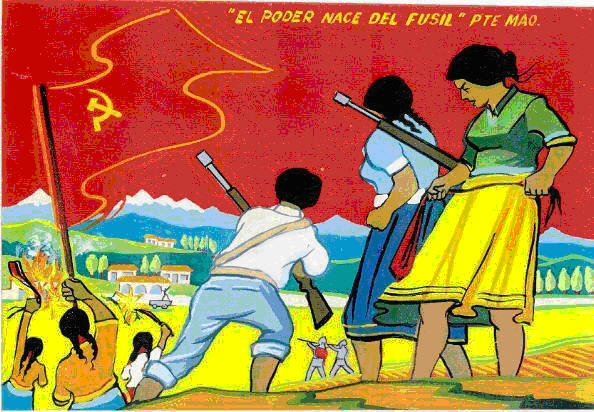
Powerful mass struggles have put—and continue to put—imperialism in check in recent years. Currently, four People’s Wars are developed in the world (India, Turkey, the Philippines, and Peru) under the leadership of Communist Parties, alongside powerful armed struggles and large national liberation movements. Extremely powerful mass movements have also taken place around the world, including in the imperialist countries, but they have not triumphed due to a lack of revolutionary leadership.
(Beyond the reactionary upsurge: imperialism and militarization of the State, Servir al Pueblo, 2025)”
In short, imperialism develops the militarization of the States in order to prevent revolution. And it promotes Fascism as part of its strategic plan to militarize the State.
“The militarization of the State is the imperialists’ response to their crisis; it is the process of intensifying repression with the strategic goal of averting revolution. The militarization of the State is not merely a military process in which the State increases the power of its repressive forces (police, army, courts, prisons); instead, the process of militarization also includes the progressive denial of liberal democratic rights (freedom of expression, belief, assembly, freedom of movement, etc.) and the tendency towards the reactionary and fascist transformation of society, with the propagation and normalization of reactionary ideas in public life.
(Beyond the reactionary upsurge: imperialism and militarization of the State, Servir al Pueblo, 2025)”
No “Left” Government Will Stop Fascism
The strategic plan of the Spanish imperialists (that is, the big bourgeoisie, of the monopolies) is to militarize the State. One of the consequences of this, among others, is the gradual promotion of fascism. That is why we say it makes no sense to vote to stop fascism or the far right. Whoever governs after November 29 will be a government that favors the rise of fascism and the far right (actively or passively). It will do so openly and brazenly, or in a more veiled manner, but it will do so nonetheless. The government that emerges from the November 29 election will be one under the orders of the big bourgeoisie, and if the big bourgeoisie dictates militarization and fascism, the government will take measures moving in that direction.
Voters convinced that voting is a “civic duty” will tear their hair out and cry out from the rooftops: “How could a government of the transformative left promote fascism? Would Podemos really govern the same way as Vox? You’re crazy!” They are the crazy ones, convinced by the propaganda of the bourgeois media; they cannot see reality.
After 8 years of “progressive” government, do we have more eviction companies or not? Is there greater normalization of reactionary ideas or not? Is there greater normalization of racism or not? Is there a greater presence of fascist organizations in the media, or not? Hasn’t “the most progressive government in history” contributed, directly or indirectly, to an increase in the reactionary and fascist tendencies of society? The rise of fascism has not happened despite of the government, but instead has been promoted by the government. Facts are facts, and no one can erase them.
We repeat: any government that comes to power after November 29 will implement whatever the big bourgeoisie wants to implement. The only thing that will change is whether it does so more openly or more covertly. The rhetoric will change, but if the big bourgeoisie wants militarization and fascism, the government will implement militarization and fascism. It’s hard to believe that the argument is “Oh no, here come the bad guys!”, when the bad guys are already here.
Yolanda Díaz’s “cute politics” has been responsible for deploying military armored vehicles during the metalworkers’ strike in Cádiz; for remaining in NATO; for evicting tens of thousands of people; for total permissiveness toward the rallies and events organized by Núcleo Nacional [Translator’s note: National Core would be the translation, a nazi organization]; for an immigration policy that is nothing more than terrorism against the outcasts of the earth; and a long list of other such actions. We insist: there is more fascism today than there was 8 years ago. Is this what voting to stop fascism is for? So that so-called “anti-fascist” bourgeois leaders can promote the militarization of the State, the reactionary shift, and the fascistization of absolutely every bourgeois democracy?
In every election held over the past 8 years, there has been a call for a “useful anti-fascist vote” to prevent the rise of the PP and Vox. For November 29, they’re doing the same thing. They can’t deceive us anymore.
“Vote! Do it for the Migrants and LGTB People!”
These same arguments apply to the “vote in defense of the oppressed,” which uses specific sectors of the working class as a political tool to encourage voter turnout. This postmodern position holds that voting is a “moral duty” because not voting is a “privilege” enjoyed by people who are Spanish nationals, cisgender, heterosexual, white (and so on). Not voting would be “exercising their privilege” because there are other people who cannot choose whether to vote or not. They have to vote because their lives depend on it; they have to do whatever it takes to prevent fascism from coming to power (migrants, LGBTQ+ people, and so on), and yes, it is true that their lives depend on it, but it is a fallacy to think that fascism can be stopped by voting.
This position is thoroughly refuted by the extensive argument we have presented above. Nevertheless, we would like to make three brief points:
1) Attacks on the migrant proletariat or on LGBT people—just as with fascism—cannot be stopped by voting. If the big bourgeoisie wants repression against specific sectors of the masses, the government in power will carry it out. In fact, for the poorest migrant proletariat, it makes no difference whether Vox or the PSOE is in power because their immigration policies are exactly the same. Over the past 8 years, the “progressive” government has perpetrated horrific massacres (Melilla on June 24, 2022; Ceuta on July 31 of this year), and thousands of African people have died on the Mediterranean and Atlantic routes. Over the past eight years, the “progressive” government has maintained the CIEs—centers of torture and rape for migrants. The PSOE and Sumar put on a friendly facade, even presenting themselves as allies of migrants, but the reality of their policies is the exact opposite.
2) Voting is not a privilege. In bourgeois legal terms, voting is a right acquired by an individual. But in Marxist terms, it is by no means a privilege. Bourgeois elections are the means by which bourgeois democracy renews its legitimacy. When postmodernism speaks of privilege, it is introducing the ideology of imperialism into the workers’ movement. It is also worth noting that it is utterly despicable when someone claims that “not voting” is a privilege, when, in fact, those who do not vote are the most oppressed of all. The abstention rate is always higher in working-class neighborhoods, in temporary-laborer towns, and in the poorest areas. Abstention rates are lower, by contrast, among university students and in wealthy neighborhoods.
3) If voting is truly the way to stop fascism, and it is solely in the hands of “the privileged,” then this denies that the poorest and most oppressed are political agents. Their emancipation would not depend on themselves, but on “the most privileged.” This postmodern position, which denounces the “white savior complex,” paradoxically defends positions that feed into it and legitimize an electoral system that excludes them.
Only Mobilize, Politicize and Organize the Proletariat Can Stop Fascism
No matter who comes to power on November 29, the big bourgeoisie will promote fascism. Voting is useless.
Does that mean the rise of fascism is inevitable? No, quite the opposite. Fascism can be confronted and defeated. Imperialism is a paper tiger in the face of the organized strength of the people, because when the working class understands the political necessity of something, there is no force that can stop it. Fascism, as a tool of the imperialists, is also a paper tiger. Fascism is destined to disappear from the face of the earth, just like all the reactionary ideas promoted by imperialism.
The only way to combat fascism is to mobilize, politicize, and organize the working class and all sectors of the people. There is no other way. Fascism is combated 100% by mobilizing the working class. It is not combated 99% by mobilizing the working class and 1% by voting. No. That is a fallacy spread by opportunists to lead the people down the parliamentary path and away from the path of struggle. Some will cry foul, but we have proven it and we say it clearly: voting to stop fascism paradoxically creates better conditions for the development of fascism.
Later, in Part 3 of this series of articles in defense of the electoral boycott, we will discuss in depth the position “vote and struggle” or “as long as you struggle, it doesn’t matter whether you vote or not.”
In conclusion, we say: the only way to combat fascism is to mobilize, politicize, and organize the proletariat. We must make workers aware that fascism and the reactionary upsurge are a direct consequence of the process of militarization of the Spanish State. Fascism and the reactionary upsurge are the imperialists’ response to the revolutionary situation that is developing. The anti-fascist struggle therefore requires a stance of clear rejection of the Spanish imperialist State, its bourgeois democracy, and all the elections that legitimize it. There is no genuine anti-fascist struggle unless it goes hand in hand with an electoral boycott.
Part 2: “The Proletariat is not Ready” and Other Lies
Many activists in the popular movement reject bourgeois elections. They believe—and rightly so—that the democracy the proletariat needs does not fit in the bourgeoisie’s ballot boxes. This idea is summed up in the slogan “Our democracy does not fit in their ballot boxes,” which has been used for decades by many political and union organizations within the popular movement.
Once one thinks this way, the question arises as to what to do: an electoral boycott, or accumulate forces for a boycott in the future? For us, it’s clear: an electoral boycott. It is a lie that we must choose between carrying out the boycott and raise the organization of the class. We can—and in fact must—do both at the same time. The idea that we must accumulate forces for a future boycott stems from two things: 1) the belief that the proletariat is not yet ready, and 2) a failure to understand the law of contradiction.
Regarding the latter (the law of contradiction, the sole fundamental law of materialist dialectics), we will discuss it extensively in the Part 3 of our series of articles, when we will criticize the position of “it is not necessary to call for a boycott, but instead to organize and struggle. Whether they vote or not, it doesn’t matter to us as long as they organize and struggle.” In this article, we will focus on the first issue.
The Proletariat Rejects the Electoral Farce
Let’s see the figures of participation and abstention in the latest elections in order to address the question of trust or not in the bourgeois democracy.
– General elections (July 23, 2023): 29.4% abstention rate.
– Galician regional elections (February 18, 2024): 32.69% abstention rate.
– Basque regional elections (April 21, 2024): 37.5% abstention rate.
– Catalan regional elections (May 12, 2024): 42.1% abstention rate.
– European elections (June 9, 2024): 50.79% abstention rate.
– Extremadura regional elections (December 21, 2025): 37.3% abstention rate.
– Aragon regional elections (February 8, 2026): 34.91% abstention rate.
– Andalusia regional elections (May 17, 2026): 35.2% abstention rate
There is a reason why millions of people don’t vote. The bourgeois press calls it “political disengagement” and speaks of a “crisis of the democratic system.” The social-democracy blames it on a “lack of legitimacy on the part of the transformative left,” citing arguments such as that they have not explained their platform well enough, that the media favors the right, or that parliamentary representation through the d’Hondt method works against them. Even intellectual sectors of social-democracy working in academia have gone so far as to say it’s because “people don’t care about politics.” These intellectuals, who call themselves experts in geopolitics, they are not only experts in nonsense, but they also demonstrate just how far removed they are from the working class.
In the working-class neighborhoods, people are constantly talking about how expensive life is, the price of fuel, or how “all politicians are thieves.” It’s obvious that most of the working class cares about politics; the thing is, for social-democracy, caring about politics means voting.
So… why are there so many people who haven’t voted in the last 50 years? The reason why, election after election, millions still fail to vote—despite all the propaganda the bourgeoisie spreads to encourage voter turnout—is very simple. The proletariat has no trust in the bourgeois democracy.
Voter abstention rates—as if they weren’t already high enough—are even higher in poor areas. Proletarian neighborhoods, day-laborer towns, and the places hardest hit by the crisis of Spanish imperialism are where abstention is highest. And it’s completely logical that this should be the case. Years go by, and the neighborhood remains the same. The government in power fails to solve the problems of unemployment, housing and rent, labor exploitation, unsanitary streets, lack of public transportation, lack of parking, the absence of rehabilitation programs for drug and addiction problems, police abuse, and institutional corruption… How can they be expected to vote for them if everything stays the same?
The proletariat has no hope in bourgeois democracy. None at all. That is why millions of people do not vote, even if it only means wasting an hour every four years. They have no hope at all in the system. We have already mentioned this in past articles:
“The fact that nearly half of the voters did not turn out to vote (and many voted for ‘the lesser of two evils’) can only be explained by two reasons. Either the masses don’t care about politics, as reactionary philosophers claim (and we know this is false, because employment, housing, and other issues are on everyone’s lips), or there is a trend toward the delegitimization of bourgeois democracy. We know for a fact that it is the latter.”
(Record-high abstention rate in Extremadura: 37.3% of voters reject the electoral farce, Servir al Pueblo)
And also:
“At the risk of stating the obvious, we insist once again that bourgeois democracy is in crisis, because there are still those who deny it. The arguments of those who defend this position can generally be summarized in two points:
1) “If turnout is over 50 percent, you cannot say that the masses distrust bourgeois democracy, because more than half support it.”
This is a superficial analysis, because it fails to grasp that political processes are full of contradictions, and that we come to understand them as we uncover their trends and dynamics. We must not view things as fixed, eternal, and unchanging. By the same token, we could say that the Great October Socialist Revolution of 1917 took place without the masses because more than 50% of the population of the Russian Empire did not participate in the revolution. And the same could be said of the Chinese Revolution. What is the objective fact? What is undeniable? That during the last elections, voter abstention has consistently hovered between 30–40%. What is our opinion on this data? That there is a trend toward the delegitimization of bourgeois democracy, and that as the revolution develops, the crisis of the old state and of bourgeois democracy will deepen.
(…)
2) “Abstention is not the same as conscious opposition to the system”
Of course not. That is, precisely, the job of revolutionaries. Or do we expect that, without working towards an active boycott, the masses of abstainers will suddenly launch an active boycott, as if the Holy Spirit were to descend from heaven? When a person does not vote, it is not because they are a revolutionary. It’s because they think voting is pointless. When a worker doesn’t vote, they aren’t participating in the basic and fundamental act of legitimizing the next bourgeois leader. Isn’t this the perfect ground on which to sow revolutionary ideas?
(On the abstention in the Andalusian elections and the crisis of the bourgeois democracy, Servir al Pueblo)
We have shown that the proletariat does not trust bourgeois elections. Between 30% and 40% of the electorate does not vote (25%–35%, if we’re generous with the defenders of the elections), a percentage to which we must add the large number of people who vote out of fear, who vote for the lesser of two evils, or who vote knowing that nothing will change.
Aren’t They Ready for Boycott?
The proletariat does not trust bourgeois elections. Why wouldn’t it be prepared to boycott the elections?
“But there are millions who still vote,” fair enough. Why not launch a boycott campaign with the millions who don’t vote? Isn’t it easier to build a revolutionary movement to overthrow the imperialist State and its bourgeois democracy with those who have no faith whatsoever in the system—and who, moreover, are the hardest hit by the crisis?
“But we revolutionaries don’t have the capacity to launch a nationwide boycott campaign”—fair enough. Why not start with a boycott campaign in one city or several cities? What’s stopping us? Don’t things develop from the small to the large? Aren’t past boycott campaigns the best “accumulation of forces” for future ones?
The proletariat is more than ready for the boycott. The proletariat wants to organize and struggle for a new world. The proletariat mobilizes and combats—often powerfully—but its struggles ultimately fail because opportunists exploit them. What the proletariat demands is leadership; it is crying out for it, but those who refuse to see will never realize it. Revolutionary organizations have often been overwhelmed by mass mobilization because they thought something could never happen—and suddenly, a spark sets the prairie ablaze.
The proletariat is fully ready for the boycott. It is the revolutionary movement that is unprepared, still wavering over whether or not to boycott. Now is the time to launch the electoral boycott. If not now, when? If not us, then who?
Part 3: “Without a Revolutionary Alternative, Boycott has no Sense”
In the first part, we demonstrated that voting does not serve to stop fascism, but to legitimize the upcoming bourgeois government. The government that will emerge from the November 29 election—whether led by the PP and Vox or by the PSOE and the Broad Front—will be an imperialist government because it will manage the imperialist State (instrument of the big bourgeoisie). If the big bourgeoisie’s plan is to implement measures to militarize the State—and that militarization includes promoting fascism and reaction—the government in power will carry out those measures. Bourgeois politicians, no matter of which color, have no room to maneuver within the fundamental plans of the big bourgeoisie. We must cast away any hope in the bourgeois democracy, no matter how tiny it is.
In the second part, we demonstrated that the proletariat is prepared to launch boycott campaigns against the bourgeoisie’s electoral campaigns. The problem is that many political organizations within the revolutionary movement are not prepared, and to justify themselves, they claim that the proletariat is not ready. This has a very negative effect, generating confusion and false parliamentary illusions among many honest people who work sincerely and daily for the revolution.
Following this line, in this third part we will address the main argument put forward by these political organizations: “There is no revolutionary alternative.” What does this argument say? That bourgeois elections are useless, but since there is no real revolutionary alternative, calling for a boycott is a waste of time. Since there is no revolutionary alternative to bourgeois elections—according to their reasoning—a genuine electoral boycott is impossible, so boycott campaigns are a waste of time or, at best, make no sense at all. Fundamentally, their idea is that “it doesn’t matter whether you vote or not; what matters is to organize and struggle.”
The Same Argument Since 1977: 50 Years Without a Boycott Because “There is no Revolutionary Alternative”
The argument that it makes no sense to boycott because there is no revolutionary alternative seems like a very solid and new argument, but the truth is that it is as old as bourgeois democracy itself. It is such a common argument that opportunists were already claiming it during the first general elections on June 15, 1977.
In those years, there were around 50 political organizations that defined themselves as revolutionary. Specifically, they identified as Marxist-Leninist, Marxist-Leninists Mao Tse-Tung Thought, Trotskyists, revolutionary Marxists… All of them ended up dissolved, liquidated, or absorbed by the PSOE and social democratic parties in less than ten years.
The purpose of this article is not to analyze the causes of these organizations’ failure; that would require an exhaustive study of them: their ideological understanding, their political analysis, their strategy, their tactics… So why do we mention them? Because of their stance on bourgeois elections. Most of the organizations that argued that the boycott should not be waged because “there was no revolutionary alternative”, ended up dissolving within a few years.
The reader may think these are misleading—or even deceptive—examples, because the failure of these organizations had many causes, and one cannot attribute the dissolution of all of them to their position on bourgeois elections.
We assert, and very firmly: yes, their position on bourgeois elections played a central role in their liquidation and/or dissolution. Because the issue of the electoral boycott goes far beyond the boycott itself of specific elections. The issue of the boycott has to do with how these organizations understood the building of a revolutionary movement.
“Boycott Without a Revolutionary Alternative…” But what Kind of Alternative do We Want?
There is much talk about how “there is no revolutionary alternative,” but not so much about what such an alternative should look like. Or better said, many organizations share the analysis that “there is no revolutionary alternative,” but each one has a very different understanding of what a “revolutionary alternative” is. If we do not have a common language, we will never be able to understand each other, so the first step is to define what we mean by “revolutionary alternative.”
For us, the existence of a “revolutionary alternative” means the existence of a “revolutionary movement.” And we understand “revolutionary movement” to mean: 1) A movement formed by an organization or a group of organizations guided by the scientific ideology of the proletariat; 2) A movement that is independent of the imperialist State, free from opportunism, and that combats revisionism; 3) A movement that seeks to seize power and recognizes that this can only be achieved through revolutionary violence; 4) A movement that is in close contact with the exploited masses—those at the deepest and most profound of the imperialist system.
Is there a revolutionary alternative? Of course there is. What is very different thing is the state of this alternative. Whether or not the revolutionary movement is capable of a serious confrontation with the imperialist State is another debate. But we must call for a boycott because there is indeed a revolutionary alternative. We say: “Don’t vote—join a revolutionary organization!” That is the alternative.
For those who oppose the boycott, their reasoning is different. They think the revolutionary alternative has to be something tangible, immediate—it has to be a workers’ power that is already established and perfect. When they say that “there is no revolutionary alternative,” what they really mean is that “there is no established workers’ power standing against bourgeois power.”
If the alternative to bourgeois elections is workers’ power, we fully agree that it does not exist… and that is precisely why the boycott must be waged! To lay the foundations for future workers’ power.
This future workers’ power that will confront bourgeois power—regardless of the fact that it will be born, defended, and developed through revolutionary violence—must be built on the basis of a profound class contempt for the imperialist State and its bourgeois democracy. This workers’ power will emerge from a revolutionary movement firmly rooted among the most exploited masses, who have no hope—absolutely none—in bourgeois politics.
Without an electoral boycott, it is impossible to build a revolutionary movement capable of carrying out these tasks. Any movement built without the boycott in its DNA will be a weak movement, with parliamentary illusions—a movement lacking the capacity and combativeness to struggle against the imperialist State. All the organizations that dissolved in the 1970s and 1980s are clear examples of this.
As we have said, for those who oppose the boycott, it makes no sense to boycott bourgeois elections because “there is no revolutionary alternative.” The trap is that, according to their reasoning, this alternative will never exist, so the political consequence is to fall into an endless cycle of building up forces while waiting until one day the time is right to boycott. It seems like a very new tactic, but as we have said, it is very old. Opportunists have been saying since 1977 that we must build up our forces in order to launch a boycott.
The Agnostic Stance is the Road to the Cemetery
From the very first moment that the decision is to carry out boycott, one rejects bourgeois democracy and educates the proletariat in this rejection. Not to take a stand in favor of the electoral boycott means to siding with the electoral farce.
When bourgeois elections take place, there are two opposing and antagonistic courses of action to choose from: to vote or not to vote. There is no other option. One cannot choose a third option. One cannot take an agnostic stance. At the moment of truth, those who say that “it doesn’t matter whether you vote or not; what matters is organizing and fighting” will either go out and vote or they will not. They will choose one of the two options.
Revolutionaries have two paths to choose.
A political movement that organizes the proletariat, with the electoral boycott as one of its principles, is a movement with a firm stance toward bourgeois elections. Bourgeois democracy will not tempt it, and it will build itself in opposition to the imperialist State.
A political movement that organizes the proletariat without an electoral boycott, on the other hand, is a movement that will always face problems when bourgeois elections take place. There will be those in favor of voting for the lesser evil, those in favor of not voting, or even those in favor of presenting candidates “tactically.”
Let each person choose their own path.
Part 4: Revisionism Behind the “Revolutionary Candidacies”
We have refuted most of the arguments put forward by opponents of the electoral boycott, but not all of them. There is still one group left. For the fourth and final part of “In Defense of Electoral Boycott,” we have saved the most recalcitrant sector of those who oppose the boycott: those who run in the elections with their own candidates.
Political organizations that run in elections—both those participating on November 29 and those considering doing so in the future—adhere to the following position: “Revolution isn’t achieved by voting, but when elections are held, we run to use them as a platform for spreading our message.”
Running in bourgeois elections to use them as a platform is an idea that has become politically and historically obsolete. Running in elections has a terrible effect on revolutionary organizations. Externally, it legitimizes the next bourgeois leader in particular, and bourgeois democracy in general. As if that weren’t enough, it creates false parliamentary illusions among the masses led by the organization in question, causing even more confusion, if that’s possible. As if that weren’t enough, the internal effect is even worse: the revolutionary organization transforms from an “organization for the revolution” into an “organization for elections.” It shifts from organizing, mobilizing, and politicizing the proletariat against the bourgeois State through revolutionary violence to organizing the proletariat to maintain the bourgeois State through bourgeois pacifism.
This is what has happened, is happening, and will happen. It has been this way in each and every country in the world. Perhaps some reader might say to us, “But one can run in elections and fight against bourgeois democracy!” We reply that no, one cannot. We already explained this in Part 3 of this series of articles in defense of the electoral boycott:
“This future workers’ power that will confront bourgeois power—regardless of the fact that it will be born, defended, and developed through revolutionary violence—must be built on the basis of a profound class contempt for the imperialist State and its bourgeois democracy. This workers’ power will emerge from a revolutionary movement firmly rooted among the most exploited masses, who have no hope—absolutely none—in bourgeois politics.
Without an electoral boycott, it is impossible to build a revolutionary movement capable of carrying out these tasks. Any movement built without the boycott in its DNA will be a weak movement, with parliamentary illusions—a movement lacking the capacity and combativeness to struggle against the imperialist State. All the organizations that dissolved in the 1970s and 1980s are clear examples of this.
(…)
When bourgeois elections take place, there are two opposing and antagonistic courses of action to choose from: to vote or not to vote. There is no other option. One cannot choose a third option. One cannot take an agnostic stance. At the moment of truth, those who say that “it doesn’t matter whether you vote or not; what matters is organizing and fighting” will either go out and vote or they will not. They will choose one of the two options.
Revolutionaries have two paths to choose.
A political movement that organizes the proletariat, with the electoral boycott as one of its principles, is a movement with a firm stance toward bourgeois elections. Bourgeois democracy will not tempt it, and it will build itself in opposition to the imperialist State.
A political movement that organizes the proletariat without an electoral boycott, on the other hand, is a movement that will always face problems when bourgeois elections take place. There will be those in favor of voting for the lesser evil, those in favor of not voting, or even those in favor of presenting candidates “tactically”.”
We are not against of making propaganda when bourgeois elections take place… But doing boycott, not running for the elections in order to maintain the bourgeois democracy! The French revolutionaries also explain it in this way:
“For our class, for the revolutionaries, the priority is in another place. To actively boycott the bourgeois elections means to assume that this game is no longer ours. Our enemy is not this or that bourgeois party, but the whole bourgeoisie and its State. So, the most urgent task for us is to solve the problem that we described previously: the capability of our class to organize itself and take action out of this sphere of bourgeois influence. It is to make barriers to re-build solidarity ties in our neighborhoods, but also putting barriers in our unions, our associations, etc.
We also denounce the testimonial candidatures so-called “revolutionaries” in a moment when the class not only has other necessities, but it expresses clearly its hostility to the bourgeois institution, particular against parliament. Since ten years ago, the majority of the working class has abstained – rightly – from all this electoral events. The priority is to take them back to the polls?
The “testimonial” candidatures, instead of promote revolutionary ideas, credit the system of generalized corruption that has characterized the bourgeois elections since the late 1980s. The finance law of the political parties has turned the political parties in truly extensions of the bourgeois State after assigning funds base on the quantity of votes, making them no only dependents, but also responsible of their activity, undermining any chance of real combativeness of this candidates.
To summarize, the electoral game is neither hones nor just. For us, the pressing needs are in other part. “To make barrier”, How many times? For how long? Stop the cretinism, we want power to our class, through revolution! Our only slogan is still: “Boycott the elections!”
Elections: Why revolutionaries call for boycott? La Cause du Peuple, 2024.
Revisionism uses “Left-Wing” Communism: An Infantile Disorder (probably the most misrepresented book by Lenin in all history) to justify its participation in elections. This is thoroughly addressed by the German magazine Class Position:
“However, some people still believe that the issue of electoral boycotts and revolutionary violence are tactical complements. As always, they refer to Lenin and the Bolsheviks’ tactics in the Russian Revolution. It is often emphasized that the Russian communists under Lenin’s leadership also participated in the Duma elections. Several historical facts are often “forgotten” – or rather, set aside. The first obvious one is that if participation in elections were a tactical issue, Lenin should have called for a boycott of the elections at certain times. However, this is something the revisionists never say a word about. Yet, in evaluating his tactics, Lenin always analyzed the class character of the elections. For what is also historically often overlooked is: 1) The question of participation in or a boycott of the elections, raised by the Russian Communists (who at that time were still known as Social Democrats), arose primarily within the framework of the democratic revolution in Russia, so that bourgeois democracy was not even the context for this question; and 2) The Duma, at the historical moment when the Bolsheviks used it, was something completely new – something the people had fought for at that time. This is not true today, especially in the Federal Republic of Germany. Here, the proletariat no longer has to fight for bourgeois democracy (or rather, the democratic revolution); the parliament or parliaments in the FRG are already part of the ruling system down to the last detail – that is, of imperialism and, consequently, of its interest groups. Today, parliamentary cretins would first have to prove that the Bundestag, any state parliament, or city council has any proletarian or even progressive character. Today, as is only fitting, wavering between the electoral farce and a boycott serves no purpose for the revolution, since the class character of the elections no longer changes – for the proletariat, there is nothing left to gain. It would only serve the counterrevolution by creating confusion among the masses. But above all, Lenin never lost sight of armed struggle in his reflections as the highest form of class struggle, and he certainly never abandoned it – a point that must be emphasized time and again on this issue.
Regarding tactics, Lenin also stated:
“Tactics must be based on a sober and strictly objective appraisal […] of the experience of revolutionary movements”
“It is entirely a matter of knowing how to apply these tactics in order to raise – not lower – the general level of proletarian class-consciousness, revolutionary spirit, and ability to fight and win.”
Their goal was to raise the level of class consciousness among the proletariat – that is, on the basis of the “experience gained by revolutionary movements.” What experiences they draw upon and how they intend to raise the class consciousness of the proletariat are questions that the defenders of parliamentary cretinism (or those who leave this path open as a back door) tend to leave unanswered. Their proletarian class consciousness on this issue is inferior to that of the broader and deeper masses.
The PCP summarized Lenin’s experience as follows:
“In the face of the elections for the Constituent Assembly, the proper course of action is to abstain, to boycott; the proper course of action is to firmly apply the teachings of the great Lenin. Lenin called for a boycott specifically against a Duma—a ‘representative body’—that was tasked with drafting a constitution to serve the ruling order in Tsarist Russia, and he based this conclusion on two grounds: first, participation would divert the revolution from its course, and second, a revolutionary upsurge was underway; we must analyze these issues by applying them to our concrete conditions (…) Calling for non-participation in the elections for the Constituent Assembly, calling for a boycott, calling for the creation of a movement opposed to and rejecting the elections, and calling for a refusal to vote is condemned as “left-wing infantile disorder.” This is mere label-sticking; it is an attempt to cover up the facts with a flurry of words; for what is at issue here is not anyone’s infantile disorder or senility. What is at issue is the real, objective situation of the class struggle in the country; what is at issue is what period we are in, what its characteristics are, and what its prospects are.”
Although this refers to a “constituent assembly,” the issue is very clear, especially in the final sentences. But what does an electoral boycott specifically mean for the work of communists? Lenin was able to provide an answer to this as early as 1905:
“As we have already said, “an active boycott” means agitation, recruiting, organising revolutionary forces on a larger scale, with redoubled energy, and bringing redoubled pressure to bear. Such work, however, is unthinkable without a clear, precise, and immediate slogan. Only an armed uprising can be that slogan”
If some people now say that we should use elections as a stage for agitation and propaganda among the masses, then we say to them: “You’re right! And in the form of an election boycott!” This is the only way communists can exploit bourgeois elections to advance their goal of seizing power for the proletariat.”
Also Chilean revolutionaries have addressed this issue:
“The historical expiration of elections
At the beginning of the last century, the revolutionary struggle of the communists considered the possibility of using bourgeois parliaments and elections to spread propaganda for the revolution. It was common practice to participate in elections and use positions of power to amplify agitation and propaganda and serve the political development of the working class and the people.
Recabarren himself, in Chile, was twice elected to Congress and, from there, actively defended the need for revolution. However, in his own experience, he ended up concluding in the 1920s that it was a waste of time, that more could be gained by agitating from a platform in a square than from parliament, and that no transformation could ever be achieved from within, because in those rotten positions there are no people, but “monsters insensitive to the pain of others.”
By the 1930s, Chairman Mao Tsetung in China had already observed that, in the practice of international class struggle, no country had truly advanced the revolution by using elections. Only the followers of revisionism—false communists—who opportunistically interpreted the Communist International’s anti-fascist policy of popular fronts as a policy of electoral fronts, embraced the idea of participating in the elections of the old reactionary States as their path. While maintaining the name of communism, the most brazen revisionists, such as the “Communist” Party of Chile, indefinitely “shelved” the revolutionary program of the proletariat and the people in order to become a bourgeois electoral party. The most underhanded maintained a certain revolutionary rhetoric that they still use today, basing their opportunism on Lenin’s thesis of “all forms of struggle,” without considering the development of Marxism in the decades after Lenin, which demonstrated the historical and political obsolescence of the electoral path.
At the present moment, when the international class struggle is showing that the world is moving into a new era of revolutions, where popular wars led by Marxist-Leninist-Maoist communists are the vanguard of the peoples; where national liberation struggles in Africa and Asia are effectively striking at imperialist interests; where the masses are rising up, shaking and even overthrowing governments, whether elected at the polls or not; where even the most “illustrious democracies” such as France and Germany are restricting liberal freedoms and brutally repressing popular protests; where shameless corruption is evident in each and every government, it is becoming clear that, at the global level, the farce of elections is becoming increasingly obvious and the supposed popular legitimacy of governments elected at the polls is becoming less and less convincing to the people.
It is therefore up to revolutionaries to help clarify why elections are a sham, why popular elections are not synonymous with democracy, but rather a mechanism that seeks to legitimize the class dictatorship of the reactionaries over the people; to explain that for the people the path is revolution and that, on this path, elections have no place; and that, in this sense, the position on reactionary elections is one more element that serves to clearly differentiate communism from revisionism.”
Elections and How to Differentiate Communism from Revisionism, Newspaper El Pueblo, 2025
As a conclusion, we cannot say anything else than as follows: if they run for the elections, they are not revolutionaries.
Conclusions: ¡Boycott the Bourgeois Elections!
In the part 1 we demonstrated that voting to stop Fascism makes no sense:
“The only way to combat fascism is to mobilize, politicize, and organize the working class and all sectors of the people. There is no other way. Fascism is combated 100% by mobilizing the working class. It is not combated 99% by mobilizing the working class and 1% by voting. No. That is a fallacy spread by opportunists to lead the people down the parliamentary path and away from the path of struggle. Some will cry foul, but we have proven it and we say it clearly: voting to stop fascism paradoxically creates better conditions for the development of fascism.”
In the part 2 we demonstrated that the proletariat is fully ready to launch a boycott campaign:
“The proletariat is more than ready for the boycott. The proletariat wants to organize and struggle for a new world. The proletariat mobilizes and combats—often powerfully—but its struggles ultimately fail because opportunists exploit them. What the proletariat demands is leadership; it is crying out for it, but those who refuse to see will never realize it. Revolutionary organizations have often been overwhelmed by mass mobilization because they thought something could never happen—and suddenly, a spark sets the prairie ablaze.
The proletariat is fully ready for the boycott. It is the revolutionary movement that is unprepared, still wavering over whether or not to boycott. Now is the time to launch the electoral boycott. If not now, when? If not us, then who?”
In the part 3 we demonstrated that a revolutionary movement cannot be developed without carrying out boycott since the beginning:
“Revolutionaries have two paths to choose.
A political movement that organizes the proletariat, with the electoral boycott as one of its principles, is a movement with a firm stance toward bourgeois elections. Bourgeois democracy will not tempt it, and it will build itself in opposition to the imperialist State.
A political movement that organizes the proletariat without an electoral boycott, on the other hand, is a movement that will always face problems when bourgeois elections take place. There will be those in favor of voting for the lesser evil, those in favor of not voting, or even those in favor of presenting candidates “tactically”.”
In the part 4 we demonstrated that to run for the bourgeois elections with alternative, testimonial o “revolutionary” candidacies makes nothing else than maintaining the bourgeois State.
The statement by the Revolutionary Committees summarizes perfectly which must be our stance regarding the elections:
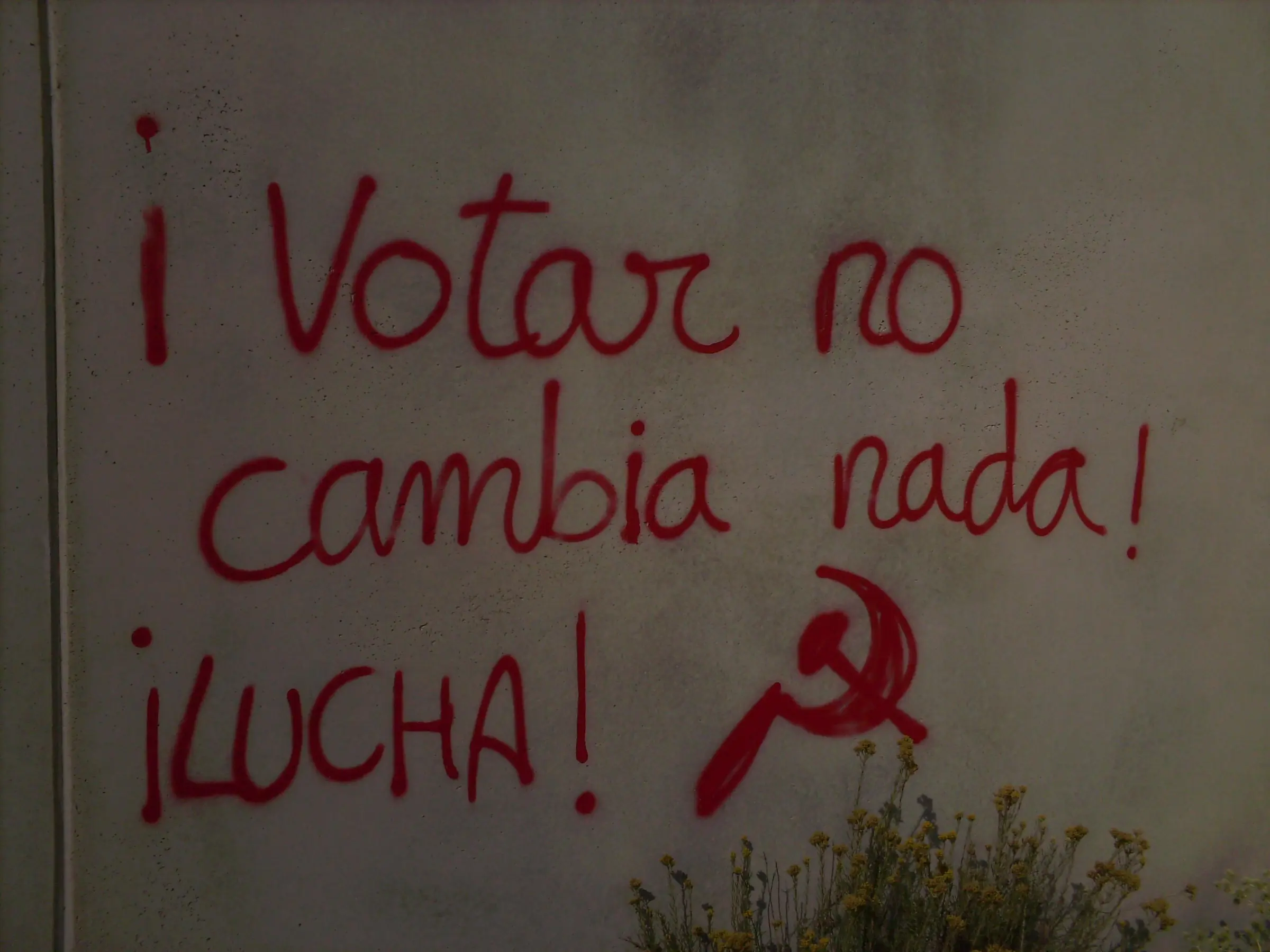
“There is no “less bad” candidate. The only thing voting accomplishes is legitimizing the next bourgeois leader in power. The proletariat does not have to choose between the bad and the worse. Don’t vote—fight!
There is no “anti-fascist” candidate or vote. Voting does nothing to stop fascism. The rise of reaction and fascism is a natural process resulting from the militarization of states. Don’t vote—fight!
There is no such thing as a candidate who serves as a “spokesperson” for revolutionaries. Any candidacy serves to prop up bourgeois democracy, legitimize the current bourgeois leader, and create false parliamentary illusions among the masses. Use the elections for propaganda? Yes, but in the form of a boycott—not by participating in them. Don’t vote—fight!
There are no middle grounds. We reject slogans that boil down to “no matter how you vote, keep fighting,” because they create confusion among the ranks of the proletariat and help perpetuate illusions in parliament. Let’s be firm and clear: Don’t vote—fight!
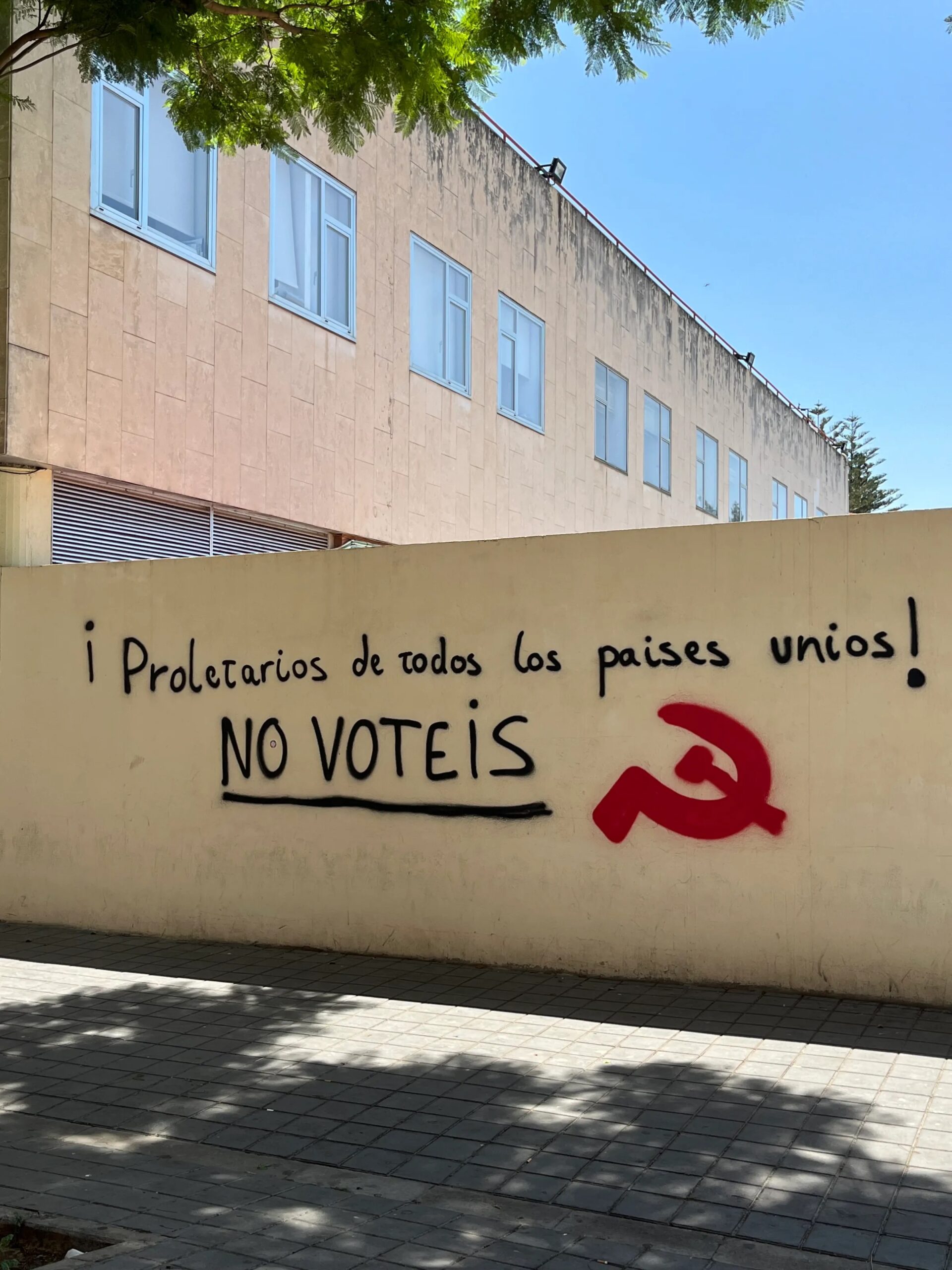
Boycott the bourgeois elections!
Boycott the electoral farce!
Don’t vote—fight!”