Spanish State – Servir al Pueblo: The Bourgeois Press Lies, Manipulates, and Dehumanizes to Promote Racism in Ceuta
We hereby share an unofficial translation of an article published by Servir al Pueblo on the 24th of August
Readers who have read our articles on the situation in Ceuta will have noticed a substantial difference between our editorial line and what is reported in the traditional bourgeois press. These media outlets—though one might more accurately call them “manipulation media”—belong to Spanish monopolies: banking, construction, energy, telecommunications, infrastructure, the military-industrial complex… It is, therefore, logical and normal for the monopolistic press to manipulate public opinion to protect the interests of Spanish imperialism.
For example, there is the Prisa Group, which owns the most-listened-to radio station (Cadena Ser), the most-read newspaper (El País), and countless provincial and local dailies. We also have the Episcopal Conference, the governing body of the Catholic Church in Spain, which owns COPE (the second-most-listened-to station), known for its more reactionary stance—a bastion of the old Franco dictatorship. If we turn to television, the pie is similarly divided among a few players such as Mediaset España (Telecinco, Cuatro, Divinity…) and Atresmedia (Antena 3, la Sexta…).
Let’s not be mistaken. There is no such thing as a “free press” among the bourgeois media. These
groups don’t even compete with one another since the same people often sit at the tables where decisions about the companies’ futures are made within the investment groups. If we follow the money, we’d find a handful of capitalists who cynically divide up the same market among themselves, creating one segment of the press that’s supposedly more progressive (Cadena Ser, El País, etc.) and another that’s supposedly more conservative (COPE, ABC, La Razón, etc.).
With this “free press,” we can expect little impartiality. When major crises arise, we see how one side or the other focuses its attacks on the PSOE or the PP, but they never disagree on the fundamental issues. This is what has happened with the crisis in Ceuta. Let’s review some key facts.
What is the nature of Spanish imperialism in Morocco?
In the future, we will write a monograph explaining why Morocco is a semi-colonial and semi-feudal country and what role Spanish imperialism plays there. But for now, let’s make a few points.
Spanish imperialism, together with Yankee imperialism,i dominates Morocco politically and economically. Spain has at least 100,000 million euros invested in Morocco, making it the primary destination for Spanish investment in Africa. Some major investments date as recently as 2023, the year in which Morocco and Spain signed an agreement worth 800 million euros. Spanish companies control resources that are vital to the survival of the Moroccan people. In an article by the Spanish government itself announcing that Acciona will invest 340 million euros in desalination plants for Morocco, the following is stated:
“Spanish companies are firmly established in Morocco, especially in strategic sectors such as energy, infrastructure, the automotive industry, banking, and technology. Many of them have a proven track record and have participated in key projects that have contributed to the country’s economic development [author’s note: they call monopolism ‘development’!]. Currently, more than 350 Spanish companies operate in Morocco, creating local jobs and strengthening economic ties between the two countries.” ii
The publication Capital Madrid reports, citing data from the State Secretariat of Commerce, that:
“The retail giant Inditex has one of its main global sourcing hubs in the Alawite Kingdom through suppliers for various brands”; “in the automotive industry, CIE Automotive, Gestamp, and the Antolín Group supply components to local automobile factories from their bases in Tangier-Mes and Kenitra”; “In transportation, Balearia and Armas Trasmediterránea are the largest maritime transport operators”; “Barceló and Riu operate hotel groups and resort complexes in cities such as Tangier, Casablanca, Marrakesh, Agadir, and Fez.” iii
And the most important point we want to highlight from this same article:
“Banco Sabadell has a branch in Casablanca with an operational license to provide all types of financial services to Spanish companies established in the country.”
The tentacles of Spanish financial capitaliv are all over Morocco. It is the Spanish monopolies that exploit workers in both the cities and the countryside of Morocco.
Now it is easier to understand why neither the PSOE nor the PP openly denounce Morocco’s big landlord-bourgeois State and its dictatorial government. They do not denounce the appalling working conditions or chronic unemployment. Some social democratic Parties, such as Sumar or Podemos, speak of the “Moroccan dictatorship,” but always to whitewash the murderous immigration policy at the borders, and they will always fail to mention that if there is a “Moroccan dictatorship,” it is because imperialism wants there to be one—because that “Moroccan dictatorship” is necessary for Spanish monopolies to exploit cheap labor.
It is understandable that millions of people are looking for ways to escape this situation. Although, as Spanish politicians have often claimed, there is “no war” in Morocco, and therefore we cannot legally grant refugee status to those who migrate to Spain. But the reality is that there is indeed a war—a war waged by the big landlord-bourgeois State against the poorest segments of the Moroccan people.
The most ferocious union busting and political and economic repression; the most ferocious semi-feudal violence in the countryside. These are the consequences of the war against the people from which Spanish imperialism benefits. The words of the State terrorist and Minister of the Interior, Fernando Grande Marlaska (PSOE), regarding the 2022 Melilla massacre still resonate today:
“With regard to the events that have taken place… it is clear that this is a violent attempt at illegal entry, and like all violence, it is unjustifiable. But we are also a democratic country that cannot under any circumstances accept that its border—which is also the border of the European Union—and the public servants who protect it are subjected to violent and intolerable attacks. When that happens, the State’s response is firm (…) we are talking about incidents that are currently the subject of several ongoing investigations.” v
Four years later, we now know that the conclusion of that investigation was to commend the Spanish and Moroccan agents who carried out the massacre.
The bourgeois press is spreading the story
We want to point out, one by one, various elements of mudslinging and confusion that the bourgeois press has spread to distort public discourse. The ultimate goal of all this is to divide the proletariat, pitting foreigners against natives. They blackmail the Spanish proletariat by telling them that they will lose rights because of foreigners. The first thing a conscious worker must realize is that, since the bourgeoisie owns the media, the public opinion they seek to impose will always serve their interests.
1. The language that defines the situation.
The newspaper La Razón has chosen to use the suggestive term “migration crisis” to refer to the events in Ceuta. This “crisis” is allegedly caused by the PSOE government, which, according to them, has been too lenient on immigration, creating a “pull factor.” This type of language is used by those who advocate a “heavy-handed” approach to end the “crisis,” thereby imposing a policy of terror at the border that is supposed to scare off foreigners.
In addition, journalists from La Razón such as Luis Miguel Serrano Montero and J.M. Zuloaga refer directly in their headlines to a “migrant invasion” or a “military conflict.” vi vii
On the other hand, “progressive” media outlets such as Cadena Ser insist on using the term “migrant crisis,” along with other additions such as “political/geopolitical crisis.” This implies that the situation is being imposed from abroad—a sort of retaliation by Morocco for which the Sánchez administration bears no responsibility. Another concept that is used is “humanitarian crisis,” again, one caused by external forces.
For these journalists, the solution to the humanitarian crisis would be greater State intervention. On the Cadena Ser opinion program Hoy por Hoy it has even been suggested that immigrants are not being cared for due to a lack of cooperation between the Autonomous City of Ceuta and the government. Anything but tarnish the image of Sánchez or the State! Pedro Blanco, the program’s current summer host, has gone so far as to describe the situation as a violation of Spain’s territorial integrity, effectively buying into the rhetoric of the most reactionary right wing.
The State-run media outlet, RTVE, directly uses dehumanizing terms such as “avalanche of immigrants.”
The truly revolutionary and correct position is to speak of a crime committed by Spanish imperialism, understanding that this would have happened exactly the same way even if any other political Party were in power.
2. Do immigrants come here to loot?
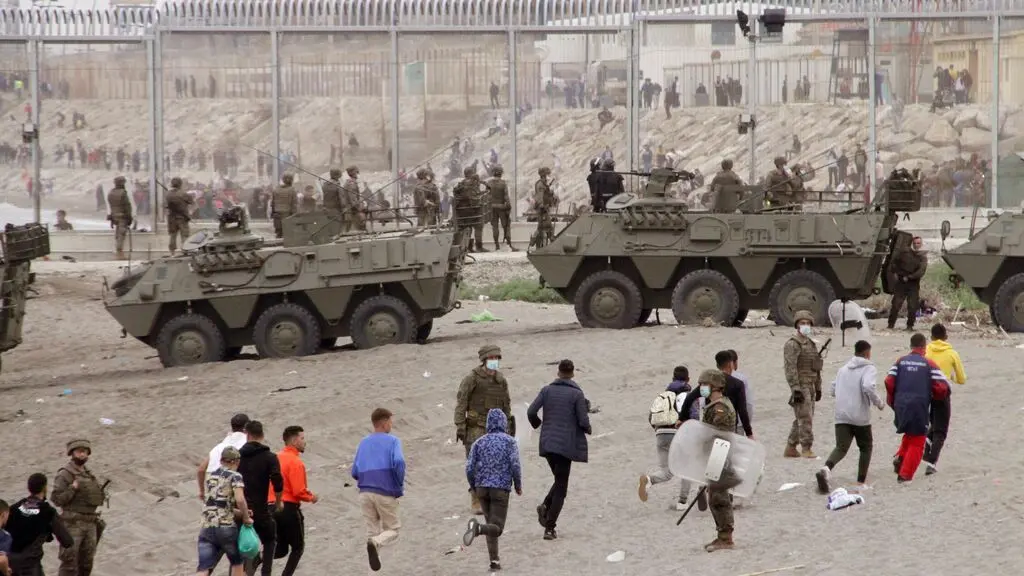
The notion of an “invasion” has been reinforced by reports that businesses are being robbed by immigrants. Obviously, there’s no denying that there have been some robberies or assaults in the city. Nor can it be denied that the city is overwhelmed—after all, Ceuta’s population doubled in just a few days. But to think that 80,000 people have risked their lives at sea simply to come and steal is extremely naive.
A very large proportion of the people who have arrived are not accustomed to committing theft or assault, but are simply poor working-class people who have endured a truly desperate situation. The simplest proof of this is that Ceuta residents and charitable organizations from across the country have had the opportunity to interact with them. One example is the neighborhood association in the El Príncipe district, which provided temporary housing for these people without incident.
The migrants have also settled on Trampolín Beach, living peacefully together, including young children. Not to mention that many are currently hiding in undeveloped areas to avoid conflict with Ceuta residents or the authorities.
Would the reader maintain the same dignity if they didn’t have a crumb of bread to put in their mouth in a foreign country? The occasional instances of looting and theft are a predictable expression of the misery caused by this situation.
3. Do immigrants arrive with iPhones and nice sneakers?
This is one of the most ridiculous arguments being echoed by major media outlets. It is completely irrelevant to an analysis of the situation what kind of phone or clothes these people have. But pseudo-journalists who insult our intelligence—such as Rocío Regidor (in The Objective) or Luis Miguel Serrano (La Razón)—turn this into a front-page headline.viii
Obviously, many of these people may own high-quality items. Can’t someone who is unemployed or poor afford them through years of hard work? These people are trying to turn an absurd anecdote into a justification for deporting and terrorizing foreigners.
4. Do immigrants bring diseases?
The claim that immigrants bring diseases has also been used as an argument to dehumanize them. Nurses who work directly with them have told various media outlets that they have detected cases of scabies, tuberculosis, gastroenteritis… But obviously, the media has chosen to focus on scabies because of its negative connotations, since it can be sexually transmitted.
Why else would reactionary media outlets like El Mundo, Voz Populi, and The Objective put it on the front page of their headlines without mentioning the other diseases? They’re trying to create clickbait by linking immigration to sexually transmitted diseases, when the harsh reality is that these diseases are to be expected among people who have gone more than a month without access to basic health services, enduring extreme cold and heat and lacking proper nutrition.
Other politicians, such as Santiago Abascal (Vox) and Alberto Núñez Feijóo (PP), are calling for immigrants to be confined even further to prevent the disease from spreading outward, without proposing any healthcare for them. They’re practically saying, “Let them die—not us!”
5. Do immigrants come here to commit rape?
Another classic argument, recycled by fascism to dehumanize immigrants, is that they come from a backward culture and engage in rape. To discuss this issue, we must acknowledge the basic fact that rape occurs in every country, because patriarchal oppression is widespread throughout the world. Moreover, rape itself is a repressive State policy. In Spain, rape is also used as a form of torture in prisons and was reserved for the most dedicated anti-fascist activists.
Rape exists because it is a fundamental element of men’s oppression of women—a hallmark of class society. The more socially vulnerable a woman is—lacking economic resources, a support network, or personal protection—the more likely she is to be the victim of rape. We must not forget that a significant portion of those 80,000 immigrants are women who arrive with no guarantees and not a single euro in their pockets; they also do not speak the language and have no way to report the abuses they suffer for fear of being deported.
All of this creates a perfect breeding ground for men (both Spanish and Moroccan!) to take advantage of them. Moroccan women, like all vulnerable foreign women, are targeted by human trafficking rings and are potential victims of sexual slavery.
This is the most fundamental and important aspect of the problem of rape, and the women who have arrived via Ceuta are the ones most directly affected. But the fascists do not focus on this. In fact, the fascists couldn’t care less if Moroccans “rape each other.” For them, the problem only begins when a Moroccan might rape a Spanish woman—a scenario for which there is not a single confirmed case among this wave of migrants, only rumors spread by the bourgeois press.
In conclusion
We in the free and revolutionary media cannot afford to repeat the bourgeoisie’s arguments. Only when we workers learn to see the class interests behind every news story and every headline will we be able to begin steering the debate toward the truth.
It is becoming easier and easier for the bourgeoisie to spread its poison; often, all it takes is a video taken out of context with no source, or an image generated by artificial intelligence. We revolutionaries hold the optimistic conviction that the truth will prevail. The arrival of 80,000 migrants is a wake-up call—these are tens of thousands of people who will swell the ranks of the proletariat in our country and who have put their lives on the line. From among them will emerge the most radical sons and daughters of the people, with the hope of wiping the imperialist system of oppression from the face of the earth.
What will we do with all those wretched pseudo-journalists, the lackeys of the bourgeoisie, then? History will have to judge them with the same measure of violence with which they judge our migrant brothers and sisters.
Notes
i Morocco is a US semi-colony, in collusion and conflict with Spain. Yankee imperialism is the main enemy of the Moroccan people’s struggle for liberation, followed by Spain.
ii portal.mineco.gob.es/ca-es/comunicacion/Pagines/España-Marruecos-refuerzan-cooperacion-economica-.aspx
iii capitalmadrid.com/2026/8/12/72229/las-empresas-españolas-huyen-del-magreb-y-reducen-a-cero-su-inversion-en-marruecos-y-argelia.html
ivTo further our understanding of the significance of this quote, we refer to V.I. Lenin’s “Imperialism: The Highest Stage of Capitalism” regarding finance capital.
v elpais.com/espana/2022-09-21/el-ministro-del-interior-comparece-sobre-la-tragedia-en-la-valla-de-melilla-del-pasado-junio.html
vi larazon.es/espana/ceuta-espana-convocan-manifestaciones-dia-ciudad-autonoma-frente-invasion-migratoria_202608236a8afa9571b42a0b5d00c749.html
vii larazon.es/espana/marruecos-multiplica-sus-esfuerzos-defensa-amenaza-duplicar-porcentaje-gasto-militar-espana_202608236a8ad191a5690f04738af67b.html
viiiTheobjective.com/economia/consumo/2026-08-01/comercios-ceuta-iphone-17-mojado/