LCDP – The Cockroach Movement in India: A First Conference in France Brings Together French and Indian Students in Paris
We hereby share a translation received of an article published by La Cause du Peuple on August 19.
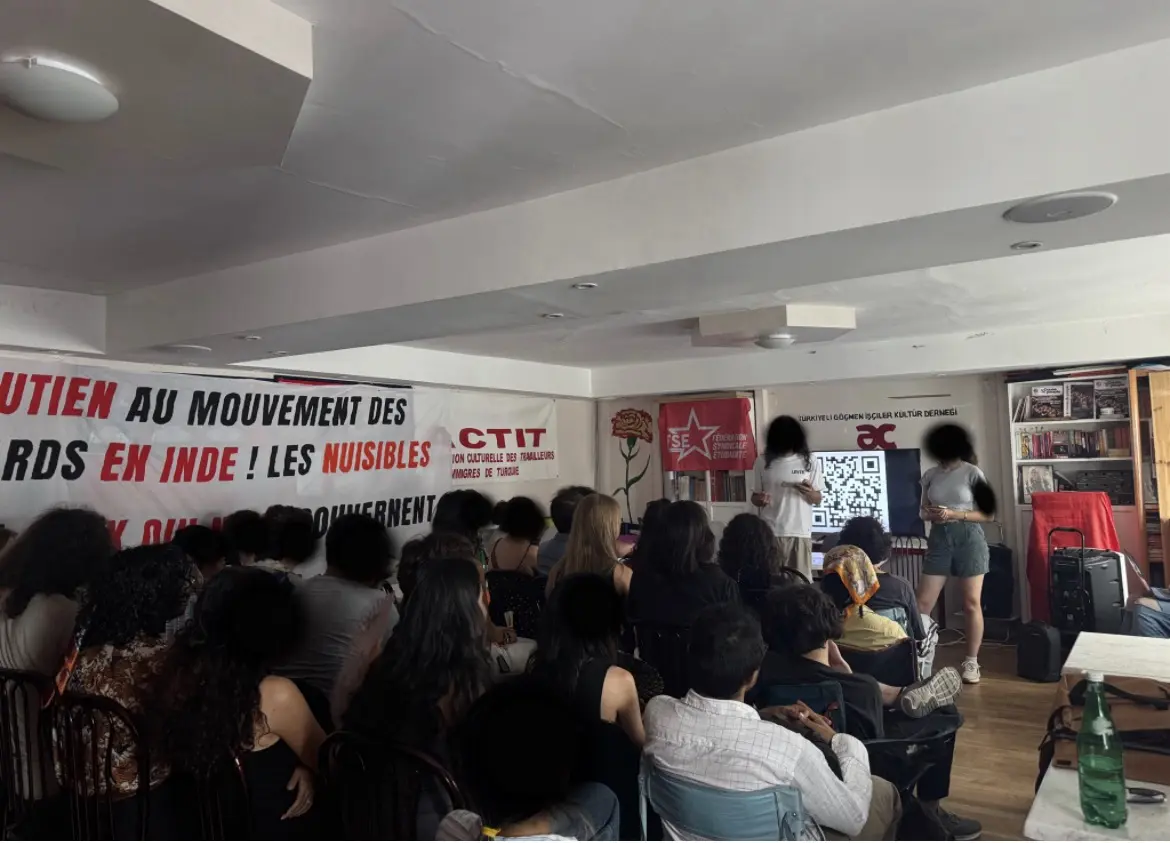
“Who will write the next chapter in India’s history? Its people. They have risen up against oppression many times, and they will continue to do so,” concluded the first Indian speaker at an unprecedented conference in Paris, organized by the Fédération Syndicale Étudiante (FSE, “Student Union Federation”). On Sunday, August 16, from 3:00 p.m. to 7:00 p.m., about thirty French students and young people gathered with about twenty Indian students and intellectuals involved in the mobilization in support of the Gen-Z movement in India. Four Indian speakers addressed the gathering, accompanied by representatives from the FSE, the Jeunesse Communiste (JC, “Communist Youth”), and the AIL, in an event that both communities co-organized from start to finish.
As soon as you enter the room, a banner hanging on the wall sets the tone: “Support for the cockroach movement in India: the real cockroaches are the ones who govern us.” Yet a young Franco-Indian woman, who has been active since July in the diaspora’s efforts in solidarity with the movement, is concerned: “I came to this conference because, for the past few weeks, some people have been claiming that we should stop worrying about politics, that the movement is over. But there are many of us who really, really want to keep going. We haven’t won yet: there’s still an entire system to overthrow.” She was not disappointed. At this conference, there was no question of reducing the uprisings in India to a humanitarian issue or of framing them as “centrist” or “apolitical” demands, as certain opportunistic leaders of the movement have attempted to do since the resignation of Indian Education Minister Dharmendra Pradhan on July 25. The young people in attendance—whether from India or Europe—are determined to defend the combative, class-conscious, and anti-imperialist nature of Gen Z’s aspirations.
As a reminder, the “cockroaches” movement began last May following the cancellation of the NEET, the centralized entrance exam for medical school, due to corruption among the officials in charge of the exam, which had led to the leak of the test questions. This cancellation left 2.27 million Indian students in the lurch—equivalent to the population of a city like Paris. Compounding this cancellation was a second glitch in a new digital grading system, which this time affected 127,000 high school students. Then, on May 15, the Chief Justice of the Supreme Court referred to the country’s unemployed youth as “cockroaches.” This was followed by weeks of protests that brought together hundreds of thousands of young people until July 25 and the march on Parliament. Students, the unemployed, and young urban workers—from diverse ethnicities, religions, and castes—marched together and organized for their common interests despite the unparalleled corporatization of Indian society. Due to the capitulation of the opportunistic leaders of the “Cockroach Janta Party”—who claim that Pradhan’s resignation represents a victory for the movement—the movement has now lost momentum in New Delhi. But the protests continue in the state of Jharkhand, against irregularities and corruption issues surrounding the civil service recruitment exam. A statement from the Revolutionary Student Front (RSF)—an unofficial translation of which we published last week—reflects on this mobilization. The young people involved in these protests are already making their position clear: they do not want a resignation or a change in government, but a fundamental transformation of the system. Far from over, the Gen-Z uprisings are already drawing their first lessons and deepening their level of politicization as the struggles unfold, particularly as they continue in a more deeply tribal state like Jharkhand.
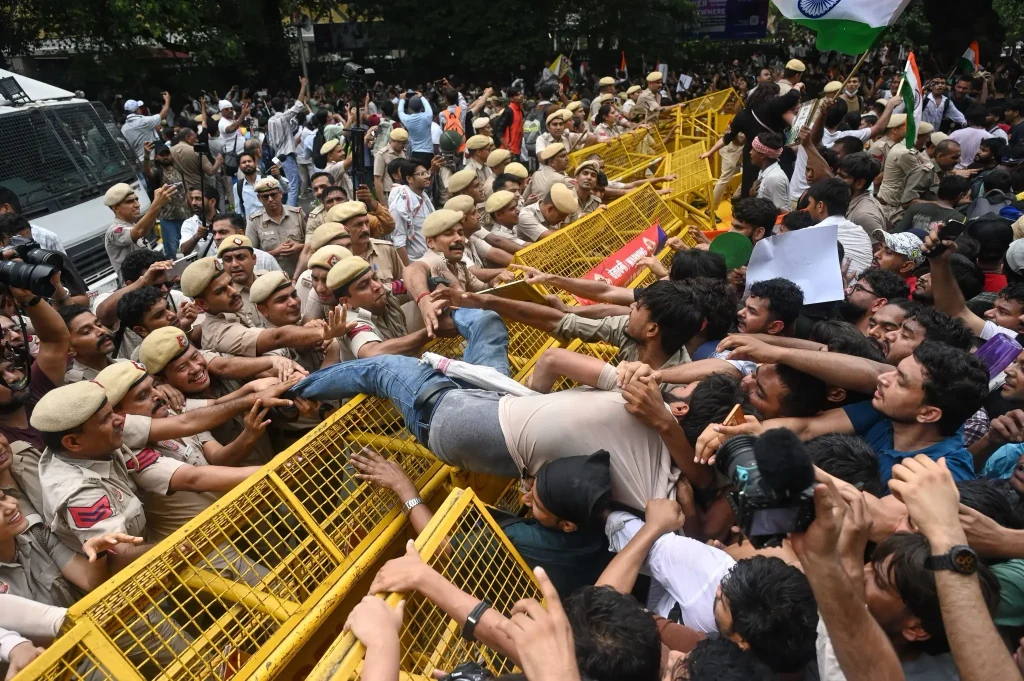

But as the conference participants assert, this mobilization does not stem from an isolated event. The growing problems in the Indian education system are directly linked to the intensifying stranglehold of the imperialists—and in particular the Yankees—on India since the end of the License Raj in 1991, brought about by the collapse of the revisionist USSR and the crisis of social imperialism. The year 1995 thus marked the creation of the first private university in India. By 2005, the country had 20 more. Today, there are more than 500. Added to privatization is the problem of corruption: today, a spot in a medical school can cost between 18,000 and 90,000 euros, paid under the table, completely off the radar. This corruption is believed to be the underlying cause of the 104 exam leak incidents the country has experienced over the past 12 years. These policies, which are destroying the education system, are directly imposed and funded by large monopolies. In 2020, the World Bank granted India a $500 million loan, earmarked directly for the implementation of the NEP 2020 reform, designed to adapt education to the needs of the market and production. Yet even today, mass unemployment remains a weapon favored by the monopolistic and comprador bourgeoisie to subjugate the Indian people, with 16 percent of 15- to 29-year-olds unemployed, and only 7 percent of young male graduates securing stable employment within a year of completing their studies. As a result, an increasing number of young people are taking their own lives: since 2021, government-affiliated statistical agencies have officially recorded several hundred suicides directly linked to exam periods across the country. Since the movement began, this issue has been one of the most frequently raised by young protesters—who are demanding that the government pay €90,000 in compensation to the families of students who have taken their own lives.
The student issue is far from being the only manifestation of this truth addressed during the conference. The FSE states: “The goal is not simply to support students because they are roughly the same age and have the same occupation as we do, but rather to support the entire Indian people, who are oppressed by imperialism—and in particular by the interests of major French corporations and banks!” This view is supported by the remarks of a young Indian man, who acknowledges that the student movement “has allowed young people to gain experience and learn to organize, but now we must fight for systemic change, not just a change in ministers. Class contradictions are intensifying across the country, so the movement must continue and expand to address other issues. A gathering like this helps.” Then, keeping their promise, the young people followed up with a screening of an excerpt from a documentary produced by the RSF on Operation Kaagar. A member of the JC explains that under the pretext of getting rid of the Maoists, the Indian state is massacring and displacing tens of thousands of Adivasis [the collective term for India’s indigenous tribes, who are generally peasant farmers and poor] in order to sell their land to large American mining companies. A Dalit speaker, after sharing her experience as a young woman from a lower caste and raising the audience’s awareness of the harshness and injustice of caste-based society, also emphasized the need to understand the significance of Operation Kaagar and the killing of more than 600 Adivasis in recent years. “I ask you to note the structure [of this policy]: once again, it is the most marginalized citizens—whether because of their caste or their indigenous identity—who end up paying the price when power, land, and resources are contested. The name of the hierarchy changes. The names of those at the top vary. But the people at the bottom remain the same.” The questions raised address the issue of the rise of Hindutva—an ideological form of Indian fascism that we recently examined in greater detail in our article “Order Reigns in India: The BJP and Indian Fascism”—and the responses from a segment of the Indian public are unequivocal: there is a direct causal link between Hindu extremism, the caste system, and British colonization—which today has given way to the imperialist interests of various oppressors, but whose structure has never been dismantled.
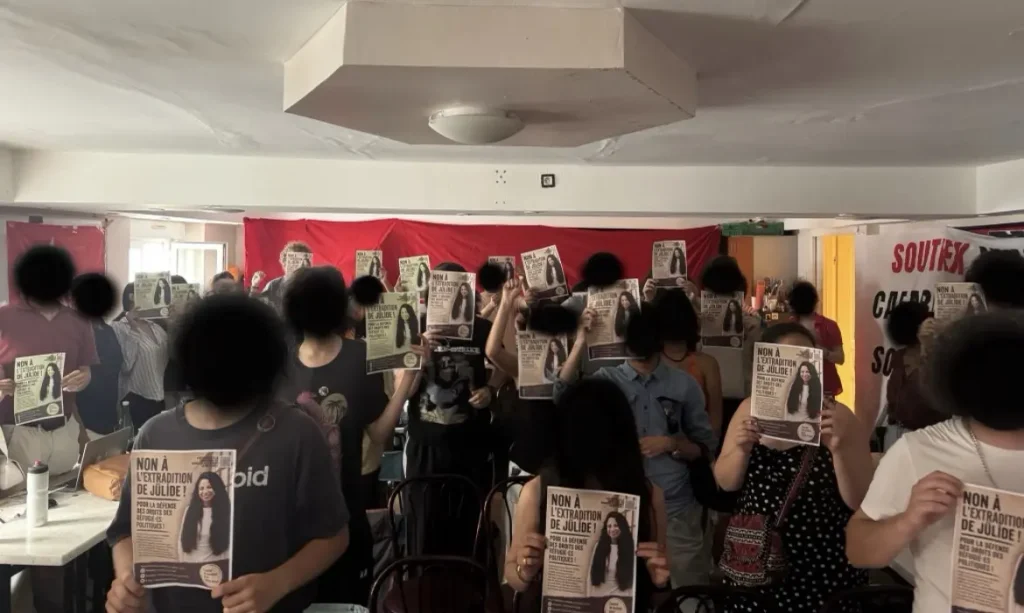
At the end of the conference, participants took a photo in support of Jülide Yacizi, a Turkish activist living in France who is currently imprisoned in Albania and facing extradition to Turkey. As it was time to part ways, discussions continued at length, first in the ACTIT courtyard and then on the sidewalk, despite the stifling heat. One participant then confided to our editorial staff, “In India, because of fascism, people are afraid to call themselves communists. But if you talk about communist ideas to almost anyone—especially young people—they’ll agree with you. People know what they must do—and what they need—to free themselves. Those who support the government remain a minority, often made up of vulnerable and isolated people whom the fascists take advantage of—a noisy minority because it’s sponsored.” Before leaving, we make a promise to ourselves: this event is a very successful first initiative, and it will lead to others very soon.
We cannot conclude without mentioning the speech Modi delivered on Saturday, August 15, to mark the 79th anniversary of India’s independence. Discredited by recent protests and cornered by uprisings from all segments of a population he nevertheless constantly seeks to divide, Modi still claims to be bringing the country’s youth into line, thereby enabling India to become a “developed nation” by its centennial in 2047. Yet, as the Communist Youth asserted in its statement, the generation rising up today is a youth that “refuses to be governed as before.” While he continues to claim to have eliminated the problem of “armed Naxalites,” India’s foremost fascist has no choice but to keep warning his supporters. The threat still looms, and now they must turn their sights on “mental Naxalites.” Like a weed from which one sometimes thinks one has pulled a few branches but whose roots remain firmly anchored, the youth of the world’s largest oppressed country now give us, too, every reason to believe that Modi and his Yankee masters are not done with the revolutionaries.