Imperialist Militarization of the Baltics
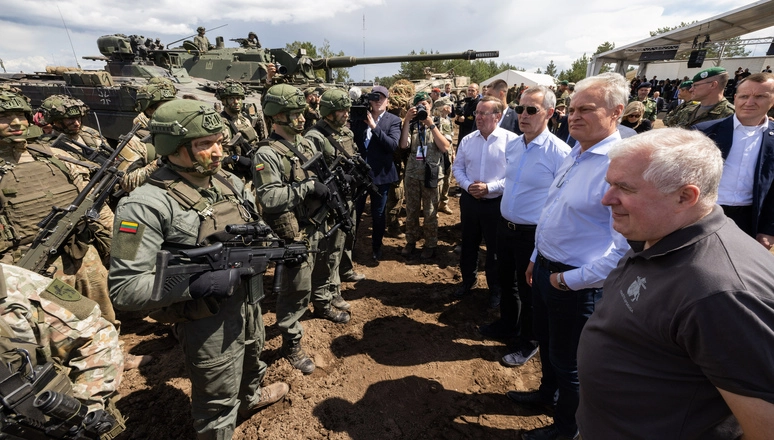
Featured image: The then NATO Secretary General Jens Stoltenberg, President of Lithuania Gitanas Nausėda, Minister of Defense of Lithuania Arvydas Anušauskas, and Minister of Defense of Germany Boris Pistorius meeting troops during the Exercise Griffin Storm 2023. Source: NATO/Iria news
While Yankee imperialism remains the dominant hegemonic force, the Baltic States have increasingly become a subject for German imperialism. Under the guise of regional security, Germany is leveraging the militarization of the Baltics to rebuild its own military and industrial capacity to expand its influence.
The Baltic States are strategically important to the EU and NATO because they form the northeastern flank, bordering Russia and, in Lithuania’s case, Belarus and the Russian exclave of Kaliningrad. The Baltic Sea has become increasingly integrated into NATO’s military planning, especially since Finland and Sweden joined. Ports, railways, undersea cables, energy grids, and airspace have become critical military and economic infrastructure. The region also connects Northern Europe with Poland, Scandinavia, and the wider EU through ports such as Tallinn, Riga, Ventspils, and Klaipėda, as well as through projects such as Rail Baltica and new electricity links.
The United States is still the dominant military force in the Baltics. German imperialism is increasing its military-industrial role, while Finland and Sweden possess especially strong economic influence, particularly in Estonia (Finland accounted for about 20% and Sweden for 11% of Estonia’s inward FDI stock in 2023). Sweden is particularly influential in banking, while Finland is prominent in trade, industry, telecommunications, and cross-border services.
The Baltic countries also heavily develop the tourism industry, with sectors specifically for sales and consumption of cheap alcohol, and the sexual exploitation of women. They are also an important source of migrant workers for imperialist powers in the region.
Militarization of the Baltics deepens the subjugation to imperialism
The war in Georgia, Russia’s annexation of Crimea and intervention in the Donbas in 2014, and Russia’s full-scale invasion of Ukraine in February 2022 intensified the militarization of the Baltic region. The invasion became the central justification for higher military budgets, expanded armed forces, larger reserve and conscription systems, and increased spending on ammunition, artillery, air defense, drones, intelligence, and military infrastructure. The war also encouraged the militarization of civilian society through “total defense,” including emergency exercises, civil-resistance planning, government-continuity measures, cybersecurity programs, and the integration of civilian infrastructure into military logistics.
Military spending in the Baltic states has risen sharply. Lithuania plans to spend 5.38% of GDP on defense this year, Latvia 4.92%, and Estonia 5.11%. All three Baltic countries rank among the very highest military spenders in Europe relative to the size of their economies. Lithuania, Estonia and Latvia are expected to spend more than the new NATO benchmark of 3.5% of GDP for core “defense”, despite the target not being required until 2035.
Their military expansion includes compulsory-service expansion, larger reserve systems, border fortifications, drones, expanded intelligence, cyber-monitoring, border biometrics, and information-sharing. In March 2025, all three countries announced their withdrawal from the Ottawa Convention, reintroducing the possibility of using antipersonnel mines. Latvia’s eastern-border fortification plan alone was estimated at 303 million EUR.
The Baltic States are acquiring artillery, ammunition, drones, air-defense systems, armored vehicles, missiles, and coastal-defense capabilities. They also purchase large quantities of US military equipment. In October, Estonia increased its spending limit for US weapons from $500 million to $4.7 billion.
The region’s military infrastructure is expanding rapidly to accommodate the shift toward permanent forward deployment. Lithuania is leading this buildup, committing billions to strategic facilities; this includes a 290 million EUR financing package for the Rūdninkai Military Campus and a €240 million modernization of the Pabradė Training Area to support the permanent presence of the German Brigade Litauen and other forces. To fund these expansions, Lithuania has secured a €400 million credit facility from the Nordic Investment Bank and has dedicated €1.1 billion over a ten-year window specifically for countermobility projects. Estonia continues its aggressive expansion, having spent $23.4 million on Camp Reedo—the first new military base since its independence—as part of a broader multi-year infrastructure plan exceeding $576 million. Latvia is similarly scaling up, with defense spending now pushed toward 4% of GDP to finance critical border fortifications and military-mobility projects.
NATO has substantially increased its military presence in Estonia, Latvia, and Lithuania. The original NATO posture consisted of three multinational battlegroups, each roughly battalion-sized—about 1,000 troops—led by the United Kingdom in Estonia, Canada in Latvia, and Germany in Lithuania. After 2022, NATO agreed to scale these formations up toward brigade strength when required. NATO also maintains continuous air policing over the Baltic States and is developing integrated air-defense networks against aircraft, cruise missiles, and drones. It has also expanded multinational exercises to test rapid reinforcement, mobilization, territorial defense, and the movement of forces through the region.
Estonia, Latvia and Lithuania are also building a joint Baltic defense line consisting of trenches, bunkers, observation posts, anti-armor obstacles, and surveillance systems along their borders with Russia and Belarus.
In January 2025, NATO launched Baltic Sentry. The operation uses naval forces, aircraft, drones, surveillance, and sensors to protect critical infrastructure. Militarization now extends across land, air, and sea.
German Imperialism
The War in Ukraine showed the weakness of German imperialism, as it was unable to protect it’s positions against the atomic superpower Russia. German imperialism has made significant advances in the Baltics, and is projected to spend €162 billion on its military in 2029, compared with €95 billion in 2025, and its new defense-spending target is 5% of GDP, having become the largest military spender after US, Russia and China.
Germany now has a permanent military presence in Lithuania for the first time since the Nazi occupation, having close to 1,200 German troops stationed there. Germany is transforming its original NATO battlegroup of roughly 1,000 troops into the German Brigade Litauen, a permanent armored brigade planned to field approximately 5,000 military and civilian personnel by 2027.
The brigade will include German forces and allied contingents from countries including Belgium, Czechia, Luxembourg, the Netherlands, and Norway. The German troops remain Bundeswehr forces, while the brigade functions as a German-led multinational NATO formation assigned to NATO’s eastern-flank plans.
Germany is using Baltic militarization to strengthen its own armed forces, increase weapons and munitions production. German companies – such as Rheinmetall, Airbus Defence, Diehl, Hensoldt, and KNDS – gather the profits from the increased militarization of the Baltics. The companies enjoy the widening markets, dependent customers, and cheaper labor. Rheinmetall, for example, has invested roughly €180–300 million in a Lithuanian facility to produce 155 mm artillery shells. The Baltic states provide land, subsidies, labor, public contracts, and a guaranteed military market, while foreign weapons industry retains the ownership, technology, and strategic control. Public money is used to build infrastructure for imperialist monopolies.
The United States remains militarily dominant – providing satellites, intelligence, airlift, missile defense, long-range strike capacity, logistics, command systems, and the extended nuclear deterrent – and is backing German imperialism in this project, while the latter is dreaming of decreasing its dependence on the US.
This sentiment is expressed also by the EU’s foreign policy chief, the Estonian poster child of pro-German imperialism, Kaja Kallas, as she urged to make NATO “more European, to maintain its strength.” Although this does not imply a break with the dependence on collusion with Yankee imperialism, it reveals the underlying contradictions between the sole hegemonic superpower and the smaller imperialist powers (mainly German).
Militarization deepens exploitation and oppression of the Baltics
Militarization deepens the dependence of the oppressed Baltic countries on imperialist powers. The purchase of weapons creates long-term dependence on suppliers for ammunition, spare parts, software, upgrades, training, repairs, and technical standards. Foreign military aid and investment shapes procurement priorities, basing arrangements, training, and military doctrine. The increase in militarization means increased taxation and the diversion of public funds from the public services toward military budgets, infrastructure, and so on.
In the Baltic states, security policy has also increasingly narrowed political and civil space. Estonia’s Parliament voted in March 2025 to amend the Constitution so that municipal voting is restricted to Estonian and EU citizens, excluding Russian and Belarusian citizens. Criticism of rapid militarization or NATO is increasingly portrayed by bourgeoisie media as “Kremlin” or “Putinist” influence rather than democratic dissent. These policies mean fewer political rights for some residents, greater repression of Russian-speaking communities and organizations, more limits on media and association, and increased State surveillance.
After Khrushchev’s counterrevolutionary coup, the Baltic countries became oppressed by Russian social-imperialism. The bankruptcy of social-imperialism in 1991 did not bring an end to national oppression, nor did it produce genuine national or social sovereignty. The Baltic bourgeoisie rapidly sold their countries to the European imperialists and Yankee imperialism.
The Social-imperialist exploitation of the Baltics is purposefully conflated with socialism, and EU and NATO are framed as the liberators of the Baltics from “communist rule,” equating anti-communism with national sovereignty, military preparedness, and loyalty to the “West.” Militarization in benefit of imperialism is portrayed as liberation, alignment with Germany and NATO as independence, and criticism of the dominant security framework as a threat to Baltic survival. This is used as psychological warfare, with the purpose of molding the public opinion in favor of increasing the militarization of the Baltics and deterring genuine anti-imperialist struggle.
Conclusion
The ruling classes of Baltic countries justify militarization and the limitation of rights with the threat of Russia, in order to advance its encirclement of Russia in the service of mainly Yankee imperialism, thereby deepening the plunder of the Baltic. The popular masses of the Baltic countries are made to bear the brunt of the cost of imperialist militarization in the service of both Yankee and German imperialism, while imperialist war industry profits from the growing markets and exploitation of the workers in the Baltics.
Militarization is strategic preparation for an inter-imperialist war (imperialist world war), but more urgently it serves only to deepen the exploitation of the people in the Baltics, and pushes the cost of the imperialist wars onto the shoulders of the working class and other oppressed classes in the oppressed nations. Genuine peace and security in the Baltics would require genuine sovereignty for the Baltic countries, which cannot be achieved under any imperialist subjugation.