Workers Struggle Against Super-exploitation and Repression in Bangladesh
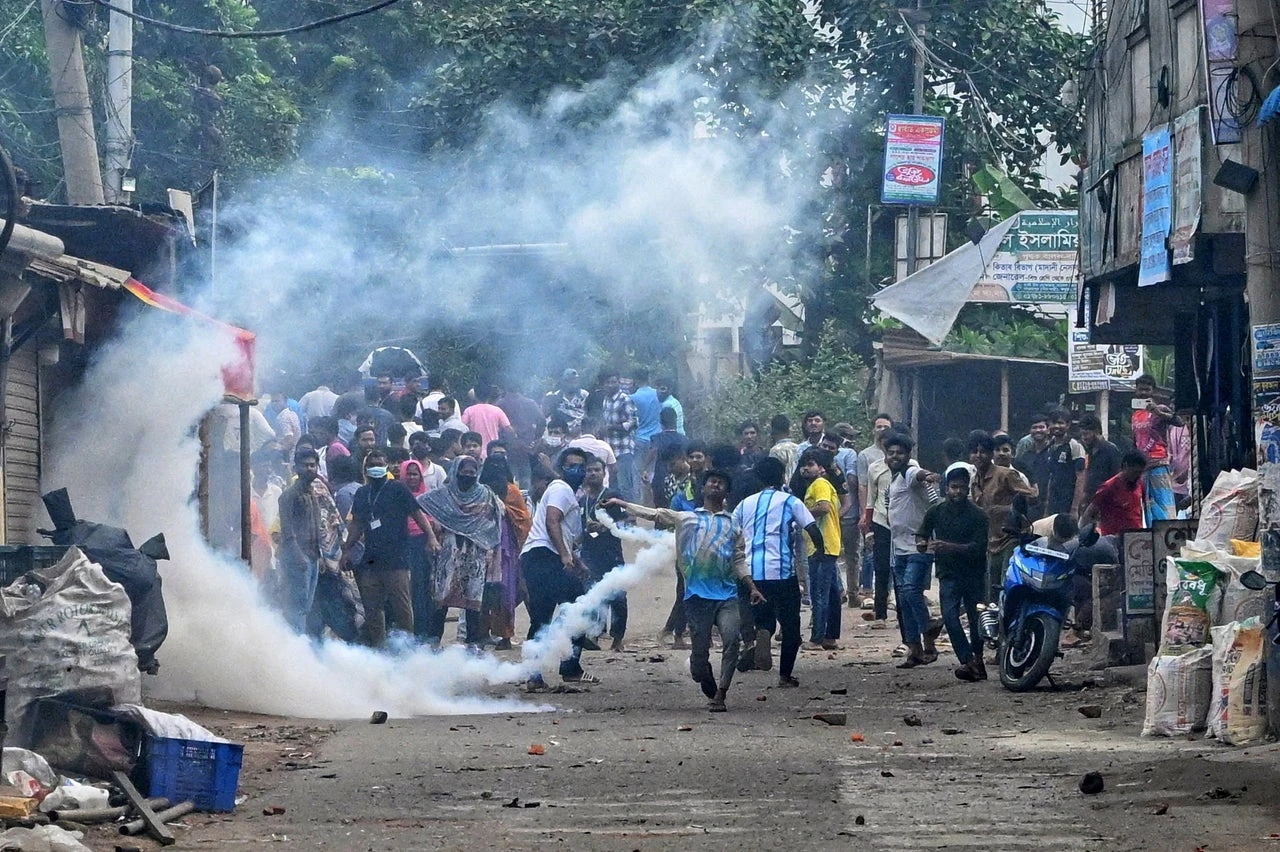
Featured image: A demonstrator hurls back a tear gas shell fired by police following a clash between the police and garment workers protesting for higher wages, in Narayanganj, Bangladesh, November 4, 2026. Source: Reuters
Bangladesh declared its formal independence on December 16, 1971. In the constitution of the then recently from Pakistan seceded country, “socialism” was written as foundational principle, alongside nationalism, democracy, and secularism. In this sense an typical example of a coperative regime, dominated by the bureaucratic faction of Big Bourgeoisie. Industry left abandoned after the war was nationalized but this policy was very soon abandoned with successive reforms – with heavy pressure from imperialist organizations such as the IMF and World Bank – and the economy subjugated to imperialist interests. The “Textile export boom” followed soon after.
Today, Bangladesh is the second-biggest clothing exporter globally, after China. Bangladesh’s ready-made garment industry made 39.35 billion USD in 2024–25, which is about 81% of its total exports. The workforce is commonly estimated at around four million people. A majority of the garment and textile workers stem from the landless poor peasantry. An IFPRI summary reports that the six largest landlords command one-fourth of the country’s land.
The clothes are made almost exclusively for international monopolies in Bangladesh’s 4,000 factories, this includes H&M, Inditex, Primark, Uniqlo, Marks & Spencer, Next, Walmart, and so on. The European Union is the largest market when counted together; while the United States is the largest individual-country market.
Textile workers’ protests and heinous State repression
The workers in Bangladesh are among the lowest-paid in the world – They are not just struggling to get by; they often cannot survive without taking loans, overtime, and receiving remittances (32.8 billion USD nationwide). The workers are paid even less than what is needed to reproduce their own labor power – a typical example of super-exploitation. Many also work for less, as even the minimum wage is often not enforced. The workers face poor maternity rights, poor workplace safety and harassment. Child labor is also used, especially in subcontracting factories.
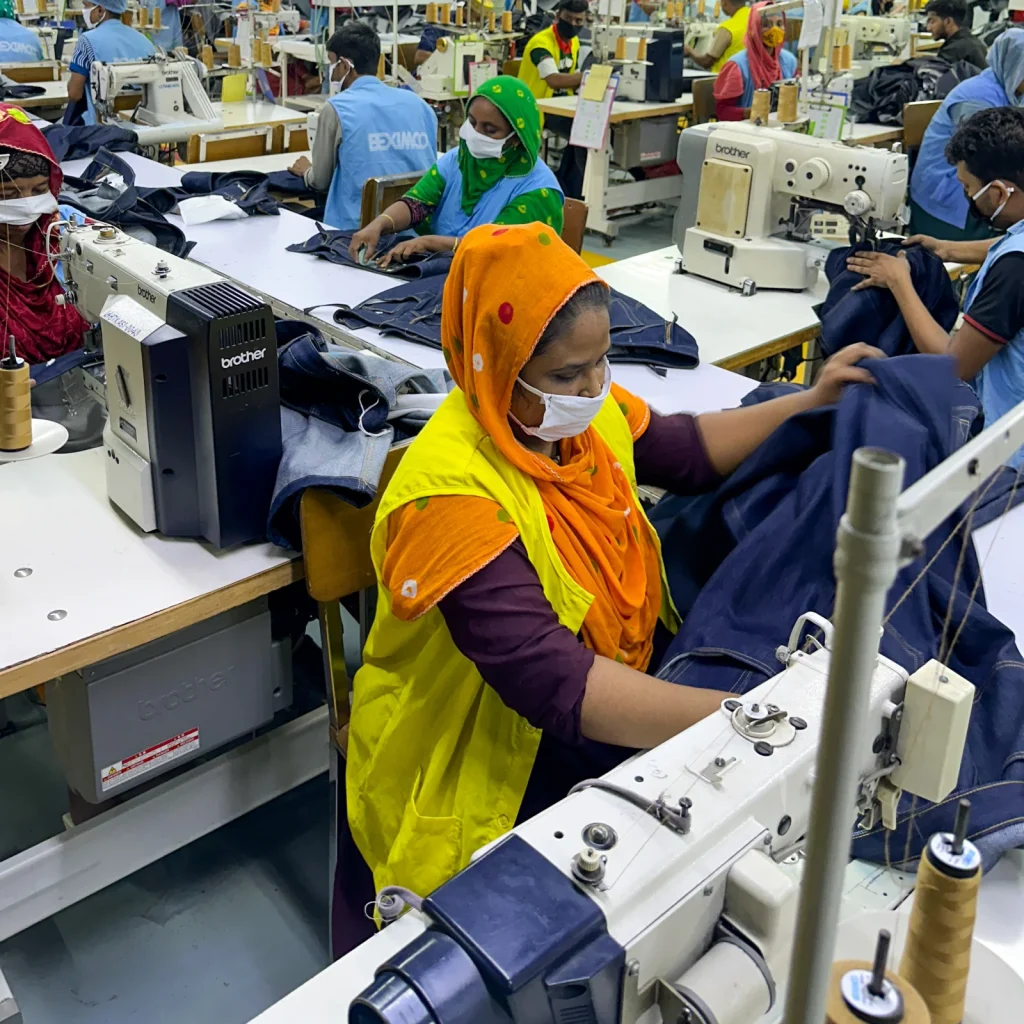
Garment worker in Bangladesh. She sews pockets on about 90 pairs of jeans an hour. The jeans will sell for about 50 USD each. She earns $134 a month. Source: NPR
Tired of low pay and rising cost of living thousands of workers took to the streets, in November, in Dhaka and nearby industrial areas. The protests intensified on Saturday, November 1, as workers demonstrated over low pay and the rising cost of living. The central demand has been a monthly minimum wage of 30,000 taka (around 246 USD), more than twice the current minimum of 12,500 taka (around 100.37 USD). It is worth noting that even a 30,000 taka minimum would still be a far cry from an actual living wage, and the current minimum has been further eroded by inflation.
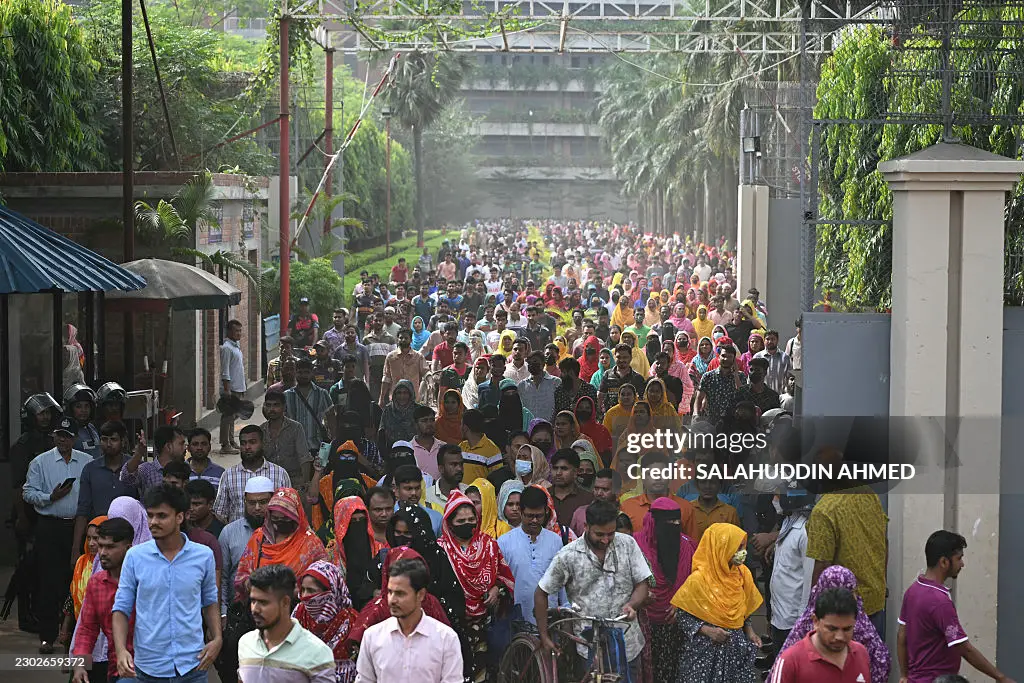
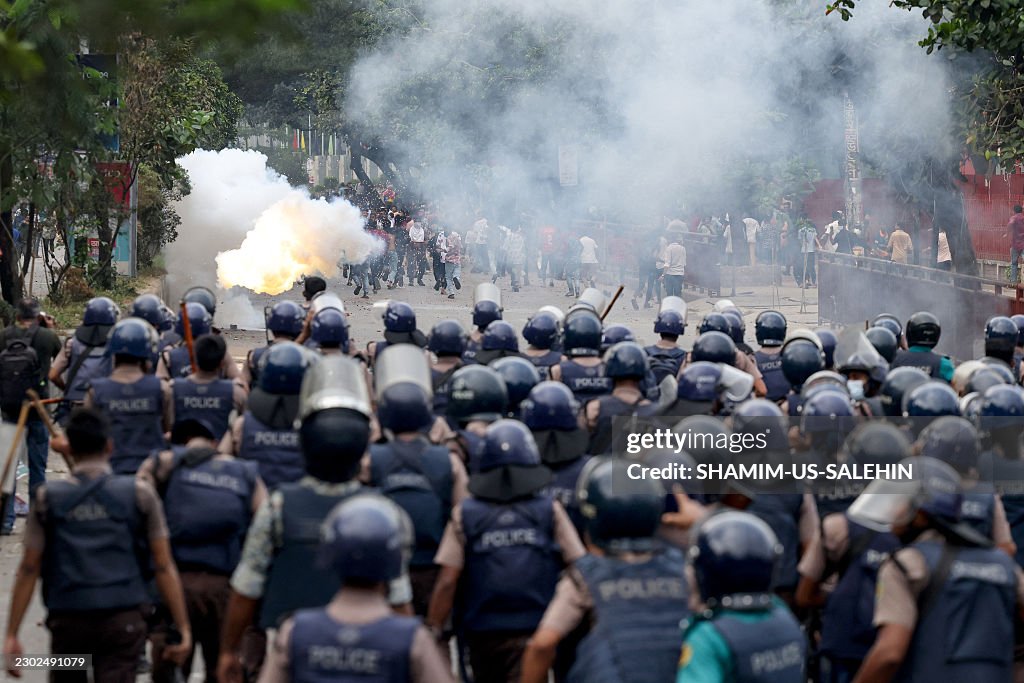
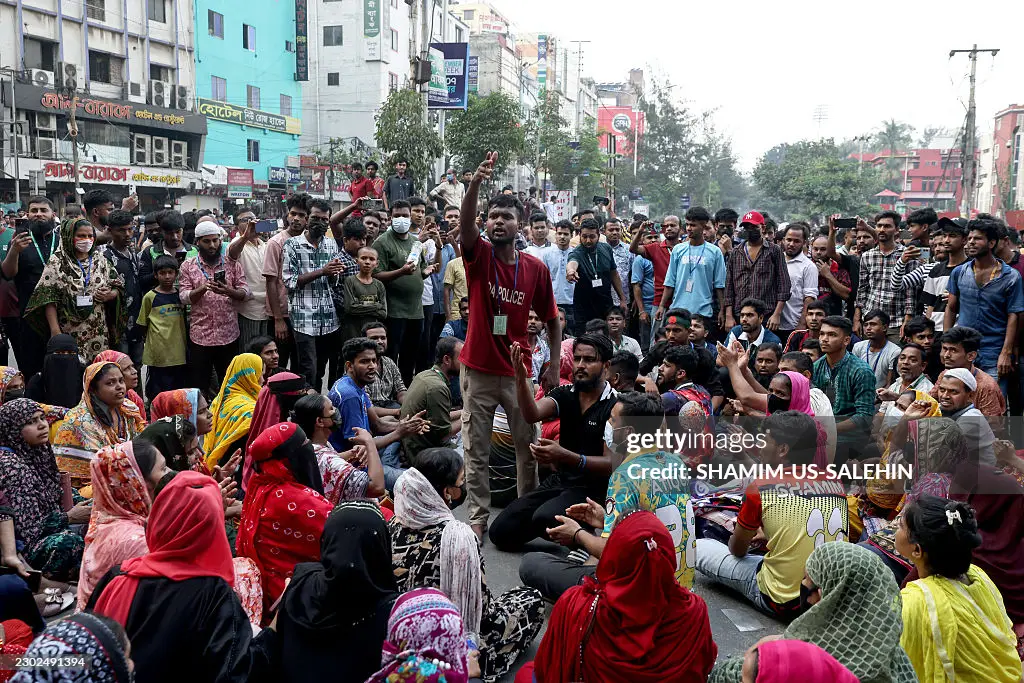
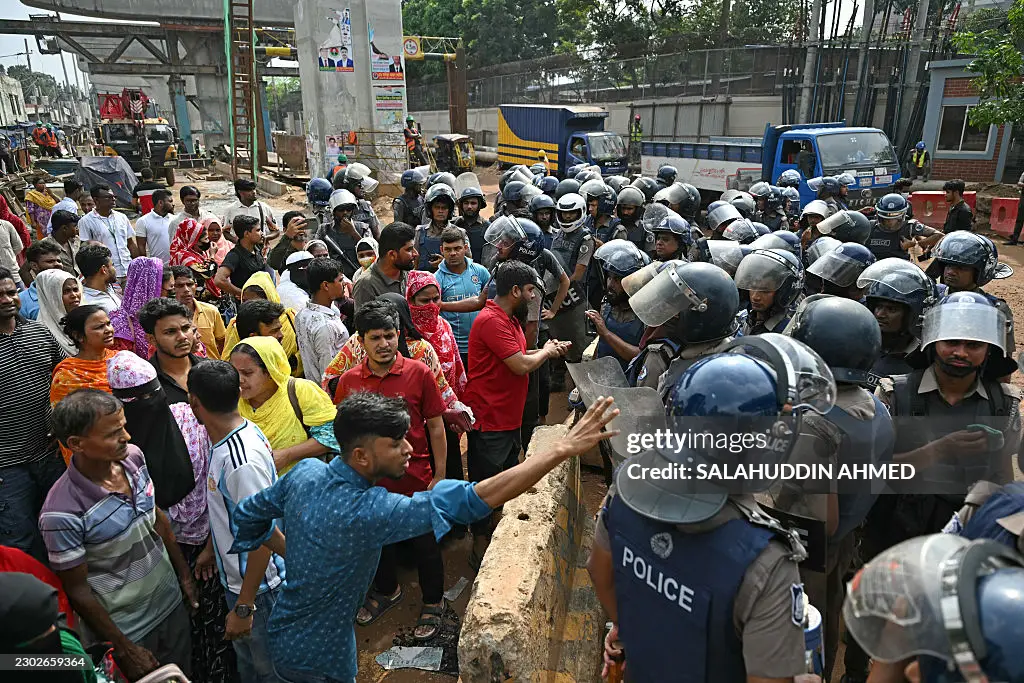
Textile workers protest demanding higher minimum wages in Dhaka on November 1-2, 2026. Thousands of Bangladeshi garment workers blocked a major highway and clashed with police on November 2. Source: Getty Images
The demonstrations spread across industrial areas, including Dhaka, Mirpur, Savar, Ashulia, and Gazipur. Workers blocked roads and staged walkouts, disrupting production and transport, and fought with police. Reportedly, more than 500 factories have been temporarily closed.
Police have used tear gas, beatings, arrests, and stun grenades to repress the protests; they have also used water cannons against the protesters. A wage-review board was formed, with worker (trade-unionist), employer, and government representation, but workers have continued protesting, knowing that the board’s creation does not guarantee a substantial increase.
A 21-year-old garment worker was murdered during State repression of the protests in Gazipur. Relatives say that he was beaten while trying to film an attack near a factory. Police used tear gas and stun grenades during the clashes.
Revolutionary Students’ Unity is one of the organizations active in these struggles. In a march on November 4 organized by them was carried out, with demands that included justice, compensation for the family of the murdered garment worker, a 30,000-taka minimum wage, an end to police searches and intimidation, and the unconditional release of detained workers. Members of the Revolutionary Workers’ Movement and Revolutionary Student-Youth Movement were arrested by EPZ police while putting up posters supporting the garment-worker movement. The People’s Democratic Students Unity demanded their immediate, unconditional release and condemned the arrests.
Bangladesh’s textile-worker protests have repeatedly turned demands on wage and precarious working conditions into wide popular action. In 2010, workers carried out strikes, factory pickets, road blockades, and fought the police. After months of revolt, the government partially gave in, and the garment-sector minimum wage was raised to 3,000 taka (comparable to around 43.07 USD in 2010), though workers continued protesting over the lack of its implementation and adequacy. The 2013 Rana Plaza collapse, which killed more than 1,000 people, made factory safety and accountability central to labor activism and helped spur the Bangladesh Accord on Fire and Building Safety.
Militant protests – including road barricades, stone-throwing, factory damage, and arson – have accompanied demands for better pay, and police repression has been strong. In 2023, workers went on strike and demonstrated for a 23,000 taka minimum wage (around 213 USD in 2023). The government conceded to the current minimum of 12,500 taka, much lower than what was demanded. At least three workers were shot by the police during the protests.
The repression faced by the workers is not limited to arbitrary police violence in strikes and protests.
Union Activists are persecuted and murdered. Amnesty International, among others, reviewed multiple incidents in which police charged thousands upon thousands of workers after a protests, shooting, and beating the workers in an attempt to silence them. In one account directly from the police, officers were said to have used 215 shotgun rounds, 127 tear-gas shells, and 52 stun grenades to disperse demonstrators blocking a highway.
There has also been prominent examples of murders of union leaders. A garment-worker organizer and union leader disappeared in 2012 and was found dead two days later, with evidence of torture before his murder. He had worked on labor-rights issues and factory disputes. The president of a garment-workers’ federation district committee was beaten to death after seeking payment of workers’ overdue wages and an Eid bonus at Prince Jacquard Sweater Ltd. Three other organizers were also injured. More often than not the criminals behind the murders enjoy the impunity of the State and only the hired goons might face legal consequences – As is the case with both of these examples.
The previous government of Sheikh Hasina has been shown to be guilty of forced disappearances and mass murder to silence any opposition. The government led by her Awami League (AL) Party was forced to dissolve and Sheikh Hasina herself to flee the country after the fierce popular student uprising in 2024, where masses famously celebrated her cowardly escape by entering her residence. After this the the army chief announced the resignation and plans for an interim government; the interim government was subsequently formed under Muhammad Yunus.
Read more in our article on it:
Bureaucratic capitalism and the interim lackey government
The shift toward privatization began in the late 1970s. The structural adjustment was formalized in the 80’s under the programs of the IMF, and Bangladesh Nationalist Party (BNP) and since then AL has continued in the path of developing bureaucratic capitalism in the service of imperialism.
The lackey and country-selling policies and worker repression are not the work of one government. The BNP government – hailed by some as the change after the brutality and arbitrariness of Sheikh Hasina – is no less of a lackey government, nor can it offer any meaningful change for the popular masses of Bangladesh, but what they do continue to guarantee is the personal overlap of people holding executive power and those within the garment industry and other monopolies.
The penetration and subjugation by imperialism in Bangladesh has been advanced in several ways. This includes the plan of Yankee imperialism to deepen the militarization of Bangladesh as part of it’s larger Indo-Pacific strategy. This includes growing military subjugation to the United States, recurring high-level defense talks, training exchanges, wider use of shared military technology, and joint exercises. In November 2026, for example, the two air forces began Exercise Cope South in Dhaka, with US-sponsored training on C-130J operations, logistics, airfield security and emergency response. All of which further tie the Bangladesh to US military doctrine and technology. As part of this two military agreements are currently being negotiated.
From the economical side, the US and Bangladesh announced a trade agreement in February 2026. Under its terms, the US keeps a 19% tariff on most Bangladeshi goods, while Bangladesh promises preferential access for many US exports, including agricultural products, machinery, and energy. The special zero-tariff route for Bangladeshi clothing is tied to using US-produced cotton or man-made-fiber.
The agreement includes commitments on imports, digital data transfers, intellectual property, environmental and labor rules, and economic-security cooperation. This makes Bangladesh more subjugated to US industrial, digital, and trade policies, while opening markets for US firms and securing purchases of US goods. This means guaranteed market access for the US.
With the EU, Bangladesh has duty-free, quota-free access under its Everything But Arms (EBA) scheme. Both mean more leverage.
The landlord-bureaucratic State of Bangladesh also relies on IMF “financing”. In 2023, the IMF approved a multi-year package of about 4.7 billion USD in loans and climate-related financing; in June 2025, it approved further access under the program. These are loans with policy conditions, which for the Bangladeshi State have centered on “stabilizing the economy and strengthening public finances”. They include raising tax revenue, including broadening VAT and reducing exemptions, limiting subsidies, keeping monetary policy tight, and allowing “more flexibility in the exchange rate”. The IMF has also called for restructuring weak banks, reviewing their assets, improving transparency and governance, and strengthening anti-corruption and anti-money-laundering measures. The IMF has said the new framework would involve phased reforms, including revenue mobilization, subsidy rationalization, exchange-rate flexibility, and banking-sector restructuring. All of this means easier penetration of foreign monopoly capital, an intended centralization of the bureaucratic capital, and most importantly, a full assault on the living conditions of the masses.
The comprador bourgeoisie who control the garment industry are commanded to adopt “greener processes” by the imperialists. The costs are funded by for example loans from international entities such as The International Finance Corporation (IFC), which announced a 100 million USD loan package for EPIC Group’s textile operations, including upgrades to energy- and water-saving equipment. Public funds are also directed to infrastructure that benefit imperialist monopolies.
The comprador bourgeoisie are servants of their foreign masters, who demand low cost of production. The power these imperialist monopolies have was clearly seen in 2020, when buyers canceled orders or simply refused to pay for them during the lockdowns in Europe and the US. This temporarily shut down most factories in Bangladesh. Bangladesh is also dependent on imports of raw materials, energy, and technology, which majorly affects the textile and garment sector.
This is subjugated capitalism – industrial growth tied to decisions made by imperialist monopolies, with Bangladesh’s big bourgeoisie acting as the local organizer, enforcer and beneficiary. The impositions of the institutions of imperialism (like IMF) have lowered the importance of the fraction of the big bourgeoisie which center in the “public sector”/State monopolies (its bureaucratic fraction) and strengthen the one that centered on the “private sector”/Particular monopolies (its comprador fraction). Beximco and BGMEA – the Bangladesh Garment Manufacturers and Exporters Association – are clubs serving bureaucratic capitalism.
A 2026 study of Bangladesh’s “market state” reported that “businesspeople” made up about 70% of Parliament by 2024, and argued that State power increasingly facilitated accumulation to the big bourgeoisie.
There is broad personal overlap between the big bourgeoisie and political office, and organized employer influence over executive policy and regulation. A 2024 report identified numerous garment-sector owners who won seats in the 12th Parliament. It listed, among others, Tipu Munshi, a garment-company managing director, and commerce minister, who promoted expanding garment exports to the United States; Salman F. Rahman, vice-chairman of Beximco and a former prime ministerial adviser; and other factory or group owners elected as MPs.
Research on private-bank governance describes closely held ownership, political patronage, and insider lending. It also reports that failing banks have received government support or recapitalization at public expense. In addition other types of corruption are widely known.
The ruling classes of Bangladesh enjoy near perfect impunity for their crimes of corruption and even the murders of union leaders and other popular activists. The State, as a tool for bureaucratic capitalism, enforces strict repression to control rebelling workers. But this also means that the system of bureaucratic capitalism that imperialism reproduces in Bangladesh is not sustainable.
The national bourgeoisie is under pressure in the textile and garment industry, as subcontractors of monopolies, are unable to compete, or sometimes even get loans. Working conditions are often the most dire in subcontractor companies, which do not implement safety improvements.
This was in part the case in the Rana Plaza incident. Subcontracting also allows monopolies in both Bangladesh and imperialist countries to “fulfill” the demanded green and human-rights certifications without any concrete changes to working conditions that would require expensive measures. We see this also in the blatant dismissal by imperialist monopolies of the previously mentioned Bangladesh Accord, which has changed nothing and has required forceful actions from unions to move at all, showing once again that for monopolies human life or environment is nothing unless it comes in the way of extracting profits.
The expansion of Bangladesh’s textile and garment industry has been built on the total deprivation of the broad masses, who will continue to not even be able to afford the clothes they make, let alone see any of the riches they have produced. Bangladesh’s industry and economy remain subordinated to imperialism, while the garment sector’s success rests on keeping labor cheap. The development of bureaucratic capitalism deepens the pauperization of the people: assembly lines move faster, employ fewer workers, and inflation further erodes workers’ real wages.
Cheap labor breeds strikes. Imperialist monopolies threaten to withdraw or pull out; the State brutally represses workers’ discontent or, at most, grants concessions after arduous, militant struggle. Even then, these concessions and reforms are often not fully or at all implemented.
Bangladesh shows not only that bureaucratic capitalism is unsustainable, but that imperialism, in developing it, is also creating its own gravediggers.