Brazil – AND: Victory of the People’s Struggle – 6-for-1 Work Schedule Repealed
We hereby share an unofficial translation of an article published by A Nova Democracia (AND) on October 15.
Victory of the People’s Struggle – End of the 6-for-1 Work Schedule is Approved, but Mobilization Must Continue to Guarantee Rights
After years of popular mobilization, the Senate approves a 40-hour work week with two days off, without a reduction in pay. The National Confederation of Industry (CNI), the Federation of Industries of the State of São Paulo (Fiesp), and the far right are orchestrating attacks on this achievement, while labor-conscious organizations defend the continuation of the fight for a 36-hour week and against labor counter-reforms.
The Brazilian masses achieved an important victory for their rights by forcing the Senate to approve, on October 14, Constitutional Amendment Proposal (PEC) 221/2019, which puts an end to the grueling 6-for-1 work schedule. The bill will now be enacted after receiving 75 votes in favor and only one against in each of the two rounds of voting. This constitutional change is the result of intense worker mobilizations over the years, and not a gift from the corrupt, suited members of Congress.
The bill establishes a paid weekly rest period of two days for workers, one of which should preferably be on Sundays, without a reduction in salary. The transition will be gradual: the weekly limit will drop from 44 to 42 hours two months after the amendment is published and will reach 40 hours at the end of 14 months. During the session, the president of the House, Davi Alcolumbre (União Brasil), cynically declared: “I am absolutely certain that we will fulfill our duty with absolute responsibility, thinking, above all, about what is best for our country.” The statement came after months of delaying the vote. Even after receiving the bill at the end of May, following its approval by the Chamber of Deputies, Alcolumbre held back the plenary’s vote until after the first round of the electoral farce.
The legislative process followed a special schedule, made possible by a request from the leadership that waived the three debate sessions of the second round. The proposal, authored by Representative Reginaldo Lopes (PT), was reported on by Senator Omar Aziz (PSD), who stated from the floor: “I have heard many speeches here that focused specifically on certain issues, but I am very pleased that the Senate will vote unanimously in favor of the constitutional amendment. We are making history, the House and the Senate.” The only vote against the amendment, in both rounds, came from Senator Hamilton Mourão (Republicanos), a retired general who participated in the coup and former vice president under Jair Bolsonaro, who did not speak during the more than five hours of discussion.
The victory was born in the street demonstrations.
The partial victory in Congress stemmed from the unrest in the streets, fueled since the creation of the Life Beyond Work Movement (VAT) in 2023, which gave greater visibility to a long-standing demand of workers.
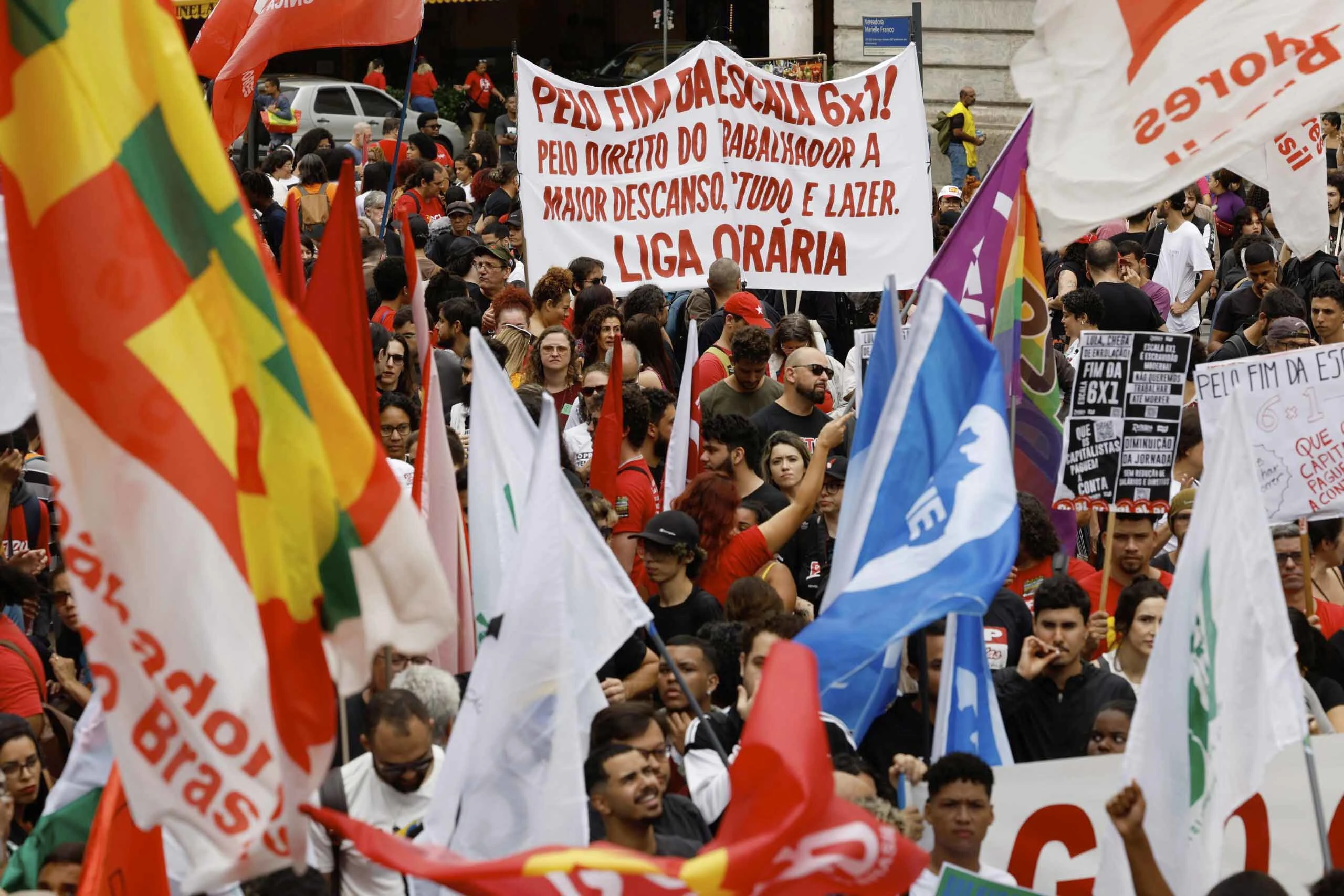
The mass revolt spread into major urban centers in November 2024, when a online petition gathered millions of signatures calling for an end to shift work. The demand continued in the 1st of May demonstrations of 2025 and 2026 and in the national mobilization day of June 30, 2026, which called for demonstrations in 21 cities across 14 states and the Federal District. In Rio de Janeiro, hundreds of demonstrators marched for about six kilometers, including sections of Avenida Brasil, bringing together popular and labor movements. The pressure intensified in October, when even the far-right Bolsonaro supporters publicly backed down from their opposition to the proposal.
Cashier Fátima Dantas de Souza Alves, a 22-year-old black woman who works standing for 8 hours a day, expressed her exhaustion, stating that she seeks “Time for physical and mental care, for my home, for my family, to spend more time with them. Today I don’t have quality time with my family. I don’t have time to take care of my health.” Her testimony reflects the reality of the 65.8% of workers tied to shift work in 2022, of whom 82% received less than two minimum wages.
Her testimony reflects a widespread reality. According to a survey by Lagom Data for CartaCapital , 65.8% of formal contracts in effect in 2022 stipulated workweeks exceeding 40 hours. Among retail and service workers subject to the analyzed workweeks, 82% earned less than two minimum wages.
Exhausting workdays also take a toll on workers’ health. A survey by the National Association of Occupational Medicine (Anamt), using data from the National Social Security Institute (INSS), recorded 393,670 benefit claims for mental health disorders between January and November 2025. Specific cases of burnout rose from 1,760 in 2023 to 6,985 in 2025.
Following the vote, CUT (Central Única dos Trabalhadores – Unified Workers’ Central) stated that this achievement “is neither a concession nor a gift from the elites” and advocated its application in every workplace and in collective bargaining. On October 15, Renata Setúbal, from Sindipúblicos of Espírito Santo, also warned that “the struggle continues,” in light of proposals for flexibility through hourly contracts.
The threats from the big bourgeoisie and the far right.
Representatives of big capital are already mobilizing against this achievement. In a statement following the vote, the National Confederation of Industry (CNI) lamented the approval and argued that Congress should should revisit the issue. FIESP, chaired by Paulo Skaf, insisted on calling the proposal a “vote-buying” amendment, claiming that the vote should take place outside the electoral calendar. The employers’ complaints accompany the effort to undermine the newly approved right.
Despite Flávio Bolsonaro’s (PL) public backtracking, reports published by the media monopoly Folha de S.Paulo and by ICL Notícias indicate that the candidate is already preparing a revision of the measure. In communication with representatives of financial capital, members of his economic inner circle, including Daniella Marques, conveyed the intention to revive proposals to relax the rules in 2027. The plan relies on the pro-Bolsonaro bloc in the next Congress to undermine the gains made in reducing the workweek.
The legislative instrument for this maneuver is already before the Senate: Constitutional Amendment Proposal (PEC) 12/2026. Presented by Flávio’s campaign coordinator, Rogério Marinho (PL), and endorsed by the presidential candidate himself, the proposal allows individual contracts with pay and benefits proportional to the hours worked, maintaining the 44-hour weekly limit.
Flávio tried to present this threat as an advantage during the campaign: “I will vote in favor of ending the 6-for-1 system. But we advocate for something even better.” At an MDB forum, he did not rule out changes and stated that the model “has to be discussed very calmly, very responsibly.” He also indicated where he intends to seek changes: “The regulations themselves will have to address this, and Congress will discuss it.”
The subservience of lawmakers to the interests of big capital was evident in the stance taken by former astronaut and Senator Marcos Pontes (PL), who, as someone who had just returned from space, argued: “I believe that people should work as much as they feel they need to. Work one day, two days, or even seven days—because my child was just born and I need to make more money.” Along the same out-of-orbit lines, Senator Carlos Portinho (PL) declared: “For all these rights to be valid, there needs to be employment. The country needs to produce, generate wealth, and distribute that wealth among society.”
Senator Vanderlan Cardoso (PSD) also defended hourly contracts: “Flexible work schedules offer hourly wages, at the worker’s discretion, with a written agreement. Under this arrangement, workers can set their own schedules, with guaranteed vacation time, a 13th-month bonus, FGTS (Brazilian severance fund), and social security, and with hourly pay never falling below the minimum wage or the sector’s minimum rate.”
The opportunism of the federal government
While big business conspires behind the scenes in Brasília, alongside the far right, to undermine the gains in labor rights, the opportunistic government of Luiz Inácio (PT) maneuvers to reap the electoral benefits of the mobilizations. The media owned by the magnates is playing along with the campaign to exalt the PT government. This propaganda obscures the downgrade negotiated by the government itself with congressional leaders, which replaced the demand for a 36-hour workweek with a 40-hour limit.
The version approved by the Chamber of Deputies in May and upheld by the Senate also allows for differentiated work schedules, such as a 12-hour work shift followed by 36 hours of rest, subject to compensation. In such cases, the 40-hour weekly limit and the monthly average of two days of rest per week must be respected. Regulation and enforcement will be new battlegrounds to prevent exceptions from undermining this achievement.
In a message to the National Congress in February, Luiz Inácio declared: “Our next challenge is to end the 6-to-1 work-to-rest schedule, without reducing wages. Time is one of the most precious assets for human beings. It is not fair for a person to work hard all week and have only one day to rest their body and mind and spend time with their family.” His government, however, maintained the labor and social security counter-reforms, despite promises to reverse the attacks on workers’ rights.
Prepare for the General Strike!
The formal adoption of the reduction does not, in and of itself, guarantee the permanence of this right. The proposed revisions for 2027 and attempts to relax the rules demonstrate the need to continue with independent mobilization, enforce compliance with the new guarantee, and advance our demands.
Since November 2024, the Workers’ League has advocated for the immediate implementation of a 40-hour work week, without a pay cut, and a schedule for a gradual reduction to 36 hours. The organization linked this struggle to the repeal of the labor and social security counter-reforms and to the preparation for the General Strike of National Resistance.
Union leader Magrão, from the Workers’ League, warned in a debate promoted by AND in May: “When the masses start taking to the streets, they go to parliament to discuss this in a way that makes it seem like parliament is going to solve things.” Defending the independence of the movement and the broadening of its demands, he stated: “It’s not enough to change the government, it’s not enough to change things if we don’t change economic policy.”
The Workers’ League’s statement called for the massive mobilization of rural and urban workers as the only way to secure the people’s rights, “promoting the path of the General Strike of National Resistance to overthrow all these anti-people, treasonous, and obscurantist measures that obey the historical logic of exploitation and oppression of our people and subjugation of the nation.”