Ansar Allah Gains Ground in Yemen as Yet Another Thorn in the Side of Yankee Imperialism
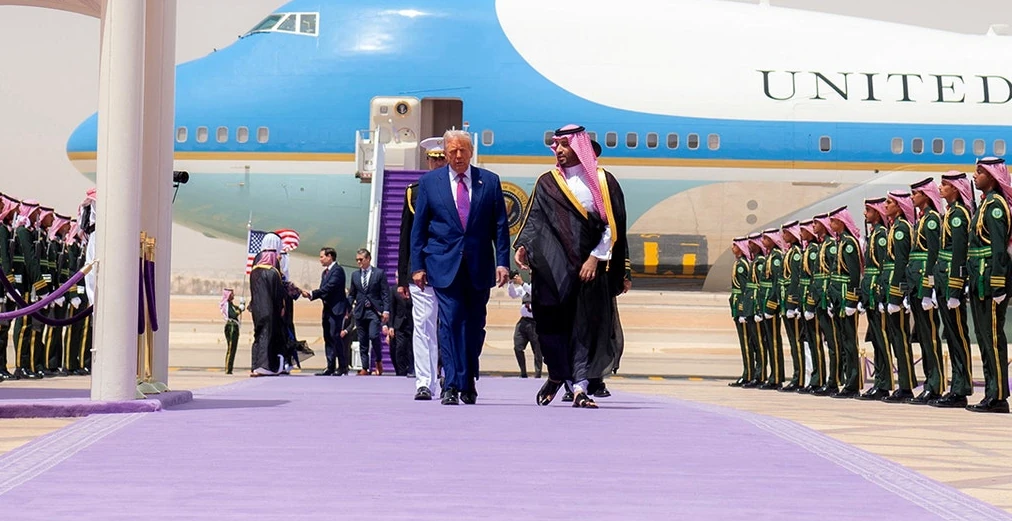
Featured image: US President Donald Trump and Saudi Crown Prince Mohammed bin Salman. Source: Reuters
On September 3, Ansar Allah, also known as the Houthis, launched an offensive against the port city of Mokha and the surrounding south-western coastline of Yemen, including Perim Island, fielding some 80,000 combatants in the operation. After a week, the offensive was successful, and Ansar Allah effectively assumed control of Mokha, the Bab al-Mandeb strait and the Red Sea coast, which much like the Hormuz strait fields a big share of the global shipping traffic.
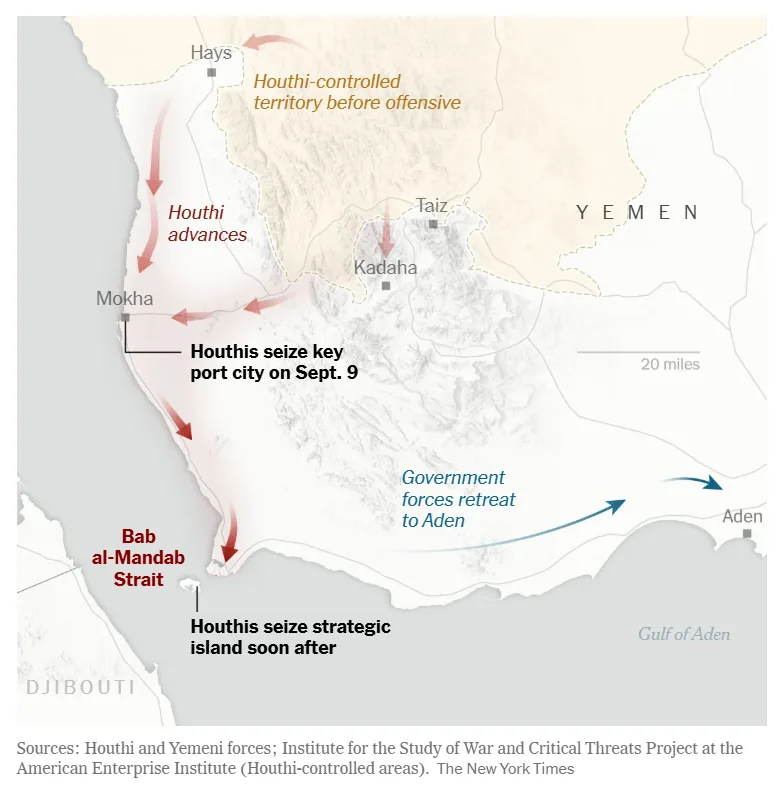
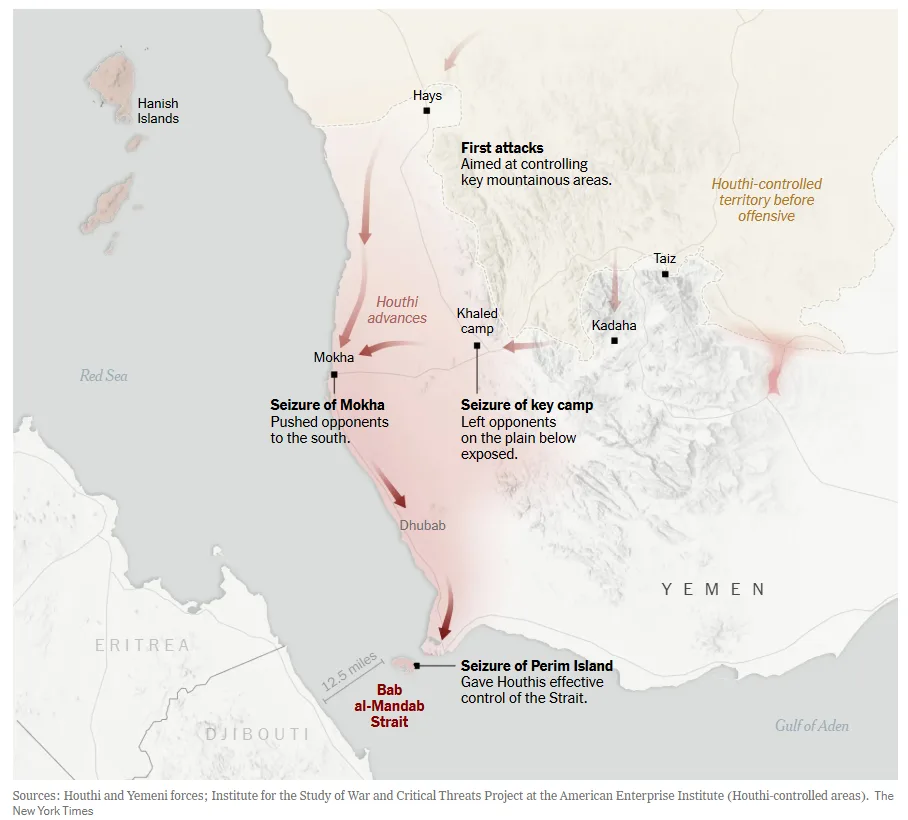
So far, the Ansar Allah forces seem to be holding its ground against the Yemen Armed Forces (YAF) –led by the lackey Saudi Arabia backed Presidential Leadership Council (PLC) – and maintains its hold over the port city of Mokha. PLC forces have however reportedly retaken some positions surrounding the Bab al-Mandeb strait. This advance by Ansar Allah comes after a series of shifts in the military and economic situation in the region, due in part to the ongoing war of aggression on Iran by Yankee imperialism, in which Yemen and Saudi Arabia also plays a part, but also in earlier developments involving an offensive in Yemen from the United Arab Emirates (UAE) – also in service of Yankee imperialism.
History of the struggles of Ansar Allah and the people of north western Yemen
Ansar Allah originally grew out of the the northern Yemen Zaydi Shia populace. The northern region of Yemen was and continue to be one of the poorest regions of Yemen, and at the time, in 2004, it was also lacking in any form of cohesive governance. The Zaydi populace was opposed to the then- Saleh government for many reasons, one such reason being the political marginalization imposed on the people in northern Yemen, another was the populace’s opposition to the government’s support of and cooperation with Yankee imperialism’s policies, especially the Yankee war of aggression on Iraq in 2003. This discontent was mobilized by Hussein al-Houthi in the at the time growing so-called Believing Youth.
In 2004, after the attempted arrest of al-Houthi by the then- Saleh government, the Zaydi movement resisted the arrest, and rose up in rebellion against the government. At some point during these struggles, the armed movement known today as Ansar Allah took shape. Since then, Ansar Allah was in constant clashes with the “offical” government. Saleh resigned from government after massive popular demonstrations in 2012 against the widespread poverty and corruption of the Saleh government, and was followed by the government of Abdrabbuh Mansur Hadi, openly supported by Yankee imperialism.
During mobilizations against the surging fuel prices in 2014 – driven by pressure from the International Monetary Fund (IMF) to cancel fuel subsidies – a popular revolt led by Ansar Allah, in a temporary alliance with the former Saleh government, eventually advanced on the capital Sanaa and captured key government buildings – forcing Hadi and his government to flee to Aden. After a year of a UN-brokered shared rule, Ansar Allah formalized their takeover and dissolved parliament, announcing a transitional governing council in 2015, while Hadi continued to rule from Aden.
In the following period, the temporary military alliance between Saleh and Ansar Allah slowly broke down, and culminated in Saleh turning against Ansar Allah in 2017, organizing an attempted coup.
After the military defeat of the coup by Ansar Allah forces, Saleh was killed, and Ansar Allah assumed sole control of north eastern Yemen. Ansar Allah continued clashing with the so-called “internationally recognized” government of Hadi until its transition in 2022 into what it is known as today, the Presidential Leadership Council (PLC).
The swift exit of UAE and a wounded Yankee imperialism compounds the strategic edge of Ansar Allah’s offensive
Late last year on December 2, the Southern Transitional Council (STC) – a UAE backed faction in Yemen seeking the creation of an independent State in the south of Yemen – declared war on the lackey PLC government, after demands that the UAE immediately withdraw from Yemen territory. After a counter-offensive from the PLC, the STC was militarily defeated and dissolved, and UAE withdrew from Yemen in January, 2026.
Suddenly, thousands of mercenaries who for a decade had fought under the leadership of the UAE stood without leadership. Eight weeks later Yankee imperialism launched its war of aggression on Iran, in which Saudi Arabia found itself in the crosshair of attacks due to its fielding of Yankee bases, and as a lap-dog of Yankee imperialism, serving as a general base of support for the Yankee offensive. It is within this context Ansar Allah prepared its offensive, employing the strategies observed by the resistance in Iran, especially through the pressures it could exert on the imperialist powers through its control of the Hormuz strait and the targeting of energy infrastructure.
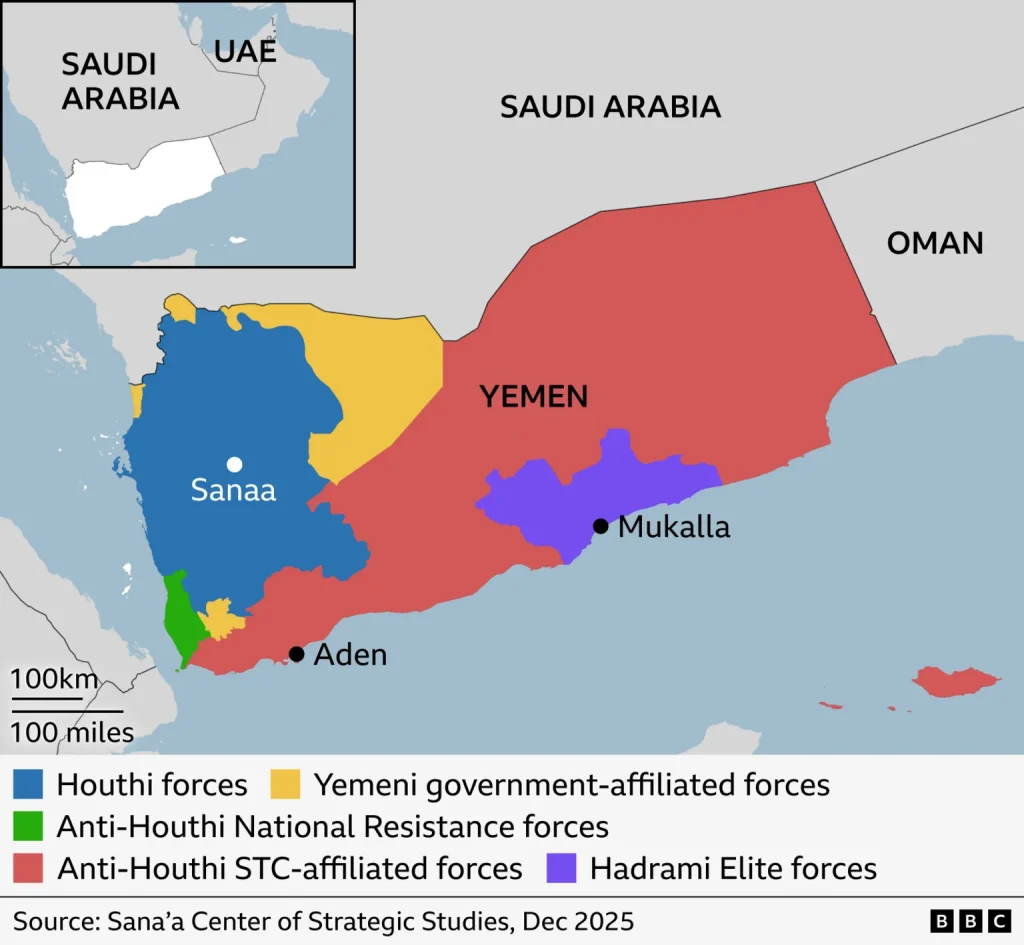
Following the seizure of Mokha, Ansar Allah have declared a blockade of Saudi ports, causing the diversion of several Saudi oil tankers, and have also targeted and struck several key oil facilities and central infrastructure in Saudi Arabia, including strikes on Aramco oil facilities in Yanbu and Rabigh, as well as strikes on several airports and airbases, including radar stations and naval camps. Ansar Allah has also struck the presidential palace in Aden, the seat of power and government headquarters of the lackey PLC government.
On top of this, Yankee imperialism has chosen not to throw its dog a bone in its clashes with Ansar Allah, having had enough with its still ongoing failure in the war of aggression on Iran and its mounting offensive on Latin America, and not having any interest in opening itself up to a potential new front in Yemen, much to Saudi Arabia’s dismay, who is completely dependent on the US militarily. The US met with Ansar Allah in September, and ensured them that they would honor the ongoing ceasefire as long as their ships were not targeted. As such, Saudi Arabia is preparing a new so-called “security partnership” with Egypt and Somalia, who are currently in talks, with a proposed framework that handles “security challenges across the Red Sea and the Horn of Africa, including maritime protection, counter-terrorism cooperation and military capacity building.” In the same vein, reports of talks with Israel and the UAE on cooperation in its war on Yemen have emerged.
Yankee imperialism fails to achieve its objectives
With the humiliating defeat against the resistance in Iran, Yankee imperialism is wary to engage itself militarily on further fronts in the region. It is not much more than a year since the last brutal military campaign waged on the people of Yemen by Yankee imperialism and its Saudi Arabian lackey, when in response to the Ansar Allah blockade of the Bab al-Mandeb strait, it launched its so-called Operation Rough Rider – a direct naval and air strike campaign that led to more than 153 civilian murders and 243 injured. A year later, Ansar Allah has remained steadfast, once again regaining territory and threatening to blockade the strait.
Since the second world war, Yankee imperialism has in general not been able to achieve the political and military aims it has put forth in the wars it has led and sponsored, recent proofs include its retreat from Afghanistan in 2021 after its 20 year-long war of aggression, its retreat from Iraq, and its failure to impose itself in its war of aggression on Iran. The advances of Ansar Allah, resisting the lackey PLC and Saudi Arabia, falls in line with this tendency of the US, and is hindering its plans of achieving control over the Middle East, which would allow it to focus its attention on deterring China in the South China Ocean and the Pacific region, as well as its intention to secure its interests in the so-called “Western Hemisphere,” as outlined in its National Defense Strategy of 2026.