Brazil – AND Editorial: Lula-PT – The Electoral Fraud that Fuels the Extreme Right
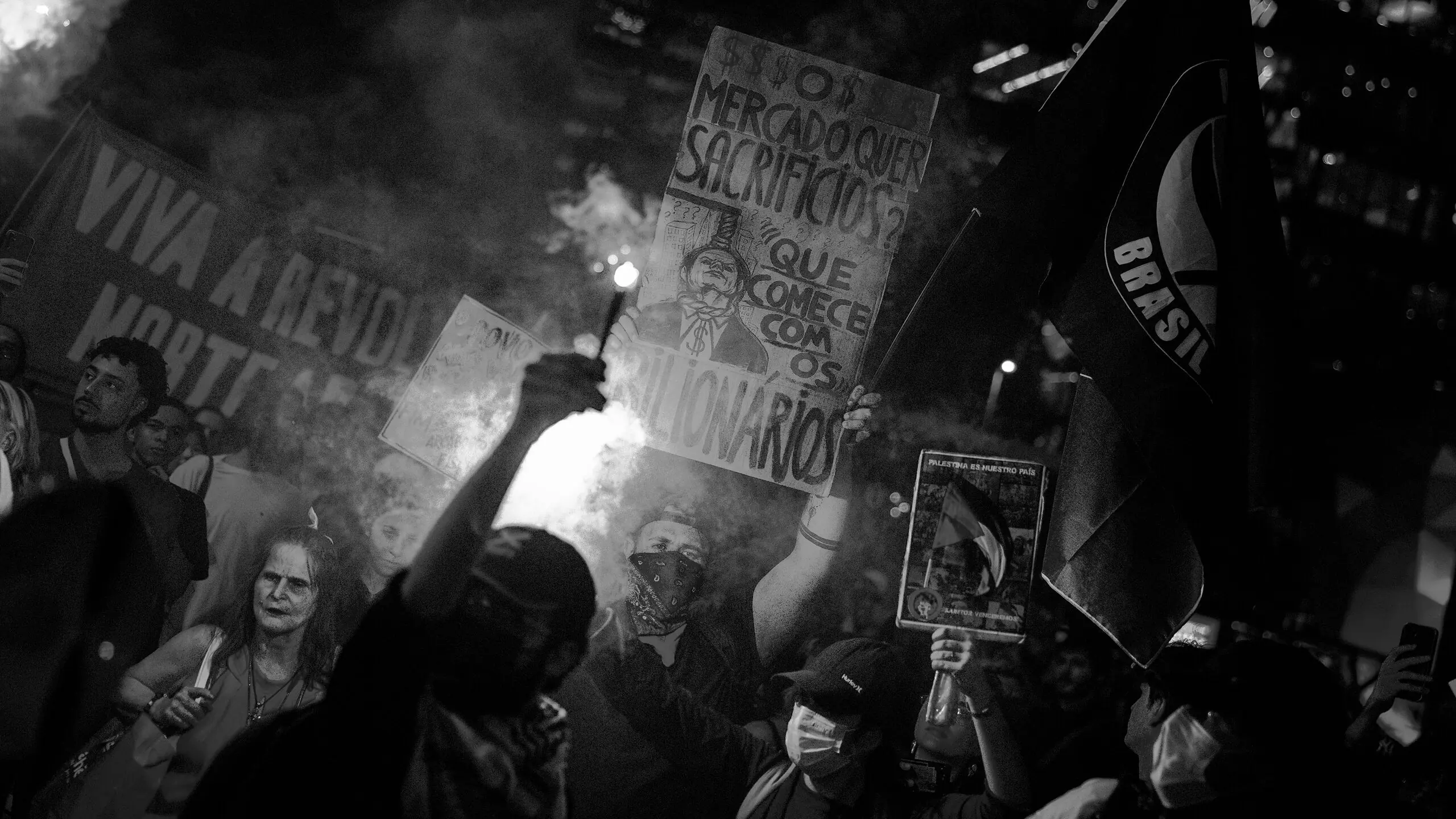
Featured image: Amid flags and banners, a protester holds up a sign reading “Does the market want sacrifices? Let it start with the billionaires!” during a protest against the “drastic budget cuts” on Faria Lima Avenue in São Paulo (SP) on November 17, 2026. In the background, a banner reads “Long live the Agrarian Revolution! Death to large estates!” Source: AND
We hereby share an unofficial translation of an editorial published by A Nova Democracia (AND) on November 26.
The Senate’s approval of Complementary Bill 299/2026 – already known as “the PT’s massive spending cut” – has many implications.
First and foremost, let’s recall that this is the third major “fiscal adjustment” in 10 years: in 2016, there was Temer’s “spending cap”; in 2023, the PT’s “new fiscal framework”; and now, this bill, also from the PT.
With the PT’s new “fiscal adjustment,” it is estimated that the health sector will lose between R$49.8 and 59.2 billion by 2030, and the education sector, R$15.2 billion. To grasp the scale of the impact, let’s compare it to the “spending cap” imposed by that bloodsucker Temer: from 2016 to 2023, when he froze new investments, he cut approximately R$ 45 billion from health care and R$ 7.2 billion from education. The new measure from the PT’s coalition government with the right wing paints an even more horrifying picture.
Seeking to justify such a “drastic cut,” the PT’s intelligentsia and its collaborators stepped forward to engage in sophistry and argue that, mark our words, this isn’t a spending cut, but rather a slowdown in the pace of growth, and that these two things are very, very different! Well, then, if that were true, the entire popular movement would have to engage in self-criticism toward that bloodsucker Temer, because so many times we launched harsh attacks on his policy of budget cuts, when in fact, judging by the PT’s defense, they were merely “fiscal balance.” After all, there were no cuts – “just” a freeze on the growth of expenditures. The same would apply to the FHC administrations, so heavily criticized by the PT for their “neoliberal program” in the 1990s, when, judging by the standard the PT now applies, they could not be condemned: after all, when it decoupled 20% of federal revenues precisely from areas with constitutionally mandated funding, such as Health and Education, just as the PT government now does with extraordinary oil revenues, that wasn’t a “spending cut,” was it? And perhaps we need to go even further: we should also turn to the British working class and ask them to be less extreme in their assessment of Thatcher’s terrible government; after all, there was no nominal cut to the health budget there either, but rather “merely” a slowdown in the rate of growth (let’s remember that the budget in this area “grew” 1.4% per year between 1979 and 1983 and 1.41% between 1983 and 1987).
Now, this opportunistic argument is a joke in the worst sense of the word! What is happening right now is precisely what we warned in this tribune would happen: to win votes, the opportunistic government stirred up public opinion against Bolsonaro’s government program, which called for “drastic cuts” to the people’s rights; at the same time, it made commitments to the domestic reactionary forces and the international financial oligarchy to serve their interests, which involve slashing the people’s rights!
But is this spending cut really inevitable? Let’s take a look: the “fund” remains at R$ 4.9 billion, almost four times the initial proposal, with R$ 3.9 billion taken from amendments and discretionary funds for education, culture, and sanitation to satisfy the reactionary parties and the government’s parliamentary base (a parliamentary base that only votes for what it wants). The R$ 525.1 billion Safra Plan has also been maintained, of which R$ 452.5 billion goes to big landlords, compared to R$ 2.7 billion for the failed “agrarian reform” (already rendered unviable and buried by two decades of PT governments). The policy of tax exemptions and debt forgiveness that drove the share of latifundium in GDP from 18-22% in 2000 to 47-49% in 2023-24 also remains intact, even with the imminent bankruptcy of Banco do Brasil due to defaults by big landlords (after all, the PT needs to “win over the agribusiness sector,” even if that means becoming a lapdog for big landlords and distancing itself from any rhetoric in defense of the peasantry). As is clear: spending cuts, at the expense of the people’s rights, are a prerequisite for the opportunistic government, under pressure from financial capital, to uphold its commitments to the domestic reactionary forces (parasites that survive at the expense of the public coffers) and to satisfy the international bankers who feed off the country’s public debt. The defense of “governability” is merely a pretext to silence the popular movement while stabbing it in the back and paving the way for the extreme right, and then, through blackmail, to blame the popular movement itself for becoming enraged by the blows it receives!
The good news, however, is that the current situation is on the verge of major transformations, and there is something positive and different about the post-election period: the revival of the mass movement. These are contingents numbering in the millions who have awakened from the lethargy into which opportunism had lulled them, faced with the danger of an electoral victory by the extreme right and its overwhelming rise through “democratic” means. And at the same time, they are fed up with the policy of “class conciliation and collaboration” and recognize in this policy one of the reasons for the rise of the extreme right. The widespread negative reaction to these measures, including the growth of popular protest against the “drastic budget cuts” and the entire policy of collaboration with the reactionary forces, is an excellent sign. The revolutionary proletariat and the popular forces under its leadership must persist and go deeper in the policy of unity and struggle with all forces capable of uniting around the building of a general strike to intensify popular protest with as many of the masses as possible against all attacks on the people’s rights, such as the current “austerity cuts” and against opportunist collaboration with the reactionary forces and the extreme right; to unmask the PT’s unreformed social democracy; and to draw, by our example in the class struggle, the honest rank-and-file of all opportunist and revisionist factions toward revolutionary tactics. Down with the PT government’s Bolsonarist “austerity cuts”! Death to fascism and imperialism!