A Nova Democracia: Riots Erupts Across Iran; Understand the Reasons Why
We hereby share an unofficial translation of an article published by A Nova Democracia (AND) on the protests in Iran.
In the first two weeks of 2026, extending from the end of December 2025, a wave of protests swept through more than 180 municipalities and spread across all 31 provinces of Iran, continuing to this day. Large gatherings are taking place in major centers of the country, such as the capital Tehran, Mashhad, Isfahan, and Shiraz. The reactionary press, in collusion with the conspiratorial apparatus of Yankee imperialism in its aggression against the Iranian nation—most recently inaugurated, in a direct manner, with the bombing of the Persian country’s nuclear facilities—has inflated the issue and launched its counter-propaganda “against autocracy.” As a result, the cannibal Donald Trump has been threatening new bombings or direct aggression against Iran, supported by these events, while in the country, the former heir to the Shah dynasty, Reza Pahlavi, has declared himself the leader of the demonstrations, co-opting the initially spontaneous mobilization of the masses onto a reactionary and pro-Yankee path.
In response, in recent weeks, the regime headed by Ayatollah Ali Khamenei has reacted to the protests with strong accusations that secret agents from Mossad (Zionism) and Yankee imperialism are operating within the demonstrations to destabilize the country. Iranian government minister Abbas Araghchi said that Iran has evidence and documents showing that Persian-speaking Mossad agents are deployed in Tehran to monitor the protests and influence events, and that confessions, documents, and photographs proving this involvement will be released. Investigations by Iran’s Revolutionary Guard have revealed that around 600 agents from the Zionist intelligence service (Mossad) are operating in Iran, instigating and coordinating the protests that are spreading across the country. It has also been reported by the local press that Mossad’s psychological warfare apparatus has been working frantically on the Internet to fuel the riots through bots.
During the wave of riots in North Khorasan province, two individuals were detained by Iranian forces and found in possession of espionage equipment, firearms, and ammunition. Images circulating from the clashes show numerous videos of irregular units among protesters, indicating that a highly organized force is operating within the protests.
The Mossad’s involvement in secret missions against Iran is nothing new. In addition to annihilation and sabotage against the Iranian nuclear system and its scientific intelligentsia, they are also involved in building a network of local agents.
In September 2025, Mossad chief David Barnea publicly stated that the agency has networks of infiltrators in the country: “Mossad has very strong operational capabilities, even more creative and powerful than before, especially within Iran and even in the heart of Tehran,” he said at a ceremony with Prime Minister Benjamin Netanyahu, the perpetrator of genocide. For its part, Iran has already reported that Mossad set up a secret base in the country before the Zionist military offensive in the war with air strikes. Mossad units placed systems (including explosive drones) near air defense and missile systems, which were activated when Zionist aircraft began their attacks.
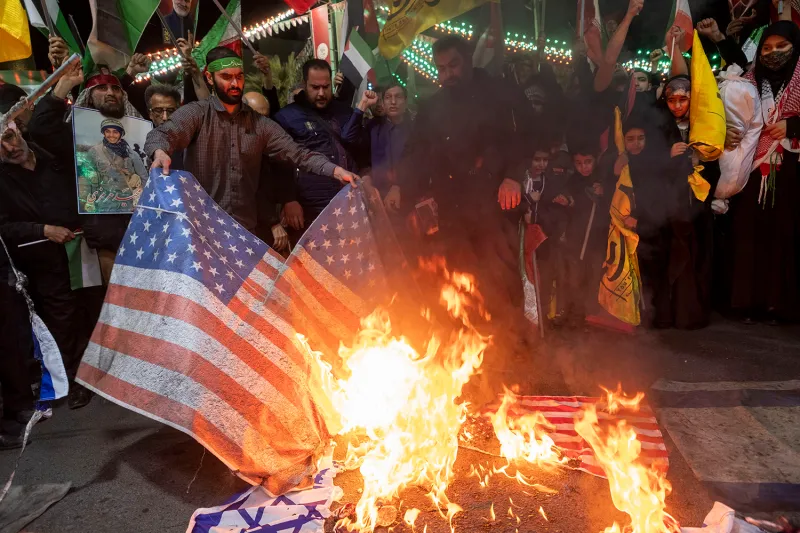
Marches raise the slogan “Death to America,” in reference to Yankee imperialism.
In response to the current tense situation, thousands of people are also marching against Yankee imperialism, mobilized by the government, calling for unity against Yankee imperialism and Zionism.
According to the Guardian newspaper, the capital Tehran held a large central rally on January 12, bringing together tens of thousands of people in Enqelab Square. The protest was called under the slogan “Death to America” and against Yankee-Zionist terrorism. The demonstration featured speeches by senior Iranian state figures, who seek to channel such mobilizations to capitalize politically for the government, such as the speaker of parliament, Mohammad Bagher Ghalibaf, who accused the US and the entity “Israel” of waging a “war on multiple fronts” against Iran: economic, psychological, military, and security.
In addition to Tehran, anti-imperialist acts were simultaneously recorded in several provincial capitals and large urban centers, including Mashhad, Isfahan, Shiraz, Qom, Tabriz, Ahvaz, Kermanshah, Yazd, and Karaj, according to reports from the Iranian state press and regional media outlets. In several of these cities, demonstrations took place in central squares after collective prayers or calls from official unions, student associations linked to the regime, and neighborhood organizations.
The riots have spread across sectors of the masses.
Despite strong evidence of secret Mossad operations, the weight of the masses in the current unrest is unquestionable. At first, the demonstrations took the form of a spontaneous uprising, caused by the sharp deterioration in the living conditions of the impoverished masses, but they were soon taken over by Zionist secret operatives and reactionary pro-Yankee political representatives who took advantage of the imperialist aggression that was taking place within them and assumed their leadership. Thus, the demonstrations, initially based on immediate economic demands, turned into political unrest against the government and were driven, in terms of violence, by the confluence of Zionist operatives and repression.
At the current stage, judging by the continuity of the unrest and the weight of the masses involved, everything indicates that the Zionist apparatus has managed to merge both tendencies into a single movement, that is, the Zionist apparatus has managed to take control of the movement or most of it. Not without reason, Iranian leaders themselves have been repeating that “legitimate social discontent” has been exploited by the US and the Zionist entity to convert economic demonstrations into sabotage against the country.
To the extent that the Mossad appears to have succeeded in joining the demonstrations and turning them into riots, the Iranian government seems to have no choice but to expand the scope of repression and mass arrests, which, although it contributes to the aggressors’ objectives, is an attempt to quell the riots. There is no official number of dead and arrested: the government reports hundreds of detainees in general and dozens of police officers killed; imperialist agencies say that more than 10,000 people have been arrested and 500 killed, an implausible estimate given the absence of the Internet, and whose source can be deduced with certainty to be psychological warfare against the Persian country.
The crisis of bureaucratic capitalism and the effects of sanctions are the economic basis of the current unrest
The economic demands raised by the Iranian masses in the initial protests, soon turned into the current riots, are strongly grounded in the crisis of bureaucratic capitalism, aggravated by US sanctions due to Iran’s support for anti-imperialist and anti-Zionist forces in the Middle East, whose strategic objectives strongly threaten the regime’s existence and even Iran’s national integrity in the medium term.
Oil production and exports, which historically accounted for about 65.5% of government revenue and 57% of total exports in 2024, are declining due to US sanctions. The sanctions imposed by the Yankees penalize US citizens, companies, and banks that maintain economic relations with Iran, as well as companies that do business with sectors targeted by the sanctions. Nevertheless, the Yankees have included strategic Iranian entities on the list of Specially Designated Nationals, which blocks assets and excludes access to the international financial system. As for oil, companies and countries that purchase Iranian oil are subject to exclusion from the Yankee financial system, fines, and asset freezing, in addition to many other implications. Thus, the Iranian government exports oil under severe conditions, sometimes through camouflaged means, forced to offer high discounts, with higher logistical costs and restricted “market access.” As if that were not enough, on January 12, the Yankee government imposed new sanctions: a 25% tariff on all products from any country that does business with Iran.
Official data shows that the Iranian economy is going through one of its worst moments. OPEC/Reuters research indicates that in December 2025, Iran’s oil production fell by about 100,000 barrels per day (bpd) due to new sanctions imposed by the Great Satan, contributing to the decline in total production. The country’s currency, the Iranian rial, suffered a drastic devaluation, with exchange rates reaching 1.4 million Iranian rials per dollar in 2026. Inflation skyrocketed as a cumulative effect of currency devaluation and trade restrictions and sanctions against the Iranian steel industry: 48.6% in October 2025, year-on-year (according to the Statistical Center of Iran). All of this puts even more pressure on import costs and the price of basic products, since Iran is a relatively industrialized country, but one focused on the export of primary goods (especially oil) under the monopoly of big landlords and an economy subordinated to production chains controlled by financial capital, imperialism. According to the World Bank, Iran’s GDP is projected to decline: a drop of -1.7% in 2025 and an expected -2.8% in 2026. For this reason, official Iranian sources estimate that approximately 33% of the population lives below the poverty line.
Only a proletarian leadership could guarantee full anti-imperialist unity
Economic sanctions against Iran, as well as conventional military actions of a specific nature combined with “asymmetric” military actions (unconventional), are part of the strategy of Yankee imperialism and Zionism to weaken the Iranian regime, thereby creating conditions to impose subversion on the regime and, in this way, disrupt what is today an important source of support for anti-imperialist armed struggles in the region, for convenience. The Iranian regime is targeted by Yankee and Zionist aggressors because of its position of support for anti-imperialist forces in the region, a position it is obliged to maintain, since the regime is only sustained internally by anti-Yankee policies and by the anti-imperialist sentiment of the Iranian masses, and regionally, in the same way, in relation to anti-imperialist guerrilla forces in the Middle East. Therefore, it is clear that the Iranian nation, subjected to continuous economic aggression and increasingly targeted by direct military aggression from Yankee imperialism in conjunction with Zionism in the form of a “low-intensity war,” is at severe risk of destabilization, even civil war, and that this phenomenon objectively serves the plans of the aggressors.
However, as the political regime of the Persian big bourgeoisie and tied to large land ownership, the regime headed by Ayatollah Ali Khamenei necessarily relies on bureaucratic capitalism, which establishes exploitation and oppression against the four popular classes of Iranian society: the peasantry, the proletariat, the petty bourgeoisie, and the middle bourgeoisie. This relationship of internal exploitation, and the fact that its economy is weakly industrialized, agro-export-oriented, and geared toward satisfying the production chains of finance capital (imperialism), together with the fact that the aggression has not yet manifested itself in territorial losses, makes Iran a naturally divided society with fragile foundations, both social and economic, whose structure is severely affected by imperialist sanctions and pressure.
Even when the contradiction against aggressive imperialism becomes more pronounced and takes center stage, with such internal contradictions becoming secondary, they can still be and are actively exploited by the aggressors in order to disrupt the unity of the national resistance front and destabilize the country.
The most solid and firm anti-imperialist unity in the country requires proletarian leadership in the anti-imperialist front, which, by supporting revolutionary transformations (economic, political, and cultural) for the benefit of the proletariat, the peasantry, and the small and medium bourgeoisie (national bourgeoisie), is capable of thoroughly applying democracy in resolving contradictions within the people: democracy in the economic sphere (improving the living conditions of the broad masses, reinforcing the unity of the anti-imperialist front), in the political sphere (freedom for all anti-imperialist forces and groups), and in the military sphere (bold mobilization of the armed masses). Only the implementation of a program of new democracy is capable of guaranteeing, under any conditions, anti-imperialist unity and national resistance in the event of aggression. Iran’s theocratic regime, although it supports regional anti-imperialist forces in the current circumstances, including for its own survival, is vulnerable to the maneuvers of aggressors because it is unwilling to thoroughly implement the necessary democratic measures internally at this point, since it relies on bureaucratic, comprador, and feudal capital and on the exploitation of the Iranian masses. This makes them vulnerable, without proletarian leadership, to manipulation by reactionary and aggressive forces.
Thus, the Mossad’s success in co-opting and converting the initial protests of the Iranian masses into riots in the service of the imperialist aggressors was already, as a possibility, determined by the fact that the Iranian regime was not a proletarian regime and that the political leadership of the anti-imperialist front was not a proletarian leadership, in addition to the fact that the Iranian regime is not yet in a state of aggression such that certain proletarian criteria are imperative for the survival of the national cause (as in the case of the Palestinian National Resistance, or other processes whose degree of aggression makes it mandatory, for the survival and victory of the resistance, to radically apply the resistance program). As such, the regime is obliged to establish a certain degree of repression and control over the popular masses in the current situation of dangerous unrest; moreover, even when there is no unrest, the regime exercises ostensive state control over working-class organizations and curtails the freedoms of the working class and peasantry, to the extent that it fears them, since it relies on the exploitation of these classes.
The recent protests express precisely this dynamic. The Iranian masses, who in moments of heightened external aggression unite with the government in their willingness to confront imperialism and Zionism, once again turn to their concrete living conditions when the level of external confrontation relatively diminishes, making it feasible for imperialism’s secret agents to exploit these contradictions. From the point of view of the anti-imperialist struggle, a possible change of government in Iran, resulting from this process and even more so in the absence of a proletarian force fighting for the leadership of the mass movement and the implementation of a revolutionary strategy, would only serve the interests of Yankee imperialism and Zionism as a step forward in isolating the armed struggle of national resistance in Palestine and throughout the so-called Greater Middle East.
The regime’s decision to encourage anti-imperialist demonstrations seems to be an attempt to isolate the unrest and expose the maneuvers of internal reactionaries colluding with external aggressors, while seeking to strengthen its own position. The big question, it seems, is whether the Great Satan intends to take advantage of these disturbances to launch a new offensive against the Iranian nation, with some specific action to achieve a partial objective that weakens the regime, or whether it will not do so. In any case, events only demonstrate, once again, that the period in which we live is one of great social cataclysms, strong eruptions, from which, in a few years, enormous transformations may impose themselves. It is a new era of revolutions.

