Servir ao Povo Brazil – The False Self-Criticism of UOC and Its Political Complicity in the Betrayal by the Sonu-Satish-Devji Revisionist Clique
We hereby share a translation of an article published by the Editorial Board of Servir ao Povo on the 9th of June.
Proletarians of all countries, unite!
Servir ao Povo Editorial Board – Brazil
May 2026
Long live the New Democratic Revolution in India, the protracted people’s war, and the CPI (Maoist)!
“The second trend [which asserts that India has become a capitalist society] brings forth the imperialist sponsored international ‘development’ model. It [this trend] argues that the classification by the Maoist Party might apply to the ending period of the 1960s but that at present ‘feudalism’ has absolutely weakened and to a large extent capitalist relations of production dominate the agricultural sector. Therefore it [this trend] tries to prove theoretically that Armed Agrarian Revolution in the rural area is meaningless. It brings forth certain traitors who betrayed the Revolutionary party, people and revolution and bowed to the enemy for this purpose. They adopt mudslinging and make hue and cry over the Party line and make vain attempts to create confusion in the revolutionary camp.” (emphasis added)
Communist Party of India (Maoist) – CPI(Maoist)
Changes in Relations of Production in India – Our Political Program, 2021
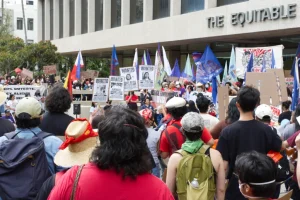
March 28, 2026, was an important milestone for international solidarity and proletarian internationalism. In dozens of cities across all continents, democratic, popular, and revolutionary mass organizations, Maoist communist parties, and honest and progressive intellectuals took to the streets in various demonstrations to denounce and reject the old Indian state and Modi’s fascist, Brahmanical, Hindutva regime and its genocidal “Operation Kagaar,” in defense of the New Democratic Revolution in India and the heroic People’s War led by the great Communist Party of India (Maoist), the CPI(Maoist). FACAM, the Forum Against Corporatization and Militarization—a revolutionary democratic organization in India—has been calling since the beginning of this year for mass mobilizations on March 28 as the International Day Against Operation Kagaar. This is a military operation that the Indian fascist regime launched over a year ago, announcing its futile aim of destroying the Maoist revolutionary movement in this most populous country in the world.
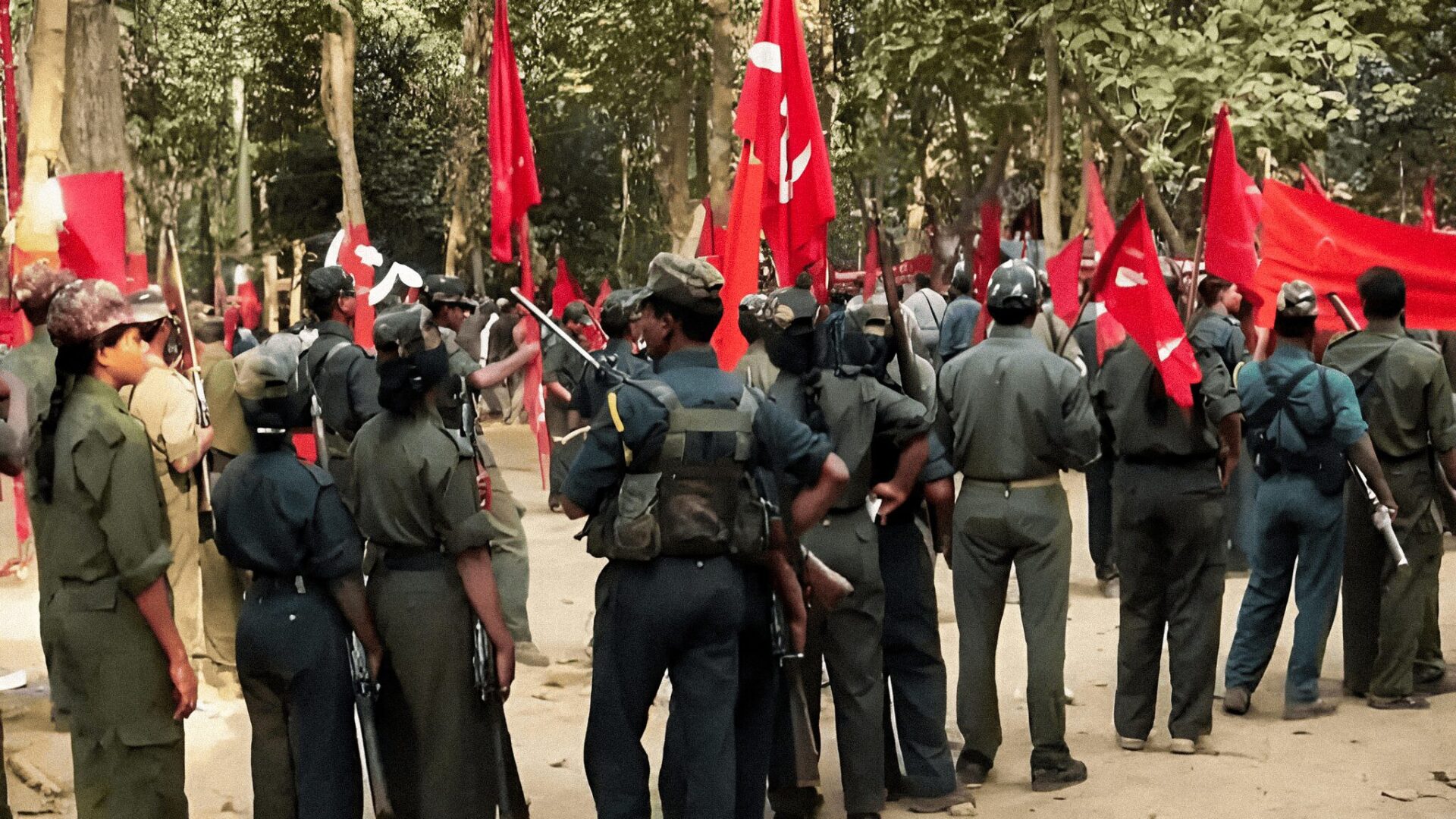
“Operation Kagaar” has been the largest encirclement and annihilation campaign waged by the Indian reactionaries by land and air against the People’s War in India. The enemy, deploying large contingents of military, police, and paramilitary forces, as well as all kind of means of warfare, has encircled the extensive guerrilla zones in the countryside and forests of India, aiming primarily to annihilate the leadership of the historic revolutionary movement that emerged from the Naxalbari Peasant Uprising, West Bengal (1967)—a process resulting from the relentless struggle against revisionism, led by Comrade Charu Mazumdar. Namely, to annihilate the cadres and leaders of the CPI(Maoist), in particular the members of its Central Committee, the commanders of the People’s Liberation Guerrilla Army (PLGA), and the leaders of the Revolutionary Governments and mass organizations. In May 2025, the General Secretary of the CPI(Maoist), Comrade Basavaraj, fell in combat during a protracted battle in which PLGA forces sought to break through an extensive encirclement operation by the reactionary armed forces of the old Indian state.
Hordes of murderers (the armed forces of the old Indian state and their auxiliary police forces and paramilitary gangs) entered the villages, mainly those of the Adivasis, but not only there, and unleashed their well-known tactics of terror against the masses through arrests, torture, and summary executions, punishing them for alleged ties to the Naxalite guerrilla movement—both to intimidate them into not joining the movement and to extract information from them.
In addition to relying on the best-trained forces of the Indian reaction, “Operation Kagaar” sought by all means to strengthen the propaganda of revisionist positions that deny India’s semicolonial-semifeudal character and the need for the new democratic revolution, and that attack the strategy and tactics of the CPI (Maoist), both at home and abroad, with the aim of encouraging defections from the ranks of the Party and the PLGA, already relying on information from capitulators and traitors. In a conspiracy with renegades like Balraj, revisionist propagandists such as the web-“Maoist” Abhinav Sinha, and especially with the clique of traitors—Sonui-Satish-Devji—in the Party leadership, the old Indian state has long made use of this gang of right-opportunist, revisionist, and capitulationist elements as its fifth column within the Party leadership, in its vain attempt to destroy the revolutionary leadership. The actions of this fifth column caused great harm and damage to the CPI(Maoist). All indications point to the clique of the traitor Sonu—as a member of the Political Bureau of the Central Committee and the person responsible for the Party’s international work—as the one who handed over to the reactionaries communication codes, meeting points, names of leaders, and strategic locations of the leadership’s operations, and who betrayed important Party secrets, which explains the speed with which members of the Central Committee and commanders of the PLGA were surrounded, assassinated, or kidnapped. Likewise, the exact location of Comrade Basavaraj was handed over to the reactionary services, where he and his security unit were ambushed, surrounded, and killed in combat.
In addition to the military losses, the defeats, and the surrenders—all instigated and forced by the destructive and deceptive actions of the traitor Sonu—like every revisionist, he attempted to cloak his capitulation in false justifications, seeking to cause maximum confusion and damage to the revolutionary camp. Sonu began to openly defend—with the backing of the old Indian state and relying on the dissemination by reactionary media monopolies—his rotten right-wing revisionist line, in which he attacked the leadership of the CPI (Maoist), accusing it of dogmatism, sectarianism, and leftism. Seeking to undermine the strategy of Protracted People’s War and the path of encircling the city from the countryside, Sonu began to argue that India was no longer a semi-feudal country, and that work in the cities would be more important than in the countryside.
Sonu’s treacherous line was decisively defeated by the Central Committee of the CPI(Maoist) late last year. In forceful statements, the Party reaffirmed its commitment to the ideology of the international proletariat—Marxism-Leninism-Maoism—and to the Principles, Programs, and General Political Line of the CPI(Maoist). The clique of Sonu, Satish, Devji, and Balraj was expelled from the Party, and its ringleaders were declared enemies of the people and the revolution.
The firm defense of the revolutionary path charted by the Central Committee of the CPI(Maoist), the heroic sacrifice of Comrade Basavaraj, and the urgent need to defend the People’s War in India have propelled international solidarity with the CPI(Maoist) to a new level. In turn, the convening of the Forum Against Corporatization and Militarization (FACAM) was a decisive factor, as it gave international demonstrations a correct direction, drawing a clear line against the opportunists abroad who traffck with the Party’s name, the People’s War it leads, as well as with the solidarity to other People’s Wars and national liberation struggles in other countries, in order to pass themselves off as revolutionaries and smuggle their right-wing and revisionist positions into the ranks of the ICM. For many years, the solidarity campaign with the Indian revolution was sabotaged by a small group of organizations whose activities were more virtual than real, and whose actions amount to nothing more than trafficking with the people’s wars seeking for online prominence by luring the unaware into their orbit. This was the same case with the people’s war in Peru and Nepal while they were winning, and after the first suffered heavy blows from the ROL’s “Peace Letters” hoax, it turned its back on it; and, in the same vein and manner, they turned to the second, which was dealt a blow by the capitulation and laying down of arms by the traitor Prachanda, only to then attempt to ride on the prestige of the People’s War in India. This time, by usurping the leadership of the International Committee in Support of the People’s War in India (CSPWI), reducing it to a tiny group that restricted its expansion to democratic, progressive, and anti-imperialist forces, and by curtailing massive worldwide support for this advanced line of struggle of the World Revolution.
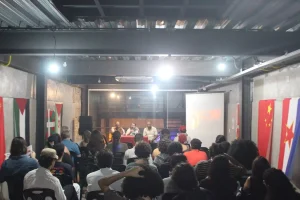
FACAM’s call was immediately answered by the ILPS (International League of Peoples’ Struggle) and the newly founded AIL (International Anti-Imperialist League), as well as by democratic organizations fighting for the rights of peoples in Europe, the U.S., and Latin America. In Rio de Janeiro, Brazil, hundreds of activists, gathered for the founding of the AIL’s Brazilian chapter, on March 28, 2026, took to the streets in a demonstration against Operation Kagaar, as well as carrying out actions against facilities of the Indian steel company Mital, one of the corporations financing the genocide and displacement of the Adivasi people from their lands for the mining and plundering of their subsoil resources. In Colombia, the founding congress of the International Anti-Imperialist League—even though it was moved to that country on the eve of its opening because the city that was to host it and the entire surrounding region in Ecuador had been attacked by a military operation carried out by the fascist Noboa government, in conjunction with U.S. imperialism— had ensured its successful convening with the participation of more than 150 delegates from 14 countries, who approved an important political declaration against Operation Kagaar. In Mexico, the Popular Current Sol Rojo and the AIL Promoting Committee (Mexico) took to the streets in support of the New Democratic Revolution in India. In Chile, revolutionaries carried out armed propaganda actions in support of the People’s War in India during the demonstrations on Young Combatant’s Day, March 29. In Ecuador and Bolivia, revolutionary organizations issued strong statements in support of the CPI (Maoist).
In Asia, there were also demonstrations in Turkey, Bangladesh, and the Philippines.
In the United States, demonstrations coordinated by various Maoist and international solidarity organizations were held in different cities and states in response to the call issued by FACAM.
In Europe, several demonstrations were held. In the Netherlands, ILPS and AIL flags flew side by side at the same demonstration calling for an end to Operation Kagaar. Major rallies took place in Austria, Germany, Finland, Norway, Sweden, and Spain in support of the Indian Revolution. In Norway, demonstrators gathered in front of the Indian embassy in Oslo. In England, the Joint Committee to Stop Repression in India and the Association of Indian Workers in Great Britain held major rallies in London and Glasgow. A major demonstration took place in Zurich, Switzerland, in which Turkish grassroots organizations played a key role in mobilizing the crowd.
In France, an extensive mass campaign against Operation Kagaar has been carried out amid the growing anti-imperialist struggle. At the local founding congress of the AIL, 400 activists raised their voices in unison against the genocidal “Operation Kagaar” and in defense of the CPI (Maoist) and the People’s War in India. At the Reconstitution Congress of the Communist Youth, 600 young revolutionaries raised their fists in support of the New Democratic Revolution in India and in tribute to Comrade Basavaraj. The Communist Party of India (Maoist) sent an important message of solidarity to this grand event:
“First of all, we wish to extend our warmest greetings to all the revolutionary comrades who are organizing the Communist Youth Congress in France.
We pay tribute to Comrade Basavaraj, Comrade Hidma, Comrade Vivek, Comrade Raju, Comrade Kosa, Comrade Anuj, Comrade Ganesh, Comrade Bhaskar, Comrade Uday, Comrade Chalapathy, Comrade Anal, and the hundreds of ardent sons and daughters of our land who fell as martyrs in Operation Kagaar, unleashed by the Indian state since January 2024.
We also pay tribute to all the revolutionary comrades who fell as martyrs in the Philippines, Turkey, Peru, Brazil, France, and in every country around the world in the struggle for the Socialist Revolution.
We rejoice at the news of the Communist Youth Congress, which is taking place at one of the most important moments in history. Although we are unable to attend in person this time due to intense repression and state surveillance, we share with you our deepest solidarity and enthusiasm.
(…)
Long live proletarian internationalism!
Long live Marxism-Leninism-Maoism!
Long live the World Socialist Revolution!
Revolutionary greetings,
Communist Party of India (Maoist)”ii
In India, the Revolutionary Student Front (RSF) held a protest rally on March 23 to demand an end to Operation Kagaar and to oppose the plundering of the Indian nation’s water, forests, and land; as well as an end to the war of aggression waged by U.S. imperialism in the Middle East. On March 31—the date set by Modi’s reactionary fascist government as the deadline for eliminating the Maoist movement in the country—FACAM held a seminar on imperialist aggression and against Operation Kagaar, featuring veteran Ka Murali, Comrade Ajith.
The impact of the international demonstrations had great significance and repercussions within India. Fearing the growth of democratic-revolutionary propaganda, the old Indian state arrested a number of students in the country linked to RSF and Nazariya Magazine. The comrades at Nazariya Magazine documented these events with a forceful statement:
“Alarmed at the fact that FACAM had given an international call to observe anti-imperialist week from 23rd to 31st March and was going to organise a people’s convention against imperialist loot in New Delhi on 31st March on the date of the supposed deadline for ending the maoist movement, the Indian state used the pretext of this case to abduct the activists and threaten them to leave their politics and to stop organising for the anti-imperialist week.”iii
In its assessment of the demonstrations on March 28, 2026, FACAM stated that:
“On March 28, 2026, revolutionary, democratic, and anti-imperialist forces across the world observed the International Day of Action Against Operation Kagaar, expressing solidarity with the struggling masses of India.
(…)
Across the globe, protests, demonstrations, and political actions exposing and calling an end to Operation Kagaar took place. The significance of this global response cannot be overstated. At a time when ruling classes attempt to isolate people’s struggles within national boundaries, the International Day of Action broke through this isolation and reaffirmed a fundamental truth: the struggle of the oppressed anywhere is inseparable from the struggle of the oppressed everywhere.
(…)
We recognize and salute the growing wave of solidarity across the globe, in the Philippines, Mexico, the Netherlands, Turkey, Brazil, Chile, the United States, the United Kingdom, Brussels, Germany, and beyond. These expressions of unity reflect the interconnectedness of the struggles of the peoples of India, the Philippines, and Palestine, and the common enemy they confront: imperialism and its stooges. This unity must be strengthened and deepened.”iv
The plans of the old Indian state, imperialism, and revisionism to crush the People’s War in India have once again been defeated. The attacks by the reactionary army and the betrayals of the revisionist renegades—none of this was capable of defeating the CPI(Maoist) or the invincibility of the People’s War, for the Maoists and the Indian masses are as close as flesh and blood; no matter how difficult and arduous the struggle may be, there is no definitive defeat for the proletariat; after all, as long as the masses and the Communist Party exist, all manner of miracles will be possible, as Chairman Mao taught us. What we are witnessing is the beginning of the CPI(Maoist)’s ideological, political, and military counteroffensive against Operation Kagaar. The progress of the international situation, the strengthening of the International Proletarian Movement and the National Liberation Movement, mean that overcoming the setbacks suffered can be much faster than at other times. To this end, revolutionaries around the world must join forces for joint actions against imperialism and its lackeys, and wage this struggle inseparably from the struggle against revisionism. On March 28, 2026, FACAM’s forceful call to action and its international repercussions are important signs that the revolutionary counteroffensive is already underway and, sooner rather than later, will bring us its deeply red results.
The false self-criticism of the UOC(MLM), a propagandist for the revisionist theses of the clique of Sonu, Satish, Devji, and Balraj
The fearless resolve of the CPI(Maoist) leadership in the struggle against the armed forces of the old Indian state and against the revisionist fifth column is proving decisive in the defeat of Operation Kagaar. In October 2025, in a spectacle orchestrated with the Indian reactionaries, Sonu surrendered himself into the arms of Modi’s fascist regime, which aimed to liquidate the CPI(Maoist) and force the capitulation of its leadership. The treacherous liquidationist plot by Sonu and Modi was defeated; the Party united around its Ideology, General Political Line, and Program, crushed the right-wing capitulationist liquidationism, and reaffirmed itself on the defiant path of continuing the People’s War. As early as October 2025, its Central Committee issued a forceful statement asserting:
“The conciliatory tendencies that Sonu and Satish have nourished for decades gradually transformed into conciliation, with Operation Kagaar, this conciliatory opportunism was transformed into treason and counterrevolutionary action. We could not correctly evaluate this development in time. As a result of this failure, both of them used their leadership positions to make serious damage to the revolutionary movement. We inform the revolutionary camp that we will revise this failure and draw the necessary lessons.”v
Also in October 2025, in a highly significant statement, the International Communist League (ICL) reinforced this call by the CPI (Maoist), declaring:
“The revisionist positions of the renegade Sonu and his clique and his betrayal are not an exclusive phenomenon from India; they are also an expression of revisionist positions existing in the ICM, where there are open and concealed advocates of the Renegade Sonu. This is why we must assume the lesson from the events and to take what happened with Sonu’s clique of traitors as an important warning for the ICM and a calling to raise the combat to revisionism and all opportunism, and particularly against the capitulationist and traitorous tendencies. Closing ranks with the CPI (Maoist) is to combat the followers of Sonu in the ICM, sweeping away all the revisionist and opportunist positions that converge with his positions.”vi
In December of that year, heeding the warning from the CPI (Maoist) and the call from the ICL, the Communist Party of Brazil (P.C.B.) published an important document in which it unmasks the so-called supporters of the People’s War in India, revealing their right-wing character and their alignment with the rotten line of Sonu, Satish, and Balraj. In this document, the P.C.B. states that:
“In the ICM, there are ‘supporters of the People’s War in India’ in the digital or virtual media, but who in reality defend contrary and opposed positions to the General Political Line and Program of the CPI (Maoist) for the Indian revolution and revolution in the countries dominated by imperialism. Both in speech and onpaper they claim to support the People’s War in India; in virtual practice they covertly defend very similar positions to the gang of Sonu and Satish. In order to support the CPI (Maoist) in this difficult moment in which the revolution in India goes through and to defeat “Operation Kagaar” it is indispensable to demarcate and combat this fake support because just as the fifth column within the revolutionary lines, these positions act in the ICM to spread opposite opportunist lines that converge with the positions of notorious Indian revisionists who say that the current stage of revolution in that country is already socialist and not new democratic, that the country is an emerging capitalist one and state the nonexistence of semi-feudality, aiming to discredit the ideological-political and military lines of the Party and thus defame it while they make salves of long live the People’s War in India and the CPI (Maoist).”vii
Specifying its criticism, the P.C.B. makes it clear that:
“We are referring to the positions in the leadership of the Communist Worker’s Union (MLM) from Colombia [UOC (MLM)], one of the participants of the International Committee to Support the People’s War in India. In the virtual medias, this organization claims to support the People’s War in India, but covertly spread ideological-political positions opposed to the formulations of the CPI (Maoist) in their theoretical materials. In addition, the leadership of UOC(MLM) literally copies theoretical formulations from Indian revisionists in order to sustain their rotten positions that reject the universal character of the New Democratic Revolution for the countries oppressed by imperialism, that is, colonial, semi-colonial and semi-feudal.
(…)
The whole chapter 5 of the magazine Negation of the Negation issue 6, the theoretical organ of UOC (MLM), titled “Regarding semi-feudality and semi-coloniality” from pages 89 to 102, is a plagiarism of the formulations of this web-revisionist from India [referring to Abhinav Sinha]. The sections ‘5.1 the theory of Mao on the semi-feudal and semi-colonial social formation’ and ‘5.2 The coincidence of the theory of semi-feudality with theoreticians of neo-liberalism regarding the capitalist ground rent’ are altogether 14 pages; from the 71 paragraphs contained in this chapter, 65 are literal copies, translations from English into Spanish, of two articles by this anti-Naxalite Abhinav Sinha titled Problems of the Revolutionary Communist Movement in India: The Question of Program and Strategy and Development of capitalist agriculture in India and the intellectual origins of the fallacy of present semi-feudal thesis.”viii
The UOC(MLM), an organization that defines itself as “the leading promoter in Colombia of support and solidarity with the revolution in India,” was simply “caught red-handed”—not only for passing off a blatant copy as its own formulation, but mainly for deliberately omitting the author’s name, because he is a notorious revisionist and a declared enemy of the CPI(Maoist). And this is not a matter of copying a passage or a specific concept, but of 14 pages of Trotskyist-revisionist text that were copied and published in its theoretical magazine.
In January 2026, the Steering Committee of the UOC(MLM) issued a political statement in which it staged a false self-criticism regarding the copying of the aforementioned text by the Indian revisionist Abhinav Sinha. It begins its statement by complaining about the “infamous accusations made by the Communist Party of Brazil,” which forced it to provide explanations, though it did so in an even more brazen manner:
“We acknowledge, in a spirit of self-criticism and with the highest proletarian spirit, that the article‘Regarding semi-feudality and semi-coloniality’in Chapter 5 of themagazineNegación de la NegaciónNo. 6
is a plagiarism of Mr. Abhinav Sinha’s article(…).”ix
They acknowledge the obvious—they plagiarized an Indian revisionist website—but there is nothing self-critical or in the spirit of the proletariat, much less any honesty, in their statement; only the impossibility of denying what the P.C.B. has explicitly pointed out. Their false self-criticism is revealed in the sentence that completes the above quote:
“(…) Problems of the Revolutionary Communist Movement in India: The Question of Program and Strategy, written by a person of whom we had no knowledge until we investigated the complaint made by the P.C.B.”x
Let’s just look at the “naivety” of the UOC(MLM) Steering Committee: it admits that it is “a plagiarism of Mr. Abhinav Sinha’s article,” only to then swear that it had never heard of him! So they found an anonymous article on the internet and copied it as part of their theoretical justification against semi-feudalism? Could it be that they actually sought arguments from Indian sources opposed to the CPI (Maoist) to support their theoretical justification for the existence of semi-feudalism in that country? Could you point us to the source from which you took the exact same words—a source in which the revisionist does not appear as the author of the text? Please, gentlemen, to make such a claim and still call it self-criticism is to mock the intelligence and patience of the International Proletarian Movement.
Furthermore, they acknowledge that they plagiarized a text, when in fact they copied two texts by Sinha. Anticipating this diversionary maneuver by the UOC(MLM) leadership, the P.C.B., in its document exposing these false supporters of the PW in India, had already warned the ICM, stating that:
“UOC (MLM) could allege there was only an editing problem, (…) but that would be another fallacy. Because in addition to mixing up two different texts, the leadership of the UOC (MLM) had the caution of removing almost all the references the text made to India. Therefore we say plagiarism not only because they do not cite the source from where they transcribed exact and long fragments from the texts of Abhinav Sinha, but also for the deception of hiding the true authorship of this revisionist. A double intellectual dishonesty. However, the most important here is to highlight the parts that UOC (MLM) left apart from their work as revisionist scribes. After all, the plagiarized parts were already refuted in the document of the P.C.B. from December 2023.”xi
Thus, Chapter 5 of the UOC(MLM) journal is not merely “a plagiarized version of an article by Mr. Abhinav Sinha”; it is a copy of the revisionist content from two articles and an edited version of those articles, since the UOC(MLM), just like a criminal trying to clean up a crime scene, sought to erase the traces of this copying, thereby aiming to maintain the facade of being a defender of the CPI (Maoist). How could they explain this? Two articles by an Indian revisionist website appear selected and edited as a chapter in their theoretical magazine, and they simply claim that they did not know the author until the “complaint made by the P.C.B.” Come on! Have some patience, gentlemen!!!
But the worst part of the “Statement by the UOC(MLM) Steering Committee” is not these crude and shameless tricks. What is revealing is that it offers “self-criticism” for the plagiarism yet says not a word about the author being a sworn enemy of the CPI (Maoist) and the people’s war it leads—of which it claims to be the greatest supporter in Colombia—while persisting in defending Sinha’s positions. That is to say, at no point does it even distance itself from this gentleman whom they have “just” met, who is a counterrevolutionary of the highest order. It persists in the falsehood: the “grave error” is plagiarism, when this is merely a cheap ploy. No, gentlemen, the gravest error—for the main danger to the revolutionary movement is revisionism—for which they offer not the slightest self-criticism, and they do not do so because, with each passing day, they assume the status of self-confessed revisionists. Thus, they reveal that:
“Plagiarism is a serious error for which the UOC (MLM) Steering Committee bears responsibility due to a lack of revolutionary vigilance. (…) A mistake that we consider, moreover, unacceptable, one that does not correspond to our long history and significant track record of struggle against dogmatism and sectarianism and, in particular, against those who deny the existence and imposition of capitalist relations in the countryside in many oppressed countries; this is a legacy that dates back to the magazine Contradicción in the 1990s and traces its roots to discussions within the Communist Party of Colombia (ML) since the mid-1960s, against the subjective and sectarian pretension of rigidly adhering to the letter of Marxism-Leninism-Maoism in order to impose it on reality (…).”xii
They are ashamed not because they share the same ideological position as the web-revisionist—an enemy of the CPI (Maoist)—and for concealed their authorship, but rather because they plagiarized a novice while they themselves are veteran defenders of those very same positions. This is what they consider “unacceptable”! This is the legacy of which they are proud—they argue that capitalist relations had already been imposed in the Colombian countryside since the mid-1960s. But it is completely false that this legacy is related to the founding of the Communist Party of Colombia (ML). The PCC M-L was led by Pedro Vásquez Rendón, a defender of Mao Tsetung’s thought—as Maoism was called at the time. Rendón participated in and led the guerrilla movements in southern Tolima, a peasant region with a great revolutionary tradition in Colombia.
What the leadership of the UOC(MLM) inherits from the mid-1960s has nothing to do with the precursors of Maoism and the People’s War in Colombia. They are heirs to the dogmatic-revisionist Hoxhaist positions into which the leadership of the PCC M-L had degenerated, particularly the Trotskyist positions, such as those of the false “Marxist” Theory of Dependency. These are the historical roots of the revisionism of the UOC(MLM) leadership; they copy from the academic revisionists of that era, such as André Gunder Frank and Ruy Mauro Marini, who advocated precisely the non-existence of semi-feudalism in Latin America, the full development of capitalism under imperialist domination, and the end of the agrarian-peasant question for the revolution in these countries.
Indeed, the UOC(MLM) neither rejects nor is ashamed of the copied and edited content from Sinha’s articles; even today, in May 2026—four months after its “self-criticism” for plagiarism—the copied publications remain on its website, intact. They did not even bother to take them down, since the content of Sinha’s articles is the same as what the UOC(MLM) advocated in the 1990s, identical to its Trotskyist roots from the mid-1960s, and the same as what these incorrigible right-wingers continue to advocate today.
The P.C.B.’s comprehensive refutation of the UOC(MLM)’s revisionist positions
In its false self-criticism, the UOC(MLM) Steering Committee has the audacity to play the victim and knows no bounds in the nonsense it hurls at the P.C.B. In its furious response to the P.C.B.’s accusations, it states:
“Regarding the baseless accusation that the UOC(MLM) claims ‘that imperialism promoted or supported bourgeois revolutions and agrarian revolutions,’ this is a fabrication by the P.C.B. Our position has been well-founded and has so far not received a scientific refutation because it is based on reality. We affirm, along with Marx, that capitalism arose in a bloodbath and continues to do so in this era of imperialist capitalism, stripping direct producers of their means of production. In Colombia, it imposed itself by stripping peasants of their lands through blood and fire, and continues to do so in the current war against the people that has been ongoing since the 1980s. Regarding this conflict, the P.C.B. claims that it is “one of the longest and bloodiest peasant armed struggles in the world,” when in fact it has been one of the longest and bloodiest armed struggles against the peasants and for the extraordinary profits derived from the land—from coca, marijuana, and oil palm plantations, oil and gold mining operations, among others.”xiii
The UOC(MLM) Steering Committee dismisses the P.C.B.’s criticisms as baseless accusations and has the audacity to claim that their position “has not yet been scientifically refuted.” In December 2023, the P.C.B. published an extensive and in-depth document titled “The New Democratic Revolution Is the Main Force of the World Proletarian Revolution.” This 189-page document refutes, one by one, the “formulations” of the UOC(MLM). This document even refutes all of Abhinav Sinha’s nonsense, which at the time was taken as formulations of the UOC(MLM), since the plagiarism had not yet been exposed. More than two years have passed since the publication of this powerful document, yet the UOC(MLM) has never made a statement or responded to any of the criticisms raised by the P.C.B. Now, in its false self-criticism, it still seeks to boast that these criticisms were never refuted. We could call this cynicism, but it is more accurate to call it by its true name: revisionism. As for this organization’s characterization that the peasant guerrilla movements in Colombia are nothing more than “bloody armed struggles against the peasants and for the extraordinary profits derived from coca and marijuana plantations,” is a statement with extremely serious consequences; it lays bare the organization’s right-wing bias by parroting the rhetoric of the Colombian fascist reaction and Yankee imperialism, which claim that these struggles are nothing more than “narco-guerrilla” movements. Given the gravity of the issue, we will address it separately later in this text.
The UOC(MLM) calls the P.C.B.’s criticisms of its formulations on imperialism and the development of capitalism in Colombia “fabrications” and “baseless accusations.” Let us examine some lengthy quotations from the P.C.B.’s document to see some of the scientific refutations of the UOC(MLM)’s revisionist positions:
“In its critique of the founding parties and organizations of the ICL—in particular, the P.C.B.—the UOC(MLM) accuses us of dogmatism for defending the continued relevance of the New Democratic Revolution in semicolonial countries. It criticizes us for an alleged lack of ‘objectivity’ in our analyses of imperialism and the development of capitalism in oppressed countries. Both in its critique and in other documents, the UOC(MLM) leadership formulates a ‘new’ theory of imperialism, which it attempts to pass off as a concrete and objective application of Maoism to the current world situation and that of oppressed countries. According to the UOC(MLM), imperialism is a ‘world mode of production’ in which ‘two trends coexist: one toward stagnation (…) and the other toward progress.’ This supposed progressive tendency would mean that imperialism ‘sweeps away the vestiges of pre-capitalist modes of production’ in the countries oppressed by the imperialist powers. The eradication of semi-feudalism by imperialism would, in turn, imply the full development of capitalism in these countries—particularly in the countryside—and that the bourgeoisie there would obtain ‘a rate of profit equal to that of the bourgeoisie in other countries,’ that is, imperialist countries. According to the UOC(MLM), there are two types of oppressed countries: 1) oppressed capitalist countries and 2) semifeudal countries—that is, two types of semi-colonies: the capitalist semi-colony and the semifeudal semi-colony. In its formulation, both oppressed capitalist countries and semifeudal countries are semi-colonies, but the character of the revolution in the former would be immediately socialist, whereas the New Democratic Revolution would apply only to the semifeudal countries.”xiv
The P.C.B., frequently citing the documentation and ideological formulations of the UOC(MLM), highlights how this organization defends an anti-Leninist position that imperialism has a tendency toward “progress,” since it “sweeps away the vestiges of pre-capitalist modes of production.” What a feat, isn’t it? In a single sentence, it shatters the Leninist theory of imperialism, which holds that imperialism is a tendency toward violence and reaction everywhere. The UOC(MLM) argues that in “some semicolonial countries,” such as Colombia, capitalism has developed fully, to the extent that the bourgeoisie in these countries is capable of earning a rate of profit equal to that of the imperialist bourgeoisie. Furthermore, it claims that the revolution in these countries would be immediately socialist, because the bourgeois stage would already have been completed. For the UOC(MLM), imperialism possesses a progressive tendency capable of sweeping away semi-feudalism in oppressed countries—that is, of transforming fundamental characteristics of these countries to the point of changing the nature of their revolutions, from a New Democratic Revolution to an (immediate) Socialist Revolution. Now, what would this be if not the promotion by imperialism of democratic and agrarian revolutions in semicolonial countries? This is not a baseless accusation on the part of the P.C.B.; quite the contrary, it is merely the objective observation of an ideological consequence of the UOC(MLM)’s revisionist formulations.
The P.C.B. draws on various passages from the classics of Marxism-Leninism-Maoism to substantiate its critique of the revisionist positions of the UOC(MLM). It cites the following, extremely important formulation by Lenin:
“Imperialism is the epoch of finance capital and of monopolies, which introduce everywhere the striving for domination, not for freedom. Whatever the political system, the result of these tendencies is everywhere reaction and an extreme intensification of antagonisms in this field. Particularly intensified become the yoke of national oppression and the striving for annexations, i.e., the violation of national independence (for annexation is nothing but the violation of the right of nations to self-determination)”xv
In other words, imperialism is “reaction everywhere”; there is therefore no progressive tendency within imperialism that would allow for the eradication of semi-feudalism and the full development of capitalism in the semi-colonies. And this Leninist formulation is developed even more fully by Chairman Mao, in a quotation also used by the P.C.B. in its scientific refutation:
“It is certainly not the purpose of the imperialist powers invading China to transform feudal China into capitalist China. On the contrary, their purpose is to transform China into their own semi-colony or colony.”xvi
Imperialist domination, as Chairman Mao puts it, does not lead the dominated countries to full capitalist development, but rather to the subjugation of these countries to a colonial or semicolonial condition, relying precisely on the pre-capitalist, feudal/semi-feudal basis—a condition that allows it to extract maximum profit, while maintaining this basis through the evolution of its forms. However, the UOC(MLM) Program is completely opposed to these Marxist-Leninist-Maoist formulations; let us see:
“Exported capital acts upon the capitalist seeds or developments in oppressed countries, and as a general trend, accelerates their development, sweeps away the vestiges of pre-capitalist modes of production, and accelerates the decomposition of the peasantry—all this without overlooking the fact that in some countries the predominant trend, especially at the beginning of this phase, was to reinforce pre-capitalist modes. The weakness of this latter tendency increases in direct proportion to the universal expansion of imperialist capitalism and its deepening (…).”xvii
According to the UOC(MLM)’s revisionist theory of imperialism, capital exported by the imperialist powers accelerates the capitalist development of these countries, sweeps away semi-feudal remnants, and accelerates the differentiation of the peasantry. Furthermore, according to this thesis, imperialism can be divided into two phases: in the first phase, the predominant tendency was to “reinforce pre-capitalist modes”; in the second phase—that of the “universal expansion of imperialist capitalism”—the tendency to reinforce pre-capitalist modes diminishes. Once again, the dual nature of imperialism: at times stagnation, at times progress; at times reinforcing semi-feudalism, at times sweeping away pre-capitalist relations of production. As we have already seen, this completely contradicts Lenin’s and Chairman Mao’s formulations on imperialism. As we will see later, this stands in direct contradiction to the CPI(Maoist)’s formulations on imperialism and its development throughout the 20th century.
The P.C.B. challenges this revisionist formulation of the UOC(MLM) as follows:
“How is it possible to try to reconcile the defense of Maoism with the fallacious thesis of progressive tendency of imperialism? How is it possible to claim to be a Maoist and say that imperialism sweeps away semifeudal relations in semicolonial countries? The UOC(MLM) claims not to overlook the fact that ‘in some countries the predominant tendency has been, especially at the beginning of the stage, to reinforce pre-capitalist modes of production.’ It attempts to reconcile its explicit deviation from Maoism with a stopgap: in some countries, imperialism, in its early stages, reinforced pre-capitalist modes of production. In this way, they turn the line of the IC and Chairman Mao into an exception and create a false dichotomy in the history of imperialism: at the beginning of the stage, it promoted pre-capitalist modes of production; later, it swept them away. The only thing the UOC(MLM) failed to explain was how this imperialist metamorphosis occurred: from reaction across the board to a supposed progressive tendency. In opposition to revisionist conceptions such as this, Chairman Mao asserts that imperialism ‘(…) will never become a Buddha.’”xviii
In the same vein of false self-criticism, the UOC(MLM) asks: “Where is the supposed assertion that ‘imperialism promoted or supported bourgeois revolutions and agrarian revolutions?’ In the bad faith of the P.C.B.” What do you mean, where? Are you no longer aware of your own formulations, or are you quibbling over semantics? It is contained in your Program, written in 2015, you revisionist plagiarists; this formulation is found in the false “Marxist” theory of dependency, in the rotten theory of Trotsky and Avakian, as the P.C.B. and its 2023 document have precisely demonstrated.
The P.C.B. refutes, with great objectivity and depth, what are purported to be examples of the UOC(MLM)’s fallacious conclusions. For example, these revisionists cite the sharecropping as a “reality-based” example that would prove the complete transition from feudal to capitalist relations in the Colombian countryside. The sharecropping constitutes a mode of production in which the peasant contributes part of the means of production and the big landowner and/or capitalist contributes another part of these means. The peasant may contribute either a plot of land or some tools; the ruling classes, on the other hand, may contribute seeds, breeding stock, or means of transportation and processing for the peasant’s produce (for example, a rice-hulling machine, a milk-processing plant, etc.). Sharecropping—a mode of production analyzed in detail by the great Lenin—has always been presented by the great masters of the international proletariat as a classic example of a semi-feudal relationship. Given the importance of the topic, let us examine in detail this further scientific refutation by the P.C.B.:
“The UOC(MLM) asserts that sharecropping relations in the Colombian countryside are not semi-feudal relations, but rather disguised forms of wage relations, purely capitalist in nature. Once again, it misapplies Lenin’s teachings in ‘The Development of Capitalism in Russia’ ; once again, it disregards the subsequent development of Leninist analyses on the issue and, in opposition to these, formulates the question as follows:
‘The process of the rise of the agricultural proletariat is in reality the process of the disintegration of the peasants—especially the small landowners—who subsist in the countryside, not as serfs, but as semi-proletarians, playing a special role in the network of capitalist relations of production in the countryside, as they are tied to the land by means of a small plot, to ensure cheap labor on modern plantations or in livestock farming. (…) The sharecropping, which classically served as the transitional system between feudal and capitalist relations—that is, the typical representative of semi-feudalism—has evolved in substance in Colombia and has become one of the means of retaining workers on the land to secure a cheap, wage-based labor force located near capitalist farms, that is, it has become a form of capitalist exploitation of the land. This wage-based relationship of production remains disguised under the old cloak of the sharecropping, appearing to be semi-feudal but, in essence, capitalist.’ [UOC(MLM), Programa para la revolución en la Colombia, Fourth Edition, 2015, our translation and emphasis]
In ‘The Development of Capitalism in Russia’, Lenin analyzes precisely this same type of relationship—the sharecropping—in which the big landowner grants a piece of land to the peasant with the aim of tying the labor force to the countryside, so that it remains available when agricultural work requires a greater number of workers, such as during planting or harvesting. Lenin characterizes this form of exploitation as a hybrid between the (feudal) system of payment in kind and the capitalist (wage-labor) system; that is, precisely a semi-feudal form. The leadership of the UOC(MLM) states that in Colombia this form has evolved into a fully-fledged “form of capitalist exploitation of the land.” But how could this transformation have occurred if one of the conditions of the capitalist mode of production is that the worker be free (dispossessed) of the means of production? The economic explanation given for this transformation—that is, from sharecropping as a typical semi-feudal relationship to a typical capitalist relationship—is as follows:
“Today, the form of sharecropping conceals the substance of a typically capitalist mode of production: the capitalist (…) invests his capital in agriculture: one part as constant capital (tools, facilities, seeds, fertilizers, and other inputs) and another as variable capital (the equivalent of the minimum wage that he is obliged to ‘advance’ to the partner, formally on account of the latter’s share in the ‘profits’). And since it is entirely variable capital—that is, capital invested in purchasing labor power for production—at the time of the supposed ‘profit-sharing,’ these ‘advances’ are deducted from the partner’s share, if there is one; and if there is no such share, the partner is under no obligation to repay any of these ‘advances.’ In reality, this is a wage-labor relationship of production disguised under the old cloak of sharecropping. It matters little that in some cases the sharecropper has, as a supposed advantage, the right to cultivate a small plot on his own account. We already know the role that this access to land by the owner plays within the overall capitalist relations of production in the countryside: to retain cheap labor for commercial crop plantations and livestock farming.” [UOC(MLM), Contradição Magazine, No. 18, 1996, our translation]
First of all, tying a worker to the land—whether by any means, whether forced or through the ‘voluntary’ granting of a plot—constitutes a feudal element. This form of ‘sharecropping’ is also very common in Brazil, where a relationship of exploitation is often disguised as a free association between landowners. The example provided by the UOC(MLM) involves a form of sharecropping in which the worker would not contribute any means of production but would merely ‘gain’ a plot of land for his own cultivation. They argue, then, that the sharecropper’s share of the profits is not actually profit, but merely a wage; as proof, they point to the fact that if the business incurs a loss and there is no profit to share, the sharecropper keeps his share and does not have to return it. This fact merely proves that profit-sharing is a sham; however, it does not support the UOC(MLM)’s conclusion that this type of sharecropping constitutes a capitalist mode of production. However, this is impossible to prove, since the binding of the labor force—whether compulsory or “free” (through the assignment of a plot of land)—cannot be interpreted as a relationship of free, typically capitalist wage labor.
(…)
The explanation—which requires an analysis of the process of super-exploitation of the peasants within the partnership relationship—was provided by Lenin, and that is why we say that the UOC(MLM) leadership misapplies the teachings set forth in ‘The Development of Capitalism in Russia’:
“Thus, in the system of payment in kind (…) the price of labor usually turns out to be less than half that of a capitalist contract. Since only local peasants—who, moreover, are ‘provided with a nadiel’ [communal land allotment]—can be required to pay in kind, this fact of the enormous decline in payment clearly indicates the importance of the nadiel as a natural wage.” [Lenin, The Development of Capitalism in Russia, OC, Progresso Publishing House, Moscow, Vol. 03, p. 213, our translation and added emphasis]
Lenin is discussing an example very similar to the one presented by the UOC(MLM). A big landowner hires a peasant with a small plot (nadiel) adjacent to his property; he spends half as much on this worker as he would if he used the capitalist system—that is, if he hired a seasonal worker from another region. Lenin then lists two reasons that make this reduction in the price of labor power possible. The first is competition among the peasants surrounding the latifundium, since, as they own a plot of land, they can generally only sell their labor power to that nearby big landowner, and the other neighboring peasants find themselves in the same situation. This drives down the price of labor power, as it represents (…) the source of latent overpopulation. The second reason points to the importance of the peasant’s plot of land as his natural wage. In other words, since the peasant owns a plot of land, even if his economy is ruined, what this plot provides serves to some extent to cover part of the costs of the annual reproduction of his labor power. Since part of his necessary labor is covered by his work on ‘his’ plot—what Lenin calls the ‘natural wage’—this enables the landowning employer to pay half the wage he would pay to a seasonal worker coming from another region who does not own a plot of land. Lenin explains the issue even more clearly in another work:
‘How can a peasant, for several years, perform work worth 10 rubles and 69 kopecks for 6 rubles? He can do so because his allotment covers part of the peasant family’s expenses and allows wages to be lowered below the level of ‘free hiring.’ (Lenin, The Agrarian Question in Russia at the End of the Nineteenth Century, OC, Progresso Publishing House, Moscow, Vol. 17, p. 74; our translation and emphasis.)
This is the secret that allows for the lowering of the sharecropper peasant’s wage, which in turn (…) exerts downward pressure on workers’ wages throughout the economy, thereby ensuring the super-exploitation of labor—which, according to Marx, is the purchase of labor power at a price below its value. The question, therefore, in analyzing this form of sharecropping is to identify what kind of relations of production it constitutes—whether purely capitalist or semi-feudal. We can, however, immediately dismiss the dismissive assessment made by the UOC(MLM), which considers it of little importance whether the sharecroppers can cultivate a portion of the land on their own. No, in this case, this is what matters most.
(…)
As Lenin points out, the secret of this super-exploitation is that the peasant’s labor on his plot constitutes his natural wage, covering part of the peasant family’s expenses, thus allowing him to reproduce his labor power while receiving a wage from the large landowner that is 4 rubles lower. However, the landlord is the owner of the plot of land ceded “free of charge” to the wage-earning peasant. The peasant’s production on this plot is not independent, for there is a relationship of exploitation between the landlord who cedes it and the peasant who cultivates it. As we have seen, the assignment is not free, since the peasant’s labor on it provides the large landowner with an extra 4 rubles of surplus value. The peasant’s labor on the plot, therefore, is also divided into necessary labor and surplus labor; what he produces on it that serves to cover the 4 rubles the large landowner deducts from his wage is surplus labor that the large landowner appropriates indirectly. The land, therefore, is not granted to the peasant for free; the value of the hidden rent he pays to the large landowner is exactly the amount that the latter deducts from his wages.
It is this relationship of production that is concealed within the sharecropping, which aims to anchor the labor force in the countryside. It appears as a free grant of land, as a favor that the landowner bestows upon the peasant. The peasant feels obligated to repay this favor with additional labor—for example, repairing fences and performing other maintenance on the property, or his wife’s work in household chores—and, moreover, it is obvious that his family will vote for the candidates nominated by the benevolent landowner. This is the bond of personal dependence; only this explains why the peasant accepts being ‘tied’ to the land and accepts a wage below market rates—precisely because he has no choice in the situation in which he finds himself. This is a wage-labor and servile relationship—that is, typically semi-feudal, and by no means typically capitalist. This is an example that illustrates very well how, beneath the forms of wage labor, pre-capitalist relations exist and are reproduced and maintained by imperialism because they are the ones that best serve its goal of maximizing profit. This is the historical and present reality of oppressed countries, in which the reactionary imperialist bourgeoisie, through the export of capital, has engendered bureaucratic capitalism on a pre-capitalist, feudal/semi-feudal basis and maintains and reproduces its underlying relations of property and exploitation of labor through the evolution of its forms. In other words, contrary to the UOC(MLM) leadership’s understanding that such sharecropping is ‘in appearance semifeudal, but in essence capitalist,’ it is in appearance capitalist and in essence semifeudal.”xix
Faced with such a profound argument, how can the UOC(MLM), in its self-criticism, claim that its formulations have not been “refuted”? It is quite convenient for the UOC(MLM) Executive Committee to simply ignore the P.C.B.’s document; pretending it does not exist is its idealistic way of “avoiding” it.
In its admission of plagiarism, the UOC(MLM) protests against the P.C.B.’s criticisms, which, in a fit of rage, brand them as a “new attack”—criticisms that have exposed its false support for the People’s War in India. In it, the UOC(MLM) states that:
“Their [the P.C.B.’s] accusation that we are not sincere defenders of the revolution in India because we have differences with our brothers in the Communist Party of India (Maoist) is a low blow, because in their narrow and sectarian minds it does not occur to them that differences among communists are inevitable and legitimate. Such narrow-mindedness and sectarianism prevent them from understanding that, despite these differences, a proletarian organization can sincerely support the triumph of the People’s War in India (…). On the contrary, this is the only consistent proletarian internationalist position toward the revolutionary struggle of the proletariat and the peoples of the world against their common enemies; a solidarity that implies no conditions whatsoever or blind following.”xx
It is despicable, shameful, and the height of dishonesty, gentlemen of the right wing, to copy texts from an Indian revisionist—a notorious and inveterate enemy of the CPI(Maoist)—and to claim that you did not cite the author because you did not know who he was; and it is brazen to edit them, disseminate them, and keep it published even after the plagiarism has been exposed. This plagiarism was admitted as such in an attempt to continue concealing the fact that they did indeed know who the author was. Therein lies the final gasp issued by the UOC(MLM) leadership in defense of its unmasked position and to hurl further insults against the P.C.B.. Who are we dealing with in this struggle? Some generic progressive and democratic force—one of the many that, though not communist, support the communists’ struggle because it promotes the progress and well-being of the working masses? No, absolutely not! In this struggle, we are dealing with an organization that claims to be Marxist-Leninist-Maoist—more than that, an organization that sets itself up as “developing” Leninist theory on imperialism and Maoist theory on the economic and social reality of countries dominated and oppressed by imperialism. Therefore, gentlemen, do not come to us with the far-fetched argument that “differences among communists are inevitable and legitimate” and that “despite these differences, a proletarian organization can sincerely support the triumph of the people’s war in India.” Indeed, in this specific situation, all of this also rings very false, because in this case we are not dealing with just any differences. Differences among communists are non-antagonistic in nature, whereas the differences in question are between Marxism and revisionism—that is, an antagonistic contradiction.
In “On Contradiction,” Chairman Mao, refuting Deborine’s revisionist philosophical school, teaches us that every difference is a contradiction; he emphasizes that contradiction and antagonism are not the same thing, and that contradictions can be of two types: antagonistic and non-antagonistic. The contradictions within the people are non-antagonistic contradictions, and the contradictions between the people and their enemies are antagonistic contradictions. Lenin established that in the era of imperialism, a break with revisionism becomes a pressing necessity, and that “to claim to fight imperialism inseparably from the fight against all opportunism is nothing but empty rhetoric.” Within the Communist Party, the class contradictions of the society in which it operates are reflected—furthermore, between what is right and what is wrong, between the new and the old—and from time to time, contradictions emerge, including those surrounding issues of ideology, line, program, strategy, and tactics; the two-line struggle is the party-level manifestation of these contradictions, which in genuine Marxist-Leninist-Maoist parties, the left wing adopts and enforces this as the method of party forging—in the struggle to resolve intensifying contradictions, in defense of the red proletarian line, and against, and for the defeat, of opposing bourgeois or other non-proletarian lines—to crush right-wing ideas, criteria, and positions and ensure the triumph of left-wing positions. The two-line struggle, whether within a Communist Party or in the International Communist Movement, is a contradiction within the people and must be resolved in a non-antagonistic manner. The contradiction with revisionism in the era of imperialism is an antagonistic contradiction and must be resolved accordingly. The contradiction with the revisionist faction of Sonu, Satish, Devji, and Balraj is an antagonistic contradiction. Now, based on the formulations of the CPI(Maoist), let us examine whether the “differences” between the UOC(MLM) and this party are merely nuances of positions within the same ideology, or antagonistic differences between Maoism and revisionism.
The valuable contributions of the CPI (Maoist) to the study of the crisis of imperialism and the process of evolution of semi-feudalism in colonial and semi-colonial countries
The document “Changes in the Relations of Production in India—Our Political Program”xxi, published by the Central Committee of the CPI(Maoist), constitutes an important contribution by the Indian Maoists to the study of the development of the crisis of imperialism in the second half of the 20th century and the beginning of the 21st century. The document was published in 2021, and as the leadership of the CPI(Maoist) reaffirmed in the documents addressing the expulsion of Sonu’s revisionist clique, this important material was drafted under the personal guidance of Comrade Basavaraj.
These formulations, as becomes clear upon studying this document, are antithetical to the revisionist formulations of the UOC(MLM) regarding imperialism and the nature of the supposed transformations that have occurred in semicolonial countries over the course of the 20th and 21st centuries. Let us examine:
1) The CPI (Maoist) refutes any interpretation that posits the existence of a progressive tendency within imperialism, or that financial capital exported to the semicolonies has produced independent or classical capitalist development in those countries.
2) The CPI (Maoist) completely refutes the revisionist theory that imperialist policy can be divided into two phases during the 20th century—namely, that at first it relied on pre-capitalist modes of production, but later acted to sweep away semi-feudalism in these countries.
3) The CPI (Maoist) demonstrates that the export of capital to colonial and semi-colonial countries throughout the imperialist phase engendered “distorted capitalist relations of production” that did not eliminate semi-feudal relations of production but, on the contrary, strengthened them through the evolution of their forms.
4) The CPI (Maoist) does not consider ideological differences on these issues to be merely acceptable differences within the same ideological camp; on the contrary, it asserts that positions claiming imperialism has swept away semi-feudalism or fostered independent capitalist development in semi-colonial countries constitute revisionist positions “sponsored by imperialism” and by the ruling classes of colonial and semi-colonial countries; it denounces these as positions embraced by renegades and traitors to the Party and the Revolution.
In this important document, the CPI (Maoist) conducts a thorough analysis of the relations of production in the genesis and development of India’s economic and social formation. It analyzes in detail the process of British colonization in the late 18th century and the leap forward in this colonization in the mid-19th century. It shows how colonization—whether in the phase of free-market capitalism or in the phase of imperialism—has always constituted a reactionary element of domination and national oppression of countries lagging behind in their economic and social development, as well as of the exploitation of their peoples. Regarding British colonization, even during the era of free-market capitalism, the CPI(Maoist) characterizes it as follows:
“Prominent changes in Indian economy in the stage of mercantile capitalism: 1. Revival of the ruining feudal relations so as to fulfill British colonial interests; 2. Peasants lost their traditional right to land and land became a commodity, penetration of commodity-money relations; 3. Destructive impact on Indian industry and commerce; 4. Destruction of self-sufficient rural economy and liquidation of peasantry and artisans; 5. Several old independent big traders and bankers of India liquidated and merchant and money-lenders who worked as middlemen for the British transformed into trading class and strengthened; 6. Domestic market shrunk further.””xxii
In this quote, the Indian communists emphasize how colonization under the capitalist mode of production has always been characterized—even in the era of free competition—by preventing the development of an independent capitalism in the colonies and semi-colonies. They highlight how British colonization of India served to restore feudal relations, deny peasants access to land, and destroy domestic industry and commerce. Or, as they state categorically: “Colonial rule created the social basis to hinder the development of independent capitalism in our country.”xxiii They describe in detail how this process unfolded:
“Revival of feudal relations: East India Company strengthened the feudal kings, nawabs and other feudal forces to mainly seize the heavy surplus out of the crops produced by the peasants and production of ordinary goods by the artisans. In places it could establish its direct rule it created new feudatories.”xxiv
The communists in India are applying the laws established by Marx in *Capital*, which specifically address the role of the “colonial system” as one of the levers of capitalism’s “primitive accumulation”—notably capitalism in England. Were there fundamental differences between British colonization and Spanish and Portuguese colonization in the Americas? There are certainly many important differences, and all of them point to how, on our continent, even more backward relations of production had been imposed—from a decaying feudalism to the regression toward the massive and heinous enslavement of Black peoples from Africa.
In the imperialist stage—the highest stage of capitalism—colonization, as seen in the quotations from Lenin and Chairman Mao, retains its reactionary character. In its revisionist formulation, the UOC(MLM) asserts that: “Exported capital acts upon the capitalist germs or developments in oppressed countries, and as a general trend, accelerates their development and sweeps away the vestiges of pre-capitalist modes of production”xxv ; For this organization, finance capital (the dominant and prevailing form of capital in its monopolistic stage) transforms the “germs of capitalism” in the colonies and semi-colonies into capitalist countries, accelerating their development. For the CPI (Maoist), the reality is the opposite:
“Finance capital played a vital role in the development of new feudal forces out of the collaborated network of government and non-government ‘party-cooperative-panchayat-police’ in the villages.”xxvi
The revisionists spread imperialist propaganda and, for this reason, claim that finance capital promotes the development of semi-colonial countries and sweeps away semi-feudalism. The Maoists demonstrate that the true role of finance capital is to reinforce national domination, which prevents any independent development and, in fact, propels the most backward social forces—in this case, feudal forces—in order to maintain oppression and domination over the people and the nation. What actually occurs is the underlying preservation of semi-feudalism through the evolution of its forms, rather than its eradication by imperialism.
However, according to the revisionist formulations of the UOC(MLM), finance capital initially relies on feudal relations and, in a second phase, increasingly weakens pre-capitalist relations of production in colonial and semicolonial countries. When did this phase shift in the role of finance capital over the dominated countries occur? According to the UOC(MLM) Program, this shift took place in the mid-20th century. That is, it coincides precisely with the post-World War II period—a period in which Yankee imperialism assumed hegemony within the capitalist camp, in opposition to the nascent and growing socialist camp. It was during this period, for example, that—according to the UOC(MLM) leadership—independent or classical capitalism developed in Colombia, and capitalist relations of production completely replaced feudal and semifeudal relations in the Colombian countryside.
The CPI (Maoist) completely refutes this revisionist formulation that the tendency of finance capital to reinforce semi-feudalism has diminished with the expansion of imperialism. They demonstrate that, both in the postwar period and in the so-called “neoliberal” period, the actions of Yankee imperialism followed the same reactionary trend as during the period of British imperialist hegemony; that is, exported capital (monopoly capital) continued to reproduce semi-feudalism and engender bureaucratic capitalism, preventing any kind of independent development. Let us see how the CPI (Maoist) analyzes the development of imperialism throughout the 20th century:
“After World War II, US imperialism came forth as a strong force as the only superpower in the world. Britain and France that won the war and Germany, Japan and Italy that lost became economically very weak.”xxvii
Regarding the revolutionary camp, the situation after World War II was as follows:
“In addition to this the upsurge of national liberation struggles as a result of the emergence of powerful Socialist camp much more weakened imperialism in global scale. It brought a change in the balance of forces in class forces. Imperialism almost lost the strength to form colonies through direct rule”xxviii
Or as Chairman Gonzalo puts it, after the end of World War II and with the victory of the Great Chinese Revolution, the World Proletarian Revolution entered its stage of “strategic equilibrium.” It is this advance of the revolutionary camp that accelerates the crisis of imperialism, generally altering the form—and only the form—of colonial domination, from direct to indirect domination. This, however, did not change the nature of imperialism, its reactionary tendency, or its pursuit of maximum profit. For this reason, the PCI (Maoist) demonstrates that:
“Imperialists started unleashing indirect/neo-colonial kind of exploitive policy as a part of turning these unfavorable conditions favorable to them. Imperialist capital allied with the feudal forces on one hand and comprador industrialists on the other in the erstwhile colonial/backward countries.
(…)
In order to achieve its aim it [Yankee imperialism] stated that it would stand for democracy as if it was opposing colonial policy. It [Yankee imperialism] entered the markets of several colonial countries in the name of free trade, free competition and free market much before WW II and started to increase its hold on the economies.”xxix
The great Lenin demonstrated with great acuity, as a crucial issue for the proletarian revolution, the necessary and inevitable “split within socialism” (that is, within the socialist parties and the international socialist movement). Revealing that the profits of capital in its imperialist phase reach such magnitude that they allow the bourgeoisie to use part of them to corrupt the upper strata of the proletariat—primarily in imperialist countries, but also in dominated countries—confirms the phenomenon of the “aristocracy of the working class” already identified by Marx and Engels. It is the hierarchies of bosses and underbosses (referred to since the final decades of the 20th century as “leaders” of work crews and factory production sections) that Lenin identified as the social and economic basis for the reproduction of all opportunism and its most dangerous and nefarious form, revisionism. The positions defended by the UOC(MLM), therefore, are nothing more than a repetition of Yankee imperialist propaganda, which—to justify its advance on the colonies and semi-colonies of rival powers, including England itself, resorted to “developmentalist” rhetoric and “import substitution” policies to weaken rival domination and lay the groundwork for the penetration of its tentacles of domination. The UOC(MLM) accepts Yankee counter-propaganda as truth and disseminates this rubbish as if it were a “novelty.”
Not by chance, but as a central issue of the ideological-political struggle—in his masterful work *On New Democracy*, written during the War of Resistance Against Japan, in which he elucidates the nature of China and its revolution at that time—Chairman Mao, refuting the theses of the “one-step” revolution and “already socialist,” of it being “rapid,” as well as the imperialist “theory of national subjugation” and “change of masters,” Chairman Mao forcefully denounced the fallacious Trotskyist propaganda—which constituted a betrayal of the nation and the Chinese people—according to which Japanese domination would industrialize China and create more proletariat for the socialist revolution. Ah! But as the scoundrel Sonu and the “Maoists” who have outgrown Marxism-Leninism-Maoism say: the dogmatists are stuck in the mid-20th century in the midst of the 21st century.
The CPI (Maoist)’s analysis builds on Chairman Mao’s analyses of imperialism and, in particular, of Yankee imperialism. Chairman Mao demonstrates how, after World War II, imperialism—primarily Yankee imperialism—began to drive a form of industrialization in semicolonial countries, both as a means of countering rival imperialist powers and to confront the growing influence of the socialist camp and the rising National Liberation Movement in countries oppressed by imperialism. In his works, Chairman Mao thoroughly demonstrates how this form of capitalism generated was “bureaucratic capitalism” and not “national capitalism” or genuinely independent capitalism. And it was based on this conclusion—reached through a Marxist-Leninist analysis of the reality in China, particularly in its countryside—that after 1945, he determined that three great mountains weighed upon the Chinese people: imperialism, feudalism, and bureaucratic capitalism. In the same vein, the CPI (Maoist) shows how the industrialization that took place in semicolonial countries after 1945—including in India—did not correspond to any new phase of imperialism in which “exported capital” would come to engender capitalist development and sweep away semi-feudalism, as the CPI (Maoist) rightly states:
“These industries were set up as a part of international division of labor of the international monopoly capitalist enterprises. They produced only to export. Therefore the development going on as a part of international division of labor in countries like India is not genuine capitalist development of the country. Indian ruling classes boast of speedy capitalist development but in fact this is [the development of] semi-colonial economy and not an independent capitalist development.”xxx
Thus, the aforementioned document, provided by the CPI(Maoist), offers us an important analysis of the process of imperialist colonial domination in the 21st century and its relationship to the reproduction of semi-feudal relations in the countryside of colonial and semi-colonial countries. The CPI(Maoist) analyzes the period of a general counterrevolutionary offensive worldwide—a period marked by the bankruptcy of Russian social-imperialism, in which the Yankee imperialist superpower assumes the status of sole hegemon. They refer to this period as “globalization,” a farcical term adopted by the imperialists and revisionists when they resort to this concept. It demonstrates how, during this period, imperialism did not exhibit any of the characteristics defended by the UOC(MLM); nor was there a progressive trend, nor a sweeping away of feudalism, nor a drive toward capitalist development:
“Due to globalization almost all the market sectors in western capitalist countries came into existence in India also. However, since they [the imperialists] collaborated with the feudal basis they [the market sectors] did not yet form like in the western countries. In fact, during the globalization period the feudal basis has been fulfilling the interests of the western capitalists and is contributing to more profits.”xxxi
In other words, the export of capital by the imperialist powers does not “sweep away semi-feudalism”; on the contrary, finance capital “collaborates with the feudal bases,” and these feudal bases, in turn, ensure “greater profits” for the imperialist powers. During the period of the general counterrevolutionary offensive worldwide—or “globalization,” as the CPI (Maoist) characterizes it—the domination of and dependence on backward countries has not diminished, as imperialist and revisionist counter-propaganda claims; on the contrary:
“The situation of the semi-colonial country declined further. Dependence grew. Since this is the neo-colonial kind of semi-colonial country there is no chance for total development of the industrial sector. Therefore, the changes are according to the needs of the imperialists, the capital of comprador ruling classes, raw material and market. There is no change in their reactionary character.”xxxii
There is not the slightest doubt regarding the antagonism between the Marxist-Leninist-Maoist formulations of the CPI(Maoist) on imperialism and the revisionist positions of the UOC(MLM) Steering Committee. Let us now examine the stark contrast between the CPI (Maoist)’s analyses of the evolution of semi-feudal forms of production relations in the Indian countryside and the UOC (MLM)’s revisionist formulations regarding the same phenomenon in the Colombian countryside. Since, for the UOC(MLM), imperialism sweeps away semi-feudal relations, the export of Yankee capital is said to have promoted the classical development of capitalism in the countryside:
“[The differentiation of the peasantry into agricultural proletarians and landlords] is the most notable phenomenon in the economic and social development of agriculture over the last half-century. The essence of the process is the class differentiation of the peasantry, not the ‘evolution of semi-feudalism.’”xxxiii
It must be made clear here that the phenomenon generated by the export of capital in the backward base of colonial-semi-colonial countries is not an “evolution of semi-feudalism” but rather its underlying preservation through the evolution of its forms. Therefore, according to the UOC(MLM), in Colombia, during the stage of imperialism, the same phenomenon that occurred in the feudal military empire of Russia in the 19th century would have been repeated.
“In the 1960s, the typical feudal relationship came to an end, transitioning from the old sharecropping (farming with the peasantry’s tools) to the new sharecropping (farming with the large landowner’s inputs, tools, and money capital) under capitalist relations of production. In 1965, Marxist-Leninists referred to the intertwining with capitalism through remnants such as the persistence of servile relations, the use of rudimentary agricultural tools and practices, and isolated pockets of a subsistence economy. Today, these remnants have evolved almost entirely into capitalism (…).”xxxiv
As we have seen previously, for the UOC(MLM), typically semi-feudal relations of production—such as the sharecropping—are in fact: “semi-feudal in appearance, but capitalist in essence”xxxv. The CPI(Maoist) demonstrates the opposite in great detail. Imperialism has not turned into a Buddha; it has not changed its essence and, therefore, has not brought about changes that could have altered the essence of colonial and semicolonial societies. Significant modifications and changes did occur, but they did not alter either the nature of these societies or the character of their respective revolutions. The CPI(Maoist) demonstrates that arguing that such transformations took place is nothing more than counter-propaganda by the enemies of imperialism and revisionism. Let us consider:
“The second trend [which asserts that India has become a capitalist society] brings forth the imperialist sponsored international ‘development’ model. It [this trend] argues that the classification by the Maoist Party might apply to the ending period of the 1960s but that at present ‘feudalism’ has absolutely weakened and to a large extent capitalist relations of production dominate the agricultural sector. Therefore it [this trend] tries to prove theoretically that Armed Agrarian Revolution in the rural area is meaningless. It brings forth certain traitors who betrayed the Revolutionary party, people and revolution and bowed to the enemy for this purpose. They adopt mudslinging and make hue and cry over the Party line and make vain attempts to create confusion in the revolutionary camp.”xxxvi
This passage accurately describes the essence and consequences of the UOC(MLM)’s revisionist positions. Thus, like the revisionist tendency criticized by the CPI (Maoist), the UOC (MLM) argues that by the 1960s feudal relations had been completely weakened, that the countryside was now fundamentally divided between agricultural proletarians and the agrarian bourgeoisie, and that the Armed Agrarian Revolution had lost its importance. Let us now examine the CPI (Maoist)’s thorough critique of this tendency, which is upheld by renegades and traitors in the service of the enemy.
The UOC(MLM) argues that the “development of capitalism in the Colombian countryside” occurred “through the latifundium route”xxxvii. Like other academic revisionists, they mechanically transplant the Leninist concept of the “Prussian path” or “reactionary path” of capitalist development in the countryside to colonial and semicolonial countries in the 20th century. They thus defend the occurrence of bourgeois transformations in these societies without the realization of Democratic Revolutions of a New Type—that is, those led by the proletariat. Chairman Mao establishes unequivocally, in the aforementioned *On New Democracy*, that in the imperialist phase of capitalism, Democratic Revolutions can only occur under the leadership of the proletariat, that is, the resolution of the pending bourgeois tasks of sweeping away feudalism and achieving national liberation can only be accomplished by the oppressed peoples and nations through Democratic Revolutions led by the proletariat and advancing uninterruptedly toward socialism. How can an organization call itself “Maoist” and maintain that a “latifundium path”—that is, a process generated by imperialism and led by the most reactionary class of the present era—could fulfill democratic tasks that can only be achieved under proletarian, that is, communist, leadership? The CPI (Maoist) firmly embodies the scientific ideology of the proletariat and therefore asserts that:
“The First question – feudal oppression: Majority of the people were suffering from feudal oppression. Since there was no anti-feudal democratic revolution in the country the feudal classes were absolutely not affected.”xxxviii
But for the UOC(MLM), the path of latifundium would lead to the end of feudalism itself, which is the essence of the semicolonial latifundium. Contrary to what the revisionists claim, the CPI (Maoist) demonstrates in detail precisely what the UOC(MLM) denies—namely, the underlying preservation of semi-feudalism through the evolution of its forms, which that organization erroneously calls the “evolution of semi-feudalism.” Let us examine some of the very telling examples provided by the Indian communists:
“We saw how the Indian exploitive ruling classes that trampled the land redistribution (land reforms) program took up and failed in programs to develop agricultural productivity in alternate ways such as community development programs, IADP [Indian Agricultural Development Program], cooperatives and ‘green revolution’ without basically changing the semifeudal relations of the British period in agriculture. However these programs helped them reorganize feudal hegemony from the level of village panchayat [associations]. New feudal forces and new forms of exploitation came forth from out of these.”xxxix
In other words, semicolonial imperialist policy, following British colonial rule, did not alter feudal relations in the slightest; on the contrary, all imperialist policies worked to reorganize feudal hegemony in the countryside and foster the emergence of “new feudal forces” and “new forms of exploitation.” After all, what occurred in India and in all countries oppressed by imperialism was that: “During this period seeds were sown for contract/corporate agriculture with the collaboration of these new feudal forces with finance capital.”xl These are extremely important demonstrations of the relationship of dependence, alliance, and subjugation between the new feudal forces and finance capital.
The CPI (Maoist) demonstrates, using specific examples from India—which are very similar to the policies and programs implemented in Latin America, in countries such as Brazil and Colombia—that “seemingly modern” relations are, in fact, merely reproducing evolved forms of archaic relations of production. Let us consider:
“Cooperative bank is an important institutional form of combination of bureaucratic capitalism and semifeudalism. NABARD (National Agricultural Bank of Rural Development) is funding the bank. NABARD is funded by the World Bank. The surplus [capital] of the local exploiters mainly the landlords also has a considerable share in this. Thus we see that cooperative capital is the mixture of investments of the imperialists and comprador bureaucratic capitalists and the local-semifeudal surplus. Only the local exploiters elected on behalf of various parties control this organisation. This was not only a source of easy credit for them but worked as a powerful instrument of power. Cooperative banks immediately increased the facility and availability of institutional credit. Thus new relations that are apparently modern took the place of traditional relations in the rural area.”xli
Even cooperativism, so extolled by opportunism and revisionism, is exposed by Indian Maoists as a policy sponsored by imperialism that represents “an institutional form of bureaucratic capitalism and semi-feudalism.” This is a telling example of how control over “seemingly modern” forms of credit serves the evolution of semi-feudal relations of production. In Brazil, control over agricultural credit in countryside cities invariably lies in the hands of the old semifeudal oligarchies, legally through their politicians who appoint the leadership of the respective state-owned financial institutions. When a peasant gains access to one of these lines of credit, he or she is invariably obliged to provide free services to these oligarchies—whether in the form of a vote, or the surveillance and care of the latifundium, such as fence maintenance, etc. Traditional semifeudal relations are replaced by “new” relations that in no way alter their essence. Let us examine how the CPI (Maoist) analyzes the processes of false agrarian “reforms”—which allocate communal lands or lands granted as hereditary holdings to peasants—as well as corporatist models or false collectivizations, which are very common in Peru, Brazil, and Colombia:
“(…) a new feudal class came into existence in rural areas utilizing local power. As a part of land reforms in 1970 surplus land was distributed to poor and landless peasant families in several areas of Kerala and West Bengal on the condition that they would become members of collective farm. But in practice their [of the peasants] land ownership became formal. All the members of the Directors’ board of these collective farms are from poor, landless peasants and families of backward castes and Dalits but they were not provided the right to sell or utilize the land as per their wish. In fact what came forth as land ownership in the name of collective farms was the corporate land ownership of the members of the Board that was in government control in several forms. They could gain this position with the support of the government and its capital. This feudalism is another form of comprador bureaucratic capitalist ownership. This is anew form in which the real owners utilized the power machinery and established oppressor caste hegemonic feudal relations on the real toilers.”xlii
This brilliant analysis of the essence of so-called cooperative, collective, or associative property—as a feudal form of bureaucratic capitalist property—accurately describes the nature of land ownership under Brazil’s failed agrarian reform programs. Since the mid-1960s, during the pro-American fascist military regime, when the Land Statute was enacted, it was established that the lands designated for agrarian reform would not be freely owned by the “settled” peasants. From that time until today, the land under government agrarian reform programs—known as “Settlement Projects”—remains the property of the old state; the “settled” peasants are granted the right to use this land. The associations of these settlements, just like the Board of Directors cited by the CPI (Maoist), are linked to and dependent on one political party or another, opportunist NGOs and social movements—which serve as the government’s base—and find themselves tied to state programs and to this or that official of the INCRA (National Institute of Colonization and Agrarian Reform) of the old state, exercising political, economic, and personal control over the “settlers.” Since they do not possess full ownership—or what would be considered typical bourgeois freehold—of their property, the peasants are always indebted to these “directors,” who from time to time threaten to remove from the “INCRA registry” those peasants who oppose this or that position taken by the Association or intermediary organizations involved in state projects and programs. In this way, countless forms of servile labor are enforced, whether economic or political.
Regarding sharecropping, the CPI (Maoist) shows that even though it takes on a capitalist appearance—including wage labor—its essence remains semi-feudal:
“Although poor peasantry and a section of the middle class peasantry lost their lands are distanced from land and other instruments of labor they did not become agricultural laborers or rural proletariat. They were tied to the same land as share croppers. They owned certain instruments of production such as plough. They distributed a part of the expenditure on production. This is a feature of pre-capitalist relations of property. Due to acute poor condition share croppers sold their crop much before or obtained food grains or money as advance from the land owners, traders and paddy dealers. With these new loans the peasantry had to leave their next crop also. They were caught in a vicious circle and it became impossible for them to come out of it. They were tied to their lands. They faced both the semifeudal exploitation and trade-usury exploitation.”xliii
The CPI (Maoist) perfectly describes the well-known “barracão” system in Brazil—a form of debt bondage that persisted throughout the 20th century in our country and still weighs today like a shackle on the peasant masses who work under a false wage system but remain perpetually bound to their exploiters, especially during harvest season. These masses are not proletarian, as they are “tied” to the land. In fact, this phenomenon is increasingly common on construction sites, in both urban and rural areas, where peasant masses are brought from the country’s most impoverished regions by “labor” brokers; They arrive at their workplaces already in debt for their travel expenses and for advances on housing and food for the period they will be working; their “wages” are never enough to pay off these debts, making them captives of these labor brokers. The barracão system and sharecropping are forms of reproduction of the most brutal medieval servitude, which is serfdom. In this form of feudal relationship, the peasant is bound, like a force of nature, to the fief, and cannot leave it without his lord’s permission. Serfdom was one of the earliest forms of feudal relations in Europe during the transition from slavery to feudalism. This is what lies hidden within the sharecropping relation, and this is what the revisionists in the UOC(MLM) leadership wish to portray as a capitalist mode of production. The CPI(Maoist), on the other hand, classifies phenomena of this mode of production as follows:
“The poor farmers are taking land on rent in two ways – for contract and for share. (…) At present most of the landless and poor farmers in most of the areas take land for contract on oral basis and cultivate. They are not the owners, partners or even shareholders of the land according to the government statistics. They can be said to be bonded slaves.”xliv
The CPI (Maoist) demonstrates how, in reality, the wage-labor relation in semicolonial countries conceals a series of new forms of feudalism’s evolution: “As wage labor rose and took an exploitive capitalist form, this apparent change is a part of the existing semifeudal exploitation.”xlv Or it reveals how peasants forced to leave their homeland are subjected to semifeudal forms of exploitation: “Feudal exploitation continues in the form of making the displaced farmers to work as regular agricultural laborers or as tenants.”xlvi It is wage labor in the countryside and the leasing of land by peasants that may take on a capitalist appearance but retains its semi-feudal essence unchanged.
To regard these relations of production in the countryside as capitalist rather than semifeudal in colonial countries is no minor issue; it is not a naive confusion or an ideological shortcoming. The CPI (Maoist) characterizes this view precisely as follows:
“Various kinds of revisionists see the form and not the content and divert the people politically. They liquidate the anti-imperialist, anti-feudal struggles. They conceal the necessity of a total change of the semi-colonial, semifeudal society.”xlvii
This is what the UOC(MLM) seeks to do in Colombia and within the International Proletarian Movement: to sow political confusion—but not only that—through its propaganda, it works against and seeks to undermine the genuine anti-imperialist struggle and the anti-feudal struggles. It ferociously attacks the revolutionary forces that are part of the united front; such is its attitude toward the armed struggles in its own country, echoing the imperialist reaction and the ruling governments. This is not a simple mistake; this is revisionism, the most dangerous form of right-wing deviation, for it is theory and practice wrapped up in “Marxist” phrases, concealing the substance of phenomena and presenting their appearance as truth. This is serving imperialism and betraying the proletariat.
Combating imperialism and reaction must be inseparable from the struggle against revisionism
In its document *Changes in the Relations of Production in India—Our Political Program*, the CPI (Maoist) highlights the inseparable link between revisionist positions that deny the semi-feudal character of colonial and semi-colonial societies and the stance of the ruling classes of those countries and imperialism. It reveals how this link is historical and highlights how the right wing in the Communist Movement of India has, for many decades, maintained—through various means—the denial of the New Democratic character of the Indian revolution. Regarding this historical process, the CPI(Maoist) states that:
“India turned semi-colonial from the British imperialist direct, colonial rule since 15 th August, 1947. [However,] Indian society was already semifeudal. Initially revolutionary communists did not fundamentally differ in this regard. In 1946-51 the great Telangana Armed Peasant struggle took place for land, bread and liberation. The leadership of the unified Communist Party withdrew from armed struggle and betrayed it. (…) This strengthened right opportunism in the Party. If we see the later strategy of the Party, the leadership of the Party made a gimmick of words and started considering India as a fundamentally independent capitalist country.”xlviii
India was a colonial and semi-feudal country under the direct rule of British imperialism. After the farcical independence of 1947, it remained a semi-feudal country in a semi-colonial condition, a situation that did not alter the character of its revolution. The armed peasant uprising in Telangana was a clear demonstration of the validity of the New Democratic Revolution in India; however, the opportunist leadership abandoned and betrayed the armed peasant masses. The revisionists then began to engage in theoretical juggling to maintain, from that time onward, that India was an independent capitalist country. And the response of the left wing within the Communist Movement of India was as follows:
“However, the revolutionary faction in the Party never accepted this right opportunist tendency. When the unified Communist Party split into the CPI and the CPI (M) in the decade of 1960, the revolutionary faction was in CPI (M). But it opposed the neo-revisionist line of the leadership. In no time, many of the first rank leaders like Comrade CM [Charu Mazumdar] and Comrade KC [Kanhai Chaterjee] the founder leaders and teachers of our Party – the CPI (Maoist) who paved the line for Indian Revolution and the activists clearly said that India was a semi-colonial, semifeudal society and raised the question of Armed Agrarian Revolution. As a result the Naxalbari armed peasant struggle took place in North Bengal in 1967. The struggle soon spread to several parts of the country. The CPI (ML) and the MCC that emerged in 1969 clearly stated the Indian society as semi-colonial, semifeudal. The parties took up the line of Protracted People’s War and went ahead with the goal of New Democratic Revolution. The successful Eighth Congress of the CPI (ML) in 1970 unanimously held this line aloft.”xlix
The process experienced by the CPI (Marxist) was a universal phenomenon within the International Communist Movement in the 1960s and 1970s. Driven by the great struggle against revisionism waged by Chairman Mao and the CPCh, there were many splits between communists and revisionists within communist parties around the world. In colonial and semicolonial countries, these splits were always linked to the issue of advancing the Armed Agrarian Revolution. This was the case in Turkey, in the movement led by Ibrahim Kaypakkaya, and in the Philippines, under the leadership of José Maria Sison. In Latin America, the same occurred in virtually every country, most notably in the case of the Communist Party of Peru (PCP), where, in 1964, the revisionists were expelled from the party, which defined itself as a Marxist-Leninist party guided by Mao Tsetung Thought. Through the most tenacious two-line struggle, the Red Faction, led by Abimael Guzmán—Chairman Gonzalo—in defense of the new-democratic revolution and the protracted people’s war, led and carried out the party’s reconstitution and launched the Protracted People’s War. This process, marked by its historic First Congress held in the midst of the People’s War, established the comprehensive definition of Maoism as a new, third, and higher stage of Marxism, and defined the PCP as a Marxist-Leninist-Maoist Communist Party guided by Gonzalo Thought. In Brazil, the PCdoB underwent a process of breaking away from revisionism in 1962, in which the prominent communist leaders Pedro Pomar and Maurício Grabois played key roles; as well as other movements, such as the Red Wing led by Diniz Cabral and the PCR, led by Amaro Luiz de Carvalho and Manoel Lisboa, all in defense of Mao Tsetung Thought, the new democratic revolution as the first stage of the revolution, and protracted people’s war as its path. Similarly, in Colombia, there was the PCC-ML trial led by Pedro Vásquez Rendón—an extremely important trial closely linked to Mao Tsetung thought and the peasant guerrilla movements in the department of Tolima.
Another important element—also of a general nature within the ICM—in this debate over the nature and path of the revolution in colonial and semicolonial countries centered on the Cuban Revolution, which triumphed in January 1959. The Cuban Revolution had a global impact, as it represented a major political and military defeat for Yankee imperialism and greatly influenced the revolutionary movement in Latin American countries. The most important positive aspect of its influence was the defense of revolutionary violence as the only path to transformation and liberation. However, as the alliance between Fidel Castro and Khrushchev grew closer, Castro’s revisionism eventually took shape as a “left” wing of Soviet revisionism, causing serious damage to various revolutionary processes, sowing confusion, and hindering greater unification of the International Communist Movement around Mao Tsetung Thought, as it was understood and termed at the time, that is, the contributions of the Chinese Revolution and Chairman Mao to Marxism, which was later defined as Maoism.
Castro’s revisionism opposed the Maoist formulation of the universal character of the New Democratic Revolution for all colonial and semicolonial countries. Using “leftist” rhetoric, it began to argue that only an immediately socialist revolution could ensure national liberation. The process of land nationalization in Cuba, touted as “socialist collectivization,” served to increase this confusion, as it was presented as a model of immediate collectivization, in opposition to collectivization through the development of cooperation—a model brilliantly achieved in socialist China.
Trotskyism immediately seized upon this trend and sought to interpret Cuba’s “socialist revolution” as proof of the correctness of the rotten “theory of permanent revolution” of the traitor Trotsky. During this period—the 1960s and 1970s—a large contingent of revisionists emerged in academic circles, who began to theorize against the existence of semi-feudal relations of production in Latin America. The political root of this issue lay in the revisionist and Trotskyist falsification of the meaning and true character of the Cuban Revolution, which was in fact a New Democratic Revolution interrupted by the leadership imposed by Castro when he surrendered to Khrushchev’s modern revisionism, turning Cuba into a sphere of influence of the social-imperialist USSR.
It was during this period that the false “dependency theories,” or “Marxist theory of dependency,” were formulated. Revisionist academics such as Gunder Frank and Ruy Mauro Marini, among others, would all turn against the existence of semi-feudal relations in Latin American countries. This gained significant international traction through “armchair socialist” journals such as *New Left Review* and *Monthly Review*, in England and the USA, respectively. The CPI (Maoist), in its extremely important document *Changes in the Relations of Production in India—Our Political Program*, also analyzes the impact and nature of this petty-bourgeois ideological offensive against the characterization of semi-colonial societies as semi-feudal. The Indian communists show how these revisionist and Trotskyist interpretations were an attempt by revisionism to launch a counteroffensive against the advances of Maoism and the “Spring Thunder” in Naxalbari:
“The comprador ruling classes brought forth ‘Green Revolution’ in the interests of the imperialists. As a result of this, basing on the distorted capitalist relations that developed in certain areas like Punjab, these classes raised a discussion on the Mode of Production (MoP) in the country. This is a conspiracy to wipe out the basis for Armed Agrarian Revolution and the line of Protracted People’s War. The discussion on Mode of Production began in early 1970s among the academicians and spread to political activists. Opinions were expressed in various methods such as presentations, analytical papers, research studies, theoretical formulations, political analyses and field reports. The discussion has been continuing even now in various degrees. Apart from economists, social scientists, political activists, ruling class parties, revisionist and neo-revisionist parties, the spokespersons of the state, planners of government schemes and several magazines provide the evidence for the same.”l
The same process experienced in Latin America was repeated in India, through a consortium of imperialism, revisionism, local ruling classes, academics—primarily influenced by Trotskyist “theories”—and agents of the old state, all seeking to “provide evidence” of the development of the capitalist mode of production in these societies. The only difference in imperialist discourse—between Yankee imperialism and Soviet social-imperialism—was that the former preached the “imperialist model of development” and the latter the hoax of a “non-capitalist path of development.” But both defended the same fallacy: the possibility of national development under the domination and subjugation of an imperialist power.
The UOC(MLM), in its fallacious “self-criticism,” boasts of being the heirs of those who, since the 1960s, have fought “against dogmatism and sectarianism, and in particular, against those who deny the existence and imposition of capitalist relations in the countryside in many oppressed countries.” It boasts of being the heirs precisely of Trotskyism, of Khrushchevite and Castroist revisionism, and of the armchair socialism of the 1960s and 1970s that “discovered” the absence of semi-feudalism in the rural areas of Latin America, repeating the Yankee counter-propaganda that after World War II, imperialism supposedly brought about capitalist development and the eradication of semi-feudalism in the semi-colonies. The UOC(MLM) defends, word for word, the very same positions strongly criticized by the Indian Maoists; let us see how this appears in its Program for the Colombian Revolution:
“Imperialist capital acted upon the embryos of capitalism in Colombia that had emerged from within the old feudal economy, driving their development especially after 1945, and by the 1960s had become the predominant mode of production over semi-feudalism, until it became the completely dominant mode of production in both industry and agriculture in Colombian society.”li
The UOC(MLM) Steering Committee applies the same theories criticized by the CPI (Maoist)—theories formulated under imperialist auspices in the 1960s and 1970s—to “analyze” Colombian society and formulate a supposed “revolutionary program.” This is not a divergence of a historical nature or over a detail in the application of proletarian ideology; these are issues related to the essence of communist doctrine—universal questions concerning the development of imperialism in the 20th century, its crisis, and imperialism’s relationship with colonies and semi-colonies. It is an issue that demands the utmost rigor and the clearest possible demarcation from revisionist and imperialist positions. Let us examine more closely how the CPI (Maoist) addresses this issue and how it analyzes the nature of this contradiction, based on the discussions held at the Ninth Congress of the CPI (Maoist) in 2007:
“The unified Party CPI (Maoist) conducted political debate regarding the mode of production in India that came forth in certain states, especially in Punjab, in the Unity Congress-Ninth Congress conforming to the principle of democratic centralism. The Congress emphasized that although distorted capitalist relations exist in certain areas of India including Punjab, the mode of production is constituted of semifeudal relations of production and that the semi-colonial, semifeudal society of unequal development must be rooted out in the path of Protracted People’s War by adopting appropriate tactics and New Democratic Revolution be accomplished and thus it further enriched the Party line.”lii
At the same time, the CPI (Maoist) analyzes how the same pattern was repeated during the Naxalbari Uprising, when the reactionaries sought to counter the advance of the Armed Agrarian Revolution by formulating false theories about capitalist development in India:
“On the other hand the imperialists by this time assessed the severe consequences in the domestic and international plane if the People’s War in India strengthens. On the dictates of the imperialists the comprador ruling classes declared our Party as ‘the biggest danger to the internal security of the country’.
Utilizing this situation, the theoretical attack on the Party line intensified once again in the form of debate on relations of production. Several imperialist sponsored think tanks emerged all over the world and in the country. They raised the discussion whether the socio-economic system of India is semifeudal or whether it changed into capitalist and whether the line of Protracted People’s War is relevant today or whether it is an outdated theory. A big seminar was held in the Oxford University in 2011 and countless researches were taken up and are going on. In this process few scholars of the ruling class took up surveys of villages. The imperialist sponsored NGOs are pouring in crores of rupees for this purpose.”liii
Among the Indian intelligentsia, there is a strong tendency—influenced by Maoism—that does not seek to mystify the relations of production in this country. This tendency upholds the semi-feudal character of India. But imperialism seeks precisely to promote a second tendency by funding it:
“The second trend is that India is not at all a semifeudal country but it has transformed into a capitalist society. This is mainly sponsored by the imperialists and the ruling classes. Enemy agents, anti-revolutionary forces, opportunist revisionist forces pushed out of the Party and traitorous forces that left the Party and surrendered to the enemy represent this trend.”liv
The P.C.B., in a recent document referring to this passage from the CPI (Maoist) document, emphasized that the Indian Maoists could not have been more prophetic:
“The conclusion quoted above could not be more prophetic: the tendency that negates the semifeudal character of India is composed of ‘enemy agents’, revisionist and traitorous forces that surrendered to the enemy. In 2021, the leadership of the CPI (Maoist) was precisely anticipating the content of the capitulationist revisionist line of Sonu who, in his letter ‘Temporary abandonment of the Armed Struggle’, states that: in Indian society ‘The main contradiction is not between feudalism versus people’s masses anymore, but between bureaucratic-comprador bourgeoisie versus masses’ and that ‘if feudalism is not at the center anymore, the strategy of guerrilla in the countryside is outdated and the struggle must change to the cities, to the industrial belts.’”lv
The UOC(MLM), in its histrionic and hammy self-criticism, boastfully proclaims itself to be “honorably, the main promoter in Colombia of support and solidarity with the revolution in India, with the people’s war, and with the Communist Party of India (Maoist) that leads it”lvi . “Leading supporters,” yet they apply to international analysis the very same line espoused by imperialism and revisionism—which the CPI(Maoist) has so harshly criticized. They claim to be “honored” by the solidarity they extend to the CPI(Maoist) while literally copying and editing formulations from an Indian revisionist website that is a declared enemy of the People’s War and the party that wages and leads it. Rather, they promote the old opportunist practice of exploiting revolutionary processes in other countries through statements of solidarity aimed solely at promoting themselves and their rotten opportunist and revisionist line.
Finally, let us return to the previously mentioned serious issue regarding the positions of the UOC(MLM): it does not merely use this false solidarity to deceive the unwary and smuggle in a revisionist line disguised as Maoism. These revisionists have also been using their false support for the People’s War led by the CPI (Maoist) to attack the Colombian guerrilla groups that have rejected the reactionary “peace plan” of imperialism and the ruling classes. In announcing its participation in the demonstrations against Operation Kagaar on March 28, the UOC(MLM) issued the following statement:
“Perhaps some of our readers have heard at some point about the People’s War in India, and of course, it would be normal—especially in Colombia— when the word ‘war’ is mentioned, to associate it either with the criminal and murderous wars waged by imperialist countries, or with the wars we are accustomed to seeing, led by groups like the ELN or the FARC, which for decades have dedicated themselves to seizing territory and controlling the vile drug trafficking business under the false pretense of working with and for the people. In reality, the population has been the victim of their abuses for the sake of the profits generated by psychotropic drugs.”lvii
Once again, they shamelessly repeat the imperialist rhetoric—supported by Petro’s opportunist government—that the peasant guerrilla groups in Colombia are “narco-guerrillas,” whose victims are the people themselves. What difference is there between this characterization of the armed struggle in Colombia and Trump’s rhetoric, which seeks precisely to use this characterization to deepen military intervention in Colombia, Venezuela, and Ecuador? The most absurd thing is that they invoke the People’s War in India to attack and criminalize the peasant armed struggle in Colombia. Petty-bourgeois revolutionary conceptions have an objective and numerous social base, carrying particular weight in our societies—oppressed, semicolonial, and semifeudal countries—and they are political expressions of classes or sectors of classes that are part of the RUF (Revolutionary United Front). Furthermore, ideological and political differences are a constant within the RUF, and the Marxist-Leninist-Maoist communist position regarding the RUF is one of unity and struggle, not of propagating the reactionary position. Such a right-wing and ultra-reactionary position as this one put forward by the leadership of the UOC(MLM) is simply unacceptable; it must be denounced, and its promoters must be unmasked within the ICM, before the international proletariat, and before the popular masses of all countries!
Thus, the guerrilla warfare waged by the ELN—which did not surrender to the old state—and by the dissident factions of the FARC that did not accept imperialism’s “peace plan” is not yet a People’s War, that is, the peasant war led by a Communist Party aimed at encircling the city from the countryside, through which the red power of the New State is generated, until the total conquest of Power. They are not yet that. But for decades they have been peasant wars against the old state, against imperialism, and against latifundium. Their ideological limitations prevent them from advancing more rapidly and from dealing harsher blows to imperialism and reaction. These are ideological limitations typical of the petty-bourgeois peasant mentality, often tainted by the influence of revisionism, particularly Castroism. But they are typical peasant wars, just as are all forms of roving banditry, such as the cangaço in Brazil, or groups of bandits who fought alongside Chairman Mao in the Tchincam Mountains. Banditry and a nomadic character are typical limitations of peasant wars, and only proletarian leadership can correct them, thereby transforming this long peasant war into the powerful and invincible Protracted People’s War.
The UOC(MLM), however, admits to having abandoned this historic task of the communists in Colombia. In doing so, they renounce the true essence of the experience of the Mao Zedong Thought-oriented factions, such as Rendón’s PCC-ML, which since the 1960s has sought to provide proletarian leadership to these armed peasant uprisings.
The Naxalbari Uprising in India took place in 1967. The main clashes in the Republic of Marquetalia, in the department of Tolima, Colombia, occurred in 1964. In India, the communists soon took the lead in the peasant uprising, which accelerated the split with the modern revisionists in 1969, leading to the formation of the CPI(ML) and the CCM. In Colombia, too, the communists sought to provide leadership to the Republic of Marquetalia, but did not succeed at first, as the influence of Castroism was much stronger in Latin America than in Asia. Consequently, Tiro Fijo founded the FARC, aligning more closely with the Cuban line than with the Maoist line, although he put forward a just agrarian program in response to the reality of the Colombian countryside.
The PCC-ML in Colombia moved in the same direction as Charu Mazumdar in India; Rendón was assassinated in 1968, and Mazumdar in 1970. In India, the CPI(ML)-GP and the CCM continued the communist, proletarian leadership of the peasant war. The CPI (Maoist) was the result of decades of this immense effort and dedication. In Latin America, with the glorious exception of the PCP, led by Chairman Gonzalo, the vast majority of Mao Zedong-inspired forces that took up arms in the 1960s and 1970s were defeated by the reactionaries and were unable to carry this forward, mainly due to revisionist capitulations and betrayals within the parties’ leadership, as occurred in Brazil with the betrayal and revisionist capitulation of the Amazonas clique, whose liquidation of the revolutionary line of the people’s war gave rise to yet another revisionist party—in this case, a Hoxhaist one—under the continued banner of the PCdoB. The same occurred in Colombia after the fall of Rendón and the emergence of various factions.
The UOC(MLM) advocates the opposite path from that of Rendón and Mazumdar. It adopts the worst revisionist theses and uses them as a theoretical justification to shirk its Marxist-Leninist-Maoist duty to organize and lead the revolutionary peasant war. It claims that the right course of action was to abandon the countryside and move to the major urban centers. And now, cowardly, it attacks the revolutionary forces that, despite all difficulties, continue to fight with arms in hand; it parrots Trump and Petro’s rhetoric of “narco-guerrilla” and, like incorrigible revisionists, uses the shining example of the People’s War in India to attack these peasant guerrilla forces. They do the opposite of what the Indian Maoists practice in their country and contribute to the international proletariat. They renounce the great example that the CPI (Maoist) offers to the international proletariat: it is necessary to pay the price in blood to ensure communist leadership of the peasant war. No matter how high this price may be, the CPI(Maoist) has paid it, and it is this shining example that it offers to communists around the world.
The world has entered a New Period of Revolutions in World History. The Al-Aqsa Flood, on October 7, 2023, is an indelible mark of this new period of revolutions. The imperialist system is in an unprecedented crisis of decomposition. The sole hegemonic superpower, Yankee imperialism, is accelerating its decline through its actions. All fundamental contradictions are intensifying, especially the principal contradiction of the era between oppressed nations and peoples and imperialism. The Heroic Palestinian National Resistance, along with the heroic resistance in Iran and Lebanon, are magnificent examples of the development of the subjective conditions for the world revolution. The National Liberation Movement, as one of the two currents of the World Proletarian Revolution and its foundation, is advancing toward a consistent struggle against imperialism—primarily Yankee imperialism—and depends on the alliance that the ICM, through the Maoist vanguard—that is, the other current that serves as its leadership— is able to firmly and boldly forge this great world united front with more people’s wars on every continent to propel and expand the World Revolution—the only condition for averting a new and third imperialist world war, the preparations for which are intensifying day by day—or, if it breaks out, to combat it with a world people’s war and wipe imperialism and all reaction from the face of the earth.
The International Proletarian Movement, which must assume the leadership of this process—with the ICM as its vanguard through the Maoist vanguard—has also made significant progress. Yankee imperialism and its junior NATO partners, in addition to their wars of aggression and acts of plunder—such as the wars in Ukraine, the Greater Middle East, and countries in Africa—and the pirate-like invasion of Venezuela involving the kidnapping of its constitutional president, Maduro, in planned operations, have been directing the encirclement operations against the ongoing People’s Wars. They are responsible for the murders of Chairman Gonzalo in prison, after 29 years of absolute isolation; of Comrades Benito and Wilma, historic leaders of the Communist Party of the Philippines; and of Comrade Basavaraj, General Secretary of the CPI (Maoist), and other prominent leaders of that party, as well as of prominent leaders of the anti-imperialist and anti-Zionist national resistance wars. But these attacks have failed to halt the People’s War or the national liberation wars, which continue to thrive and defy the counterrevolutionary tide before the eyes of the world. The same is true of the People’s War in Turkey, led by the heroic TKP/ML, and the People’s War in Peru, which is continuing through the process of General Reorganization of the PCP. The continuation of the People’s Wars and preparations for new ones, the founding of a new international organization of the proletariat—the International Communist League (ICL)—as well as the recently organized International Anti-Imperialist League (AIL), constitute the main subjective advances in the field of the International Communist Movement (ICM). Communists and revolutionaries must make every effort to defeat imperialism’s plans one by one. The highest international task today for consistent revolutionaries and democrats is to fight in defense of the Palestinian, Iranian, and Lebanese National Resistance, for the defeat of Operation Kagaar, and in support of the ongoing People’s Wars.
Advancing in this struggle is only possible through a relentless fight against revisionism and all forms of opportunism. Revisionism is the main danger to the revolution, precisely because it is the masked enemy within the popular struggles. Crushing the right wing, annihilating the fifth column, and punishing the traitors to the revolution—this is a pressing necessity and is already underway. Last March 28 was a momentous day. The fifth column inflicted terrible damage on the CPI(Maoist), the People’s War, and the rural masses, but it was unable to decapitate the CPI(Maoist) and the Maoist revolutionary movement. “Operation Kagaar” and the fascist Modi were defeated in their delusional attempt to eliminate the Maoist movement; preparations for the counteroffensive are already underway, and—better late than never—the revolution will be victorious. The International Proletarian Movement will fulfill its role in this task by attacking imperialism and its lackeys, as well as revisionism, inseparably, relentlessly, and without any concessions.
Down with Operation Kagaar!
Long live the New Democratic Revolution in India!
Long live the Protracted People’s War!
Long live the Communist Party of India (Maoist)—CPI(Maoist)!
Comrade Basavaraj is immortal!
Death to revisionism and all opportunism! Death to Sonu and his clique of vile traitors!
Expose the political complicity with the treachery of the Sonu-Satish-Devji clique among the defenders of their anti-Maoist theses and the fake supporters of the People’s War in India and the CPI(Maoist)!
Long live the World Proletarian Revolution!
i In recent years, Sonu served as the international representative of the CPI(Maoist) and issued communiqués under the codename Amrut.
iiMessage from the Communist Party of India (Maoist) to the Communist Youth Congress in France, 2026, our translation
iii Nazariya Magazine, “Repression Will Not Hault Our Work”, 2026
iv FACAM, apud heraldorojo.org, 2026
v CPI(Maoist), apud ICL, “Reaction is Bound to Fail, and the People’s War in India is Bound to Triumph!”, 2025.
vi ICL, “Reaction is Bound to Fail, and the People’s War in India is Bound to Triumph!”, 2025.
vii P.C.B., “To Defend the People’s War in India and the CPI (Maoist) is to Defend its General Line and its combat Against Revisionism” 2025.
viiiP.C.B., “To Defend the People’s War in India and the CPI (Maoist) is to Defend its General Line and its combat Against Revisionism” 2025.
ixUOC(MLM), Statement by the UOC (mlm) Steering Committee on the New Attack by the Communist Party of Brazil, January 2026. Our translation and emphasis.
xUOC(MLM), Statement by the UOC (MLM) Steering Committee on the New Attack by the Communist Party of Brazil, January 2026. Our translation and emphasis.
xiP.C.B., “To Defend the People’s War in India and the CPI (Maoist) is to Defend its General Line and its combat Against Revisionism” 2025.
xiiUOC(MLM), Statement by the UOC (MLM) Steering Committee on the New Attack by the Communist Party of Brazil, January 2026. Our translation and emphasis.
xiiiUOC(MLM), Statement by the UOC (MLM) Steering Committee on the New Attack by the Communist Party of Brazil, January 2026. Our translation and emphasis.
xivP.C.B., “The New Democratic Revolution Is the Main Force of the World Proletarian Revolution,” December 2023; Our translation, bold and italics in the original; underlining added by us.
xvV. I. Lenin, Imperialism, the Highest Stage of Capitalism. Emphasis added by the P.C.B.
xviChairman Mao, “The Chinese Revolution and the Communist Party of China,”emphasis by the P.C.B.
xviiUOC(MLM), Program for the Revolution in Colombia (2015), italics by UOC(MLM), translation and emphasis added.
xviiiP.C.B., “The New Democratic Revolution Is the Main Force of the World Proletarian Revolution,” December 2023; Our translation, bold and italics in the original.
xixP.C.B., “The New Democratic Revolution Is the Main Force of the World Proletarian Revolution,” December 2023; Our translation, bold and italics from the original; underlining ours.
xxUOC(MLM), Statement by the UOC (mlm) Steering Committee on the New Attack by the Communist Party of Brazil, January 2026. Our translation.
xxiCPI (Maoist), “Changes in Relations of Production in India – Our Political Program,” 2021.
xxiiCPI (Maoist), Changes in Relations of Production in India – Our Political Program, 2021. our emphasis.
xxiii“Colonial rule created the social basis to hinder the development of independent capitalism in our country.” CPI(Maoist), Changes in Relations of Production in India – Our Political Program, 2021. Emphasis added.
xxivCPI (Maoist), Changes in Relations of Production in India – Our Political Program, 2021. Emphasis added.
xxvUOC(MLM), Program for the Revolution in Colombia, 2015, italics by UOC(MLM), our translation and emphasis added.
xxviCPI(Maoist), Changes in Relations of Production in India – Our Political Program, 2021. Our emphasis.
xxviiCPI (Maoist), Changes in Relations of Production in India – Our Political Program, 2021. Our emphasis.
xxviiiCPI (Maoist), Changes in Relations of Production in India – Our Political Program, 2021. Our emphasis.
xxixCPI (Maoist), Changes in Relations of Production in India – Our Political Program, 2021. Our emphasis.
xxxCPI (Maoist), Changes in Relations of Production in India – Our Political Program, 2021. Our emphasis.
xxxiCPI (Maoist), Changes in Relations of Production in India – Our Political Program, 2021. Our emphasis.
xxxiiCPI (Maoist), Changes in Relations of Production in India – Our Political Program, 2021. Our emphasis.
xxxiiiUOC(MLM), Program for the Revolution in Colombia, 2015, italics in the original, our translation and emphasis.
xxxiv UOC(MLM), Program for the Revolution in Colombia, 2015, italics in the original, our translation and emphasis.
xxxvUOC(MLM), Program for the Revolution in Colombia, Fourth Edition, 2015, translation by the P.C.B. and boldface added by us.
xxxviCPI (Maoist), Changes in Relations of Production in India – Our Political Program, 2021. Our emphasis.
xxxviiUOC(MLM), Program for the Revolution in Colombia, Fourth Edition, 2015, Our translation and emphasis.
xxxviiiCPI (Maoist), Changes in Relations of Production in India – Our Political Program, 2021. Our emphasis.
xxxixCPI (Maoist), Changes in Relations of Production in India – Our Political Program, 2021. Our emphasis.
xlCPI (Maoist), Changes in Relations of Production in India – Our Political Program, 2021. Our emphasis.
xliCPI (Maoist), Changes in Relations of Production in India – Our Political Program, 2021. Our emphasis.
xliiCPI (Maoist), Changes in Relations of Production in India – Our Political Program, 2021. Our emphasis.
xliiiCPI (Maoist), Changes in Relations of Production in India – Our Political Program, 2021. Our emphasis.
xlivCPI (Maoist), Changes in Relations of Production in India – Our Political Program, 2021. Our emphasis.
xlvCPI (Maoist), Changes in Relations of Production in India – Our Political Program, 2021. Our emphasis.
xlviCPI (Maoist), Changes in Relations of Production in India – Our Political Program, 2021. Our emphasis.
xlviiCPI (Maoist), Changes in Relations of Production in India – Our Political Program, 2021. Our emphasis.
xlviiiCPI (Maoist), Changes in Relations of Production in India – Our Political Program, 2021. Our emphasis.
xlixCPI (Maoist), Changes in Relations of Production in India – Our Political Program, 2021. Our emphasis.
lCPI (Maoist), Changes in Relations of Production in India – Our Political Program, 2021. Our emphasis.
li UOC(MLM), Program for the Revolution in Colombia, Fourth Edition, 2015; our translation and emphasis.
liiCPI (Maoist), Changes in Relations of Production in India – Our Political Program, 2021. Our emphasis.
liiiCPI (Maoist), Changes in Relations of Production in India – Our Political Program, 2021. Our emphasis.
livCPI (Maoist) Changes in Relations of Production in India – Our Political Program, 2021. Our emphasis.
lvP.C.B., 2025, “To Defend the People’s War in India and the CPI (Maoist) is to Defend its General Line and its combat Against Revisionism.” emphasis by the P.C.B., our underlining.
lviUOC(MLM), 2026, Statement by the UOC (MLM) Steering Committee on the New Attack by the Communist Party of Brazil. Our translation and emphasis.
lviiUOC(MLM), 2026, The International Campaign Against Operation Kagaar in India. Our translation and emphasis.