Brazil – AND: Peasant Associations in Rondônia Increase Pressure for Flávio’s Removal from Incra
We hereby share an unofficial translation of an article published by A Nova Democracia (AND) on September 11.
‘Resign now!’: Following Accusations from the LCP, Peasant Associations in Rondônia Increase Pressure for Flávio’s Removal from Incra
Peasants call for a march to the Incra (National Institute for Colonization and Agrarian Reform) in Porto Velho, demanding regularization, land titles, transparency, and dignified treatment. Since April, the LCP (League of the Poor Peasants) has accused the superintendent of withholding land title chain processes, favoring big landlords, and acting in collusion with the so-called “Jed’s gang” and the former commander of the PM-RO (Military Police of Rondônia), Régis Braguin.
A campaign calling for the immediate removal of Luís Flávio Carvalho Ribeiro from the INCRA Regional Superintendency in Rondônia has gained momentum among peasant associations and families living in encampments, who are demanding his “immediate resignation” and organizing a march to the agency’s headquarters in Porto Velho (RO), with activities scheduled for the 23rd and 24th at 9 a.m. The associations base their demand on the slow pace of land regularization processes, a lack of transparency, and insufficient results. Flávio has been denounced since April by the LCP, which accuses him of holding up land title registration processes, favoring big landlords, and acting in collusion with the so-called “Jed’s gang” and the former commander of the Military Police of Rondônia (PM-RO), Régis Braguin.

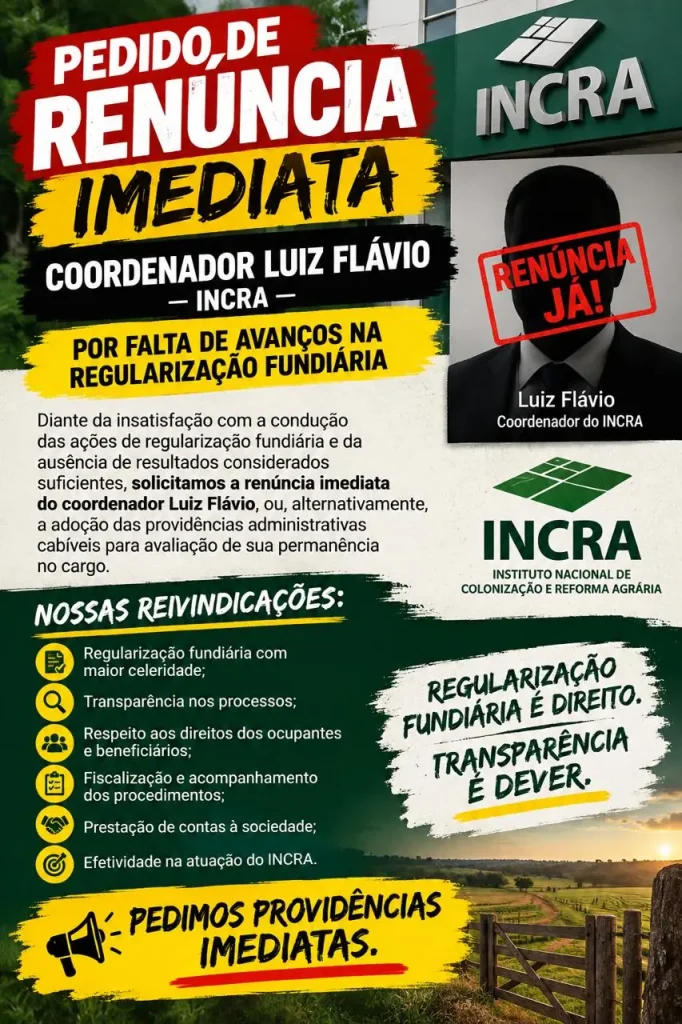
“In light of dissatisfaction with the handling of land regularization efforts and the lack of results deemed sufficient, we demand Flávio’s immediate resignation,” states one of the documents circulated. Hundreds of peasants organized by the LCP occupied the INCRA office in Porto Velho (RO) on August 8, 2013. (Photo: CPT-RO/Reproduction) published by the peasants. If he does not step down, the document demands “the adoption of appropriate administrative measures to evaluate his continued tenure.”
The demands include greater speed in land regularization, transparency in processes, respect for the rights of occupants and beneficiaries, oversight of procedures, accountability, and effectiveness in the actions of Incra (National Institute for Colonization and Agrarian Reform). Other documents call for the issuance of title deeds and Land Use Concession Contracts (CCUs), as well as assistance to small producers and “dignified and accessible” service from the agency.
“Land regularization is a right, transparency is a duty,” summarizes one of the slogans. Another call proclaims: “All associations united for the rights of their members and those living in encampments,” while also demanding “documentation, respect, dignity, and land titles now.”
According to an investigation by AND, the campaign’s impact led to an attempt to halt the mobilization by promising to issue “campsite certificates.” This ridiculous proposal sparked widespread outrage and met with resistance among the peasants: after all, such a document does not regularize the land, does not guarantee the family’s right to remain there, nor does it replace the CCU or the definitive land title—which leaves the door open for land grabbing by the latifundium.
This fear is based on a concrete precedent. In 2020, a report by Agência Pública revealed that peasant Amado Pedro da Silva possessed a certificate signed by Flávio during his previous tenure as superintendent, which listed him as a settler in the Flor do Amazonas Settlement Project. INCRA, however, did not provide him with the document certifying him as a beneficiary of “agrarian reform” nor did it finalize the settlement; meanwhile, a large group of soybean-growing big landlords presented alleged documents of acquisition for the area and encroached on the plot cultivated by the peasant.
Promises, Services, and Few Land titles.
When he returned to the superintendency in 2023, appointed by Luiz Inácio (PT), Flávio presented among his priorities the “acceleration of land regularization,” the “improvement of the agency’s operational capacity,” and “dialogue with rural movements.” In January of this year, Incra signed an agreement with the Rondônia Federation of Agriculture and Livestock (FAPERON) – an employers’ organization linked to the CNA System (Brazilian Confederation of Agriculture and Livestock) – to implement the “Terra Cidadã” Program with the support of rural producers’ unions.
Official propaganda promised to “speed up the process of granting definitive title deeds” and expand access to public policies. FAPERON itself estimated at that time that more than 40,000 rural properties in Rondônia remained without definitive documentation.
In September, the employers’ federation announced that a mission carried out by Incra, the Federal Institute of Rondônia, and FAPERON had provided 1,051 services in three municipalities . However, the report only records the issuance of only 49 title deeds, 32 CCUs, and 33 Certificates of Occupancy Recognition. It is this gap between the thousands of pending cases and the land that has actually been regularized that the associations’ campaign is addressing.
LCP filed the complaints in April.
The LCP’s first public complaint against Flávio came on April 16, following an attack on the headquarters of the former NorBrasil ranch, in which a retired civil police officer died. The League denied any involvement in the incident and stated that the accusation leveled against it sought to cover up a “scheme” between big landlords, police officers linked to the then-former commander of the PM-RO Régis Braguin, the superintendent of Incra, and the so-called “Jed’s gang.”
In the statement, the organization accused Flávio of brokering a deal to hand over part of the land in the Tiago Campin dos Santos 2 Area (TCS2), occupied and cultivated by peasant families, to a big soybean landlord. According to the LCP, Flávio “sat on the process,” failed to forward it to Brasília, and did not carry out the official study of the ownership chain of the former NorBrasil – a measure that, the League argues, would demonstrate that it is federal land illegally seized by the latifundium.
The organization further denounced that Flávio sought to separate the families from the peasant leadership through threats and promises. The message attributed to him was blunt: “Wherever the LCP is, there will be no land for them.”
The statement also accused the “Jed’s gang” of terrorizing residents of the Tiago Campin dos Santos area, expelling families, burning houses, extorting fees under threat, and persecuting LCP supporters. According to the League, the group expanded its activities after Operation “Godos” in November 2025, when the repression murdered the peasant Elias Camilo, injured his wife, arrested the popular lawyer Lenir Correia Coelho, and persecuted peasant leaders and supporters of the struggle for land.
The accusation against the ‘Flávio-Jed-Braguin gang’
On May 26, after two peasants were executed by the PM-RO during the so-called “Operation Dominus,” the LCP released a second statement. The organization denied that the victims were members of its ranks and characterized the incident as a “cover-up” by what it called the “Flávio-Jed-Braguin gang.”
According to the statement, those executed were part of “Jed’s gang” and acted as informants for the police forces in the scheme set up against the LCP. The League maintained that the group had the protection of police officers linked to Braguin and served the purpose of expelling families, disorganizing the masses, and paving the way for shady deals involving TCS2 lands. In this statement, it attributed to Flávio another threat made against the peasants: “With the LCP, you won’t have land; without the LCP, you will have land.”
Braguin, nicknamed “guaxeba” by the peasant organization (a term used to refer to goons in the pay of big landlords), had already publicly admitted to employing “counterinsurgency” formations in operations by the Special Police Operations Battalion (BOPE) against alleged “armed groups” associated by him with the League. During his campaign for federal deputy, the former commander appeared firing at targets identified with the acronyms “CV,” “PCC,” and “LCP,” despicably placing the peasant organization in the same line of fire as groups linked to drug trafficking.
‘They cannot stop the Agrarian Revolution!’
The third statement, published on the occasion of the 31st anniversary of the Heroic Peasant Resistance of Santa Elina, reiterated and deepened the accusations. The LCP pointed to Flávio’s administration as the most prominent example of Incra’s actions against families fighting for land and stated that the superintendent “sits on the land-title cases.”
According to the organization, Flávio works with lawyers, politicians, “guaxebas” (thugs), and corrupt police officers to divert public lands into the hands of the latifundium, in addition to producing land registries used to deceive families and benefit politicians during an election year. The League also denounced that the distribution of precarious certificates and registrations serves as a front to make the agency appear active, while the peasants remain without guaranteed land ownership.
Now, peasant associations are demanding the removal of this same superintendent and rejecting the replacement of regularized land with new “encampment certificates.” The campaign thus amplifies the pressure unleashed by the League’s denunciations.
In responding to the successive attacks from the latifundium, the far right, and the organs of the old State against the struggle for land, the latest declaration affirms that the peasant struggle “marches forward firmly and unwaveringly” and concludes: the attacks of the reactionary forces “fail and cannot stop the Agrarian Revolution!”
The AND editorial team attempted to contact those named in the allegations reproduced in this article but received no response by press time. The newspaper remains open to publishing any statements that may be submitted.