Bolsonaro Supporters and Big Landlords Attack the Struggle for Land in Brazil
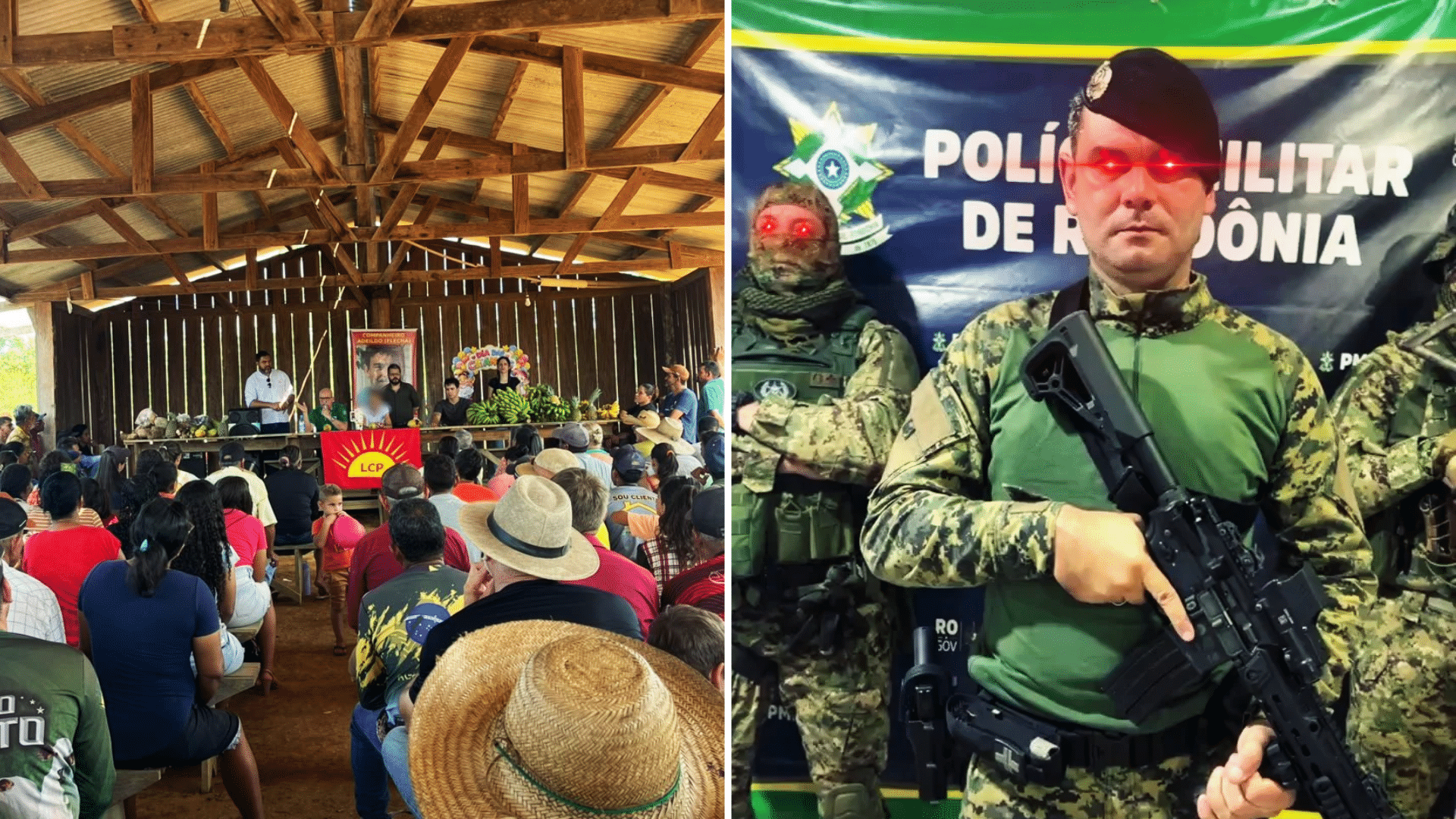
Featured image: On the left, peasants crowd the Popular Assembly of the Tiago Campin dos Santos Area, on October 23, despite the intimidation tactics of Régis Braguin; on the right, the colonel with agents of the Military Police of Rondônia. Source:AND
In Rondônia, two men were killed in a police operation; in Mato Grosso do Sul, an Indigenous man was found dead. Separate cases, both unfolding amid struggle for land. The three deaths reported in Brazil’s countryside have brought renewed attention to violence surrounding land conflicts and to police action.
In União Bandeirantes, Rondônia, BOPE officers killed Lindomar Eugênia dos Santos, known as “Nelore,” and Rodrigo José dos Santos Ferreira, known as “GPS,” on October 30. Colonel Régis Braguin said officers located the men through intelligence work and identified them as members of a group known as the “Jed’s gang,” which he linked to the League of the Poor Peasants (LCP).
The LCP disputed that account. It stated the men were never members of the organization and pointed to their deaths as a “cover-up,” alleging that they were killed to conceal crimes and that their deaths were being used to associate those crimes with the LCP. A Nova Democracia (AND) notes differing descriptions of the operation: an initial report referred to patrols, while Braguin described an intelligence-led effort to find and surround the men.
LCP has denounced this in a statement. You can read it below:
In Mato Grosso do Sul, Damácio Moraes, 40, a Guarani Ñandeva man, was found dead on October 30 beneath the stands of a community sports field in Porto Lindo Indigenous Territory. Indigenous reports cited said he had injuries to his head and neck. His death came amid threats and attacks against Indigenous people in the state.
The federal government responded by announcing that 145 National Force agents would remain in the region indefinitely, patrolling three villages. AND points that police deployments cannot resolve the deeper disputes while Indigenous land claims remain unsettled. It notes that the identification process for the Iguatemipeguá II territory has been underway since 2008, and that the national Indigenous organization APIB has called for progress on 73 declared Indigenous territories in 2026.
On October 31, the federal government announced that 145 National Force agents would remain in the region indefinitely, with patrols planned for Sassoró, Limão Verde and Taquaperi. The article argues that deployments do not resolve the underlying conflict while land claims remain unsettled: identification of the Iguatemipeguá II territory has been underway since 2008, and the national Indigenous organization APIB called for progress in 2026 on 73 territories that have already been declared.
These acts of violence both point to far-right and big landlords in revenge of election results and struggle for land. Mato Grosso do Sul The “Invasão Zero” group, a paramilitary landlord force, and congressman Marcos Pollon (PL-MS), who called Guarani-Kaiowá people “terrorists” during an August 19 offensive against the Aratikuty retake in Dourados, while police destroyed structures and big landlords and goons surrounded the area.
Braguin, on the other hand, had tried to intimidate families before a Popular Assembly in the Tiago Campin dos Santos area on October 23: the day before, he arrived at Vila Alípio de Freitas with armed officers and four police vehicles. Residents said the visit was intended to disrupt the meeting; one reported damage to a tractor and missing tools and keys. The assembly went ahead, drawing hundreds of peasants and supporters, including lawyers, students and representatives of Brazil’s land-reform agency, Incra. Families called for their plots to be regularized, and, according to the LCP, Incra presented a concrete proposal to acquire the land for them.