Haiti in the Imperialist Crosshairs
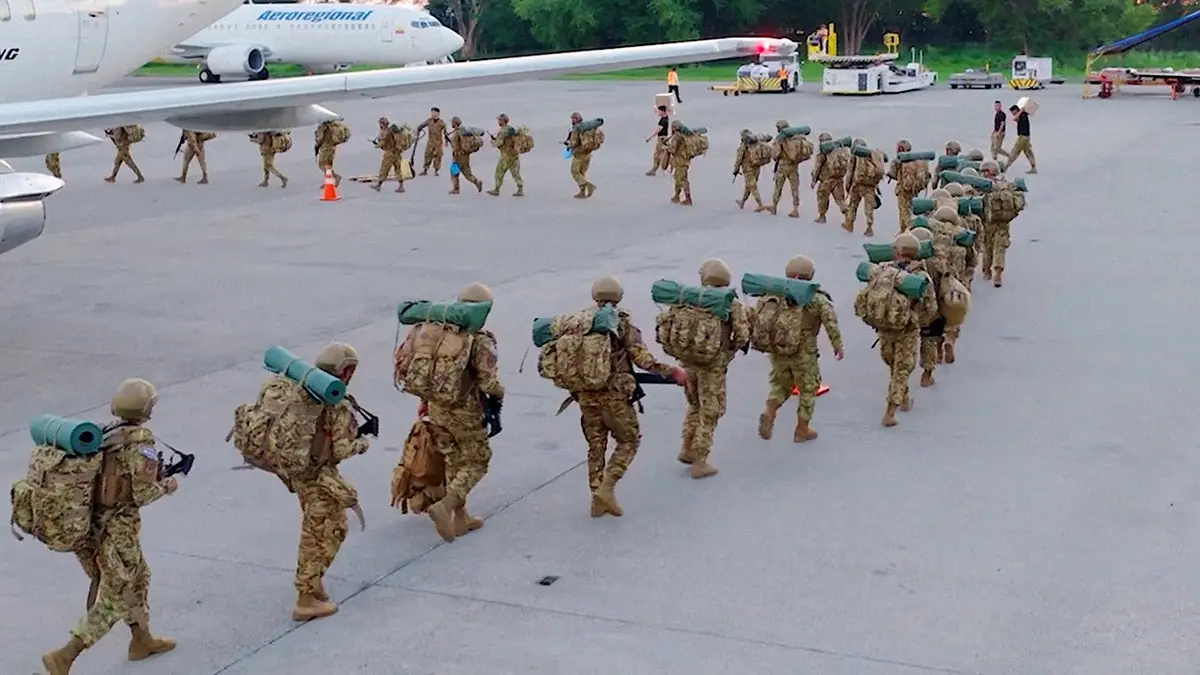
Featured image: El Salvadoran troops arriving in Haiti. Source: Fox News
On November 2, 2,000 of El Salvador’s Armed Forces invaded Haiti under “the mandate” of the military operation in service of imperialism, the Gang Suppression Force (GSF). Officially, the invasion comes as a “search and rescue” mission, after four Salvadoran aviation officers came under attack outside Port-au-Prince as part of the so-called “peacekeeping” GSF operation.
The invasion comes after a long history of occupation of Haiti, going back centuries, and marks another step in the Yankee imperialist plans to maintain dominance over the Latin American continent.
The Gang Suppression Force (GSF) and its goals
The GSF, from which the current invasion gets its mandate, is a so-called “UN-backed security mission,” meaning that – although it was authorized by the UN Security Council in 2023, and reports to the same instance – it is somehow a “non-UN-led” operation.
On the surface, the GSF is made out to be a “multinational taskforce,” an armed force in place to assist the Haitian National Police (HTP) in security matters, such as security for supporting the expansion of the repressive apparatus and its infrastructure, which is generally underdeveloped. Kenya is said to be leading this taskforce, but the operation has been a Yankee operation from the start, with other imperialists also having concrete interests for the development of a repressive apparatus in Haiti.
The operation falls outside the usual mechanisms of the usual so-called UN “peacekeeping operations,” the financing of logistics, communications and infrastructure is handled through a trust fund where “interested countries” contribute. As of June 2024, only 21 million USD of the funding cost of the GSF could be attributed to this trust fund – the rest, some 600 million USD – came directly from the Biden regime, alongside the coordination of the deployment itself. The operation is in other words a US operation, despite attempts to characterize it as a “multinational” project. This is a way for the US to “outsource” its military campaign, taking into use its faithful lackeys on the Latin American continent, and throughout the world, to shoulder the military deployments for its interests. It also serves as a way to distance itself from the invasion on a diplomatic and international level, as a “third party” is officially in charge.
Haiti Under the Heel of Yankee Imperialism
During the political crisis after the killing of the president of Haiti in 2021, the Biden regime called for the GSF taskforce to be made operational, then under the name of Multinational Security Support Mission (MSS). These calls came after the then Haitian prime minister Ariel Henry inquired for international help to curb the influence of the abundant armed groups of organized crime operating in the country. According to the UN, between 150-200 armed groups operate throughout Haiti, with 23 of them operating in the metropolitan area of Port-au-Prince, and according to the same analysis by the UN, they “are in fact controlling very strategic areas of the capital and the main roads connecting Port-au-Prince to the ports and to the land borders as well as coastal towns and areas”
Herein lies the real center of the interest for the development of a repressive apparatus in Haiti for Yankee imperialism – they need a repressive apparatus under their control in order to further expand the exploitation of the country, and facilitate the flow of capital. Per now, the HTP controls around 9,000 police, and are facing difficulties with recruitment. That is 9,000 police officers in a nation fielding a population of more than 11 million. The current invasion therefore, is only a “rescue operation” in the sense of guaranteeing more direct control of resources that are currently passing through the hands of the many armed groups.
This operation is by no means a new phenomenon – rather, the political situation of the last few years has created an opportune situation for Yankee imperialism to once again grasp for the furthering of the exploitation of the Haitian nation. The GSF was created in 2023, but just a couple years before, another international taskforce had been in effect – the United Nations Stabilization Mission in Haiti (MINUSTAH).
MINUSTAH was an operation with the same objectives as the GSF, that was initiated after a resolution, once again by the UN Security Council, in 2004. The UN Security Council Resolution 1542 was adopted, much like the GSF, after US calls for international support to “restore order” in Haiti after a coup d’état removed President Jean-Bertrand Aristide, who then fled to the US. Following the coup, the George W. Bush regime led Operation Secure Tomorrow, and in late February, 2004, invaded Haiti with around 2,700 foreign troops, 900 of them Canadian, 400 of them French. After a campaign lasting until May, the operation fought back imperialist control of the country from the rebels of the National Revolutionary Front for the Liberation and Reconstruction of Haiti.
After the Yankee invasion, MINUSTAH took over, with 2,366 military personnel and 2,533 police being fielded in Haiti, led officially by the Brazilian Army, operating as an extension of the repressive apparatus of Haiti, subservient to the interests of imperialism, mainly Yankee imperialism. The operation continued to serve as the repressive arm of imperialism in Haiti until 2017, when MINUSTAH was discontinued amid growing international disdain towards the many accounts of misconduct and abuse from the troops toward the civilian population, including hundreds of accounts of rape – even of children – as well as the introduction of cholera into the country, which led to 800,000 cases and over 9,000 deaths. A smaller operation took over from 2017 to 2019 under the name United Nations Mission for Justice Support in Haiti (MINUJUSTH), fielding around 1,275 foreign police officers, until it was discontinued in 2019 and exchanged by a permanent United Nations Integrated Office, set to coordinate all of the remaining projects, actions and funds of the United Nations in Haiti.
Yankee imperialism has a long history with occupation and exploitation of Haiti, going back as far as the start of the 20th century – when the US invaded Haiti in 1915 after the National City Bank of New York (now Citybank) called for the Woodrow Wilson regime to take control of the country’s political and financial interests, once again an invasion organized in the aftermath of popular rebellion in the country. After the rebellion in Haiti – fueled by the then president’s execution of political prisoners – killed the president, the US invaded with 330 US Marines, taking control of the country’s capital, and continued to rule through martial law, with the US-created Gendarmerie of Haiti. The invasion imposed the end to the constitutional ban against the foreign ownership of land, which had existed since Haiti’s constitution. The US employed a form of forced labor called “corveé” in order to facilitate the construction of infrastructure, resulting in thousands of deaths. Direct occupation lasted as long as to 1934, after which a formal transfer of authority was transferred to the Gendarmerie of Haiti, a force both created and loyal to Yankee imperialism.
Haitian subservience to Yankee interests continued through many decades, even through the self proclaimed anti-communist regimes of “Papa Doc” and “Baby Doc,” (François and Jean-Claude Duvalier) which led severe repression against the growing popular and revolutionist movement in their consecutive regimes lasting from 1957 to 1986 which murdered tens of thousands, and drove over a million people to flee the country. After “Baby Doc” Duvalier fled Haiti in 1986, the US once again needed a subservient puppet to consolidate the growing political instability, and was internationally campaigning for “free” elections to be held in Haiti.
After intense campaigning by the US, elections were held in Haiti at the end of 1990, with a voter turnout of around 50%, electing aforementioned Jean-Bertrand Aristide of the National Front for Change and Democracy (FNCD). The elections were marked by the presence of the UN, once again asserting its control over the Haitian people, this time through the United Nations Observer Group for Verification of Elections in Haiti (ONUVEH), which sent so-called election monitors. Eight months later Aristide had his first experience with being deposed through a coup d’état. The coup was led by remnants of the Haitian military command which had taken over the rule of the country after “Baby Doc” fled the country in 1986.
Fearing once again that Haiti was slipping through their fingers, the US again started touting its war horns. The US started threatening military intervention, and called for international support through the UN, leading to the adoption by the UN of Resolution 940 in 1993 – the first time the UN authorized the use of force to “restore democracy.” In September 1994, the preparations for the US-led Operation Restore Democracy were finished, and the US invaded with 25,000 troops and two aircraft carriers – a show of force, ultimately leading to the overthrow of the regime and the reinstating of the ousted Aristide. The operation was then given over to the United Nations Mission in Haiti (UNMIH) in 1995, with the US military in command, fielding around 4,000 US troops in Haiti until 1999.
This also highlights another function of developing a repressive apparatus in Haiti for imperialism’s interests, namely for the purpose of counterinsurgency. Yankee imperialism has nearly a century of concrete examples of what happens when they leave their puppets to rule “on their own” – they get felled by popular rebellion or by conflicting internal factions. For Yankee imperialism, much like its plans for the rest of the Latin American continent, installing lackeys must also be accompanied by the insurance that those lackeys are able to facilitate the imperialist super-exploitation, through a functioning State apparatus.
Trump regime renews effort to restore the extraction of resources from Haiti
The invasion of November 2 is in this sense not a new development, but rests on more than a century of exploitation through military occupation, and serves as an indication that once again Yankee imperialism finds less than optimal the conditions for the imposition of their plans, which include the exploitation of the 142 million barrels of oil and 1,2 trillion cubic feet of natural gas found in Haiti, and military control of the area, which goes hand in hand with the growing threats and aggression against Cuba.
It is no coincidence that it is the Bukele regime of El Salvador that has been given this task, considering its displays over the last years of its willingness to serve its Yankee imperialist masters, even fielding concentration camps for the massive wave of deportations from the US during the Trump regime.
On June 16, Nayib Bukele met with Trump behind closed doors in the White House, this is quite unusual, as foreign visits are often flaunted to international media and touted on the presidents social media, however, no records exist of what was discussed in this meeting. One White House source mentioned that among the topics discussed were “migration, regional security and economic growth.” It is a safe assumption to make that the current invasion of Haiti was one of the topics on the table. The framework (the GSF) is already in place, and the recent attack on the officers in Haiti is not something that warrants a force of over 2,000 soldiers, it is a natural consequence of fielding troops in a foreign country. It is much more likely a long awaited excuse to increase the deployment of troops in Haiti, to expedite the expansion of Yankee exploitation.
As of a report from November 11, more than 100 people had been murdered in the operation that started on November 2, 24 of which have been confirmed to be civilians. During the following week at least another 70 murders were reported. Meanwhile three Salvadorian soldiers have lost their lives in an accident handling one of their explosive drones. The El Salvadoran operation, which outnumbers the GSF deployment of around 1,500 soldiers, has deployed five MD500 and two Sikorsky UH-60 Black Hawk helicopters, and was initiated through the transport support of the United States Southern Command (SOUTHCOM), using Lockheed C-130 Hercules aircraft. The operation has established its headquarters Tabarra, next to the US embassy. An operation targeting and destroying the supposed house of the leader of the 400 Marwozo gang was carried out after Bukele inquired for the address on X. On November 20 the Haitian Minister of Justice and Public Security announced, that three prisons would be constructed working with a Salvadorian company, after visiting El Salvador, confirming also the deployment.
Parts of the current US regime have also called for sanctions to be imposed on several Haitian politicians, while groups subservient to imperialism in Haiti have called for all politicians affected by sanctions to step back from a participation in the elections, that have been postponed until July 2027.
The operation must be seen in the context of the strategy of Yankee imperialism for the Latin American continent outlined in the National Security Strategy of 2025, with its plans to ensure “American preeminence” in the so-called “Western Hemisphere.” The “Donroe” Doctrine – Trumps corollary to the Monroe Doctrine – to ensure the control of what it considers its “back yard,” by realizing counterinsurgency operations and thwarting plans by other imperialists such as Russian and Chinese imperialism to expand their influence on the continent.