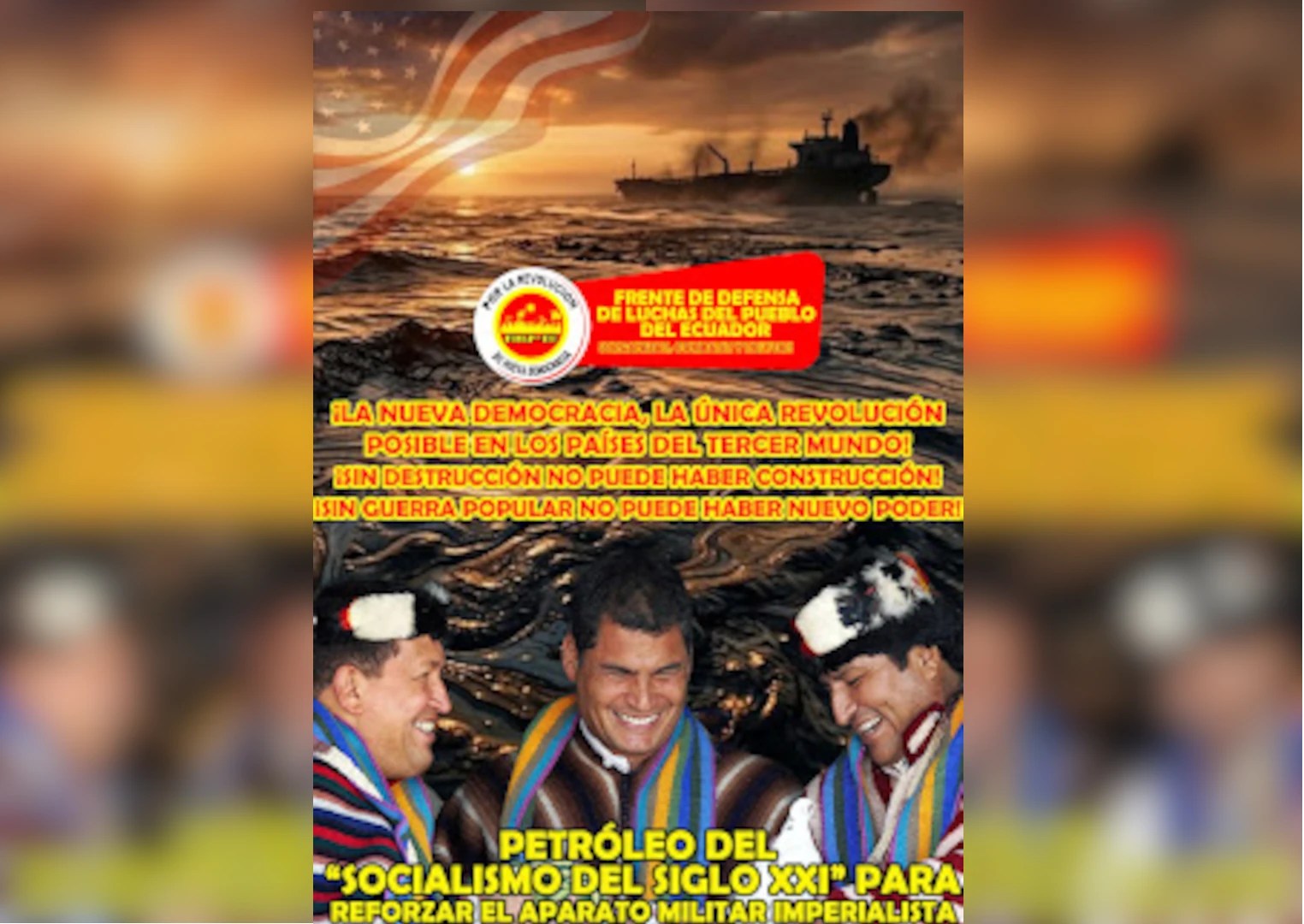
Ecuador – FDLP: Petrol of “21st Century Socialism” to Strengthen the Imperialist Military Apparatus
We hereby share an unofficial translation of an article published by the Front in Defense of the Struggles of the People – Ecuador (FDLP – EC) on September 16.
The so-called “21st century socialism” emerged in Latin America in the middle of the collusion and struggle of the imperialist powers and the crisis of bureaucratic capitalism in the countries of the third world. This crisis expressed itself in the worsening of the living conditions of the masses, on whose shoulders the ruling classes unloaded the weight of bankruptcy, and in the sharpening of the contradictions between the comprador bourgeoisie and bureaucratic bourgeoisie.
Taking up false patriotic, anti-US, sovereign speeches, and raising struggle against the poorly named “neoliberalism” – a radical expression of the comprador bourgeoisie in semi-feudal and semi-colonial countries – its promoters started a campaign to legitimize its politics. They sought popular support with a “program” looking to “retake” national sovereignty, “distribute the riches,” defend natural resources, expand social rights and to incorporate the masses into political life.
The leaders of this offspring had a particularity: some were waste products of progressivity and the domesticated left, including former members of organizations like AVC and MPL [translator’s note: ¡Alfaro Vive, Carajo! and Montoneras Patria Libre, two guerrilla organizations active in the 1980s in Ecuador]. They did not come from the big bourgeoisie, nor were they owners of big or median means of production. They were individuals and collectives at the service of the bureaucratic faction of the big bourgeoisie, and ended up becoming their political operators and, not infrequently, they became junior partners in their firms. Ah, and there were also a few “useful idiots,” especially in the ranks of Pachakutik and the PCMLE [translator’s note: “Pachakutik Plurinational Unity Movement” and the “Marxist–Leninist Communist Party of Ecuador”].
The immediate political “operators” understood that the control of the State apparatus allowed them to reproduce themselves economically and politically until becoming a new expression of the bureaucratic bourgeoisie.
In Ecuador there already exists a precedent of this “phenomenon”: the high command of the Armed Forces. The Ecuadorian military dictatorships, unlike others in Latin America, presented themselves as nationalists and revolutionaries. We did not have a simile of criminals like Videla or Pinochet, but that does not mean that they are dictatorships that should be tolerated. Under this rhetoric a new layer of big landlords emerged, that made use of the agrarian reforms to take for themselves vast stretches of land in the North-East, Amazonía and other regions of the country.
Many military personnel went on to form part of the big producers of African palm oil and spread their interests to banking and other business. People of popular background used the State as a lever for accumulation, and formed a new layer of the bureaucratic bourgeoisie linked to the old State and to the development of bureaucratic capitalism.
The history of Hugo Chávez was not any different. He represented the interests of the Venezuelan bureaucratic bourgeoisie by a political act that was skillfully and efficiently channeled by this faction, which was in struggle with the comprador bourgeoisie.
Initially they became the axis of the so-called Bolivarian Revolution. Later Evo Morales in Bolivia and Rafael Correa in Ecuador continued with the monstrosity of the “Citizen Revolution”. As if the “citizens” outside of the classes and class struggle could make a revolution.
To hide this bureaucratic bourgeois program, they put up a shrill and lying show of bells and whistles. In Ecuador for instance they gave out slogans like “Nothing for us, everything for the homeland” and “Socialism of the good life.” They talked of the “citizenship participation”, “democratic, participative and proactive”. In Venezuela: they proclaimed “the homeland is for everyone”, “Venezuela now is for everyone”. “Homeland, socialism or death. We will win!” and “Towards 21st century socialism”. In Bolivia, “Lead by obeying the people,” “A dignified, sovereign, and productive Bolivia,” “Land and territory,” and “Refound Bolivia.”
With that fanciful rhetoric, they sought to confuse the masses and give a red veneer to a big landlord-bourgeois project, which oscillated between yellow and pink. They concealed the fact that, in our semi-feudal and semi-colonial societies, it does not correspond to a socialist revolution, but rather a democratic revolution of a new type. Furthermore, it is obvious that a “socialist” revolution cannot be carried out without an armed revolution led by the proletariat; therefore, it cannot be achieved through elections nor built upon the old State, which embodies the joint dictatorship of the big bourgeoisie and big landlords. The so-called “21st century socialism” was, in fact, a necessary means to revive bureaucratic capitalism and contain the revolutionary struggle of the masses.
A good part of the domesticated left and opportunism embraced this project. The Socialist Party of Ecuador, the PCMLE, Pachakutik, among others, renounced the possibility of popular struggle, further tying the masses to electoral processes, and presented the administration of the old State apparatus (the government) as a “path to socialism.” The most confused among them argued that these governments represented the national bourgeoisie. This was a political and ideological error: the national bourgeoisie, oppressed by imperialism and constrained by bureaucratic capitalism, is one thing, while the bureaucratic bourgeoisie, which grows in tandem with the State apparatus, public contracts, and imperialist capital, is a completely different thing.
Some of these governments somewhat scaled back their economic and political commitments to the USA (aspects that did not alter the structure of domination they have maintained since the late 19th century); in exchange, they opened their doors to Chinese capital, which they presented as a sovereign partner and a “multipolar” alternative. Chinese imperialism acted like all imperialism does: it bound us with foreign debt; it exported capital and goods, secured raw materials, conquered markets, and blocked the path to the nascent industrialization process, all while plunging us into large-scale mining projects.
Its cheap products dealt a brutal blow to the national bourgeoisie, which was utterly incapable of competing with Chinese monopolies and their mass production—much less, in the case of our country, with a dollarized economy historically subjugated to imperialism.
The popular sectors, previously cast aside and forgotten by governments serving the comprador bourgeoisie, found a space that offered them hope for better days in 21st century socialism. In the early stages, these governments implemented social measures that captured the attention of the masses. Finally, increased revenue from petroleum exports allowed them to finance health, education, and housing programs, improve road infrastructure, and, among other things, provide subsidies to the most disadvantaged sectors of society. But, turning a blind eye to this bleak reality, the Bolivarian governments were driving the economy further into a state of reprimarization: they expanded mineral and gas extraction in Bolivia, and oil production in Ecuador and Venezuela. In other words, we were not breaking free from the semi-feudal entrapment.
Amid all that populist upheaval, the leaders of these movements gained some popular support. In Venezuela, Chavismo sparked an “anti-oligarchic” movement and a sense of national sovereignty. In Bolivia, the rise of Evo Morales channeled the accumulated struggles of peasants, workers, and indigenous peoples. In Ecuador, Correísmo capitalized on the rejection of the most backward expressions of the big bourgeoisie and big landlords to build a falsely revolutionary movement that even deluded sectors of the left and the indigenous movement who were convinced they were living through a revolution.
The strategy of the misnamed Bolivarian Revolution opened up spaces in public administration, assemblies, congresses, and regional governments for veteran popular, union, and indigenous leaders. Thanks to available revenues, these governments somewhat improved the functioning of the old State’s bureaucratic apparatus and spread the idea that “the State is here to serve everyone.” In doing so, they obscured its class character and concealed the fact that this State serves the joint dictatorship of the big bourgeoisie and big landlords.
This phase of the so-called “21st century socialism” was pivotal. Greater State intervention in the economy, and in particular in public employment, served as a panacea for the further enrichment of the big bourgeoisie. By giving it a more prominent role and presenting it as a “business-oriented State,” concessions were expanded, and contracts and agreements were signed with large national and transnational corporations. Big landlords, mining companies, and even imperialist monopolies gained access to large-scale concessions. All bourgeois factions and big landlords received their share of the pie.
Investment in public works did not benefit all of society equally either. The main beneficiaries were large construction companies, merchants and suppliers of materials and machinery, intermediaries, banks, and certain groups linked to transportation and other services. The State concentrated and distributed enormous resources through contracts, loans, concessions, and public procurement, which fueled the profits of these sectors of the big bourgeoisie.
To put this into perspective: The construction sector had its highest peak of the 2008–2026 period in 2014, under the regime of the “citizen revolution”, with a historic record of USD 6.893 million, representing 9.83% of the Gross Domestic Product (GDP). Between 2016 and 2017, 2,9 million hectares were granted under concession to various companies and countries, including Canada, China, and Austria, among others.
During that same period, private banks posted record profits, accumulating total net earnings of 2,8 billion USD.
“21st-century socialism” built a captive social base, particularly in the electoral arena. Its governments resorted to populism and, in some cases, adopted openly fascist behaviors, as was the case with Rafael Correa. Correísmo exploited the influence that the old opportunist and revisionist left still held among the masses to create parallel organizations within the popular movement. It implemented a policy of pitting masses against masses in order to divide and neutralize popular protest, especially among those who didn’t “buy into” that nonsense about “21st century socialism.”
They also adopted new constitutions and took control of part of the administrative apparatus, but left the structure of the old State intact. Those constitutions proclaimed social rights and incorporated concepts such as participatory democracy, the rights of nature, a plurinational State, and citizen power… In this way, they gave the opportunistic left and the pachamamistas [translator’s note: term used by indigenous activists referring to the “Mother goddess Pachamama”] what they had always sought: demands that might have been just under certain historical conditions, but which became the ceiling of their aspirations, the limit they were unwilling to cross. For this left and a large part of the indigenous leadership, that was everything. In exchange for reforms and State positions, they gave up on destroying it and helped avert the popular revolution.
The disputes within the big bourgeoisie (comprador bourgeoisie versus bureaucratic bourgeoisie) were intense and, at times, violent. In Venezuela, Bolivia, and Ecuador, there were clashes, repression, and deaths. These contradictions reflected the discontent of the masses, but also the struggle for control of the State and the division of the spoils of the fat cow.
Our countries also became a battleground between the imperialist powers. The United States, China, Russia, Germany, and France competed for mining concessions, markets, natural gas, oil, and other resources, without losing sight of each country’s geopolitical position.
The bureaucratic bourgeoisie, hiding behind the grandiloquent rhetoric of Chávez and Correa, sold us on the idea that turning away from Yankee imperialism only to fall into the clutches of Chinese or Russian imperialism was more dignified for our peoples. Many misguided leftists came to believe, and still believe, that China is socialist and that today’s Russia is the same as the Soviet Union of the first half of the last century. Nonsense!
The Bolivarian Revolution spoke of uniting “patriotic” businessmen, military personnel, workers, peasants, and government officials around a national project. Bolivia’s MAS party struck deals with mining cooperatives, big business, agro-industrialists from Santa Cruz, and peasant organizations. Rafael Correa proposed modernizing Ecuadorian “capitalism” under strong State leadership. He called it a “change in the productive matrix”, something that “smelled” of industrialization, but no, it was just another fairy tale.
The bankruptcy of theses processes did not take long. In Venezuela, the economic and trade blockades imposed by the United States strangled the economy. While the Chinese and Russians were barely scratching the surface, the Yankees have been entrenched in the roots of Venezuela’s economic structure for over a century. The imperialist offensive reduced revenues and forced the government to cut public works and social programs. Once again, the masses bore the brunt of the crisis.
In Ecuador, Yankee imperialism attempted to regain the ground it had lost to China and Russia under the guise of “restoring democracy.” In Bolivia and Ecuador, it did not apply the same strategy as in Venezuela (economic blockade, criminalization of leaders, military intervention); on the contrary, it spurred on a belligerent opposition and exploited internal contradictions, including those among former allies of Morales and Correa, to undermine the Bolivarian project from within. They launched campaigns using digital platforms to spread disinformation among the masses and leaders, and unleashed their full media and legal resources to “neutralize” them.
It was then that the limitations of these “revolutions,” that only existed in the minds of their architects, were laid bare. Being in government and administering the State apparatus does not mean holding power.
They sold the idea that the bureaucratic bourgeoisie was a national bourgeoisie and that, therefore, it should receive State support: credit, contracts, markets, and alliances with imperialist powers of various stripes. Under that pretext, they strengthened a faction of the big bourgeoisie. That was the essence of their project.
Today, years after that ripple in a puddle of water, and that forest of bonsai trees sold as majestic jungles, all that remains is the leaf litter, stained by disappointment, disillusionment, and corruption. What also remains is the circumstantial defeat of the bureaucratic bourgeoisie, which lost ground in nearly every country where it fueled the illusion of a 21st century revolution.
But the aftermath is profound and painful. They dismantled or crushed unions and indigenous and popular organizations. When the people mobilized to confront them, they resorted to fascism, imprisoning popular fighters and destroying popular and union organizations that have not yet been able to rebuild themselves. This explains, to a large extent, what is happening now in Ecuador: a popular movement weakened and nearly demobilized by Correísmo, revisionism, and opportunism, outgrowths of the same political cesspool. They handed the country over to imperialism on a silver platter.
As a result of this demobilization campaign, we now face the imperialist offensive against the country under unfavorable conditions. We have US and Zionist military forces operating in Ecuador, while the Armed Forces and organized crime groups massacre the people, make popular activists disappear, and consolidate a police State of imprisonment and repression.
In Venezuela, the events were just as dramatic as in Bolivia and Ecuador, if not more so. The blanks fired by Maduro, Delcy Rodríguez, Diosdado Cabello, and the Armed Forces, ended up being a farce in the face of imperialist aggression.
In the face of the Yankee invasion, no one came forward to defend that “revolution.” Not even the military personnel marching through Caracas, singing revolutionary songs and pledging absolute loyalty to Maduro. Only a handful of Cuban internationalists fought, who believed it was right to defend a process incapable of responding with the dignity shown by the Cuban people during their long resistance. They also defended the illusion of those who had seen in Bolivarianism a revolutionary way out and the possibility of building a different society.
Petroleum from Venezuelan “socialism” for the imperialist war machine
The handover of Venezuelan petroleum to the United States completely lays bare the bankruptcy of so-called “21st century socialism” and its true class character. Not a damn thing remains of what they once proclaimed with such vehemence and which, in its early days, spewed fire. Sovereignty, anti-imperialism, and revolution perished with no greater significance than that displayed by Maduro, abandoned by his comrades, handcuffed, and shipped off to a prison in the US.
The leadership that replaced Maduro, headed by Delcy Rodríguez and backed by the United Socialist Party of Venezuela, decided to submit to the very same Yankee imperialism – which they had once “fought” – with incredible ferocity.
Just a few weeks ago, Venezuela granted a 100-year concession for the exploitation of oil fields containing approximately 65 billion barrels of oil, accounting for nearly 20 percent of its reserves. The US government would control 55 percent of the joint venture, either through direct ownership or the right to obtain oil at cost. Donald Trump celebrated that the deal will double the reserves under US control, while Delcy Rodríguez presented it as an agreement for the “economic recovery of the country.” The PSUV also backed it and described it as a mechanism designed to protect national interests. These imbeciles hand over sovereignty and resources to imperialism and talk of national interests.
As if Venezuela hadn’t already experienced a veritable political earthquake, the bureaucratic bourgeoisie is handing over a portion of the country’s primary wealth to the power that blocked its economy, intervened in its internal affairs, imposed its conditions by force of arms, and kidnapped its top leader, Maduro, to take him to a prison in the US. The Venezuelan leadership did not resist: they capitulated. Faced with imperialist pressure, they abandoned the sovereignty they had proclaimed and turned the petroleum of the people into a guarantee of their own political survival.
This capitulation is not the work of Delcy Rodríguez. We believe that blaming her alone is to lose objectivity. Did she act like a lapdog? Well of course she did. But, ultimately, she is not the only one to blame. Neither is Maduro. The problem runs deeper: it is ideological. It is the result of the line that guided the Bolivarian Revolution from the very beginning.
Chavismo never destroyed the old State nor did it dismantle the economic ties that bind Venezuela to imperialism. It was never going to do so. It was and is part of the big bourgeoisie, and one would have to be half-crazy to think it would commit political harakiri. What it did, was to manage bureaucratic capitalism with a narrative laced with a bit of populism and revolutionary slogans: distribute a portion of oil revenues and present that “bonanza” as the fruit of a revolutionary process that never existed.
Chavismo’s betrayal of the Venezuelan people takes on an even more grave dimension because the oil it hands over strengthens the United States and Israel and helps sustain the criminal war in Western Asia. The deaths that imperialism and Zionism leave behind in Palestine, Lebanon, Yemen, and Iran are not only the result of brutal Yankee and Zionist aggression. They also bear the mark of Venezuela’s cowardly and treacherous leadership. They, the leaders of the government and the PSUV, are accomplices, they contribute to the military campaign that imperialism wages anywhere in the world, including in Ecuadorian waters, where it massacres small-scale fishermen under the pretext of combating drug trafficking, or carries out the criminal bombing of small-scale miners, whose neutralization is demanded by the large monopolistic mining corporations.
What, then, remains of Bolivarian anti-imperialism? Nothing. As our people say on the street: not a damn thing! The very same leadership that used the Palestinian cause as part of its propaganda now accepts that Venezuelan wealth should strengthen the main protector of its executioners. Solidarity with Palestine was reduced to speeches, flags, and diplomatic statements. The truth is, objectively speaking, they ended up stabbing them in the back.
We must take stock of all this: it is important. We must analyze it further and more thoroughly. In the end, everything reaffirms us on our path. There is no room for “half-measures.” We cannot fall into the trap set by that wretched left in our country which, wearing blinders, comes out in support of a project of the bureaucratic bourgeoisie in our nations, where revolutionary rhetoric masks the darkest aspects of bourgeois strategy amid its internal contradictions.
The gravity of these events has an enormous impact on the Venezuelan people, but also on the rest of the peoples whose rulers bet on the “21st century revolution.” This so-called “progressive” bureaucratic bourgeoisie managed, for many years, to stick the organizational and combative capacity of broad sectors of the people in the freezer. The comprador bourgeoisie on the other hand, more deeply “entangled” with the Yankees, worked to bring about the defeat of the bureaucratic bourgeoisie through a powerful propaganda campaign waged across all possible media: formal, informal, and educational. It led people to believe that this drivel about the “revolution” was little short of the most radical communism humanity had ever experienced.
They “waved the black flag” to such an extent that today, in Ecuador, any individual, organization, or group that protests against Noboa’s criminal regime is stigmatized as a correísta. And, according to this fascist and imperialism, being a correísta is synonymous with being a communist, a guerrilla, or a revolutionary.
We must always understand that within the ranks of the big bourgeoisie there is both collusion and conflict. Its factions collude when the “security” of the old State is threatened by the class-conscious elements of the working class and the people, but they also struggle among themselves, even violently, for the control of the State and the distribution of wealth.
Let’s draw lessons from all this. The conclusion? The only socialism Latin America can achieve will be the one born after a New Democratic Revolution led by the proletariat. And that is not achieved at the ballot box, nor by having a “cup of coffee” or going crazy on ayahuasca in an indigenous binge. Rather it is through organization, People’s War, and the conquest of Power. Only then can the way be paved for socialism and the dictatorship of the proletariat. If it’s not this, it’s nothing.
NEW DEMOCRACY, THE ONLY POSSIBLE REVOLUTION IN THIRD WORLD COUNTRIES!
WITHOUT DESTRUCTION, THERE CAN BE NO CONSTRUCTION!
WITHOUT PEOPLE’S WAR, THERE CAN BE NO NEW POWER!