Colombia – Nueva Democracia: Increased plunder and militarization in the first two months of rule of the lackey Abelardo
We hereby share an unofficial translation of an editorial published by Nueva Democracia on October 29.
The first two months of the new administration have revealed how the lackey Abelardo De La Espriella is slavishly implementing the plans of Yankee imperialism for Colombia and Latin America.
The imperialist system is in the midst of a general crisis, and the US, as the hegemonic power, is at the epicenter of the global crisis. It has a public debt exceeding 100% of GDP, while its government has a fiscal deficit of nearly 6%, and projections indicate that both of these negative indicators will continue to rise over the next decade. The cost of borrowing (interest) is also rising, and the Yankee State is forced to secure new sources of revenue (primarily through plundering its colonies and semi-colonies) to prevent structural fiscal deterioration. At the same time, it must safeguard its domestic economy and prevent an economic recession: ensuring that its goods continue to sell worldwide, preventing a rise in unemployment among its population, and maintaining consumption levels. The problem of the “financialization” of the Yankee economy – that is, increased speculation – creates financial bubbles that can burst at any moment, as could happen with the financial bubble surrounding AI, dragging major tech companies, banks, and governments into bankruptcy.
In an attempt to maintain its hegemony and contain the crisis, Yankee imperialism subjects the oppressed countries of the third world to even greater plunder, exploitation, and oppression. The recent military aggressions against Venezuela and Iran, as well as its increasingly open and brazen political interference in all the countries it dominates, installing openly subservient governments to safeguard its economic and political interests, are an expression of its current economic and political situation and are part of its desperate attempts to avoid sinking into a deeper and more acute economic crisis. However, in response to this, increasingly broad, conscious, and combative national liberation struggles are emerging against imperialism – such as the national liberation struggles in the Middle East, where the heroic Palestinian National Resistance stands out.
Against this backdrop of crisis, the struggle among the imperialist powers over the division of the world is intensifying, to the point that preparations for a possible third world war are increasingly central to the plans of all imperialist countries, particularly the United States. The recent documents of National Security Strategy and National Defense Strategy of Yankee imperialism outline an open and intense struggle against Chinese imperialism, as well as preparations for war to secure dominance over the Indo-Pacific region. The struggle over supply chains is becoming increasingly hostile: fuels, strategic minerals, rare earth elements, and trade routes are all in the crosshairs of the imperialist powers.
The ruling classes are shifting the cost and consequences of the crisis onto the shoulders of working people. In response, massive protests are erupting around the world against cuts to the rights of the people, against the deterioration of working conditions and livelihoods, and against rising taxes and the cost of living. The massive youth protests in France, the struggle for housing in Spain, and the student movements in India and Chile, among others, are just a few examples from recent months.
This global crisis not only leads to greater exploitation and oppression by the imperialists, but also to greater rebellion on the part of the people. The trend toward revolution is a major concern for Yankee imperialism, which knows that times of crisis and war fan the flames of the world proletarian revolution, a fire they have never been able to extinguish. In July, the Yankee Secretary of State Marco Rubio convened more than 60 delegates from different countries to express his concern over the “resurgence of political terrorism” and the “far left.” Communists, anti-capitalists, anti-imperialists, anti-fascists, anarchists, radical environmentalists, and other movements were declared threats to be combated by Yankee imperialism. All US lackey states must coordinate their intelligence apparatuses to identify and attack the popular, democratic, and revolutionary organizations that oppose the plans of North-American imperialism.
Latin America and Colombia
All of the above reveals the plans of Yankee imperialism for Latin America, which call for greater control over and plundering of strategic resources, such as rare earth metals and oil; greater control over the entire territory and all critical infrastructure, such as the Panama Canal; greater interference in the politics of all dominated countries, installing governments fully subordinate to Washington’s interests, and promoting forms of government increasingly oriented toward fascism; greater control over the armed forces of the dominated countries, through funding, joint operations, military “cooperation” treaties, and all kinds of “agreements” to ensure that the armed forces of Latin American countries are fully guided by Yankee military command, serving as the armed wing that guarantees plunder, control of the territory, the repression of popular protest, and the containment of the revolutionary movement.
At the second meeting of the Shield of the Americas, Trump instructed its members (the lackey governments of Latin America) “to help protect the enormous natural wealth of this hemisphere.” “You have tremendous natural wealth – perhaps the greatest in the entire world – and you must not allow it to be taken by hostile external powers; we cannot let that happen… we must ensure control over our own oil and gas pipelines, rare earth elements, and agricultural trade corridors – something you know how to do very well.”
Given the US’s current appetite for control over Latin America’s wealth, Colombian Vice President José Manuel Restrepo has already made several trips to the US to offer our natural resources to Yankee imperialism. In his own words, “There are many opportunities for the United States in Colombia.”
However, the Colombian economy, subjugated to and dependent on imperialist investments, is also in crisis. Currently, Colombia is facing one of the worst fiscal deficits in recent decades, exceeding 7% of GDP, and a public debt that amounts to 60% of GDP and makes up 25% of the 2027 budget. It has also lost the confidence of foreign investors, with a 33.2% drop in Foreign Direct Investment over the past four years. Added to this is the downgrade of its credit rating by the agencies of big international finance capital.
Put simply, this means that the Colombian government does not have sufficient resources to function, that large foreign capital is not flowing into Colombia as it did in previous years, and that major international banks consider lending money to the Colombian government to be riskier than it was in the past. Abelardo’s government, serving Yankee imperialism, faces the urgent task of reversing this situation and reinvigorating bureaucratic capitalism – that is, the penetration of imperialist capital in alliance with the capital of the Colombian big bourgeoisie and big landlords – to plunder our natural resources and exploit our working people.
It is within this context that the main economic measures Abelardo has promoted during his first two months in office are framed:
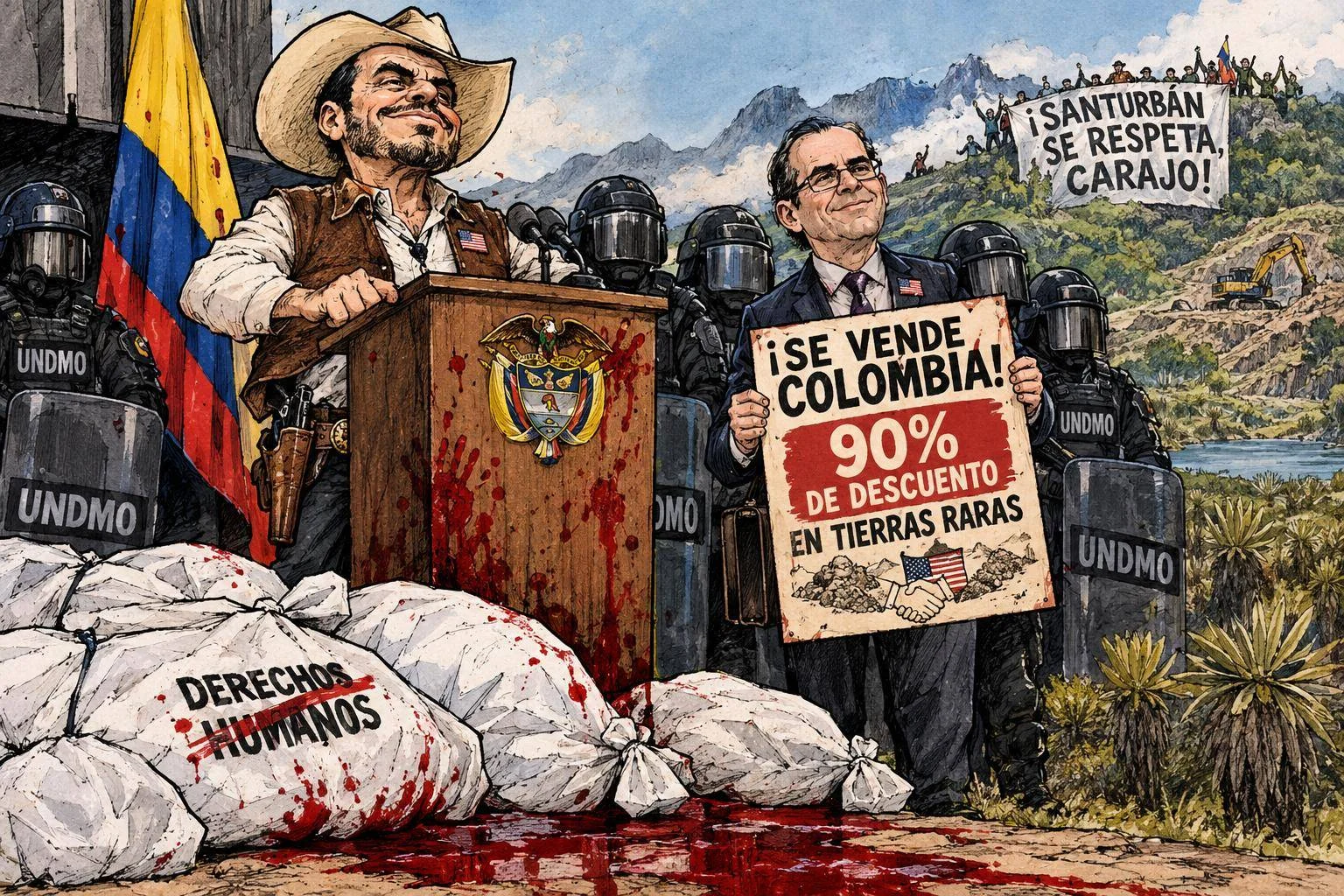
– Repeal of environmental protection decrees for the moorlands of Santurbán, which has been coveted for decades by multinational mining companies.
– Signing of a “Cooperation Framework on Rare Earths and Critical Minerals” with the US
– Revitalization of Ecopetrol focused on hydrocarbons, for which fracking will be used.
– Requesting a loan from the International Monetary Fund (IMF) and subjecting the country to the austerity packages and economic guidelines imposed by that institution.
– Announcement of the “Rescue Law,” which will seek to cut government spending, reduce social investment, and implement tax adjustments.
Another major problem Colombia faces in serving the needs of Yankee imperialism is the state of public order and security. To advance the plunder, Abelardo needs to regain control of the national territory through militarization. Under the guise of the fight against “narco-terrorism,” Abelardo seeks to combat armed groups, especially the insurgencies, which are a thorn in the side of foreign investment seeking to exploit the country’s vast national wealth.
In the wake of the resounding failure of the Petro administration’s “Total Peace” initiative, we will now have a new warmongering government that promises to wipe out illegal armed groups by force. This is a story that has repeated itself many times over the course of more than 60 years of armed conflict in Colombia, where peace processes and warmongering offensives have alternated like two sides of the same coin: the war of the rich against the people. Historically, both false promises of peace and militarization have failed spectacularly, time and again, because they never truly address the root of the problem: latifundium, land ownership, and the dispossession of millions of peasants.
Abelardo states that he will not negotiate with any illegal group, that all will be treated as “terrorists,” and that those who do not submit will be killed. Thus roars “the tiger” (of paper), with his pistol at his waist and walking among corpses in white bags, people killed in various bombings, like a true overseer of a semi-feudal estate, obediently safeguarding the interests of his master, Yankee imperialism, on Colombian soil.
To comply with the policy of militarization across all of Latin America, guided by Yankee imperialism under the guise of the war on “narco-terrorism” Abelardo’s government has implemented the following measures in its first two months:
– Joining the Shield of the Americas.
– Signing military and military intelligence agreements with the US and Israel.
– Continuation of the bombings, which had already begun under the previous “total peace” government.
– A military offensive against so-called “illicit economies” – that is, against coca cultivation and “illegal” mining – indiscriminately attacking the livelihoods of thousands of poor peasants and small-scale miners.
– Announcement of a new Anti-Terrorism Statute which, among other things, makes it easier to charge and prosecute as “terrorists” those popular forces that oppose plunder, militarization, and increased exploitation.
– Glorifying the Armed Forces, whitewashing their image as murderers, boosting their morale so they will carry out the plans of Yankee imperialism, and instilling fear to give them free rein in their repressive role.
Abelardo’s plans and, more broadly, the plans of Yankee imperialism, spark a just popular resistance against plunder and exploitation. Anti-imperialist and anti-fascist banners are being raised once again on a broad scale by the Colombian popular movement. Yankee imperialism’s fears regarding the growing trend toward revolution throughout the world are also evident in Colombia: Abelardo has been tasked with containing the growing popular protest and preventing the strengthening of popular, democratic, and revolutionary movements and organizations in our country. For this reason, in his first two months, he has attacked the student movement, which has so far been the sector of society that has most actively denounced the new government’s treasonous and repressive plans. And then, in response to the call for the first national mobilizations, called for by the popular movement as a whole (labor federations, indigenous organizations, student groups, etc.), Abelardo has counterattacked with a decree to “regulate popular protest,” that is, to limit protest and facilitate repression by the police.
Thus, the first two months of Abelardo’s lackey government reveal its nature as a government at the service of Yankee imperialism. In the context of the general crisis of imperialism, the decline of Yankee imperialism, and its growing rivalry with Chinese imperialism, Abelardo’s government is designed to ensure greater plunder of our natural resources, greater military control over our territory, greater subjugation of the Colombian Armed Forces to Yankee command, and greater containment and repression of popular protest and the revolutionary movement. This happens at a time when popular protest is surging and the trend toward revolution is growing worldwide.