Norway – Tjen Folket Media: The Passing of a Bourgeois Monarch
We hereby share an unofficial translation of an editorial published by Tjen Folket Media on October 4.
On August 28, the head of State of the bourgeois and imperialist Norwegian State, King Harald V, died at the age of 89. In accordance with bourgeois law, his son was sworn in as the new king three days later.
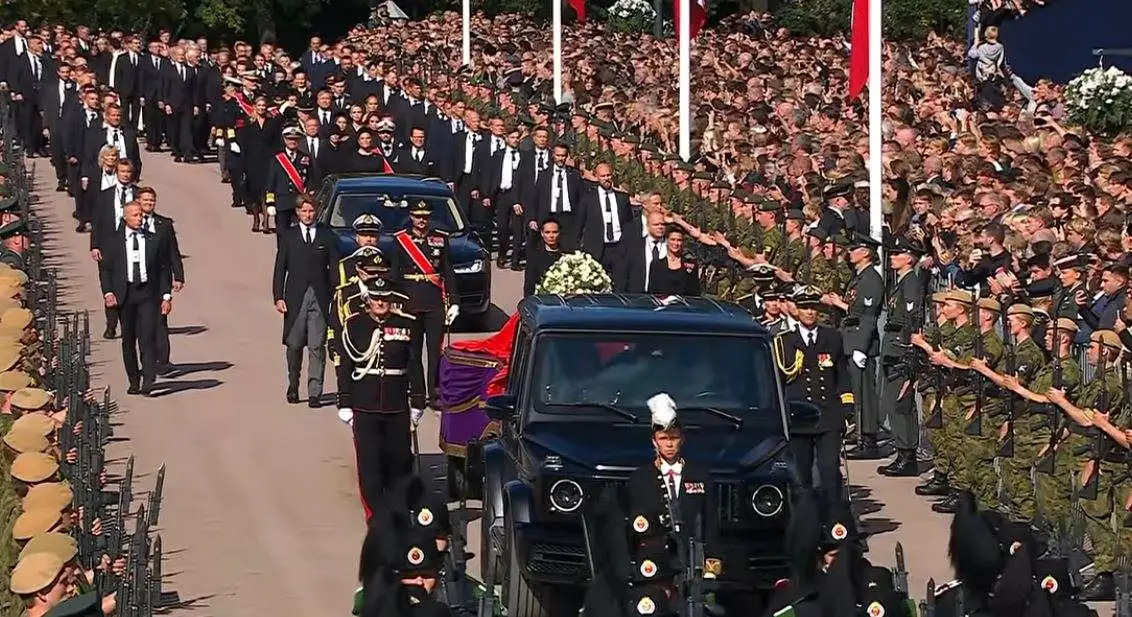
For the first time in Norwegian history, an official period of national mourning was declared, lasting from the day of his death until the funeral two weeks later. A total of 3,500 soldiers from the reactionary armed forces accompanied the “supreme commander of the realm” to his final resting place at Akershus Fortress, 1,900 of whom stood as an honor guard along the procession route.
Among those walking closest to the coffin in the procession were the Chief of Defense, military aides-de-camp, Prime Minister Gahr Støre, the new King of Norway, the kings of Sweden and Denmark, and foreign heads of state, including President Zelenskyy.
Bourgeois “truce”
During the national period of mourning, the bourgeois parties – based on a swift agreement between the Labor Party and the Progress Party – also reached yet another innovation: a political “truce” would prevail throughout the entire period of mourning. The center-right parties were to completely refrain from debates and political maneuvers.
Only the Center Party challenged the “truce” when the tax breaks on gasoline and diesel were repealed on September 1, and prices once again reached 30 kroner [translators note: around 3 USD] per liter. More expensive tractor diesel seems to be the only thing that can rival the king when it comes to stirring up strong emotions in the party of the milk, butter, and meat monopolies. It also came to light that the Center Party had not been presented with any agreement regarding the “truce” at all. They had simply received an email from the Labor Party’s parliamentary leader, Tonje Brenna, which laid out the terms of the “truce.” There was never any discussion and never any meetings between the parties to clarify the rules—the “truce” was agreed upon between the Labor Party and the Progress Party behind closed doors…
Incidentally, the Labor Party in government displayed its supreme arrogance and carried out a series of planned ministerial visits and public statements despite the “agreement” with the other parties. The government does not engage in politics, you see – not unlike the late monarch.
Covered-Up Scandals
The death of the bourgeois monarch has, much like the hasty lung transplant of Crown Princess (now Queen) Mette-Marit Tjessem Høiby, served to cast a “veil of forgetfulness” (or a veil of mourning) over the scandals that have rocked the royal family over the past year. First, the then-Crown Princess’s son was exposed and convicted as a serial abuser of women, a sexual predator, and a cocaine addict. Second, the Crown Princess’s close relationship with the sexual predator Jeffrey Epstein was revealed last year. As a result, she was also exposed as a liar, having long denied any contact with Epstein, the suspected Mossad source.
Nothing is quite like a lung transplant, a grand funeral, and a political “truce” to give the royal family some much-needed breathing room. Incidentally, the convicted Marius Borg Høyby is serving his sentence in freedom at the king’s stately estate, Skaugum, restricted only by an electronic ankle monitor. He was able to attend the funeral. This stands in stark contrast to all the “ordinary” prisoners in Norwegian jails, who can only dream of such treatment. The Norwegian media, of course, did not criticize this, but some foreign newspapers pointed out the disparity in treatment.
Part of the Reactionarization and Militarization
We view the period of mourning, the “truce,” and the massive propaganda campaign surrounding the monarch’s death in the context of the arms buildup and warmongering in today’s Europe. Never before has a monarch’s passing been marked in this way in Norway. “Finally,” the reactionary army was able to demonstrate its ability to march in step, and politicians and commentators could wallow in unbridled nationalism. The entire spectacle was tailor-made to serve the reactionary shift and militarization of the State and society.
An increasingly fragmented Storting (parliament) and weakened “ruling parties” may also increase the monarch’s political significance in the years to come. In countries with presidents, the political crisis facing the world today is generally met by concentrating more power in the executive branch—that is, in the hands of the president. A trend toward presidential absolutism is therefore a reality in a number of countries, such as the United States and France. Despite constitutional limitations, the Norwegian constitutional monarch is the head of both the State and the government (also known as “the King in Council”), as well as the “commander-in-chief” of the reactionary armed forces. During World War II, the government used the king to legitimize the government-in-exile as the country’s leadership. The latest outburst of royal worship serves, in perspective, to position the king to appoint governments without the support of the Storting.
The Norwegian royal family is thoroughly bourgeois. Unlike other countries with strong feudal and aristocratic traditions, King Haakon VII was “headhunted” by the Norwegian Storting in 1905 from the Danish royal family. Official bourgeois history portrays this choice as a tactical move to neutralize Norwegian foreign policy vis-à-vis the European great powers. The Danish Prince Carl (who changed his name to Haakon…) belonged to the House of Oldenburg, the same as the British monarch. Only about 20 percent of Norway’s population had the right to vote in 1905 (400,000 out of 2.3 million), and it was this one-fifth of the population that chose the monarchy. Subsequently, the bourgeois Storting elected a king with family ties to the British royal house. All in all, both the choice of a monarchy (rather than a republic) and the selection of a specific monarch bear the hallmarks of the bourgeois Norwegian merchant spirit, which prompted the genocidal Trump to exclaim: “Norwegians are brilliant businesspeople; they’re good ‘traders,’” following his meeting with Støre & Stoltenberg in 2025.
The bourgeois monarch embodies the bourgeoisie of the old Norwegian State. Palaces and royal estates on the West Side and in Asker, West Side schools, and shipowner husbands who invest in Brazil, quackery and shamanism for profit, Olympic sailing, and cocaine at Solli Plass. Amid all this bourgeoisie, the queen’s connection to Epstein becomes part of a pattern, rather than an exception.
Today, the royal family plays an important political and economic role for the Norwegian State and Norwegian business community – for example, as ambassadors and facilitators of investments and trade agreements – but its most important role is ideological. As the foremost symbol of the State – a figurehead standing above politics (formally, not in reality!) – the monarch holds great significance as head of State and “supreme commander.” This was evident as tears rolled down the cheeks of Norwegian soldiers lined up along the funeral procession route. With his motto “Everything for Norway,” the monarch sets an example for the reactionary armed forces, and in this way he can once again become extremely important to the bourgeoisie in times of war or crisis.
How have the kingdom’s revisionists and opportunists reacted to this national orgy of mourning? The Red Party – aptly enough – colored its logo black on social media throughout the mourning period and called the king “a unifying head of state.” The leader of the revisionist party “NKP” wrote on Facebook: “A people’s king has died. (. . .) Like his grandfather, he was also the king of the communists.” (August 28, 2026)
A dark reaction and adulation for the bourgeois monarch, in other words. Yet another confirmation that these revisionists and opportunists have come to terms with the bourgeois order. The head of the imperialist bourgeois State, the warlord who pinned medals on the chests of Afghanistan’s occupiers, is, according to their own statements, also the revisionists’ king. Further comment is superfluous.
The old will be supplanted by the new
To summarize in closing: We interpret the “mourning period,” the “truce,” and the warlike funeral, staged by 3,500 soldiers, as events serving the imperialist rearmament currently underway in Europe and Norway. We further view this rearmament as part of the trend toward militarization and reactionary shifts in the old bourgeois States. The basis for this development is the general crisis of imperialism, a crisis that manifests itself in all spheres of society: the economy, politics, and ideology. In the political sphere, the crisis manifests itself particularly as a crisis of parliamentarism (fragmentation, “the decline of the people’s parties,” etc.) and a tendency to concentrate more power in the executive branch—be it with the president, the government, or – potentially and in perspective – with the king.
This development reflects the protracted death of imperialism. These are elements of a decline that is unfolding with ever deeper and more acute contradictions, and militarization is part of the bourgeoisie’s response to the world proletarian revolution. There is thus a poetic logic in the fact that the highlight of the Norwegian bourgeois State’s celebration of itself was an expensive funeral.
Our main focus as revolutionaries and communists is not on the old order, which is in its final phase, but on the new—on the burgeoning life and forces that have the future ahead of them. New generations of revolutionaries are turning to Maoism, and new power is being built by poor peasants and workers who take up arms and storm the old and decaying strongholds. Revolutionary movements are in the process of sweeping away the vast heap of opportunism and revisionism step by step, through revolutionary action. The bourgeoisie looks back to the Middle Ages to find its “unifying symbols.” We look forward to the rising sun and the shining red banner with the hammer and sickle. That is how it is, and that is how it must be, in a world that is increasingly splitting into two: reaction or revolution.
Sources:
Hans Majestet Kong Haralds bortgang – Veiledning til den nasjonale sørgeperioden
– En hel nasjon er i sorg – regjeringen.no
Kong Haralds gravferd oppsummert – Norge – Oslo
– Vår øverste krigsherre er alltid med oss
Norge tok farvel med Kong Harald – Forsvaret
Ville ha nytt møte om «borgfreden» på Stortinget. Nå snur Senterpartiet.