France – La Cause du Peuple: Two Translations of Articles on the Student Struggles
We hereby share two translations received per email, of articles published by La Cause du Peuple (LCDP), on October 8, October 10, respectively.
The Role of Revolutionary Violence and Revolutionary Tasks in France Today
The great high school revolt, which originated among the working-class youth, is the concentrated expression of all the problems of a society and its social system in deep crisis, and at the same time, it holds the solutions to those problems. The renewed class struggle brings the issue of “violence” back to the center of the debate. The driving force behind the current historical process can be summed up in the growing contradiction between the revolutionary violence of the masses and the reactionary violence of the bourgeois apparatus.
Engels, in his masterful work The Role of Violence in History, explained that violence is a means of maintaining the economic base, just as it is a means of transforming it. France is a class society in which the bourgeois minority exploits the majority—the proletariat. It is a society based on the exploitation of the French proletariat and, primarily, of the proletariat in oppressed countries: violence cannot but be at the heart of its reproduction. This system of domination can only be maintained through reactionary violence.
The bourgeois state is, when stripped of all its disguises, a special detachment of armed men outside of society[1] whose role is to maintain bourgeois social order through the police, the army, prisons, and the justice system. The forces of law and order “grow stronger as class contradictions intensify within the state”[2]. Thus, violence is justified from the bourgeois perspective when it serves its interests. Violence, police killings, military intervention, and massacres are legitimate from the bourgeois perspective in order to maintain order. The maintenance of order—that is, the order in which the bourgeoisie dominates all of society—is legal violence, whereas revolutionary violence that fights for a just order is transformed into “urban violence.” Violence becomes an absolute evil when it becomes the political tool of the proletariat and the masses. We understand why destroying a life through mutilation is acceptable, even necessary, whereas burning a trash can is a crime in France in 2026.
France’s most oppressed proletarian youth, who experience politics—that is, the antagonistic friction between the proletariat and the bourgeoisie—firsthand, have instinctively grasped the class nature of the state. In their time, the Yellow Vests had likewise begun to grasp this through lost eyes, beatings, and prison. The younger generations don’t need grand speeches to understand that the state and the rich couldn’t care less about pacifist rhetoric. They understand—and have done so ever since class society has existed—that without a balance of power, there is nothing. No significant change in history has ever been achieved through petitions or demonstrations marching from Bastille to Nation.
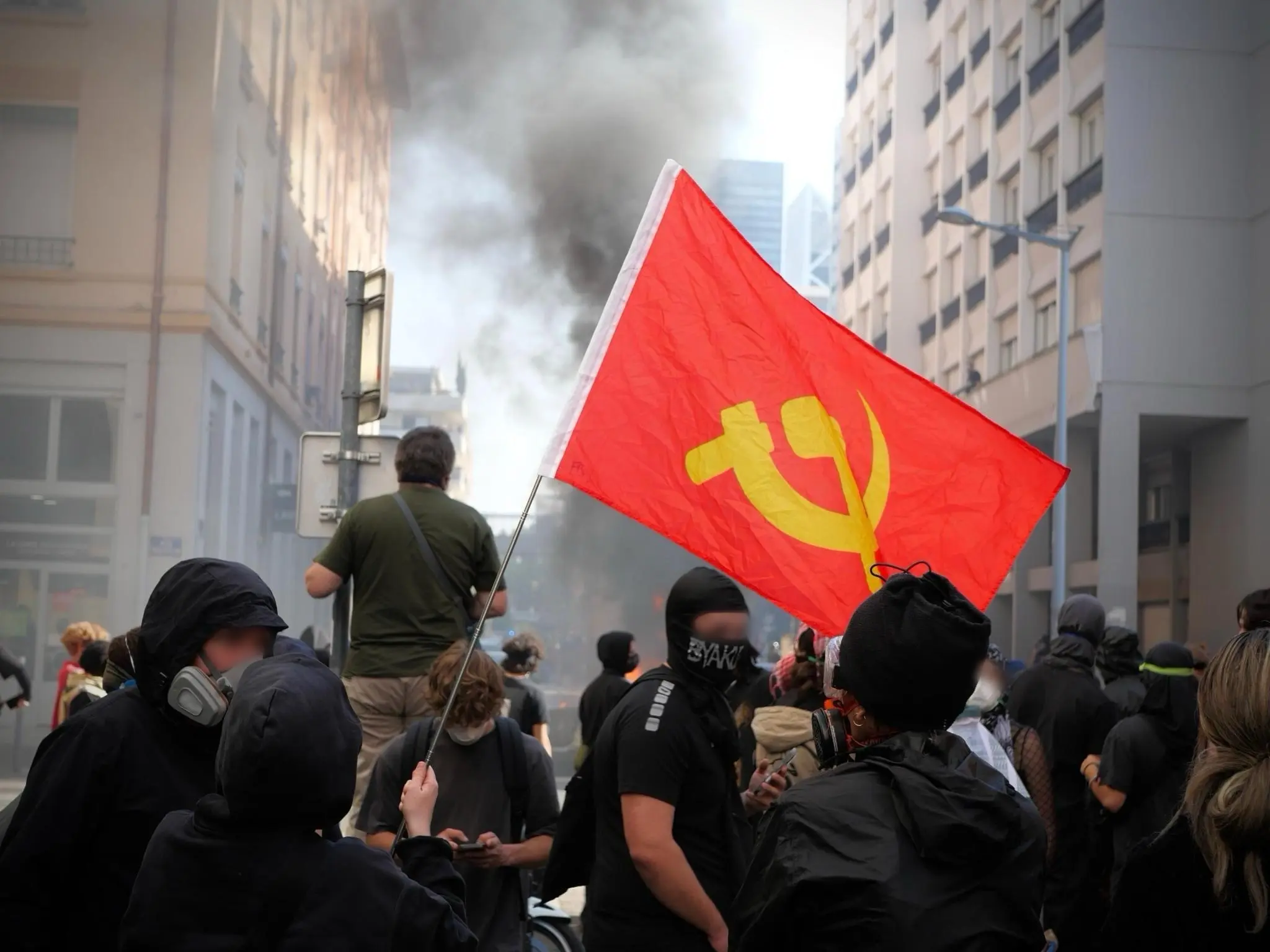
Thus, Thursday, October 1, could only send the bourgeoisie and its entire state apparatus into a panic. The proletariat of the metropolitan suburbs, unleashing a relatively massive revolutionary violence with a fervor that would not have shamed their Communard ancestors, brought back memories of the Reign of Terror.
The proletarian youth are the worthy heirs of the Sans-culottes and the sons and daughters of the immortal Paris Commune. With organized spontaneity, the finest youth our country has to offer, armed with a courage in keeping with history, have come to destabilize the bourgeois consensus and give vibrant expression to the deep-seated rage of the people. The youth of the 93rd department have become the sounding board for 70 percent of the population—in short, the popular masses. These young people, just like the proletariat, are not part of the consensus; they reject it because, through historical experience, they know it runs counter to their interests. This is why the typical downtown demonstrations are shunned by the heart of the class. These demonstrations belong to the middle strata, to the “trade unionists,” to the “political establishment,” to all those who have not fundamentally broken with the consensus and who still expect something from this crumbling regime. The proletarian youth, alongside its shock troops, the Communist Youth, has shown that the proletariat is the driving force and the leadership of the Socialist Revolution in France. The proletarian youth has succeeded in drawing the rest of the youth in its wake—this is a telling fact. The same will be true of the working class, which alone has the means to lead the vast sectors of society in crisis. Here, too, the sole question is the building of a powerful Communist Movement—that is, of its vanguard.
Now, we understand the strategic importance for the bourgeoisie of containing the youth movement (and any social movement) within non-antagonistic demonstrations—ones that neither shatter the consensus nor the bourgeois order, and that reject politics. The hijacking of negotiations after days of drawn-out, hollow struggles is always the sign that control has been regained. Here we see the struggle between the old and the new, between the old era and the new wave of the Proletarian Revolution. The return of political violence signifies the rupture of socialism from imperialism in action, in practice.
The demonstration on Tuesday, October 6—during which the police were ordered to hold back, to repress with a certain degree of restraint, and to allow and control spontaneous protests—was an attempt to regain control over the movement and reintegrate it into the democratic spectacle by draining off the excess of militancy. It is therefore clear that the Communist Movement as a whole must push to destroy this consensus by increasing the mobilization and militancy of the masses. In this sense, immediate demands are of little importance compared to the question of developing revolutionary consciousness. The demands of any movement are always a contradiction; they must enable victories but at the same time can become part of the democratic spectacle, of a return to normalcy. One would have to be quite naive—or hypocritical—to think that the explosion of revolutionary violence in recent days is the result of a shortage of teachers… To think this is to depoliticize the Movement, for the real issue is contemporary society itself: the future of a youth whose future is completely slipping away from them, whose horizon lies between ecocide and world war. The demands of the insurgent masses were entirely different; they boiled down to “fuck the cops” and “burn down the school,” condensed into “we are not dogs.” What else are we talking about, if not the direct representatives of bourgeois oppression in the daily lives of proletarian youth? The bourgeois school is not an agent of the proletariat’s emancipation, but a tool for training people to accept an unjust order: capitalism. Meanwhile, the police haunt the daily lives of working-class neighborhoods and terrorize young people in their own living spaces. To directly challenge power—without going through all the mechanisms of bourgeois control—is in itself a demand for the necessity of seizing that power through revolutionary means. The proletariat desires power; it demands political leadership.
The current movement is in a state of limbo; we must throw all our weight and conviction behind it to tip the scales toward revolution. The political challenge today is to break free from and shatter the “social movement-style” drift of the past. We cannot accept that it be co-opted, assimilated, or destroyed by opportunism. This must be championed by the Communist Movement by every means possible. To accept the state’s reassumption of control over the movement is to sign its death warrant and to condemn the 17th in advance. It is also to push the youth into the arms of electoral opportunism, which will profit from the proletariat’s distress. It is in these intense moments that the Vanguard reveals itself and is chosen by the masses. There is already a revolutionary segment of the population; it has the necessary mass to change the political agenda of restructuring and reactionary transformation of the old society—we must awaken it.
In any case, revolutionary violence is just. The proletarian youth of France are glorious; they have shaken the very foundations of the old society by reminding all the wealthy, the bourgeoisie, and their watchdogs that the Terror of 1793 has merely been postponed. They are courageous, not cowards. Let it be known: beneath every hood slumbers a Robespierre, a Communard, a member of the Resistance; there will be no room for half-measures.
[1] Lenin, The State and Revolution.
[2] Ibid.
What the Struggle Teaches Us: 10 Years of the High School Student Movement
Lenin observed in his Lecture on the 1905 Revolution that: “The real education of the masses can never be separated from their independent political, and especially revolutionary, struggle. Only struggle educates the exploited class. Only struggle discloses to it the magnitude of its own power, widens its horizon, enhances its abilities, clarifies its mind, forges its will. “
We can very easily apply this lesson to the situation of the high school student movement in France over the past decade. From 2016 to 2026, the transformations and twists and turns of this “usual” form of mobilization in our country constitute an absolutely typical example of the development of the class struggle in France. And this is a step in the right direction. Not everything is going back to “the way it was.” Profound changes are expressed in such movements.
1) The impact of education reforms and the reactionnarization of the bourgeois State on the high school student movement
If we summarize the form of high school student mobilization to which we were accustomed, we find the repetition of the same patterns: blockades at the end of the year (November–December) or in the spring (March–April), with schools remaining quiet at the beginning of the year and during final exams.
The forms of struggle were well-established: everyone would meet at 6:30 a.m., set up barricades with trash cans and chains in small groups, then gather in large numbers when the school buses arrived, march around, and finally hold a general assembly or a demonstration. All of this took place in a “festive” spirit—we’d shout, skip classes, and so on. And the next day, we’d go back to our normal lives.
This typical formula wasn’t—even 10 or 20 years ago—a bad one. It educated thousands of young people in their first steps as activists, their first collective experience of organizing.
But over the last ten years, generally speaking since the movement against the Labor Law, things have completely turned upside down. Why? Because the bourgeois state, in its need for restructuring, has turned everything upside down in education. High schools 10 years ago weren’t paradise: they taught students—as they still do—to bow down to the boss (vocational schools), and to dream of becoming a boss, engineer, or manager within an unjust capitalist order (technological and general schools). But the situation has gone to rot, as it always does. And 10 years of Macron have added a few stinking bombs to this cocktail.
The introduction of Parcoursup and the baccalaureate reform established selection criteria for entry into higher education. There were protests against these reforms, but when they were implemented and made permanent during the COVID crisis (2020–2022), they had a purely demobilizing effect. That was the first phase.
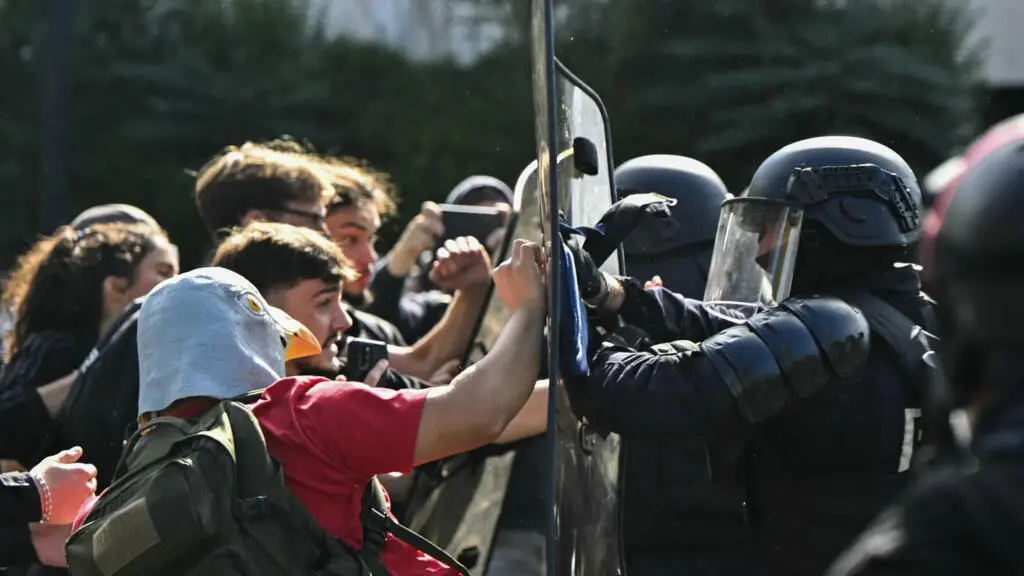
The final-year high school students, who had been highly active in previous movements, became completely trapped by the Parcoursup schedule. The burden of “consequence-free” activism thus naturally fell on the lower-year students—the last grade without exams—who were less politically equipped (and even less so in human and material terms, as they were younger and less independent) to take on such movements that would win over their older peers. Similarly, repression intensified, initially from within. In late 2018 and in 2019, several Parisian students were expelled from their high schools following blockades. Then repression came directly from the police: in 2020, four students from Maurice Ravel High School in Paris were held in police custody for 24 hours—a situation that would have been “very rare” six years ago.
Similarly, the introduction of specialized programs has thrown high school administrations into chaos. Class groups were broken up, schedules were stretched thin, and the baccalaureate lost the sacrosanct value it had held for the past 222 years. Here, too, the situation has deteriorated: from teachers and students half-heartedly implementing the new reform, two or three generations of high school students later, we now have students without teachers everywhere. Total waste. And finally, after the great revolt of June 2023, the final nail in the coffin was the infamous “8 a.m.–6 p.m.” plan, designed to keep young working-class kids from “hanging out on the streets.” The school schedule wore down a generation that was already celebrating its first dark circles under the eyes by age 11 in middle school. Sweet France!
These reforms follow a dual movement in the restructuring of French imperialism. The first—and primary—movement is the militarization of society, an integral part of the monopolies’ march toward war. The money siphoned off from the National Education system isn’t going anywhere—it’s being funneled directly into the Defense budget, whose growth has only accelerated since the beginning of the Macron era. The recent military programming laws—the second version of which was adopted by the National Assembly this year—foretell nothing but a bleak future for the proletariat of France and the world, which once again finds itself an unwilling candidate for the slaughter.
The second trend, which goes hand in hand with the first, is the monitoring of youth. To meet the ideological imperatives of the march toward war, the bourgeoisie expects young people—and particularly the proletarian youth—to toe the line, for it is they who will be sent into the line of fire to serve its financial interests. To control this youth, it is therefore necessary to destroy any prospect for a future outside of a servile attitude toward the State, which, from a very young age, must appear as a threatening and all-knowing force—one that they will learn to love later, through a process similar to Stockholm syndrome. We must also, at all costs, prevent them from entertaining thoughts of rebellion; so we indoctrinate them, doing everything possible to break them politically and ideologically so that they do not raise their heads.
This ideological shackle exists not only in the minds of the proletarian youth in the form of the police or the bourgeois media, but also in the form of the school system itself, embodied in the arbitrary and repressive figures of teachers, supervisors, and principals—all of whom serve as a management layer for the youth, tasked with bullying and training them, now aided during this movement by all manner of pacifying opportunists ready to do anything to infantilize them and make them swallow the pill of the bourgeois democratic game.
But things do not remain static. What rots serves as the foundation for beautiful plants to sprout. And what has sprouted from the pile of manure that is the failed school reform? A spirit of resistance! From being demoralizing, the situation has become explosive through the patient accumulation, over several years, of reasons to rebel.
Were the final-year students demoralized? Never mind! You’ve killed the baccalaureate; so they’ll have no reservations about blocking everything starting in September! You’re sending in the police and threatening expulsion? No problem—high school students will now come prepared and ready for a fight, because “that’s the only way to make things happen” (a high school student quoted on French radio station France Info on October 4)! You’re breaking up class groups and the school’s established norms? Then the high school students will replace them with a stronger sense of collective spirit, realizing that they’re (relatively) all in the same shit (at least on the scale of a single school)!
The bourgeois state, in its attempt to fix its nauseating system, has indeed cut off the flowers that were blooming there 10 years ago. It bought itself a few years during which no high school movement could gain a foothold. But it failed to see the green thorns on the new branches that its own actions had strengthened! What the struggle teaches us is that the reactionary trend transforms into its opposite and has produced mass resistance. We must keep this lesson in mind in other areas of the class struggle, such as imperialist militarization.
2) The youth take up the struggle ahead of the rest of the masses
Putting ourselves back in the context of late summer 2026, the reasons to rebel were simmering among the majority of the population. Essentially, it was the fuel price that was on everyone’s lips (and still is!). A call to action emerged for October 17, so we had to wait a month, a month and a half.
But just like last year with September 10, the passion of the youth decided otherwise. High school students took the lead (while remaining connected to) the demands. Unlike during the CPE (First Employment Contract) or the pension reforms, they did not serve as a reserve for the trade unions or bourgeois political forces in a struggle against a government initiative. They rose up in a revolt rooted in specific demands (for teachers, school renovations, etc.) but with a political substance. What they were demanding, they were not demanding just for themselves, but for everyone.
This is how we must understand the mass line: the Young Communists and all those who have listened to young proletarians understood from the very beginning that sector-specific demands limited to individual high schools were not what was causing such anger. There was something deeper, something more general, that became apparent when, in early October, more than one-third of schools were blockaded or disrupted, according to official figures—which the ministry consistently underestimates.
High school students have acted as trailblazers; they dared to fight with the means at their disposal, without backing down. They adapted their methods of struggle to the new situation by bringing a very important factor into play: mass mobilization. Instead of small, determined blockades starting at 6 a.m. in the most working-class high schools, it was often the collective decision of a large number of students that prevailed. This marks a rise in the quality of the high school movement. What the struggle teaches is that the high school movement—often caricatured as a movement “without demands,” one that “latches onto anything” just to skip class—no longer exists in that form. There is now a high school movement that has emerged in its own right in this country.
3) Proletarian hegemony in the youth movement
And this movement has a very clear class character. The hegemony, the initiative, the composition—everything here is proletarian. From the Parisian suburbs to remote high schools rising up in rural areas for the first time in decades, this represents a transformation in the composition of the high school student movement.
In 2023, the Great Uprisings of June mobilized a whole generation of young people nearing adulthood; and it was generally these young people who were arrested and thrown into prisons for rebelling. But anyone who paid close attention knows that there were also plenty of younger ones, a bit closer to middle school age, who are now the generation of high school students we see before us. They were shaped by that uprising and the methods of struggle against the police and the bourgeois state.
In 2005, the uprising following the deaths of Zyed and Bouna had itself drawn a certain segment of the working-class youth into the struggle. But in 2006, during the CPE protests, it wasn’t the same young people who were participating in the blockades and the struggle.
What has changed is that there is now a certain identity between the rebels of 2023 and those of 2026. And this is not merely an individual identity; it is above all practical: what young person in 2026 will not come to a blockade prepared, that is, with a certain level of material and intellectual training for the struggle? The fact that high school students from areas where the poorest masses live have risen up is no coincidence. They are the children of the proletariat. This isn’t “Generation Z” or the “Tasty Crousty generation”—it’s the generation that sets off fireworks to keep the police at bay and drives them back wherever possible through struggle.
The use of social media and modern means of communication—which these young people use extensively—has played a very positive role, both in terms of organizational methods and a shared identity. From isolated groups or loosely connected networks, we have, in the space of just a few days, evolved into a united national movement spreading very rapidly across the entire country. This factor explains the regime’s growing desire to control these tools—and, even more so, to restrict them in the event of a major political crisis. This media blackout—which has been observed in the suppression of numerous mass movements around the world in recent years—is the next step on the agenda of reactionary forces in France and the West in general, given the sheer strength of this new wave of rebellious working-class youth.
And the hegemony of this generation is reflected in the fact that, in the early days, the high school students’ blockades in the city center were organized precisely under the slogan of “support for the suburbs” and other forms of solidarity. The movement has reversed: previously, it was the “activist” high school students from the city center who would try to “stir things up” in the suburbs. Now, it is the working-class youth who are rallying behind them all the masses who want to follow them.
Of course, the military-style discipline imposed on working-class youth makes the struggle difficult and painful. Eden, the high school student who had his jaw broken at point-blank range at age 14, was standing in front of the Château d’Epluches automobile high school in the Val d’Oise. Similarly, vocational high schools located in industrial zones are harder to shut down: there’s only one transit line, and industrial buildings all around… But despite this, and despite the endurance it requires, the young proletarians are fighting.
What the struggle teaches us is that the weight of the proletariat within the masses—even when it has only an inexperienced leadership in a few places—is such in our society that it sweeps everything before it. It unites 90% of the masses behind it in the struggle under its banner.
4) The role of violence, and what does this generation stand for?
We wrote yesterday: “The current movement is in a state of limbo; we must throw all our weight and faith behind it to tip the scales toward revolution. The political challenge today is to break free from and shatter the ‘social movement’-style drift of the past.” ”
It is very important to pause for a moment on this fact, because all the fundamental movements we have highlighted and celebrated so far—some people applaud them in public but want to channel them, divert them, toward their own electoral, conciliatory goals.
All the professional opportunists who berate high school students at the slightest sign of unrest are like a house of straw in the face of a storm. By opposing the violence the masses have chosen, by seeking to direct their anger toward the ballot box or toward a “way out of the crisis,” they seek to deny reality and return the proletarian youth to their original position: subjugated to the order of the bourgeois school system, subjugated to the petty-bourgeois leadership within the high school movement—a supporting force for a certain faction of the bourgeoisie in the struggle for supreme power over the bourgeois State.
But they can do little in the face of the wave of class struggle that is sweeping through the country. Whatever they gain today by convincing a high school student to vote for Mélenchon in 2027 or a few young people to join their collective—which bows its head while raising its fist—they will lose a hundredfold in the class, and faster than they think. For this generation, the illusions of social democracy and opportunism will not be shattered at age 30 or 40, as they were for the Mitterrand or Hollande generation. It is at age 17 that they will have seen in the streets that politics in our time centers on an open confrontation with the bourgeois State, that the State can be “overwhelmed,” and that we must raise the level of the class struggle.
What the struggle teaches us is that history does not move backward, and that whatever we sow today, we will reap tomorrow. So, bold youth, forward with your movement! Bring the masses into the struggle and sabotage the reactionary charade the bourgeoisie is preparing to stage! See who are the friends and who are the enemies of the class struggle, and close ranks! Dare to fight, so you may dare to win!