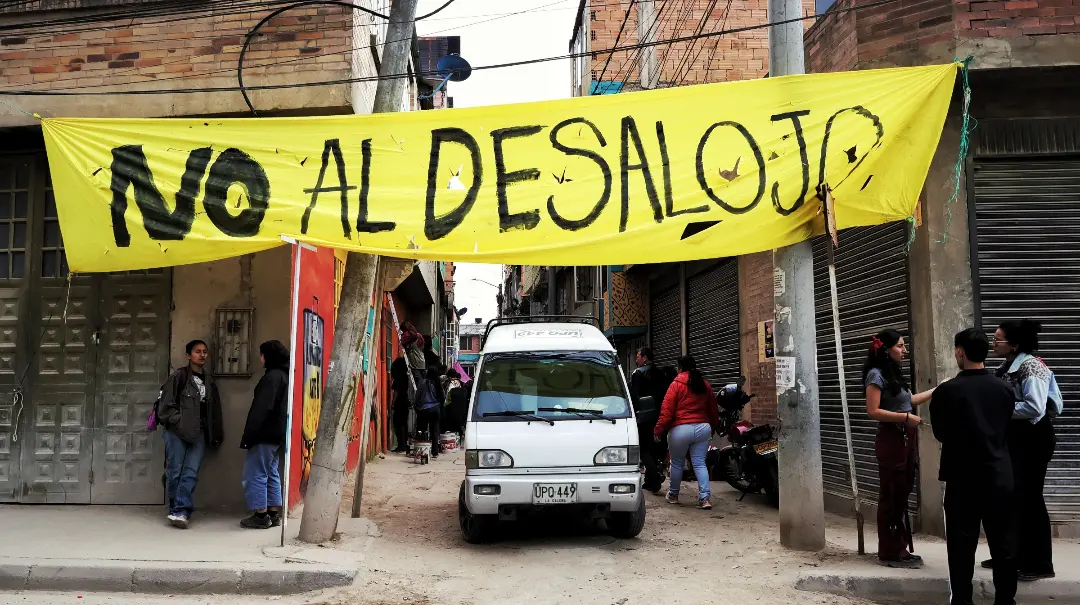
Colombia – Nueva Democracia: Resistance Continues in El Remanso
We hereby share an unofficial translation of an article published by Nueva Democracia on October 11.
In May of this year, Remanso 1, a neighborhood located in the Bosa district of Bogotá, made national headlines. Nearly 500 people were set to be evicted from their homes. Although, thanks to the efforts of its residents, supported by activists and popular organizations, they managed to have the eviction suspended on two occasions (in May and July of this year), the uncertainty continues, as the new eviction date is scheduled for February 2027.
A Neighborhood Built by Hand
Like hundreds of others across the country, El Remanso 1 is a working-class neighborhood built by its own residents. Bricks, cement, and all other materials were purchased with wages that barely reach the minimum wage and amid debts of all kinds. Every wall, every room, every house was built by the hands of parents, children, and relatives. Like so many neighborhoods, this one is the result of the constant effort of a hardworking and resilient community.
El Remanso is a poor neighborhood in Bogotá, located in the far southwestern corner of the city, in the district of Bosa. Hours away from the city center, its streets remain unpaved, and there are no parks or hospitals in the area. However, it is the home and greatest asset of those who live there, as well as the only housing security for entire families, more than half of which are headed by women, and the only security in old age for its elderly residents.
The neighborhood has been around for 16 years, and most of its residents say they bought their land with their life savings, received a document that appeared to be legal, and paid property taxes in their own names for years. They also set up and paid for utilities all these years. Even so, the land is registered in the name of a large company called Sotrandes, which is threatening to evict them and leave them on the street.
Faced with this situation, the mayor’s office has only promised a subsidy covering a couple of months’ rent, but everyone knows that even if that money arrives, losing their homes means ending up on the street. The distress is so great that residents blame this situation for the deaths of two people from the neighborhood amid the escalating conflict.
Sotrandes Aims to Evict Them
Sotrandes is a company that began in the passenger transportation business in Bogotá in the 1970s, and today its owners have companies that operate within the Transmilenio system. In other words, they are part of the country’s big capital and profit from the capital city’s miserable public transportation system, which is hated by its residents for stealing hours of their daily lives and more than 10% of their wages, all while offering an undignified service. Additionally, they also operate in freight transport, as well as passenger transport in Peru and Mexico.
The owners of Sotrandes, as typical representatives of the big bourgeoisie, hold the lives of the people in contempt. Although they have had no need for these properties over the past 16 years to continue accumulating and increasing their capital, they are pressuring the government to leave an entire neighborhood without homes or a future.
As part of the solution, some propose that the Mayor’s Office purchase the land, paying a percentage of the market value, and then allocate it to the families. This mechanism is protected by law and has been used previously in Bogotá in the case of the Maria Paz neighborhood, which was legalized in 2017 by then-Mayor Enrique Peñaloza. According to Sotrandes, the property is worth $8,000 million, but others claim it is worth $2,500 million.
Whether through eviction or purchase, Sotrandes wins.
What is the housing alternative for the city’s poor?
Housing is a basic necessity, yet for working people it is not a right. And even when housing programs exist, construction companies and banks must turn a profit while offering undignified housing. It is worth recalling the case of IUPAC, through which Luis Carlos Sarmiento Angulo, as owner of Grupo AVAL, became the country’s wealthiest individual by charging middle-class families interest rates that exceeded the cost of the homes themselves in the 1990s; or the Bosa Porvenir housing projects in Bogotá, which suffered for years from flooding by the Bogotá River due to problems in their design and construction. Even so, housing programs are practically nonexistent: the last free housing program in Colombia was in 2013, and subsidized housing programs are inaccessible to the poorest sectors due to the requirements and savings they must have to qualify.
The historical alternative available to the people has been to occupy land to build their own homes. This has been the origin of most working-class neighborhoods, which emerged amid the struggle for housing. However, some of these neighborhoods had to occupy hillside land or land along the banks of rivers and streams, and now the government is evicting them (or attempting to do so), as is the case with the Plan Jarillón in Cali, or the recent case of the Manrique neighborhood in Medellín. In other cases, powerful landlords have stepped in and managed to have them demolished, as in El Remanso 1 in Bogotá.
Unless they can secure land for construction, working families are forced to pay rent that takes up between 50 and 65 percent of their wages. And more and more people are having to do so: over the past 20 years, the percentage of families living in rental housing has risen from 31% to 40%, and last year, for the first time, the percentage of those living in rental housing exceeded that of those living in their own homes. The result is the increasing impoverishment of working-class families, many of whom are forced to live in severely overcrowded conditions.
With no homeownership programs, insufficient wages to cover rent, and the eviction of those who built their own homes, the government is increasingly fueling the need for the struggle for affordable housing.
This housing reality is clear to working people, and El Remanso is no exception: holding on to their homes is the most logical necessity and has been the motivation for their struggle.
El Remanso 1 Continues to Resist
Faced with the threat of eviction, the neighborhood has not stood idly by. It has been organizing and fighting back. Thus, on May 6 of this year, when the first eviction attempt was scheduled, residents set up barricades and staged protests, while also mounting a legal defense, until they secured an initial postponement.
Their struggle did not end there; they also went to protest in Bolívar Square and have continued to organize community activities to strengthen their bonds, build greater solidarity among other residents in the area, and raise awareness about their situation. All of this led to a second postponement of the eviction. However, the threat remains, and so does their struggle. That is why the residents have continued to organize activities to strengthen their movement, and they are also calling on other sectors of the community to stand in solidarity with their struggle.
The example set by El Remanso shows the way forward in defending neighborhoods and defending the people.
No to the eviction of El Remanso 1!