France – la Cause du Peuple: The Government Yields to Police Alliance’s Power Grab
We hereby share an unofficial translation of an article published by la Cause du Peuple on November 19.
The few passersby who enjoy strolling between the Tuileries Gardens, the Champs-Élysées, and the Place Beauvau know that the neighborhood is highly sensitive. The numerous embassies, the Ministry of the Interior, and especially the Élysée Palace and its grounds form one of the most heavily guarded and secure areas in France. It’s usually impossible to walk along the presidential palace grounds without a sentry or guard ordering you to cross the street or leave the area immediately.
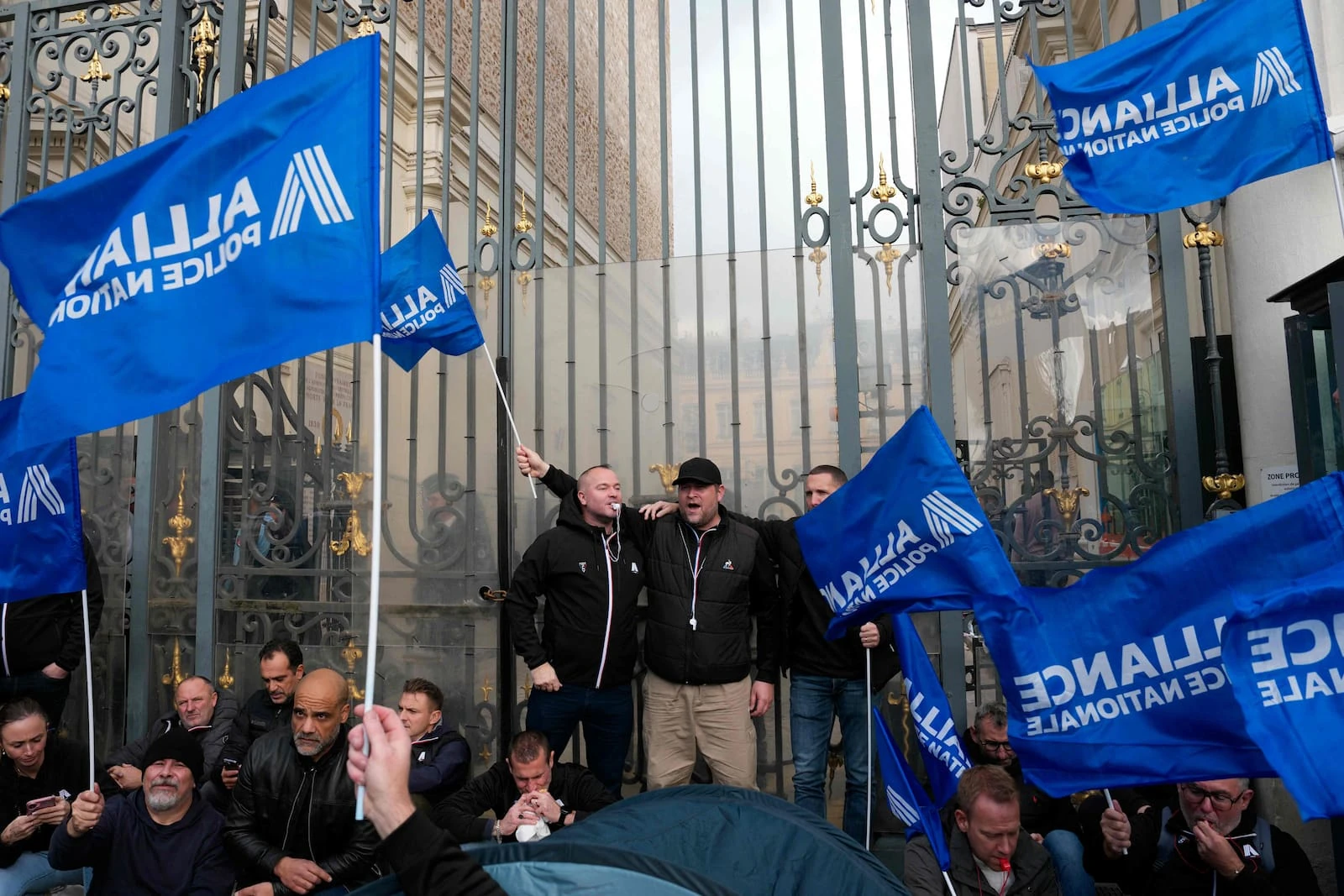
Yet this Wednesday, the Alliance Police Nationale union defied all “republican protocol” to hold an impromptu march along the Élysée Palace, pretending to set up a small encampment of tents in front of the Ministry of the Interior on Place Beauvau. No declaration to the prefecture, no prior authorization to march in the heart of the State apparatus; where any other protest would have resulted in casualties, injuries, or even loss of life, 400 or 500 police officers “peacefully” forced the State to back down.
According to union secretary Fabien Vanhemelryck, the minister was told: “We’re capable of doing this; we can do it again; we are capable of doing this every day if necessary. If you abandon us, the Élysée Palace isn’t far away, Matignon isn’t far away, we know the addresses .” What millions of people and the country’s youth had never obtained was granted by the State in less than an hour. Ten minutes after the surprise action, the union was received by Minister Laurent Nuñez to begin negotiations, immediately securing a salary increase agreement.
The class struggle is clearly taking its toll on the repressive apparatus. A few days before this action, we learned that many police officers, particularly members of the Republican Security Companies (CRS), were circumventing their ban on striking by taking numerous sick leaves. A month ago, on October 17, just as many had refused to join their colleagues during the day, as the Ministry had completely underestimated the initial scale of the repression. For the State, the situation is too serious to risk yet another loss of confidence in a sovereign institution as vital as the National Police.
Behind the regime’s fear lies the anxiety of seeing its very foundations crumble and give way. We still barely grasp the already historic nature of the ongoing revolt, particularly the level of pressure being exerted on the State, especially the education system, the judiciary, and the police. The State endured major police uprisings in 2016, 2020, and 2023. Since then, it has regularly faced sporadic mobilizations organized by police unions, albeit of lesser intensity. We still have fresh in our minds the images of hundreds of officers marching at night, hooded or masked, down the Champs-Élysées, threatening members of parliament in front of the National Assembly, challenging court rulings, and so on. These movements took place concurrently with large-scale protests among judges and prison guards, and even included threats from generals and high-ranking officers.
Alongside wage demands lies a deeper impulse, accelerated by the State’s restructuring reforms: the factious desire to establish relative autonomy for the police force, free from the basic principles of the rule of law. It is in the hope of stemming this dissent that the regime is gradually granting officers ever-greater autonomy and impunity, at the expense of command stability: permission to carry firearms off-duty, delegation of IGPN investigations to “local ethics units,” attempts to prohibit the recording or dissemination of images of law enforcement, a “presumption of self-defense,” free train travel, etc.
In reality, the police are engaging in a pressure tactic against the regime without intending to openly rebel against it. The factious intentions of some of its members do not alter the fact that the very existence of the police force depends solely on its organic link with the bourgeois State as its sole condition of existence as a body at war with the rest of society. Alliance’s power grab is therefore a cleverly calculated bluff, instructive for the masses in struggle who have seen how the demands of the uniformed thugs are met within the hour.
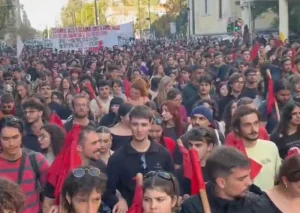
Since the start of the school year in September and the systematic beating of an entire age group that was rightfully in revolt, the gap between the general public and the National Police has never been wider. Long gone are the days when the regime had largely succeeded in restoring the image of the “guardians of peace” in the eyes of large segments of the population, following the 2015 attacks. Now, it is common knowledge that the police are using fascist groups as auxiliaries for maintaining order, by the groups’ own admission, all fueled by the complete and deliberate lack of transparency of government spokespeople. This Tuesday, the media outlet StreetPress revealed the close ties between the Director General of the National Police, Louis Laugier, and the fascist group “Ligue Ligérienne” and the traditionalist Catholics of the Priestly Fraternity of Saint Peter. Corporatization is therefore advancing hand in hand with an ultra-reactionary ideological breakthrough within the State’s institutional bodies, already heavily imbued with the precepts of the Party of Order.