Brazil – Stop Massacres: Eight Military Police Officers Suspended After Planting Drugs and Torturing a Man
We hereby share an unofficial translation of an article published by Stop Massacres! of Brazil, a special dossier by A Nova Democracia, on the 13th of May.
Eight Military Police Officers Suspended After Torturing a Man and Planting Drugs in His Car During a Traffic Stop in Torres
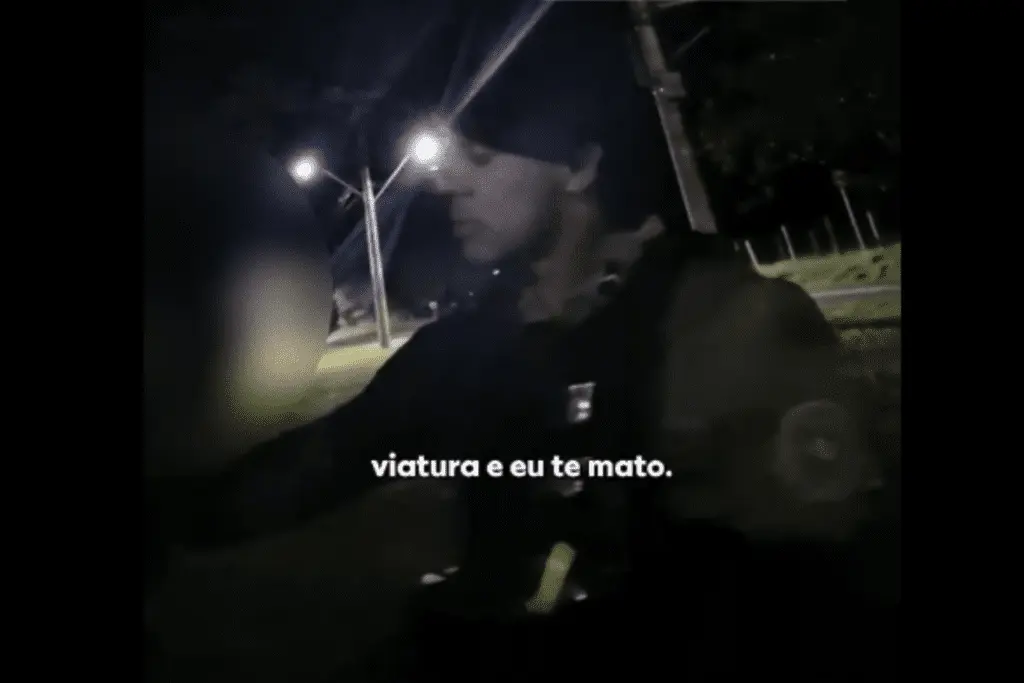
Eight police officers from the Rio Grande do Sul Military Police were suspended from duty following an investigation that confirmed the use of physical torture during a stop on the State’s coast, in Torres. The incident occurred in May 2025, but the decision to suspend them was not made until April 30, 2026, after footage of the crime was found on one of the torturers’ cell phones by the Military Police Internal Affairs Division, following the execution of a search and seizure warrant at the Torres battalion.
In the footage, the soldier identified as Rubilar Da Veiga is the one coordinating the attacks in front of his accomplices, delivering kicks and punches while intimidating the man who had clearly surrendered and was already in custody: “I’ll throw you in the patrol car and kill you,” barks the officer, who has been with the force for two decades, while also threatening to break into the man’s home: “We’ll come into your house whenever we want. And the boys are tough, okay?” said the brave torturer after kicking and beating an unarmed man alongside his tormentors.
According to the investigation, the victim suffered a fractured jaw and was reportedly hospitalized for three months as a result of the incident. As shown at the end of the video, the police officers also reportedly damaged the man’s car to make it appear as though his injuries had been caused by a traffic accident.
In addition to the footage showing the assault carried out by these butchers of the people, during the torture session, police officers from the “intelligence unit” appear wearing balaclavas
The freedom to repress the people in Rio Grande do Sul
Although the Military Police Internal Affairs Division carried out the suspension of the torturers and made the charges public, it has a history of protecting police officers and covering up crimes committed against the public, as in the case of the murder of student Hérick Vargas that same year, in September 2025, when police officers killed the student inside his own home after being called by his family to subdue a psychotic episode. At the time, the Internal Affairs Division, despite numerous inconsistencies in the officers’ statements, closed the case, only for footage from the officers’ body cameras to be made public a few weeks later.
Cases like this have become all too common and are on the rise every year in the state of Rio Grande do Sul, such as the murder of the young man Luan Alves de Lima, on March 9 in São Borja, on the western border of Rio Grande do Sul, and the execution of laborer Josias Rodrigues Vicente in Vila Buraco Quente in Porto Alegre, who, according to a video recorded by community residents, was shot at point-blank range by the Military Police during an operation.
While the government of Rio Grande do Sul claims to have reduced police lethality by 43.6%, the brutality of the old State apparatus remains in place to repress and exterminate working-class workers and students. This phenomenon is evident in cases such as the arrest of a municipal guard in Gravataí in 2024, who brutally murdered a worker at a gas station, or the recurring violence against delivery workers, which culminated in a protest by motorcycle couriers in Porto Alegre after a delivery worker was shot in the neck during a “stop and search.”
Such crimes reveal the modus operandi of an organization that today kills more people than it did during the years of military dictatorship in Brazil, when it was created to serve as an instrument of control and social oppression against the country’s poorest people, fueling the genocidal and deceptive “war on drugs” and escalating its methods of repression to ever-greater levels to maintain this society built upon the exploitation of workers in both the city and the countryside.
As democratic-revolutionary youth organizations point out in their joint statement, titled “Reactionary War Against the People Enters a New Chapter with the Deadliest Police Massacre of the 21st Century,” released in condemnation of the deadliest massacre in Rio de Janeiro’s history: “The reactionaries use the so-called ‘war on drugs’ and the groups, misnamed ‘factions,’ to justify a war against the poor, whose policy of mass incarceration of poor black youth and atrocious repression only causes such groups to grow further, which is then used to justify even more repression.”
However, the more terror is inflicted on the masses, and the more the establishment feels free to oppress them while applauding and passively watching the actual crimes committed against the vast majority of the people, the louder the popular resistance grows across the country, drawing strength from within.