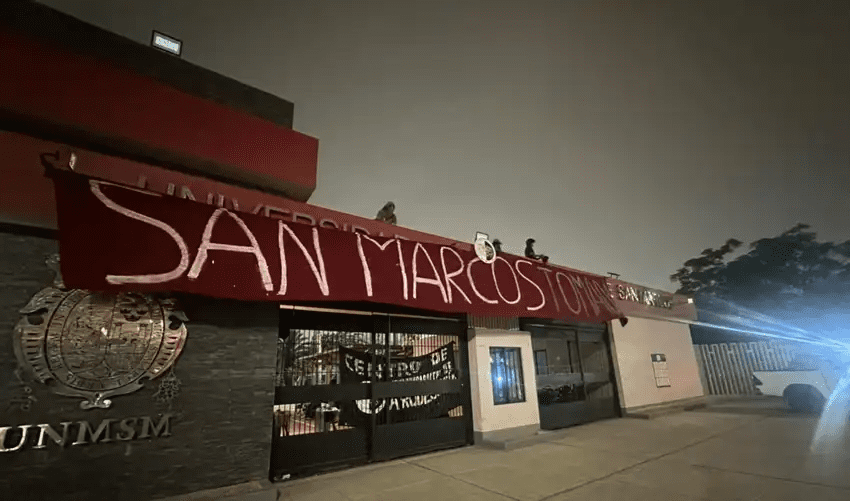
Peru: Student Occupation of UNMSM Against University President Reelection Bill
We hereby share an unofficial translation of an article published by A Nova Democracia (AND) on the 17th of May.
Students at the National University of San Marcos (UNMSM) in Lima occupied the University City campus on May 12 in direct response to the Congress of the Republic’s attempt to impose the immediate reelection of academic officials. The mobilization, which took over the campus during the institution’s 475th anniversary celebrations, aims to block Bill No. 12736, nicknamed the “Jerí Ramón Law.” Protesters are controlling the access gates and assert that the action will only end when the legislative proposal is definitively removed from the congressional agenda.
The occupation is concentrated at Gates 1, 2, and 3 of the university located on Venezuela Avenue in the Peruvian capital, where organized groups are holding internal marches and setting up roadblocks to disrupt the university’s administrative operations. According to representatives of the San Marcos University Federation, the occupation is a response to the “Jerí Law,” which amends Articles 66 and 68 of the University Law to allow rectors and vice-rectors to remain in office for an additional term immediately. The action coincides with the anniversary of the oldest university in the Americas, turning the festive occasion into a scene of protest against cronyism and the politicization of higher education institutions.
Bill No. 12736 was drafted by the reactionary Podemos Peru party and promoted by a coalition of forces including Fuerza Popular, Renovación Popular, and Avanza País. The bill was brought directly to the full Congress without undergoing technical review by the Education Committee, prompting criticism from students and university organizations due to the lack of prior technical debate. If approved, the law will allow university presidents and deans to seek an immediate additional term, altering electoral rules amid the current president, Jerí Ramón’s, interest in remaining in office.
In addition to facilitating the immediate reelection of the university president, the bill extends this privilege to college deans, requiring only a temporary two-month leave of absence prior to the election. For students, the change favors the perpetuation of the academic bureaucracy and undermines the rotation of university leadership positions. The academic community denounces this legislation as a direct ploy to benefit UNMSM Rector Jerí Ramón, who visited Congress shortly before the bill was introduced.
The current occupation comes amid a series of protests at UNMSM. In 2024, students had already occupied the University Campus in protest against allegations of irregularities in internal elections and against Jerí Ramón’s attempt to remain at the helm of the university. At the time, the protest also denounced the Electoral Committee’s control and the actions of outside groups against the demonstrators.
In an interview with the newspaper RPP, a leader of the San Marcos University Federation (FUSM) stated that the students are demanding three things. “That Congress reject the bill on the reelection of university rectors, which will be debated on Thursday; that elections for rector and student representatives be held transparently and in person; and that the threshold for student representatives to secure seats on the university council and assembly be lowered. Last year it was 10%, now it is 20%, and there is no explanation for this change,” he said.
University administration attempts to criminalize student occupation
Faced with the ongoing occupation, University President Jerí Ramón took legal action against the students. Speaking to Rádio Nacional, she stated: “It’s not as if I could break down a door and nothing would happen to me. Young people need to learn to be accountable for their actions.” The dean confirmed that formal complaints had been filed with the Office of the Prosecutor for Crime Prevention, seeking to treat the student occupation as a “criminal act” and hold individual students liable for alleged damage to the infrastructure.
University administrators are attempting to make dialogue contingent on the immediate evacuation of the campus, a move viewed by students as an attempt to demobilize the movement before the vote on the reelection bill. During a special session of the University Council, Ramón stated: “Let them end the occupation, and then we’ll sit down to talk.” The students denounce this stance as inconsistent, since the university president also stated that the talks would not address the election process for “university officials” under the pretext of not interfering with the electoral committee. In the students’ view, the maneuver seeks to buy time and weaken the resistance while reactionary forces rush the vote in Congress.
The occupation has received support from other student organizations
The resistance in San Marcos is not isolated and has found an echo in other institutions, such as the Pontifical Catholic University of Peru, where students also staged a mass occupation of the rector’s office. At that institution, the protest was directed against tuition hikes and the reduction of installment plans—measures that directly affect students from working-class and low-income families.
Political groups such as the Confederation of University Students of Peru (CEUP) have also endorsed the demands of the protesters in San Marcos. The CEUP issued a strong statement asserting that the “Jerí Law” fosters the perpetuation of power and the consolidation of patronage networks that undermine democratic alternation. According to the organization, any reform in higher education must be thoroughly debated with professors, staff, and students.
The Association of Public Universities of Peru (ANUP) and the National Council of University Presidents have also expressed their outright rejection of the bill, describing the scheduling of the vote without prior technical debate as “extremely serious.” Student activists reiterate that the bill does not address the shortage of resources or the lack of equipment, serving only as a legal shield for administrators.
Student groups issued a joint statement titled “WHOEVER TOUCHES ONE STUDENT TOUCHES US ALL,” in support of students at UNMSM and PUCP. The statement asserts that the university movement must act as the “critical conscience of the country,” advocating for education as a right rather than a privilege for the few. The groups note that defending autonomy is also defending the memory of the youth’s historic struggles against the military regime and its interventions.
The groups’ statement highlights five fundamental points of support: the unrestricted defense of autonomy; the right to organize and mobilize; the demand for accessible, quality public education; the opening of transparent and binding dialogue; and respect for student representation as a legitimate actor.
The Federated Center for Social Sciences and Humanities (CEFECSH) at the Enrique Guzmán y Valle National University of Education – “La Cantuta” expressed solidarity with the occupation, reaffirming that “it constitutes a legitimate response to the bill promoted by reactionary and anti-democratic sectors” and that it is the duty of students to learn that rights were never granted, but won. “The history of our people shows that no right has been won without organization or struggle. Today, more than ever, it is necessary to strengthen student unity and defend the public university against those who seek to turn it into a space controlled by political and bureaucratic interests.”
Despite threats of expulsion and legal proceedings initiated by the university administration, the students at San Marcos maintain control of the entrances and ensure that the University City will remain occupied. While the university president lamented the incidents that occurred during the celebrations with foreign guests, the students reaffirmed that the university’s anniversary should be celebrated with a struggle “for a public, scientific university at the service of the people”—as they state at the end of their statement—and not with projects that subject the institution to the political control of permanent interest groups.