Tjen Folket Media – Kenya: Interview with an Organizer of Poor Peasants
We hereby share an unofficial translation of an interview published by Tjen Folket Media on the 17th of May.
A contributor for Tjen Folket Media attended the Pan-Africanism Summit Against Imperialism (PASAI) in Nairobi, Kenya, on May 11 and 12. PASAI was organized as a protest against the “Africa Forward” summit organized by French imperialism and the Kenyan State. We will be publishing a series of articles written during this trip.
During PASAI, Tjen Folket Media spoke with Comrade LM, a member of the CPMK [Translator’s note: Communist Party Marxist of Kenya], about his work among poor peasants in the Siaya region. Siaya is a county in western Kenya, by Lake Victoria, and the region is known in Kenya for its high level of political activity and struggle.
LM explains that the party is working to organize the poor peasants here to fight for land redistribution. He says that the promised land reforms were never implemented in Kenya, and that the country is semi-feudal. The majority of the population are peasants, and land is largely concentrated in the hands of large landlord families and monopolies.
LM says that 20 to 30 families own most of the land in Kenya, and among the most prominent of these are the Kenyatta family, the Moi family, and the Ruto family—the families of the country’s first, second, and current presidents. He goes on to explain that the Ruto family has become major landlords by using their political power to rob land.
Much of the land that is now concentrated in the hands of wealthy landlords has been taken from peasants, creating a class of landless peasants. LM states that this is directly linked to the situation involving the many street children in the major cities—often called “chokora”—as well as the millions of people living in informal shantytowns in the cities. The capital, Nairobi, has “Africa’s largest slum,” an informal settlement in the middle of the city that is home to around 2.5 million people—roughly half the city’s population. These masses live in deep poverty, often just a stone’s throw from large luxury hotels and the local headquarters of foreign monopolies. Poor peasants were promised land reform after Kenya’s independence, but this promise was never kept—on the contrary, they found that the new rulers and foreign monopolies seized the land and left them landless. Jomo Kenyatta, Kenya’s first president and a lackey of British imperialism, confiscated vast amounts of land.
Much of the land in Kenya lies fallow—that is, it is not in active use—and LM explains that it is therefore essential to raise awareness among peasants that the land must be put to use; the question of whether to confiscate or conquer the land is one that arises in his work with poor peasants in Siaya. Land is the big issue in Kenya, says LM and his party, and he continues: “When we take power, we can solve all these problems. We can carry out land reform to create a basis for industrial development.” He explains that today a lot of cotton and tea are produced, and many minerals are also mined, and that this is controlled by the imperialists and their monopolies.
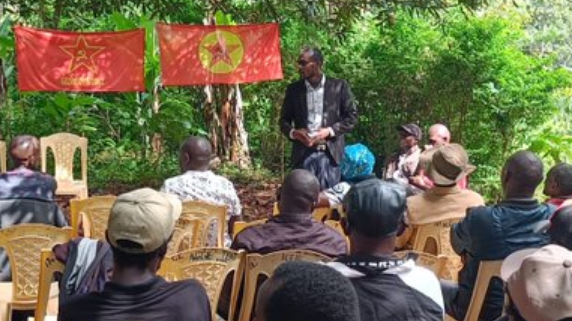
LM also explains that organizing poor peasants is hard work and that they are, so to speak, “working against the wind.” It’s about raising the people’s awareness, he says, and he notes that Kenya is in a deep crisis and that vast numbers of people are turning to religion for hope. They believe that only a supernatural force can save them. Therefore, part of the struggle is to win the masses over from an idealistic standpoint to a position based on material reality. He explains that the rulers use religion as a tool, including through the president’s “National Day of Prayer” and pastors who promise “promises from above.” Instead, LM and his comrades are working to organize the masses to fight for their own interests. The masses have established their own mass organizations in various villages, with guidance from the Party, where the masses choose their own names, such as Wadhi Kanyakla (“We Work Together”).
The CPMK views this work as a key issue in advancing toward the national-democratic revolution, which is directed against the imperialism and semi-feudalism that are holding Kenya back.
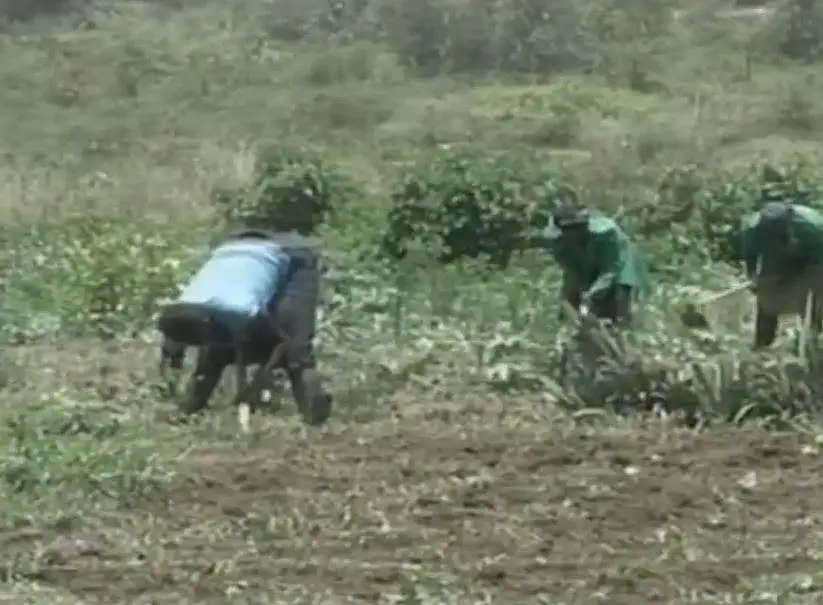
When the CPMK’s General Secretary, Booker Omole, was arrested, poor farmers organized by the party in Siaya gathered to demand his release: