Imperialism Molds the Serbian Economy to Serve Its Own Interests
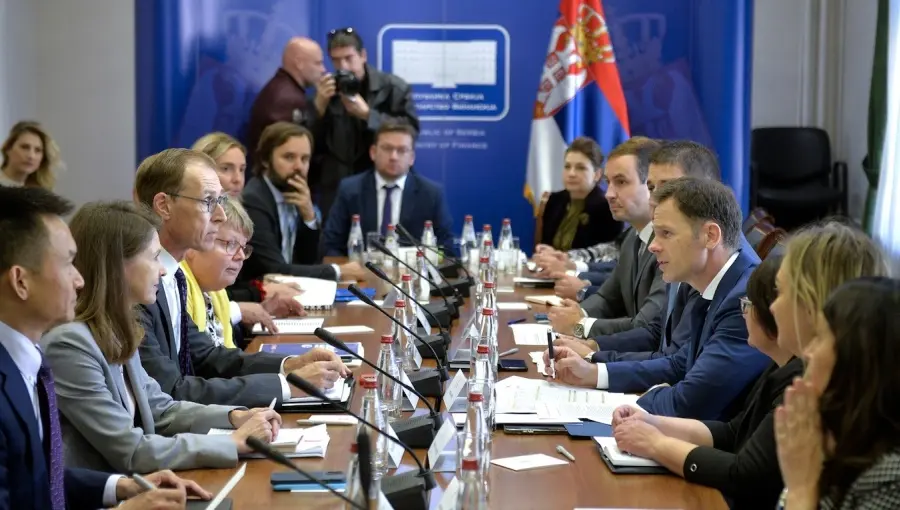
Featured image: Serbian officials hosting an IMF delegation in Belgrade. Source: minfin.gov.rs
Against the backdrop of the Kosovo War – which ended with NATO’s 78-day bombing campaign in 1999 – and Slobodan Milošević’s fall from power in 2000 after mass mobilizations exploited furthered by the United States, the domination as well as that of European imperialist powers over the new Serbian government increased. The further molding of the Serbian economy through a series of political changes, serving the interests of imperialist exploitation, soon began. This process was guided with a heavy hand by institutions such as the EU, the International Monetary Fund (IMF), and the World Bank.
In a wider frame in the Balkan region, IMF and the World Bank pushed for economic reforms designed to transition these economies to impose domination of the “Western imperialists” (EU and US) through several specific mechanisms.
Central to this model was the privatization of State-owned enterprises. The goal was to increase efficiency and attract Foreign Direct Investment (FDI) by transferring ownership to private entities, often foreign investors. This process was frequently paired with what they called “fiscal consolidation” measures, which demanded of governments to reduce public spending and budget deficits to stabilize their currencies and manage national debt.
Pressuring Reforms Through Foreign Debt
In Serbia, this post-2000 economic transition is often presented as a necessary passage from isolation and economic collapse to stability. In reality, the series of economic reforms it included opened Serbia to deeper exploitation by Yankee imperialism and the imperialist powers within the EU. Emerging from war and sanctions, the country gave creditor countries ample opportunity to pressure reforms that benefited imperialist powers eager to take more of the markets of the former Yugoslavia. They did this through the Paris Club – which is a forum of major creditor countries, such as the US and Germany, protecting imperialist interests and keeping oppressed countries dependent on imperialist States – and the London Club – a similar tool for private creditor banks. The IMF-backed economic reform program became the condition to stop Serbia from drowning in foreign debt; in essence, this was blackmail, although sections of the Serbian ruling class eagerly agreed. Specifically, Paris Club relief was explicitly linked to the successful implementation of the IMF program, while the London Club negotiated its own debt restructuring with Serbia.
These international institutions operate under the hegemony of Yankee imperialism. Their reform agenda included “stabilizing” public finances and the currency, reforming taxes and public spending, restructuring banks and State-owned companies, and opening the economy to private investment and trade. In short, the IMF’s economic reform program molded the Serbian economic system to better suit the interest of imperialist Finance Capital and propel the evolution of Bureaucratic Capitalism in the country.
By providing just enough liquidity to prevent a total collapse, the IMF ensured that Serbia remained dependent on successive “arrangements.” With this, this made the Serbian government accountable to the IMF board in Washington rather than to its own citizens.
While not a traditional “loan,” Russia also influenced via Gazprom. By providing gas on favorable terms or creating long-term dependencies, Russia ensured that Serbia would remain politically cautious. If Serbia moved too close to the West, the “cost” of this energy dependency could be raised, acting as a non-monetary debt that the State must “pay” in political loyalty.
The World Bank and the Dismantling of Domestic Banking
Fitting into the scheme of the IMF, the Serbian authorities moved on January 3, 2002, to liquidate four major State banks: Beobanka, Beogradska Banka, Investbanka, and Jugobanka. The World Bank had linked financial assistance to this banking reform and the closure of insolvent banks. This decision was driven by senior officials associated with the G17 Plus economists, including Deputy Prime Minister Miroljub Labus, Finance Minister Božidar Đelić, and central-bank governor Mlađan Dinkić. The impact was immediate: about 8,500 bank employees faced losing their jobs, leading workers to occupy offices and unions to appeal to the authorities to halt the liquidations. Furthermore, these closures threatened firms that owed money to the banks and relied on them for credit.
This restructuring continued with the 2003 Law on the National Bank of Serbia (NBS), which established an independent National Bank and made price stability its primary objective. This independence limits the ability of governments to use credit and monetary tools directly for industrial development. Consequently, privatization was pushed and foreign banks were encouraged. Crediting decisions moved outside Serbia, meaning that the decision of what is financed and what is not became largely the property of imperialist intent.
According to Princip, when Serbia attempted to make minor changes to the law to allow the NBS to purchase government bonds in order to stimulate domestic development, the IMF and the European Central Bank (ECB) immediately reacted with blackmail. “They made it clear that financing one’s own country was the exclusive right of Western commercial banks, while Serbia was intended only to play the role of a monetarily obedient servant,” the Serbian media concludes.
Trade and investments
Alignment with EU legislation was similarly used to mold the Serbian economy. Although the EU had developed regional approaches toward the Western Balkans in the late 1990s, the EU’s interest in Serbia became far more visible after Milošević fell. This trajectory led to the EU–Serbia Stabilization and Association Agreement in 2008, the application for membership in 2009, candidate status in 2012, and the start of accession negotiations in 2014. Today, Serbia remains in this “membership process,” and countries inside the EU have become Serbia’s largest trading partners. The primary exporter and importer being Germany, while Chinese social-imperialism is currently the single largest investor. Russian imperialism remains important factor in the energy sector.
Erosion of Industry
To meet the requirements of debt stabilization programs, the State sold off massive industrial conglomerates. Once the factories were sold, Serbia lost its ability to produce high-value goods.
Although Serbia had already experienced deindustrialization, the reforms of the 2000s accelerated it, deepening the state of semifeudalism. As industry weakened, the economy leaned more on services, construction, agriculture, and lower-value manufacturing. Imports grew faster than exports, leaving Serbia with a trade deficit; the markets thus became more open and privately run, while domestic industrial production and export capacity shrank.
Most banks in Serbia are foreign-owned, mainly by EU-based owners. The foreign ownership of banks is a central part of this structural decay. When most banks are owned by foreign financial groups, national development goals are subordinated to commercial calculations that disregard local employment or industrial strategy. This was further compounded by the stabilization of the dinar, which profited foreign capital and put the national bourgeoisie at a disadvantage as they could not compete on price – an effort for which the IMF expressed gratitude.
On the Recent Struggles
Serbian people don’t stand idly by against exploitation and oppression.
Recently Serbia’s youth have led protests against corruption, for education funding, and the right to protest. The movement began after a concrete canopy at the railway station in Novi Sad collapsed on November 1, 2024, killing 16 people. The station had recently been renovated as part of a major Chinese social-imperialist-backed infrastructure project. The disaster was a show of the corruption and government negligence, and the demand for accountability rose. What started as campus blockades and demonstrations grew into a nationwide movement, drawing support from other sectors like peasants, education workers, lawyers and so on.
For months, students blocked university campuses and organized marches and public gatherings. Their demands broadened beyond the station collapse to include greater transparency, independent institutions, and an early parliamentary election. Teachers, farmers, workers and opposition supporters joined in. The movement’s scale made it one of the most serious challenges to President Aleksandar Vučić and the Serbian Progressive Party, which had governed since 2012.
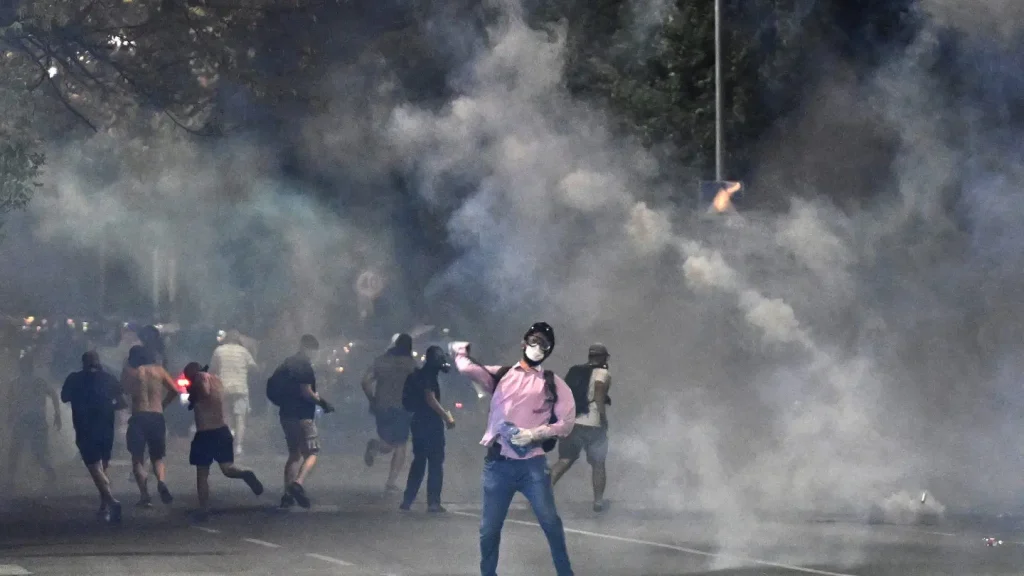
The most visible clashes came as demonstrations became more confrontational in 2025. At a major Belgrade rally on June 28, organizers called for an early election. Police used tear gas and stun grenades, and dozens of people were arrested. Vučić accused protesters of trying to overthrow the government with foreign backing; demonstrators said the authorities had ignored their demands and were escalating repression.
Tensions rose sharply again this August. In Valjevo and Belgrade, protesters clashed with riot police, who used tear gas as demonstrators threw bottles, rocks and flares. Party offices were set on fire or damaged. Some protesters said they had taken to the streets after video circulated showing police beating a young man. Human-rights groups and detainees separately reported assaults and mistreatment in custody.

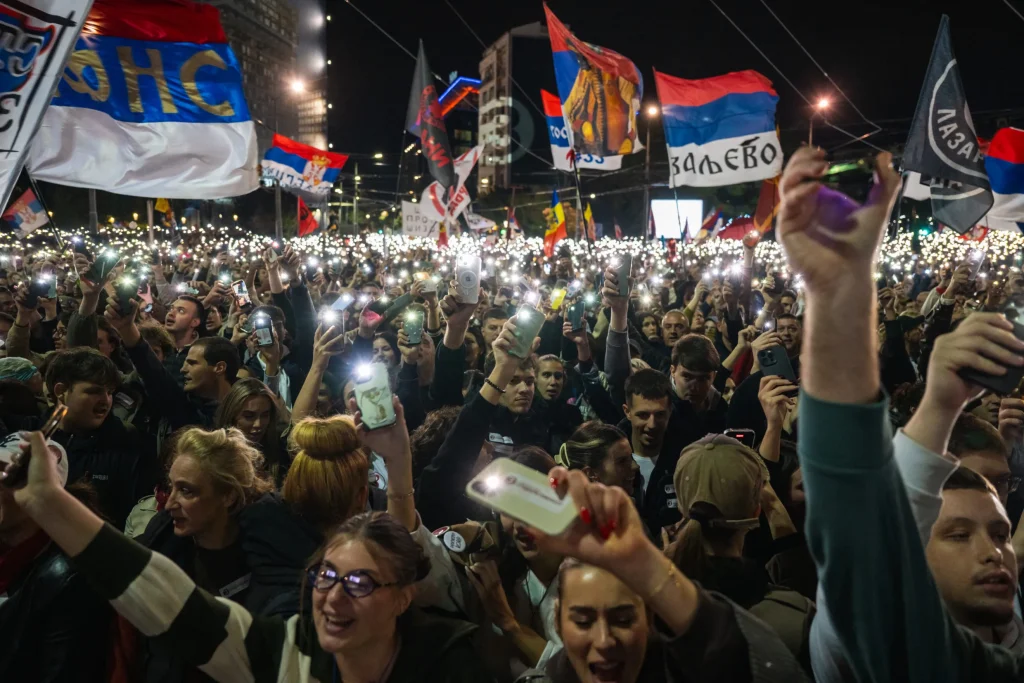
The movement’s origins reach beyond one disaster – it is a clear expression of the development of the contradiction the People vs. Bureaucratic Capitalism. Protesters have raised issues of Corruption, lack of media independence and the concentration of political power for a long time. Vučić and his allies reject accusations that they have undermined democratic freedoms. Still, the protests connected everyday anger over lack of accountability with broader demands for trustworthy institutions.
Recently some forces have misled the justified anger of the masses, trying to direct it to parliamentarian cretinism, and backed a parliamentary candidate list called the Student List, which won the recent election and Vučić conceded the Progressive Party’s 14-year rule.
On Monday 27 October, about 30 protesters entered Informer TV’s newsroom in Belgrade, surrounded editor-in-chief Dragan Vucicevic, and called for his arrest, interrupting the broadcast. The incident came amid celebrations after the opposition Student List defeated Aleksandar Vučić’s party in Sunday’s election.
Student List candidate Ilija Srdanovic urged protesters to remain calm and avoid violence, in a way showing his role as a pressure-release valve, aiming to contain the people’s discontent.
IMF has raised concerns about the protests, stating that prolonged unrest could affect investor confidence.
Conclusion
In Serbia, “Western” imperialist powers, after defeating the old regime militarily through genocidal aggression , used internal contradictions – between sections of the ruling classes and between the ruling classes and the masses – to advance their own goals. This pattern is mirrored in other oppressed countries, such as in the Euromaidan events of Ukraine, for example.
Foreign debt and financial “aid” was used as a leverage to deepen the subjugation of Serbia. Although Serbia has been used here as an example, this type of economic changes in the service of imperialism are common in oppressed nations globally, including other parts of the former Yugoslavia, such as Montenegro. This subjugation means making the changes considered necessary by the imperialist interests so that a oppressed country’s economy can serve the export of capital. It is a tool for imperialist plunder, and the cost is borne by the people – tax increases, cuts to the public sector and deepening of semifeudal exploitation.