Yankee Imperialism Increases Pressure on Cuba
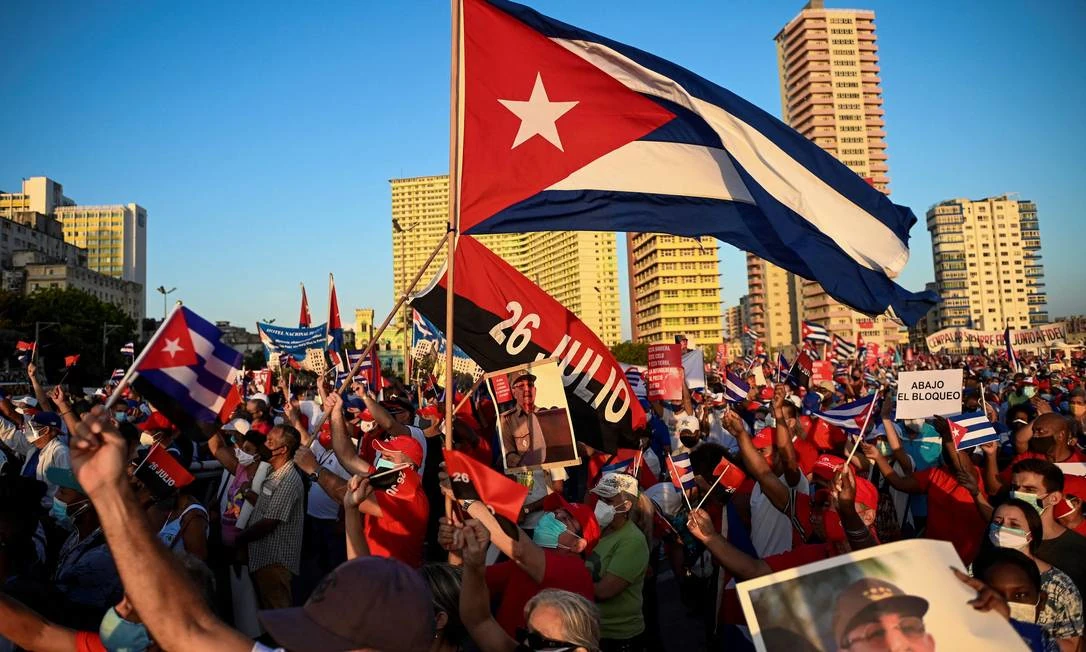
Featured image: Cubans participate in a rally in support of the government of President Miguel Díaz-Canel in Havana, on July 17, 2021, days after mass opposition protests Source: YAMIL LAGE / AFP
The threat against Cuba did not appear out of nowhere. When Donald Trump declared that “Cuba is next,” he spoke in the aftermath of celebrating the Yankee aggression on Venezuela. “But pretend I didn’t say that,” the president added trying to be funny, but the message that he wanted to send was crystal clear: Yankee imperialism is prepared to use its power and military to decide what happens in its “backyard.” The so-called “Donroe Doctrine” gives this old ambition a new slogan. Its substance is the same – Latin America belongs under Yankee domination, and governments that resist that order will be punished.
The history of US interventions and pressure against Cuba began when Spain surrendered its colonial control after the Spanish-American War, after which the United States established a period of strong influence and intervention, formalized by the Platt Amendment, which included rights to intervene in Cuban affairs and establish a naval base at Guantánamo Bay, which has stayed under US occupation ever since. Cuba became formally independent in 1902, but US influence remained substantial. The armed struggle for national liberation overthrew the pro-Yankee regime of Fulgencio Batista and displaced the economic foothold of US imperialist monopoly capital in Cuba. The revolution, though, lacked proletarian leadership and different factions inside the leadership had different lines on how to move forward. One example of which was the debates surrounding Cuba’s dependence on the production of sugar. Social-imperialist Soviet Union pressured this decision, giving their imperialist exploitation of Cuba a socialist veneer with the “international division of labor.” Fidel Castro was never a communist, and sold out the revolution to the (social-)imperialist rulers in Moscow after getting the cold hand from the ones in Washington.
The Monroe Doctrine, 1823, was presented as a warning to European empires to stay out of the Americas. As US power grew, Washington turned it into a warrant for intervention. Theodore Roosevelt’s 1904 corollary claimed for the United States an “international police power” over the region. US interventions in Cuba, Nicaragua, Haiti and the Dominican Republic followed under the banner of order and stability. In practice, those words meant nothing but defending the influence and the interests of Yankee imperialism.
Cuba has paid a high price for refusing that subordinance to Yankee imperialism. After the 1959 revolution, the US refused to accept the Castro regime, so the new government nationalized US-owned property and sought to break the island’s dependence on Washington. The United States answered with invasion: the CIA-led Bay of Pigs operation in 1961 failed, but the campaign to overthrow the Cuban government did not end there. Operation Mongoose pursued covert destabilization. The embargo, imposed in stages and made comprehensive in 1962, became another instrument of pressure. Declassified US documents show that officials sought to create economic hardship and popular discontent in the hope of weakening the government. Cuba became a focal point of the so-called Cold War, escalating in October 1962 when the US discovered Soviet nuclear missiles on the island. The discovery sparked a tense standoff between the two superpowers, as President John F. Kennedy imposed a naval quarantine and demanded that the missiles be removed. After nearly two weeks of negotiations, Khrushchev agreed to withdraw them, and the crisis ended without nuclear conflict. Cuba stayed subservient and dependent to the social-imperialist Soviet Union before facing a severe economic crisis after its collapse.
Today Cuba remains an oppressed country, surrounded by US military bases, with massive dependence on exports, especially of energy. Cuba has substantial offshore oil and gas deposits, but the domestic usage of them is limited.
The US pressure has caused significant shortages. Almost directly after the abduction of Maduro, Trump pressured Venezuela and Mexico to halt oil export to Cuba. The US sanctioned Cuba’s state oil company, CUPET, in June 2026, as fuel shortages and blackouts were already putting daily life under strain. Restrictions on fuel affect electricity, transportation, food distribution and health services. A Nova Democracia (AND) describes the sanctions as an energy blockade. The UN human-rights chief has warned that US sanctions are causing widespread harm and putting lives at risk – And in the end it has not only endangered lives but multiple people were murdered by the Yankee blockade.
Cuba has a dependence on external sources of foreign currency and imports. Tourism, medical-service exports, remittances, and commodities such as nickel and tobacco provide important income, but that income comes from a relatively narrow set of channels. Cuba’s June 2026 reform package widens the space for private firms, foreign investment, and direct trade. The measures include allowing private businesses and cooperatives to engage more directly in importing and exporting, loosening restrictions on foreign investment, and permitting private banks.
Cuba has natural resources, and markets in trade, tourism, investment, and other sectors, which undoubtedly interest Yankee imperialism. But it seems Cuba does also present a military concern for the sole hegemonic superpower. In addition to close ties with Russia and China, Cuba is located only around 90 miles from Florida and is near important Caribbean routes.
In addition to the embargo, the US has made new intelligence and military maneuvers. The CIA has reportedly created a new Cuba task force focused on recruiting and handling sources, cyber operations and covert influence. The report points to an expansion of intelligence work. Its significance is sharpened by the history of the CIA’s earlier Cuba task force.
That intelligence buildup is accompanied by signs of contingency planning. The Army Reserve was assessing whether it could provide Southern Command with logistics, engineering, medical and military-police units potentially needed within 90 to 120 days. The reconnaissance around Cuba’s maritime approaches and air units were also placed on heightened readiness. In addition, Surveillance overflights have been gathering intelligence on Cuba’s Armed Forces.
The regional picture adds to the pressure. The USS Nimitz carrier strike group has arrived in the Caribbean and US military sent roughly 600 US soldiers training in Panama, with later exercises planned in Honduras and Colombia. Taken together, these developments mean more Yankee militarization in the region. Intelligence gathering, contingency planning and displays of military force intensify pressure and signal readiness for military action.
The 2025 National Security Strategy calls for the United States to “reassert and enforce” the Monroe Doctrine and prevent other imperialist powers from controlling strategic assets and locations in the hemisphere. It is a declaration that Yankee imperialism intends to preserve regional supremacy and constrain the choices of governments that build ties with its rivals. Cuba is located close to the United States, the influence of China and Russia are viewed as a threat to the interests of Yankee imperialism.
In May, Trump and the gusano Secretary of State Marco Rubio framed Cuba as a threat, which had posed a security issue for years due to its ties to Russia and China. Trump added in his rally for candidates in South Florida on October 23 that: “Actually, what we’re going to do with Cuba is, we’re going to come back from Iran. Those beautiful ships will pass Cuba. We’ll have one of them stop about 50 yards off the coast. They’ll raise up their hands. And then we’re going to send Marco Rubio in to finish up the deal.”
The Venezuela precedent sharpens the pressure. This US operation showed it is once again prepared to openly and militarily engage in the region. Trump’s remarks linked that operation to the future of Cuba. At the same time, reports about a CIA task force, tightened economic sanctions, and increased military activity have added to the pressure, which create a frame for the negotiations with Cuba.
The recent unsealing of an indictment against Raúl Castro and other leading Cuban figures over the 1996 shootdown of the Brothers to the Rescue planes could provide a basis for framing his capture as a law-enforcement operation, similar to what was used in Maduro’s case, maintaining that his capture on trafficking charges was an extraterritorial application of US law, not a foreign military intervention.
That backdrop gives added weight to CIA Director John Ratcliffe’s meeting with Cuban leaders in late May, where he was accompanied by an officer involved in Maduro’s capture. Signaling what could follow if negotiations fail.
The US is creating pressure, along with supporting internal conflict – as sanctions, threats and efforts to isolate the island already narrow its economic options and increase the burden on the people intended to weaken Cuba and force capitulation – one way or another orchestrate a change in leadership and open Cuban economy to US domination, and using internal or exiled discontent as a fifth column. The US would rather achieve its goals in Cuba with their so-called “negotiations,” but this doesn’t mean direct aggression is out of the question, as was seen with Venezuela.
The “Donroe Doctrine” and threat to Cuba and all of Latin America is Yankee imperialism doing its all to maintain its position of hegemony. The US wants and needs to impose control over whole of its so-called “backyard.” Cuba, resisting the advance and occupation and blockade of Yankee imperialism for decades stands in the way of these plans. As does even more deeply the revolutionary situation brewing all over Latin America.