Colombia – Nueva Democracia Editorial: Defend Democracy and Restore Hope
We hereby share an unofficial translation of an editorial published by Nueva Democracia on the 3rd of May.
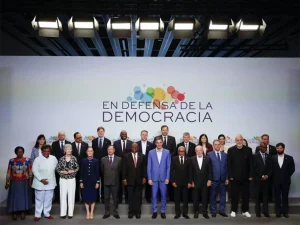
That the most exploitative, warmongering, and genocidal State in the world, led by the murderer Donald Trump, sends “election observers” to monitor the elections in Colombia, and that the National Electoral Council (CNE) recognizes and accredits the US Embassy and 86 of its delegates as international observers to “strengthen the transparency” of the May 31, 2026 presidential elections, demonstrates the profoundly subordinate nature of “Latin America’s longest-standing democracy” to imperialism, primarily US imperialism. This highlights the state of crisis and decay of this false democracy, where foreign interference is sold to us as transparency.
In 2022, abstention stood at 45.09% in the presidential election and exceeded 50% in the legislative elections. Abstention is in reality the great “invisible Party,” the true winner of the elections. More than half the country chooses not to participate. Added to this are blank and invalid votes, which accounted for nearly 2% in the last presidential election, and a vote often influenced by patronage, promises of employment, local pressure, or simply the act of voting against another candidate—anything but an act of conscious and voluntary democracy. Is the people ignorant or indifferent? Or is the idea that the country’s fate is decided in elections, in itself, a lie?
The electoral process is hailed as the supreme act of democracy, while social reality tells a different story: between 2016 and 2024, the Attorney General’s Office recorded 1,372 murders, of which 1,322 remain under investigation. Of that total, 793 cases saw no significant progress, and of the remaining 529, 217 resulted in convictions. In only 20 cases were the culprits punished. 187 social leaders were murdered in 2025, and there were 621 femicides between January and September of that same year alone. The crisis in the healthcare system is one of the clearest manifestations of structural failure, while this administration’s Health Minister washes his hands of the matter with statements that “the problem is one of management, not funding.” People die while waiting for surgery or an appointment with a specialist. The figures confirm this: in 2025, more than 312,000 legal actions were filed regarding healthcare, an increase of 47,500 cases in a single year. For working people, access to healthcare is not an effective right; requesting an appointment with a specialist is a feat, and obtaining treatment or surgery is a veritable ordeal. Thus, daily reality teaches the people, consciously or unconsciously, that the State and its institutions mean impunity and the denial of the most basic rights.
The current leader always has a ready-made explanation. The blame falls on the opposition, because “it didn’t let us govern”; on the previous president or government, because they left behind inherited problems; or on the guerrillas or the invisible internal enemy. But this narrative of false polarization between the far right and the so-called left serves to deliberately obscure the fact that the root of the problem lies not in one government or another, but in the very structure of the State and the nature of society.
The operating revenues of the thousand largest non-financial companies—which represent just 0.05% of the more than two million economic units registered in the country—account for 83% of GDP. Furthermore, 70% of these companies belong to conglomerates, either as parent companies or subsidiaries, which demonstrates a high degree of capital centralization. The main economic groups—the National Federation of Coffee Growers, the Sarmiento Angulo Group, the Ardila Lülle Group, the Santo Domingo Group, and the Antioqueño Syndicate—subjugate the entire national economy and sell it out to the interests of imperialism. Land, the primary factor of production in “backward economies” such as Colombia’s, is distributed in a profoundly unequal manner: 1% of the farms hold 81% of agricultural land. Thus, it is a minority—big landlords and the big bourgeoisie—that concentrates power and determines the country’s course, while the majority is exploited and excluded.
Thus, the polarization between a so-called “left” and the far right seeks to obscure a deeper reality: this democracy, the State, the three branches of government, the armed forces, and the entire institutional framework are all part of the ongoing domination of working people by a handful of families and economic groups.
It is true that some governments and candidates of the so-called “left” speak of power concentrated in the hands of the oligarchy and denounce the fact that a few families control the country’s politics. However, those very denunciations, paradoxically, end up being the greatest favor done to the ruling classes. For they give the putrid world of politics an air of renewal, create illusions that the government can change its character, and channel social discontent into institutional channels. As Alejandro Gaviria put it: “Better to have a controlled explosion with Petro than to bottle up the volcano.” This has been, at many points in the country’s history, the role of certain governments that present themselves as left-wing: to channel social discontent, manage it, and, ultimately, contain it, without transforming the structures of power.
In the late 1920s and early 1930s, the labor, peasant, and popular movements were experiencing a significant upswing—with strikes in the railroads, in the oil sector, and at banana plantations, as well as peasant associations fighting for land and organizing against the power of the landowners, including the landmark uprising in Líbano, Tolima, led by the Revolutionary Socialist Party—the government of Alfonso López Pumarejo came to power with the promise of sweeping social reforms. His program, called “The Revolution in Progress,” proposed, among other things, an agrarian reform that was supposed to improve the living conditions of the people.
López Pumarejo’s rise to power channeled and diverted the strength of the popular movement toward expectations of institutional change, weakening its autonomy and capacity for struggle. In practice, his agrarian policy ended up favoring the big landlords and big capital: it promoted the commodification of land, rural credit, and capitalist expansion in the countryside, while effective redistribution was marginal and slow. The result was the demobilization and fragmentation of the peasant movement. The “Revolution in Progress” was, in reality, a consequence of the rise of the popular movement of the previous decade and a prelude to the period known as “The Violence”.
“The Violence” and later the “National Front” demonstrated how the State shifted power among the ruling classes, while the people were reduced to cannon fodder in the disputes among those at the top. The people reorganized and struggled for land, bread, and freedom. In the 1950s and 1960s, the country saw a vigorous peasant and revolutionary movement, in which broad sectors ceased to be cannon fodder for liberals and conservatives and took up the banner of the agrarian revolution.
In this context, the government of Carlos Lleras Restrepo promoted the creation of the ANUC (National Association of Peasant Users) to institutionally channel the agrarian struggle. Although sectors of the peasantry used this organization to promote land seizures, it also served to corporatize, divide, and demobilize part of the movement, subordinating it to the logic of the State.
Lleras Restrepo toured various regions of the country, delivering a speech in which he stated: “An essential aspect of the reform is that those peasants who have spent years and years working on land that does not belong to them… become landowners.” He added: “We can no longer continue living in an era of local strongmen… Up with the strongmen bossing people around, down with the people obeying!” Thus, in practice, these slogans gave the State and the ruling classes a reprieve, cleansed the institutions of the blood of violence against the popular movement, and paved the way for the agrarian counter-reform that would follow.
In the 1980s and 1990s, the State promoted peace processes with various guerrilla organizations. Far from representing a structural solution for the majority, these agreements aimed to neutralize the sectors fighting for democratic and revolutionary demands. At the same time, they helped legitimize the existing order and the electoral path by integrating former insurgent actors into the institutional system. The result of the “democratic” opening was the extermination of broad sectors of the popular movement—as happened with the Patriotic Union—at the hands of State and parastatal forces, and the strengthening of paramilitarism throughout the country.
Once again, “institutional renewal,” “agrarian reform,” “peace agreements,” and the “Constituent Assembly” were largely a response to the rise of the popular and revolutionary movement and paved the way for the next cycle: the bloody 1990s and 2000s, characterized by paramilitary massacres carried out in collusion with sectors of the State and with the backing of US imperialism through Plan Colombia. During that period, between 6 and 6.6 million hectares were seized from the peasants (approximately between 1996 and 2006), and between 2,500 and 3,500 massacres were committed throughout the country. This was an attempt to drown the guerrilla struggle and the popular and revolutionary movement in blood.
But the people, who always seek to determine their own destiny, gradually built up their resistance. Young people, in particular, demonstrated their capacity for organization and popular struggle, standing out during the heroic days of September 9 and 10, when the people set fire to some 76 police facilities across the country, and in the Great Popular Uprising of 2021, when for months the youth of the people confronted State forces in both rural and urban areas. This once again highlighted the crisis of the existing order and the need, for the ruling classes, to initiate a new cycle of diverting the popular struggle—a strategy of “changing something so that nothing changes”—through the controlled explosion of the popular movement.
Today, the masses face a dilemma: Cepeda or the return of Uribism. But the force behind the resurgence—with renewed momentum—of the far right—whether Uribism or its new forms—is precisely political opportunism, Petrism, which, by managing the existing order while waving the banners of change, ends up playing a functional role in the reaction. Raising the banners of change to corporatize and legitimize this democracy is, in other words, putting lipstick on a pig. It speaks out against the oligarchy, while promoting an alliance with José Félix Lafaurie, president of Fedegán (representative of the big landlords), and agreements with the Antioquia Business Group, Gilinski, etc.
The only way to halt the advance of “the far right”—which has its economic base and ideological, political, and social reproduction in latifundium—is not the “pacifism” of a government rusted by opportunism, but the decisive struggle against the raging forces of the far right and their death squads in the service of latifundium.
Democracy does not lie in the elections of a bureaucratic-big landlord State. No government can change the profoundly dictatorial character of the State, which is sustained by the country’s economic structure and the power network of the ruling classes: from local bosses and patronage networks to the armed forces, whose training, ideology, and policies have historically been shaped by the United States for counterinsurgent and anti-popular purposes. This historical continuity of “democracy” reflects the project of the big landlords and bourgeoisie who, since independence, have replaced the Spanish crown with foreign interests—first British, then American—to exploit the working people. It is the democracy of massacres perpetrated by paramilitaries side by side with the armed forces, of false positives, of the subjugation of the majority to the power of a few.
What a government can try to change, however, is its facade: presenting itself as the champion of a grand pact and a national dialogue with the big landlords, the big bourgeoisie, and imperialism, giving the false impression that these sectors are open to negotiation and that they will voluntarily hand over the land, the surplus value they extract from the people, control of our resources, and our sovereignty. After centuries of exploitation and repression, the idea that good governance will make them “see reason” is, quite simply, a deception. Expectations are raised that it is enough to defeat a few recalcitrant far-right elements in the elections or to pressure Congress to pass laws “that benefit the people.” It is an exercise in legitimizing the existing order, a performance that masks exploitation with rhetoric of change and formal democracy, while the structures of power remain intact.
Unions, associations, and young people remain in a state of waiting, pinning their hopes on changes coming from above. Popular organizations are thus placed at the service of the institutional structure of elections, subordinated to the logic of supporting the elections and then the president during his term, so that he may have more influence within Congress and promote one law or another. As a result, organizations are disarmed; corporatization replaces the class independence of democratic and revolutionary organizations; pacifism replaces militancy; and the class struggle is replaced by conciliation with the exploiters, by turning the other cheek.
On this May Day, International Workers’ Day, we call upon all the Colombian people: trade unionists, the militant youth, the peasant masses, and all workers. It is time to defend democracy and regain hope.
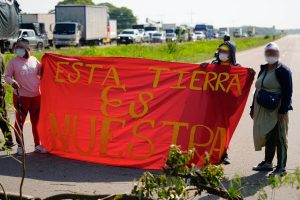
Defending democracy means strengthening the class independence of labor unions, building organizations that break with the patronage and corporatism that keep them mired in lethargy, and building grassroots organizations that win and defend rights—just as the people have always done—through struggle. Defending democracy also means defending the democratization of land: land for those who work it, by dismantling the latifundium, one of our nation’s most profound problems. This is not achieved through agreements with big landlords like Lafaurie, nor by purchasing marginal plots that they choose to offer at exorbitant prices, but by supporting the peasant struggle for the right to land.
Defending democracy means raising the consciousness of all those masses who do not vote today—not so that they might renew their trust in a political system that has never done them any good, but so that they might organize themselves and transform their unconscious electoral boycott into a conscious struggle for their rights and against the exploitative state. The struggle for democracy is the struggle for the right to rebellion that peoples have always possessed against those who exploit them. It is the fighting spirit in pursuit of true national independence. Or would independence from the Spanish crown have been achieved by opening a dialogue with the kings and the Murillos?
To regain hope is to regain the conviction that it is possible to change this society from the ground up, to renounce the “better than nothing” mentality, to stop settling for crumbs. It means believing in a free and sovereign country. Gaining hope means having faith that real change is achieved through popular organization, the head-on struggle against the state and the ruling classes it protects, and the conquest of the rights that have been denied to us for centuries. Less circus and more struggle: only in this way will we build a free and sovereign country.