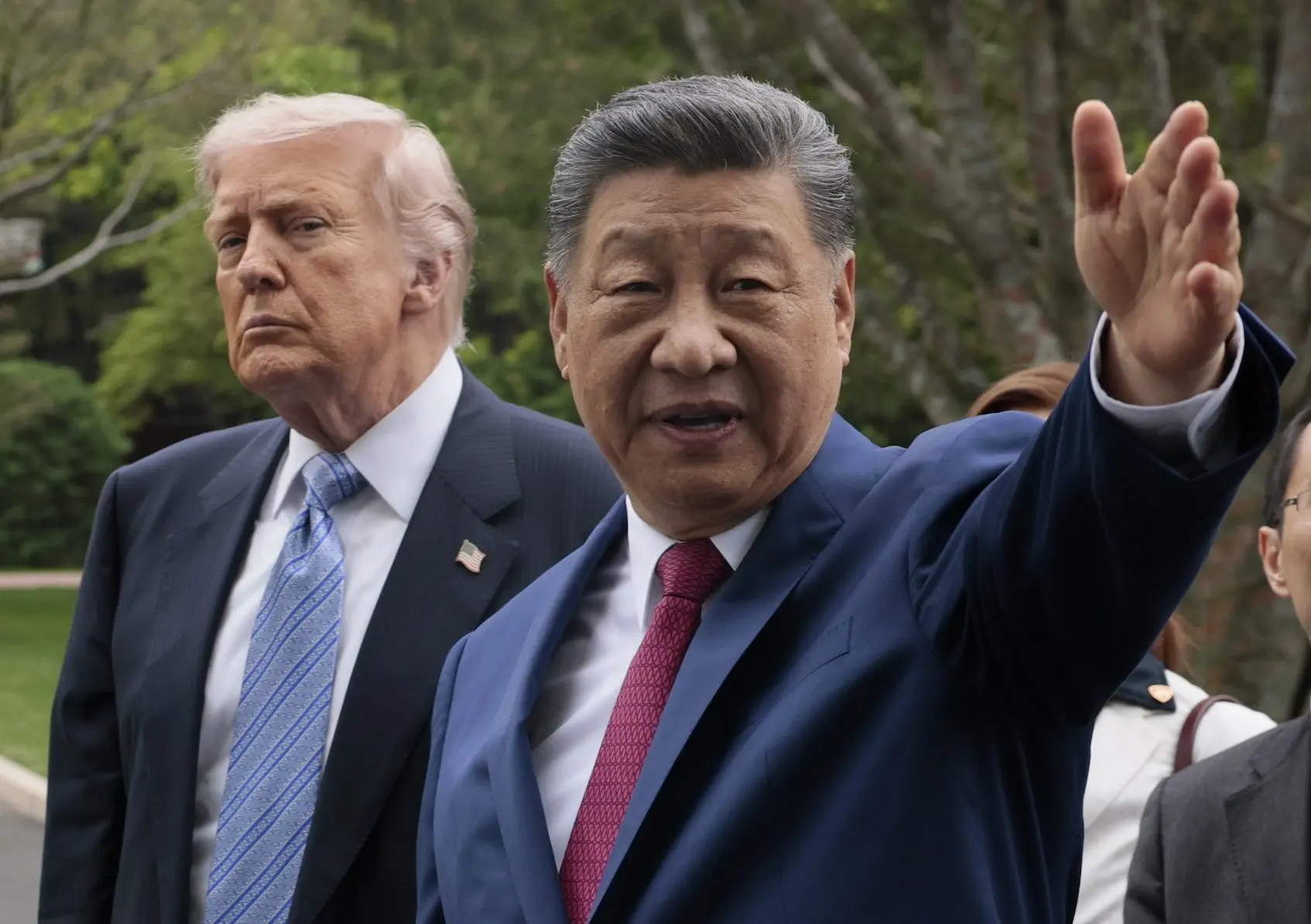
AND – Analysis: Trump Leaves Beijing Without the Political Victories he Sought
We hereby share an unofficial translation of an article published by A Nova Democracia (AND) on the 18th of May.
US President Donald Trump concluded a two-day State visit to China on Friday (May 15) without securing any major concessions from Beijing on the crucial strategic issues at stake. Welcomed by the social-imperialist leader Xi Jinping at the “Great Hall of the People” in Beijing, Trump attempted to present the meeting as a personal victory and even went so far as to say that the summit could be “the greatest of all time.” However, according to the imperialist press itself, the concrete results were modest: partial trade agreements, promises to purchase agricultural products and aircraft, and no decisive solution regarding Taiwan, Iran, Artificial Intelligence (AI), or “rare earths.”
The diplomatic spectacle was carefully staged. There was a military guard of honor, a State banquet, a tour of the Temple of Heaven, and even a visit to the Zhongnanhai compound, a complex closed to the Chinese power elite. Trump, known for his blustering diplomacy, flattered Xi Jinping in public, called him a “friend,” and said he had “respect” for China and for the Chinese president’s work. Xi, for his part, maintained a more restrained tone and warned that Sino-American relations could enter a “very dangerous situation” if Washington handled the Taiwan issue inappropriately. Despite this, Xi also agreed to visit Washington in the northern hemisphere fall, at Trump’s invitation.
The Taiwan issue and collusion
In a closed-door meeting, Xi stated that if the Taiwan issue were mishandled, the two countries could “clash” or even go to war, according to the imperialist news agency Reuters, citing Chinese State media. The White House, however, omitted Taiwan from the subsequent official summary of the visit, even though the issue had been central to the talks. The omission indicates that Washington avoided making public a point on which it was directly pressured by Beijing.
The day after the meeting, Chinese Foreign Minister Wang Yi stated that Beijing had observed that the US “understands China’s position” and “takes Chinese concerns” regarding Taiwan “seriously.” Wang reiterated that Taiwan is “the most important issue” in China-US relations and demanded that Washington adhere to the “One China” principle and the joint communiqués signed between the two countries.
After the summit, when asked whether Taiwan should feel more or less secure following the meeting with Xi, Trump replied, “neutral.” He then said that “nothing has changed,” but added that he didn’t want anyone to declare independence “because the US is supporting them” and that he didn’t want the US to travel “9,500 miles to fight a war.” Trump also did not confirm the $14 billion arms package for Taiwan. He said, “I may or may not do it,” and, according to the AP news agency, stated that the package was “on hold” and that “it depends on China,” calling it “a good bargaining chip.”
The primary US interest in negotiations with China lies in “rare earths” and critical minerals, over which China exercises export controls as a means of exerting pressure on the US, thereby severely limiting the strategic capabilities of the defense, aerospace, semiconductor, AI, and entire high-tech industries.
The summit also served the interests of Chinese social-imperialism, which did not appear as a passive party in the face of pressure from Washington. As AND has previously analyzed, the Chinese revisionist regime combines a show of force, military preparedness, and economic diplomacy to deter its main rival, attract allies, and expand its positions in the struggle for markets, technology, routes, and strategic resources.
In Beijing, Xi sought to elicit signs of caution from the US regarding Taiwan, preserve control over critical minerals, and keep open the trade routes that fuel his own monopolies, thereby avoiding an immediate breakdown that would harm Chinese exports, investments, and industrial supply chains. The meeting, therefore, reflected the dual movement of the imperialist powers in conflict: they vie for the economic and political division of the world, but also agree on temporary restraints when the crisis threatens to spiral out of control.
The battle over ‘rare earths,’ trade, and tariffs
The trade press noted that several commitments were announced primarily by Washington and have yet to be confirmed in detail by Beijing. Regarding “rare earths” and critical minerals, the White House said only that China would “address” US concerns about shortages of yttrium, scandium, neodymium, and indium. Reuters noted that this fell short of any Chinese commitment to eliminate the export control regime, which remains a tool for exerting pressure on the US military, aerospace, and semiconductor industries.
According to Reuters analysts, Beijing is likely to continue issuing licenses and approving shipments on a selective basis, especially for civilian sectors, but will retain the power to veto and delay approvals for sensitive items. US Trade Representative Jamieson Greer said that exports have improved and that there have been large recent shipments of yttrium, but he acknowledged that China is still “dragging its feet” on some licenses and that Washington needs to intervene on behalf of affected companies.
On the trade front, the White House announced the creation of two bilateral bodies: a US-China Trade Council and a US-China Investment Council. According to the Trump administration, the former will address “non-sensitive” goods, while the latter will serve as a forum for discussing investments. Beijing, for its part, spoke of “balanced and positive results” in economic negotiations and of expanding trade under a framework of reciprocal tariff reductions.
The White House stated that China will purchase at least $17 billion worth of US agricultural products annually in 2026, 2027, and 2028, in addition to previous commitments regarding soybeans. It also announced that Beijing has approved an initial purchase of 200 Boeing aircraft and has partially restored access for US beef and poultry to the Chinese market.
The summit resulted in an unstable truce: Washington secured purchase commitments and formal channels for negotiation; Beijing preserved its leverage over “rare earths” and extracted signs of caution from the US regarding Taiwan. Far from resolving the dispute, the summit merely showed that US imperialism and Chinese social-imperialism seek to manage their rivalry while preparing for new clashes. Taiwan is at the center of the tensions, and the US non-interference in this matter appears to be driven by pressure to secure access to “rare earths.”