Tjen Folket Media – Kenya: Interview with an Organizer of Workers
We hereby share an unofficial translation of an interview published by Tjen Folket Media on the 22nd of May.
A contributor to Tjen Folket Media (TFM) attended the Pan-Africanism Summit Against Imperialism (PASAI) in Nairobi, Kenya, on May 11 and 12. PASAI was organized as a protest against the “Africa Forward” summit organized by French imperialism and the Kenyan State. We will be publishing a series of articles written during this trip.
During PASAI in Nairobi, TFM had the opportunity to speak with a member of the Communist Party Marxist Kenya (CPM-K) who is involved in organizing industrial workers. Comrade Kainia told us about this work, but also shared many insights into Kenyan society.
Comrade Kainia told us that he has a university degree and used to work in a white-collar job, but that he, like many other comrades, is now unemployed. This reflects the high unemployment rate in Kenya’s cities. Even if you have a college or university degree, there simply aren’t enough jobs to go around.
Many people we spoke with later told us that when foreign imperialists build roads or undertake other projects in Kenya, they employ engineers and other professionals from their own countries as middle managers, and Kenyans are hired only to do hard manual labor.
Comrade Kainia explained that he and other members of the CPM-K have been working for some time to organize workers in an industrial town in southern Kenya. They established a party group there, and since then, Kainia and other comrades have regularly visited to live among and fight alongside the workers in this town.
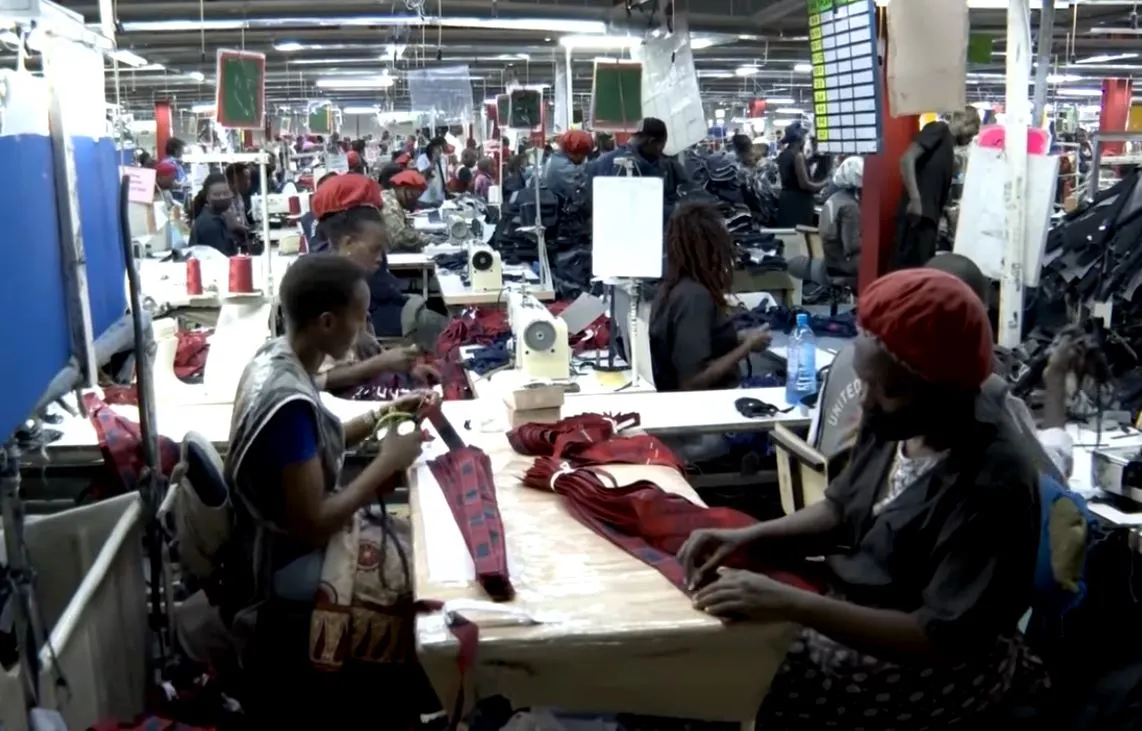
The city is primarily home to the textile industry, and most of the workers are women. This has sparked a great interest in women’s issues for Kainia. He tells TFM that through the AGOA agreement (an agreement between US imperialism and a number of sub-Saharan African countries) and tax-free “Export Processing Zones,” an increasingly export-oriented industry has been built up in Kenya. Large monopolies can establish themselves in special zones where they are exempt from paying taxes to Kenya and where they can export brand-name clothing duty-free to, for example, the US
Kainia explains that in the small industrial town where his friends work, there is a shortage of both drinking water and paved roads. The workers earn very low wages, and they have to buy not only food but also drinking water. At the same time, loan sharks and capitalists involved in gambling are taking advantage of this precarious situation. The comrade says the town is full of pawnbrokers and loan sharks who offer “microcredit”—that is, small loans—at interest rates that rise very quickly if the loan isn’t paid back soon.
The comrade says it’s hard work to organize the workers in this town. Many, especially the female workers, are very skeptical of what they perceive as politicians. They are used to politicians showing up during election campaigns, and they are used to broken promises. Furthermore, unionizing is strictly prohibited in such factories, which are mainly owned by Asian investors (China, India, the United Arab Emirates, etc.).
When the comrades began their work, they handed out leaflets and talked to people about their party. They encourage the masses to talk about their problems and describe their lives. The masses often meet them with skepticism, believing that the activists are just another group of opportunists. But Kainia explains that they follow the mass line, spending several days at a time with the masses, eating with them and playing games. He goes on to say that they conduct social surveys and carry out class analysis to aid their future work.
Kainia further explains that the context in which they work is one of extremely corrupt bureaucratic capitalism. A young relative of his recently encountered this reality when she was taking her driver’s license exam and found that the driving instructor demanded a bribe to pass her. This is the reality for the masses in Kenya, he says, noting that the interest rates on small loans offered to workers in the industrial city are often 30 percent.
Finally, he tells us more about the Kenya Land and Freedom Army (KLFA)—often referred to as the “Mau Mau uprising”—and how they waged a guerrilla war against the British. Kainia explains that these fighters were initially only men, based on old patriarchal structures, but that they gradually incorporated more and more female fighters, so that everyone became a fighter in this revolutionary war against British colonialism. He says that the KLFA was militarily defeated, but that they fought heroically to the death. He says there are many lessons to be learned from this war, and points to how the CPM-K honors the martyrs and leaders from this struggle, and how the masses must liberate themselves with their own hands.