Peru: Two Week Student Occupation of the University of San Marcos
We hereby share an unofficial translation of an article published by A Nova Democracia (AND) on the 26th of May.
Students are Defying the University Administration and the Old Peruvian State and Have Been Occupying San Marcos for Two Weeks
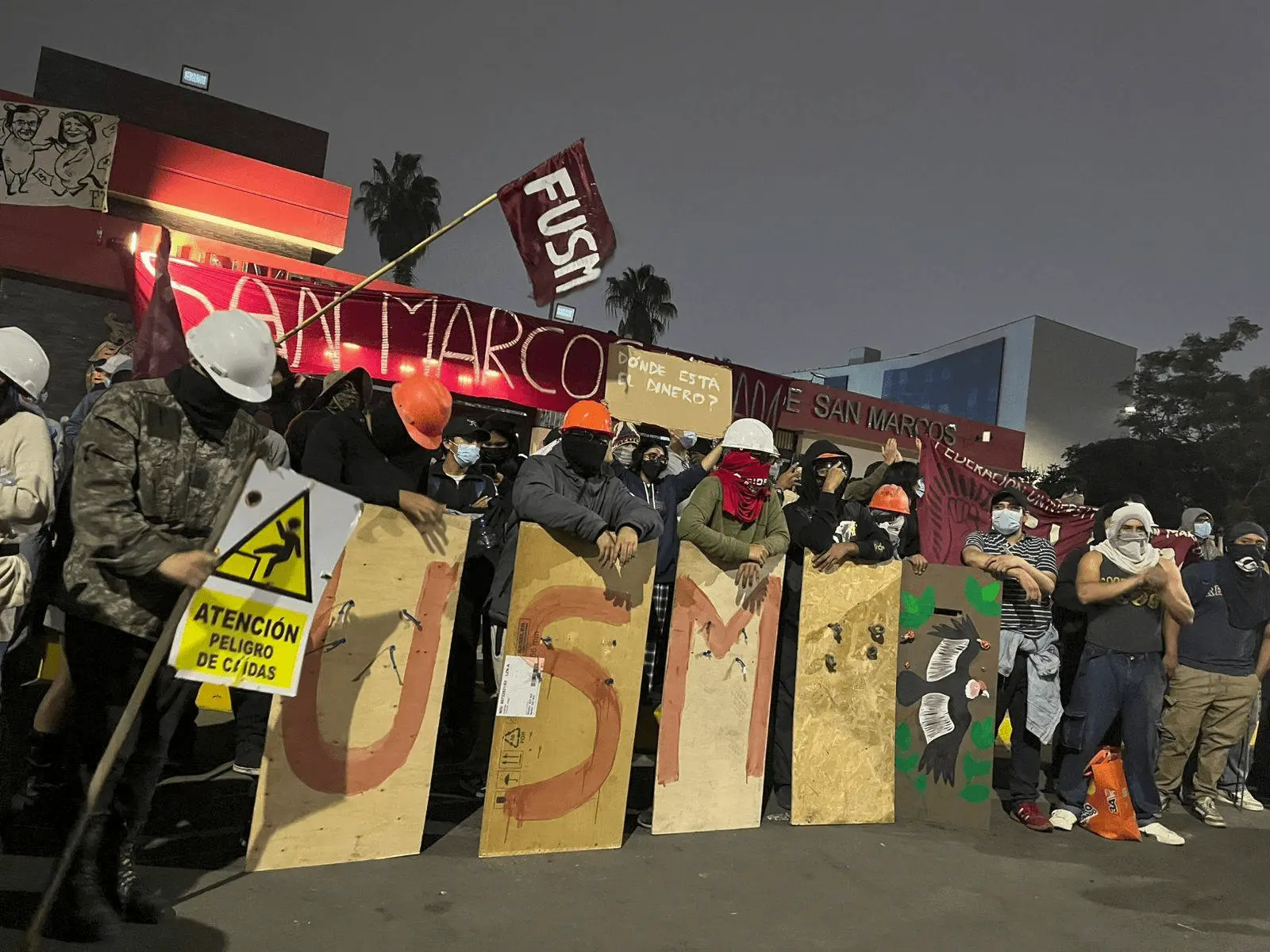
Students from the National University of San Marcos (UNMSM), under the coordination of the San Marcos University Federation (FUSM) and various student groups, have been occupying the University City in Lima since May 12. With barricades and access controlled by student groups, the mobilization seeks to block Bill (PL) 12,736, nicknamed the “Jerí Ramón” Law, which would allow for the immediate reelection of university presidents and deans. The occupation has brought in-person academic activities to a standstill and forced the establishment of a mediation committee following the resignation of the majority of the University Electoral Committee.
The establishment of the dialogue committee, scheduled for May 26 with the participation of the Public Defender’s Office, was presented by the students as a tactical victory for the occupation. The official announcement comes exactly two weeks after the start of the occupation of the campus known as Cidade Universitária, a direct and firm response by the student councils against the continuity-seeking maneuvers attributed to Rector Jerí Ramón, whose group seeks to perpetuate itself in the administration of the continent’s oldest university through spurious legislative counter-reforms promoted by Congress.
As part of this escalating student resistance, the University Assembly, which held a special session on May 22, was compelled to accept the irrevocable resignation submitted by the majority of the members of the Electoral Committee. Seven of the nine members of this bureaucratic body, including the chair and the secretary, had resigned two days earlier on the explicit grounds that there were no institutional or operational guarantees to proceed with the election process—which had been challenged by the students and was being conducted by the university administration.
To unify the students’ stance and continue the occupation, on May 23, FUSM adopted a resolution approved at the General Student Assembly, which mandated the complete closure of all gates and access points to the campus, prohibiting the entry of staff, support personnel, and faculty, as well as the movement of vehicles not belonging to the organized student body. In an official statement, they affirmed that “these measures represent the culmination of our organized struggle, undertaken so that we may be heard and have our demands respected.”
The impasse that has paralyzed the university for two weeks stems from the imposition of the controversial Bill 12736, introduced in October 2025 by Congressman Edgar Tello, whose text currently under debate in Congress aims to legalize the immediate reelection of university presidents and deans at all public higher education institutions in Peru. In addition to the change regarding reelection, students allege that the university administration attempted to raise the electoral threshold required for student representation in co-management bodies to 20%, seeking to undermine the possibility of student co-governance, as well as to impose entirely virtual voting.
Police repression and attempts to criminalize
Last weekend, the student federation was forced to issue a public warning denouncing the circulation of doctored audio files in which, using artificial intelligence tools, the voice of a student representative was grossly altered. According to FUSM, the maneuver occurred shortly after warnings about a possible invasion of the campus by vandals and law enforcement agents, and was intended to spread misinformation, weaken student unity, and destabilize the occupation’s leadership.
The FUSM statement condemned the “attempt to discredit the leaders with the aim of sowing distrust among students. We warn that these dishonest practices are not uncommon; some have even used images from the university’s security cameras to accuse us of being ‘responsible’ and, thus, criminalize us.”
Alongside the violence and digital fraud, university administrators ordered the closure of physical classrooms, mandating that undergraduate courses be moved to online platforms. Students viewed this move as a ploy to reduce campus activity and weaken student organizations.
The Federated Center for Social Sciences and Humanities spoke out against the measure, denouncing its political nature, demanding financial transparency, and questioning the destination of university funds withheld during the suspension of in-person activities. In a statement, the organization asked: “Where is the money going? Every time classes are suspended, where does the unused budget go—both for fuel and for the university cafeteria? What is actually being done with this money?”
The Deterioration of Public Education and the Struggle in Jaén
The student protests rocking Peru are spreading to other provinces, exposing the chronic neglect and precarious conditions plaguing the country’s education system. In the province of Cajamarca, students at the National University of Jaén have kept the campus entirely occupied since May 10 due to the suspension of the university cafeteria service, a neglect that has persisted since the start of the academic year in March and directly affects more than 450 students who depend on this basic assistance to ensure they can remain at the university.
Appearing before the Congressional Committee on Education, Youth, and Sports last week, the head of the Ministry of Education, María Esther Cuadros Espinoza, provided clarification regarding the conflicts in Jaén and San Marcos. The minister invoked constitutional university autonomy in the case of Lima and attributed the collapse of the cafeteria in Jaén to bureaucratic obstacles with the State Procurement Supervisory Agency, promising only an assessment of the students’ demands for the immediate dismissal of the local Organizing Committee.
At the same time, the protests spread to the San Marcos School of Physical Education, located in the La Victoria district. Students mobilized in response to reports of robberies, extortion, and protection money demands by criminal gangs plaguing the area surrounding the campus. In the face of these reports of physical insecurity, the university administration’s response was limited to authorizing private motorcycles in classrooms—a measure deemed senseless and outrageous by the students.