Mexico – Mural Newspaper: Special Supplement | June 2026
We hereby share an unofficial translation of a Special Supplement of the Mural Newspaper published on the 16th of June.
Today, after the first fifteen days of the National Strike and under fire from the reactionary forces and their campaigns of criminalization, denigration, provocation, and repression, it is worthwhile for the democratic teachers’ movement to analyze, from the grassroots level and within its various structures, the development of this day of struggle, proposing tasks that will help maintain the morale and unity of the teachers’ movement. From the Mural Newspaper, we want to offer some points for collective reflection, which we present in this Special Supplement, to contribute to the fighting spirit that must permeate the rank and file.
Read and share the Popular and Democratic Press!
OUR MAIN TASK: TO MAINTAIN THE UNITY AND MORALE OF THE MOVEMENT
The CNTE’s National Strike, which began on June 1, has now entered its fifteenth day, facing a series of problems that have arisen in the heat of the class struggle and are putting to the test the political and organizational capacity of the democratic teachers’ movement. This is not the first time, over the course of these nearly 47 years of struggle, that the democratic teachers’ movement has faced the intransigence and smear campaigns of the old State. Previously, the CNTE waged a long and exemplary struggle against the tyrannical governments of the PRI and the PAN, forging itself in the heat of a thousand street battles. Today it is up to the CNTE to wage this same struggle against the Morena governments and their self-proclaimed “fourth transformation.”
Against the democratic teachers’ movement, there is an entire media campaign of political lynching led by the Office of the President of the Republic, which every morning seeks to portray the CNTE’s struggle as nonsense, insisting time and again that there is “dialogue and openness,” that SEGOB and SEP “have provided answers,” that “there is no money” to meet their demands, among a long list of other claims. Furthermore, the pro-government press and social media accounts paid for by the regime repeat the refrain: “Where were they during the PRI and the PAN?” as if it were not a well-known fact that the National Coordination of Education Workers has been one of the bulwarks of the popular movement in our country that for more than four decades has held high the banners of democracy and the revolutionary transformation of society, paying a high price in the form of education workers who have been imprisoned, murdered, and disappeared by the regime.
Thus, if the history of the class struggle has taught us anything regarding the relationship between the working class and the government in power under this mode of production, it is precisely that “The executive of the modern state is but a committee for managing the common affairs of the whole bourgeoisie. ” (Marx). This is clearly reflected in the attitude of Claudia Sheinbaum Pardo as she staunchly defends the interests of bankers, large monopolies, and imperialist powers that shape educational policies in Mexico and around the world.
Today, as we mark the first fifteen days of the National Strike and while under fire from the reactionary forces and their campaigns of vilification, criminalization, provocations, and repression, it is worthwhile for the democratic teachers’ movement to analyze, from the grassroots level and across its various structures, the progress of this day of struggle, outlining tasks that will help it keep the morale and unity of the teachers’ movement high. Here at the Mural Newspaper, we would like to propose some points for collective reflection.
The Stages of the National Strike.
In general, the current teachers’ struggle has gone through at least four stages in recent weeks.
1) Section XXII of the CNTE began its work stoppage on May 25 with two sit-ins, one in Oaxaca City (80% of its membership) and another in Mexico City (20% of its membership). The measure, agreed upon by the State Assembly aimed to increase pressure at the tripartite negotiating table to achieve results at the state level one week before the outbreak of the National Strike, in order to then focus on the latter.
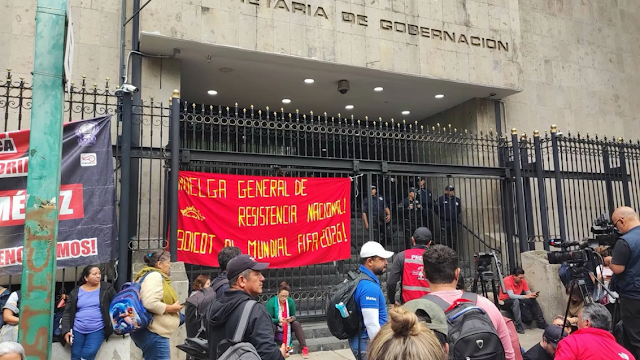
2) On June 1, the National Strike broke out with strong participation from various CNTE contingents. If last week the opportunistic governments of Brugada and Sheinbaum had demonstrated their fear by attacking teachers in Oaxaca, with the start of the National Strike, the Mexico City and federal governments confirmed their reactionary nature by launching a direct attack on the national teaching community, where two comrades from Guerrero suffered facial injuries, resulting in partial or total loss of vision. Despite the repression and the heavy security presence in the Zócalo, the opportunistic Morena governments failed to prevent the establishment of the sit-in in the heart of the country, which spread across several avenues, calling for solidarity from the people and their organizations.
3) On June 8, with the start of the second week of the National Strike and the arrival of new contingents of teachers and teacher-training students in the nation’s capital, as well the expansion of teachers’ actions across different states of the republic—including the liberation of toll booths, roadblocks, and the occupation of federal buildings and facilities, customs posts, border crossings, etc.—the teachers’ movement went on the offensive, giving vitality and material strength to the slogan “Boycott the 2026 FIFA World Cup,” which spread across the entire world, setting off all the alarm bells of imperialism and the old Mexican State. The federal government’s desperation to set up dialogue tables almost daily in order to wear down and neutralize the teachers’ movement was evident; also notable was the regime’s counterinsurgency efforts as it intensified the campaign of political lynching against the CNTE, the FECSM, and any movement that joined the boycott’s actions. Sheinbaum was shouting herself hoarse, crying out, “The extremes are joining forces—the so-called left-wing radicalism and the far right”—in an attempt to lump all popular movements together with the reactionary Salinas Pliego and the fascist right.
4) On June 10, with the arrival of contingents of students, peasants, the searching mothers, and other groups, the old Mexican State was forced to find a way to defuse the protests. Its first tactic was to fragment the movement, seeking at all costs to prevent all these small streams from converging into a single torrent. The second tactic was the announcement by SEGOB following the last meeting with the CNUN, stating that they await “the CNTE’s response.” This brings us to the most important day in the context of the National Strike: June 11, June, the day of the opening match of the World Cup, when the searching mothers, the student movement, anti-gentrification movements, neighborhood assemblies, and other sectors were able to mobilize, reach the stadium gates, and resist the city police, returning blow for blow. The democratic teachers’ movement also mobilized, and the sheer number of its participants made it a powerful army of workers capable of stopping the ball from rolling, but it fell into the trap of “civility” and the “peaceful movement,” and after yet another press conference, it decided not to fight and to return to the camps. From that point on, the balance of power shifted in favor of imperialism and the old Mexican State; the monopolies and the oligarchy understood this immediately and sent their spokesperson, Claudia Sheinbaum, to issue a threat, saying that she no longer saw any point in negotiating and that she would not engage with the Coordination.
Reorganize the movement and boost its morale
The old Mexican State has tried to create a scenario of defeat to crush the morale of the rank-and-file teachers mobilizing in Mexico City and across the country. With or without justification, it has spread rumors claiming that the leadership has sold out, or that the sit-in is losing participants. At the same time, it continues to send its riot squads to provoke the camps and also seeks to encircle the sit-in with its riot police. Sheinbaum is thirsty for revenge, and her bourgeois class pride will drive her to retaliate against education workers and every struggle that dared to challenge the world of the rich; this is part of the cost of the struggle of lessons, and we must prepare ourselves to face them with fortitude and political maturity.
That is why it is important to reorganize the teachers’ movement and boost its morale from the grassroots up, while keeping the CNTE’s unity and struggle strong. This is a good time for every union delegation, every school district, every sector, every region, and every local chapter to engage in an exercise of criticism and self-criticism in which we are able to place, at the forefront, the common interest of the teachers’ movement while rejecting capitulation. Absolutely all of the Coordination’s demands are just and correct.
What is needed today is for the teachers’ movement to draw the necessary lessons from this National Strike. The lack of dialogue and the regime’s intransigence are only one aspect of the contradiction of the moment; the other (and main) aspect is the degree of solidarity built up by the CNTE among the various workers’ unions, student movements, peasant movements, popular movements, movements of searching mothers, tenants, settlers, etc., at the national level and particularly in those states where the Coordination has a presence… “Now and then the workers are victorious, but only for a time. The real fruit of their battles lies, not in the immediate result, but in the ever expanding union of the workers.” (Marx). In that sense, the Solidarity Forum on Strikes and Active Struggles convened by the CNTE on June 6 must have a political and organizational continuity that allows us to revive the slogan of the General Strike of National Resistance against the old State and imperialism. It is urgent that the rank-and-file teachers promote from below the unity of the CNTE with the forces of the people and that a National Convention for the Unity of the People’s Struggles be convened.
Long live the National Coordination of Education Workers!