A Report from the Russian Maoists
We hereby share a report that we have received.
Sovinter’s founding forum took place on 26–28 April in Moscow. The main formal organiser of Sovinter is the Russian parliamentary party ‘A Just Russia’. To understand the nature of Sovinter, one must start with this party and examine the nature of ‘A Just Russia’.
‘A Just Russia’
‘A Just Russia’ is a party of the major oligarchy, whose leadership and ranks include many influential businessmen. The party itself is closely integrated into Russia’s state system.
The ‘A Just Russia’ party was formed from the nationalist and conservative parties ‘Rodina’, ‘Pensioners’ Party’ and ‘Russian Party of Life’ in October 2006. According to the plan devised by Vladislav Surkov, a senior official in the presidential administration, ‘A Just Russia’ was intended to form the basis of a two-party system in Russia, supplanting the LDPR and the CPRF as the ‘left-wing’ and ‘nationalist’ parliamentary parties [1]. The new party was then led by Sergei Mironov, a friend and ally of Putin from the time they both worked in St Petersburg in the 1990s [2]. After its creation, ‘A Just Russia’ failed to oust the CPRF [3] and the LDPR [4] from politics, but it was not disbanded and remained a major parliamentary party in Russia.
‘A Just Russia’ does not, in fact, participate in presidential elections and rarely takes part in gubernatorial elections, backing the candidacy of Putin/Medvedev and often supporting governors from ‘United Russia’ [5], who are appointed by Putin. [6] [7] ‘A Just Russia’ fields its own candidates only for city, regional and all-Russian parliaments, thereby ensuring its presence in government bodies. The victory of ‘A Just Russia’ candidates during the years of bourgeois democracy in Russia was secured through assistance from ‘United Russia’, when the latter did not field strong candidates in constituencies where ‘A Just Russia’ was in contention for victory. Coordination between United Russia and A Just Russia is not limited to elections. Together, they form part of a corporatist alliance of parties and public organisations known as the ‘All-Russian People’s Front’, which was established by Putin in 2011.
The ideology of the ‘A Just Russia’ party is not clearly defined. In fact, in its campaigning, it presents itself as a non-ideological pro-government party that calls for ‘improving’ people’s lives, making life ‘fairer’ and ‘making the authorities listen’. The phrase ‘for Putin!’ frequently appears in its campaign materials. Nominally, the party describes itself as social-democratic and represented Russia in the ‘Socialist International’ from 2006 to 2022. In terms of its internal rhetoric and policies, ‘A Just Russia’ is effectively a conservative party with a tendency towards situational left-wing populism. In accordance with the party programme [8], the section ‘Who are we?’ begins with a declaration of Russia’s greatness and the assertion that they are a party of true patriots. Two pages later, it states that ‘A Just Russia’ are socialists. According to the party programme, the party’s goal is ‘21st-century Russian socialism’.
A Just Russia is responsible for drafting and co-drafting all the repressive laws currently in force in the Russian Federation. For instance, anti-LGBT laws began to be introduced in Russia in 2013, and the author of these laws at the time was Elena Mizulina, a member of parliament from A Just Russia [9]. This policy remains a favourite topic of A Just Russia MPs to this day [10]. A Just Russia is directly linked to the introduction in Russia of repressive laws on ‘foreign agents’, on ‘insulting the feelings of believers’, and on ‘discrediting the army’. ‘A Just Russia’ has contributed to the tightening of laws on ‘treason’ and ‘extremism’, and is actively pushing for the introduction of a tougher migration policy in Russia. ‘A Just Russia’ also actively supports the militarisation of the country, a chauvinistic attitude towards other nations, and Russia’s war against Ukraine. Even before the war, its parliamentary candidates actively called for military campaigns against other countries during political debates on Russian television, in order to secure living space for the Russian people and to bring in new Russian populations from the post-Soviet republics.
The party has representatives on various committees. For example, the current Human Rights Commissioner of the Russian Federation is Yana Lantratova, a member of ‘A Just Russia’ [11], and before her, the same post was held by Tatyana Moskalkova, also a member of “A Just Russia”
‘A Just Russia’ is an anti-communist party. Its leadership regards the October Revolution as a great tragedy, and, in the view of the ‘A Just Russia’ leadership, Lenin and the Bolsheviks discredited socialism. [12]
In its current form, ‘A Just Russia’ was formed in 2021, when two political parties merged with it. These were the ‘For Truth!’ party and the ‘Patriots of Russia’ party. Of particular note is the extremely chauvinistic ‘For Truth!’ party, which was led by the reactionary writer and National Bolshevik Zakhar Prilepin [13]. Between 2021 and 2025, Prilepin served as co-chair of the ‘A Just Russia’ party alongside Mironov, after which he became more deeply involved in the military sphere, but he remains an active propagandist and figure within the ‘A Just Russia’ party.
Alexander Babakov
Alexander Babakov is the formal head of Sovinter during its formation and holds the position of ‘Chair of the Organising Committee of the First International Socialist Forum “Sovinter – For Socialism in the 21st Century”’. Therefore, for a further examination of Sovinter, it is necessary to consider Babakov in detail.
In 2006, Babakov was the leader of the ethnic nationalist party [14] ‘Rodina’, which merged that same year with two other parties to form ‘A Just Russia’. At the same time, Babakov had always been politically close to ‘United Russia’ and Putin. During the protests of 2011–2012, Babakov left ‘A Just Russia’ and remained a member of ‘United Russia’ until 2020. [15] Subsequently, in 2020–2021, Babakov was a member of Zakhar Prilepin’s National Bolshevik party ‘For Truth!’ and, together with Prilepin and his party, returned to the leadership of ‘A Just Russia’. Since 2012, he has served as the Special Representative of the President of the Russian Federation for Interaction with Organisations of Compatriots Abroad. As a member of the Federation Council, he served on the Federation Council Committee on International Affairs until 2021. Currently, Babakov is Deputy Speaker of the State Duma of the Russian Federation, as well as the second-in-command of ‘A Just Russia’, serving as the party’s ‘first deputy chairman’. [16]
It is quite evident that Babakov is a far-right politician, closely integrated into the projects of the presidential administration.
At the same time, Babakov is known for his involvement in foreign policy projects of Russian imperialism with foreign politicians and organisations. In 2014, Babakov played a key role in securing a large loan for Marine Le Pen from the ‘First Czech-Russian Bank’ [17]. Since 2022, Babakov has been a defendant in a case concerning the creation of a network of Russian influence for subversive activities in the US [18]. We have good reason to believe that the Russian Foreign Intelligence Service and other Russian intelligence agencies operate through Babakov.
Why was ‘A Just Russia’ specifically tasked with establishing the Sovinter?
Before analysing the Sovinter forum itself, we must address the question posed in the title. Given the circumstances described, and bearing in mind the tasks assigned to the Sovinter by Russian imperialism, it is essential to compare it with the alternatives.
- It would appear that the CPRF is slightly less integrated into the structure of the presidential administration and the Russian security services than ‘A Just Russia’, which was created specifically for certain tasks during the Putin years. Therefore, the CPRF, which is also entirely dependent today, seemed to the initiators of Sovinter to be an unsuitable option. One factor behind this may be that the CPRF already has numerous international contacts, which the initiators of Sovinter decided not to publicly associate with Sovinter. Another factor may be that ‘A Just Russia’ is not as well known internationally, and the initiators of Sovinter hoped to use it to attract more organisations and individual politicians to the ‘new project’.
- It would appear that ‘United Russia’ was deemed an unsuitable option by the initiators of Sovinter. This may be because United Russia is more widely known as a right-wing party than A Just Russia is in the same capacity. Therefore, the initiators most likely reckoned that no one would believe in the creation of an ‘international socialist organisation’ on behalf of United Russia, and that from an outside observer’s perspective, this would appear more suspicious.
- It is quite likely that Babakov’s party affiliation and personal background played a role. Since Babakov is currently a member of ‘A Just Russia’ rather than ‘United Russia’, and as such state-integrated international projects are typically handled through Babakov, he was tasked with leading the creation of Sovinter.
What is Sovinter’s role from the perspective of ‘A Just Russia’ itself?
On 17 April, ‘A Just Russia’ published a video featuring an interview with Nikolai Novikov, a member of parliament from ‘A Just Russia’. [19] Novikov points out that the creation of Sovinter is linked to Russia’s return to the role of a leading centre of the global socialist movement. Justifying the importance for Russia of becoming such a centre, Novikov says that there are billions of people around the world who support socialism, and therefore Russia must capitalise on these sentiments. He also links the creation of the Sovinter to the need to rally around Russia those who support Russian aggression against Ukraine and those who support ‘socialism’ without an LGBT agenda, based on the traditional family and the values enshrined in all religions. Novikov claims that many organisations in Western and African countries are drawn to Russia and Russian leadership over them. The major problem, according to Novikov, was that Russia had not led the global socialist movement for 30 years, and therefore missed many opportunities and failed to reap the benefits of potential political, cultural and economic cooperation.
Novikov points to ambitious plans to create a ‘socialist’ social network, which will be integrated into the Sovinter. More will be said later about this global ‘digital platform’, which, as Novikov put it, combines elements of Twitter and Telegram.
As Novikov points out, the creation of Sovinter will strengthen Russian civilisation, bolster Russia’s relations with the ‘countries of the global majority’ and form the basis for a future ‘stable’ world order.
Another video interview was published by ‘A Just Russia’ on 30 April, following the forum in Moscow. In it, Alexander Vorobyov, a deputy from ‘A Just Russia’, was interviewed. There, Vorobyov articulated positions similar to those previously expressed by Novikov, but also said the following in response to a question about the significance of the Soviet experience today:
‘You cannot imagine how much wonderful, active nostalgia was expressed by hundreds of delegates who had arrived from dozens of countries, for the fact that this [the creation of the Sovintern] was done by Russia. It was done by our state. You could see how much people missed it. And even young people who remembered what the Soviet Union did for the countries of Africa, for the countries of Latin America, in the course of its struggle against world imperialism. It’s all alive. It gets through to them, and even very young people remember. They pass it on as if it were a fairy tale. And you cannot imagine how thrilled they were.’ [20]
The original purpose of the Sovinter website and its commercial aspect
At the time of the forum in Moscow, Sovinter already had a website [21]. However, the website was clearly inherited by Sovinter from another project linked to an online ‘socialism’ museum aimed at Russian and international audiences. At the time of the forum, the website contained no sections relating to political resolutions. There was only the museum and information about the forum. Everything related to this online museum and the debunking of myths about socialism remains on the website to this day. The official description of this old project also remains and states:
‘Sovinter is a digital museum designed to objectively document and reflect on the material and social achievements of socialist countries. We believe that this historical experience is of the utmost importance for the future of humanity.’ The site also mentions a new component of this online project: ‘This resource is just the beginning. In the future, a closed social network for researchers and like-minded people from all over the world will be launched here.’
This sheds light on the original concept and the organisation’s strange name. ‘Sovinter’ was clearly intended, according to the original concept, to refer to the Soviet Union for an international audience. As the project became part of the broader agenda of Russian imperialism, with ‘A Just Russia’ joining the initiative, it became entangled with additional business interests and the interests of the security services in creating a controlled social network for ‘socialists’ under Russia’s control; the site’s objectives expanded rapidly. The site’s developers clearly could not keep up with this growth, and still cannot.
The site’s creators also spoke at the Sovinter forum itself. The first of them is Alexander Vorobyov, Managing Director of TROPASS LLC. Please note that this Alexander Vorobyov and the Alexander Vorobyov from ‘A Just Russia’ are different people. The second of the site’s creators is Vladimir Lysenko, Deputy Vice-Chancellor of Lomonosov Moscow State University, Technical Director of TROPASS LLC, and developer of the ‘SOVINTERN platform’. LLC “TROPASS” is an IT company specialising in artificial intelligence and software development. Publicly available information about the company [22] states that it was established on 18 April 2023. The company has a paradoxically huge authorised capital of 5,000,000 roubles, when the minimum authorised capital required for registration is 10,000 roubles. Furthermore, apart from the owner, the company has only one employee on its books. All the company’s financial indicators for 2025 show a sharp decline compared to 2024. The company itself is loss-making, incurring tens of millions in losses for the owner every year. [23] Together with a certain Alexei Igorevich Basov, Alexander Vorobyov also owns ‘KONSTRUKTORSKOE BYURO BV’ LLC, which is engaged in the wholesale trade of carpets and furniture. The second company is also loss-making. In 2025, it incurred losses of 1.2 million roubles for its owners. However, according to publicly available data, no one is employed in this wholesale trading company. On the other hand, unlike TROPASS LLC, the second company has a standard authorised capital of 10,000 roubles. [24] Alexander Vorobyov has a third company, of which he is the founder, called AG RUS LLC. [25] Formally, this is a company engaged in engineering and technical design, and its full name is ‘Architectural and Urban Planning Institute’. However, no one works for the company either, and its authorised capital is 10,000 roubles. Furthermore, it has not submitted any tax returns and, formally, it did not carry out any activities in 2025. In addition to the individual (Vorobyov) as a founder, this company also has a founder that is a legal entity. This legal entity is the company ARKOL LLC. This is yet another company with a registered capital of 10,000 roubles, which has no employees but recorded a loss of 4.3 million roubles in 2025 and a decline in all economic indicators. [26] ARCOL LLC is allegedly engaged in ancillary services in the field of land transport. The director of this company is Mikhail Porshnev, who, in addition, is a sole trader in the field of legal services related to real estate. Meanwhile, the director of AG RUS LLC, Georgy Velikoretsky, owned a legal entity that served as the regional branch of the ‘For Truth!’ party in the Yaroslavl Region until July 2021. [27] It would appear that in some way these dubious, rather marginal and commercially unsuccessful businessmen in the AI and software sector found their way into Sovinter.
At the Sovinter forum on 27 April, Alexander Vorobyov gave a presentation outlining his ambitious plans to create a social network for ‘socialists’. [28] In the promotional video, Vorobyov promises an anonymous social network, integrated message translation and AI-powered bots. It is clear that Vorobyov has announced a Telegram clone, which will, however, be deliberately controlled by the Russian security services and will have an extremely small audience. In this case, this is actually the best possible news, as this part of Sovinter directly undermines Russian imperialism. This is yet another ‘national messenger’ project (this time ‘international’), of which there have been many in Russia, and all the money that will actually be allocated to it will be safely embezzled. The likelihood of this is extremely high.
Plenary session of the Sovinter forum on 27 April
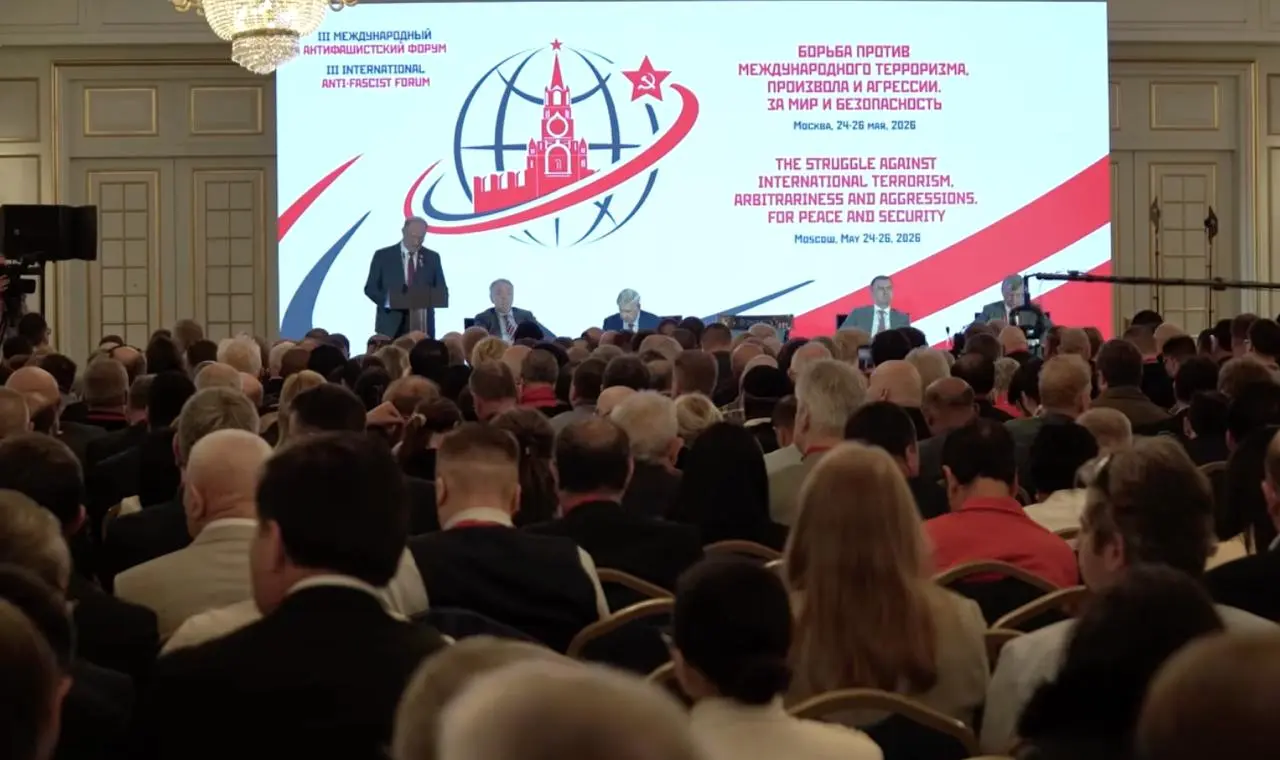
The plenary session of the Sovinter forum began with the reading of Putin’s address to those gathered. Putin himself did not attend the forum. [29] Following Putin’s address, a video message from Sergei Mironov, leader of ‘A Just Russia’, was shown. [30] Mironov also did not attend his organisation’s forum in person. Following Mironov, video messages were shown from former Bolivian President Evo Morales and former Paraguayan President Fernando Lugo. Next, a video message from the ‘American Communist Party’ was shown, read out from Iran by Christopher Helali. This was followed by a video message from Zakhar Prilepin, who recorded it whilst in the occupied territory of south-eastern Ukraine, ‘in the Donbas’. [31] This order of speeches was clearly intended to set the scene and present the event as possessing both state legitimacy and international significance. The most important president on the planet – Putin. His colleague and the head of the main Sovinter party – Mironov. Two former presidents from Latin America. Two politicians, Prilepin and Helali, who broadcast from theatres of military conflict, equating Iran’s just war of national resistance against the US with Russia’s colonial imperialist war against Ukraine.
Once the tone of the event had been set, Alexander Babakov, head of the Sovinter organisational committee and second-in-command of ‘A Just Russia’, took to the podium to speak. [32] Whilst the presidential administration had prepared a report for Mironov that at least resembled a discussion of socialism, Babakov delivered the standard speech of a Putin official. Babakov quickly descended into odes to President Putin, glorifying the genocide in Ukraine and the development of the Russian economy. There were so many arguments concerning A Just Russia’s pre-election promises by ‘A Just Russia’ regarding the creation of new jobs and the integration of business into state programmes, there were so many that it seemed as though Babakov seriously expected his speech to be heard not only by foreign guests, but also by Russians ahead of the State Duma elections on 18–20 September 2026.
If Babakov was trying to pass himself off as a ‘socialist’, he was doing a very poor job of it. He has neither the habit nor the interest. A significant part of his speech was devoted to how to develop the economy, build the financial system and introduce new technologies into industry. It is clear that at certain moments he either forgot that he was speaking to an international audience rather than a Russian one, or he forgot that the people in the hall did not, for the most part, represent the ruling parties in their own countries, and his arguments about joint projects in investment and high technology were completely irrelevant to the majority of the audience.
Moreover, Babakov effectively proclaimed the Russian Federation to be a socialist state. According to Babakov, capitalism is what exists in the countries of the ‘collective West’. In his speech, the capitalist was equated with the Western. Socialism was equated with the Russian system and ‘sovereignty’. Xi Jinping and Narendra Modi were cited as moral authorities.
Babakov’s speech was the forum’s keynote address and the main policy statement of the Sovinter. Subsequent speeches were intended as brief comments on the reports already presented. Such comments were made by representatives of the Sovinter’s co-organising organisations present at the forum – the ‘Workers’ Party of Great Britain’ (George Galloway), the ‘American Communist Party’ (Haz Al-Din), the ‘Moroccan Party of Progress and Socialism’ (Said Bakkali), the ‘Sandinista National Liberation Front of Nicaragua’ (Arling Alonso), the ‘Movement of Socialists of Serbia’ (Bojan Vulin), the ‘Socialist Party of the Republic of Moldova’ (Bogdan Țirde), ‘Tunisia, Forward!’ (Snoussi Dabbabi), and the ‘Union of Democratic Socialists of the Democratic Republic of the Congo’ (Crispin Kabasele Tshimanga Babanya). In their speeches, they thanked “A Just Russia” for establishing the Sovinter and expressed their support for both the party and Russia, asserting that socialism is impossible without traditional values and even that socialism is impossible without God, as the representative from Moldova put it. Following these speeches, Babakov took the floor again and summed up by saying that the speakers and their colleagues were those who stood against the “evil of the collective West”. In subsequent speeches, “A Just Russia” and the Russian Federation were also thanked by Fidel Castro’s grandson, the representative of a Chinese university, Liu Xu, the head of the “Communist Party of Kenya – Marxist”, Booker Omole, and Dimitrios Patelis, one of the leaders of the pro-Russian and pro-Chinese so-called ‘World Anti-Imperialist Platform’. Booker Ngese Omole went so far as to call the Sovinter ‘the international department of the Leninist party, the party of Stalin’ and dismissed as a lie the claim that ‘Russia wants to conquer the Sahel region’. [33]
Other Sovinter events in Moscow
The forum’s plenary session was not the only event that Sovinter held in Moscow. There were wreath-laying ceremonies before and after. Following the plenary session, there were also so-called ‘strategic sessions’, the topics of which were: 1) ‘Digital partisans: political communications in the 21st century’, 2) ‘The Sovinter Platform: Socialism, Social Media, Artificial Intelligence’, 3) ‘The Conflict in Donbas as a Focus of Global Attention’, 4) ‘The Situation During the Third World War and the Strengthening of the Anti-Imperialist and Anti-Fascist Front’.
The organisers have made photos and videos from all the events freely available online. [34] Note the rather lengthy 13-minute speech by Nikolai Starikov at one of the sessions. [35] Starikov is a well-known anti-communist writer in Russia who considers Lenin to be a British spy and the October Revolution to be a secret British plan to remove Russia from the First World War. Furthermore, he believes that the Entente helped the Bolsheviks to win the Civil War. According to Starikov, Stalin was a secret service agent and a secret Orthodox monarchist who, after the revolution, allegedly destroyed Leninism and restored imperial order in the country. Starikov has written numerous books on this subject, which are very popular in Russia and form the basis for many of the conspiracy theories prevalent in Russian society. [36] A defender of tsarism and a fascist, Starikov has recently also become one of the leaders of ‘A Just Russia’. [37]
Russian imperialism has established direct contacts through Sovinter with the World Anti-Imperialist Platform. Sovinter signed its main documents and joined it, whilst the World Anti-Imperialist Platform, in turn, joined Sovinter. [38] [39]
The Sovinter and the international propaganda of Russian imperialism
During the Sovinter forum held in Moscow, a resolution was adopted entitled ‘On resolving the crisis surrounding Ukraine by addressing its root causes, whilst fully respecting the purposes and principles of the UN Charter in their entirety and interrelation’. This document, subservient to Russian imperialism, is obediently couched in Russian state rhetoric and fully supports the imperialist aggression of the Russian Federation against the Ukrainian nation from 2014 to 2026, concluding with the words ‘The International Socialist Network SOVINTERN expresses its support and solidarity with the Russian Federation in the cause of strengthening regional security and stability.’ To conceal its true nature, this resolution was camouflaged by other resolutions – in support of Iran, Maduro, the DPRK, Africa and Cuba. [40]
On 22 May, the Ukrainian army struck the grounds of a college hall of residence [41] in Starobelsk, located in the Luhansk region occupied by the Russian Federation. Several dozen people were reportedly killed in this strike. Such stories are a constant reality of the Russian-Ukrainian war, in which hundreds of soldiers die every day and where the Russian Federation kills dozens of civilians daily through rocket attacks on Ukrainian rear areas and drone strikes targeting people in frontline towns. Against the backdrop of the 9 May ceasefire with Ukraine and speculation about the possibility of ending the conflict, Russian imperialism began actively promoting the story of Starobilsk in its propaganda. The Russian Federation sent statements regarding Starobilsk to the UN and other international organisations. [42] Under the pretext of the events in Starobelsk, Putin publicly rejected the possibility of peace with Ukraine. [43] The outrageous absurdity of Russian propaganda reached such a level on this issue that Russian imperialism declared its desire to bury the girls in ‘wedding dresses’, as reported by Yana Lantratova, a member of ‘A Just Russia’, a war criminal and ‘Human Rights Commissioner in Russia’. [44]
The Soviet International, in line with Russian imperialist propaganda, issued two statements. On 23 May, a statement was released under the eloquent title ‘To the murderers of children in Starobelsk – a new Nuremberg!’. [45] On 25 May, an article entitled ‘Unity in condemning the terrorist attack in Starobelsk’ was published. [46] The first text contains an open call to bombard the Western media with disinformation about the events in Starobelsk. The second text absurdly states that “SOVINTERN supporters are convinced that those responsible for the war crime in Starobelsk must face an international tribunal following the example of Nuremberg, and call on all friendly forces to disseminate information about the tragedy as widely as possible, and to show solidarity with Russia in its struggle by all available means”.
Thus, Sovinter immediately became a tool in the hands of Russian imperialism, justifying its genocidal and colonial policies in Ukraine.
Conclusions
Sovinter is an organisation created by Russian imperialism to pursue international political objectives within a ‘socialist’ milieu loyal to it. Such projects cannot proceed without the involvement of the Russian security services. The position of nominal head has been filled by an individual who has been repeatedly implicated in organising Russian influence abroad. Sovinter has brought together the interests of the foreign intelligence service, the opportunistic interests of a number of officials close to Putin, and the business interests of Russian capital in the IT and artificial intelligence sectors.
The leaders of Sovinter – Putin, Babakov, Mironov, ‘A Just Russia’ – are genocidal maniacs and mass murderers responsible for the deaths of hundreds of thousands of people in the aggressive wars of Russian imperialism and for fascist repression within Russia itself. Russian imperialism, stained with the blood of countless peoples – from Chechnya to Ukraine and Syria – is attempting to pass itself off as a ‘bulwark of socialism’ and a ‘guarantor of state sovereignty’ in order to satisfy its drive for maximum profit and penetration into new markets. Russian imperialism hopes that through such ideological ploys and manipulations it will be able to secure a more advantageous position for itself in the struggle and collusion with other imperialist powers.
Sovinter is needed to coordinate the external influence of the Russian secret services and serves as a new apparatus for the organised infiltration of societies in other states. Whereas external influence was previously fragmented, through projects such as Sovinter, Russian imperialism is attempting to create a system for coordinating organisations and individuals loyal to it across the globe, concealing this influence of the secret services through a system of solidarity in the form of an ‘international organisation’.
A highly underestimated aspect of Sovinter’s role is its potential to strengthen Russian imperialism, not only and not so much in the struggle against American imperialism, but in potential competition with Chinese social-imperialism. In fact, a structure directly controlled by Moscow, relying on Russia’s authority and funded and managed by Russia, will in future be able to challenge China’s authority as the main bastion of global revisionism and pseudo-socialism. It is highly symptomatic that events such as the Sovinter forum are taking place in Russia, given the CCP’s relative international passivity on such matters. Through ‘A Just Russia’ and the CPRF, and via its direct military ties with the DPRK, Russian imperialism is clearly attempting to regain the influence in international revisionism that it lost following the collapse of the USSR. The restoration of Russian influence within the ‘socialist movement’ is openly declared as a key and long-term objective by Russian politicians themselves. At the same time, Russian officials and businessmen, to whom Russian imperialism entrusts contacts with ‘socialist parties’, have so far failed to adapt to this mission and continue to slip into the rhetoric they are accustomed to in their dealings with European diplomats and the heads of transnational corporations.
Attempts by Russian imperialism to create fake ‘internationals’ and deceive oppressed nations, the proletariat and communists across the world must be universally and strongly condemned.
June 2026
References and notes
1 – vsluh.ru/novosti/obshchestvo/otkuda-nogi-rastut-surkov-ozvuchil-novye-instruktsii-kremlya_90136/
2 – Mironov was a deputy in St Petersburg from 1994 to 2000, and deputy head of Putin’s election campaign headquarters in St Petersburg in 2000. Mironov’s first initiative after his election to the Federation Council in 2001 was to extend the presidential (Putin’s) term of office from 4 to 7 years. In 2004, as leader of the ‘Russian Party of Life’ and a presidential candidate, he declared that he was not campaigning for himself in the election, but for Putin’s election. Shortly before Prigozhin’s mutiny, Mironov became very close to the Wagner Group and even posed with their famous hammer, used to kill deserters. Prigozhin personally presented Mironov with such a hammer. Mironov also advocated for the legalisation of all private military companies.
3 – The Communist Party of the Russian Federation, established with Yeltsin’s permission in 1993, is a ‘left-wing’ nationalist party led by Gennady Zyuganov. It is officially the ‘heir to the CPSU’ and continues the policy of Soviet revisionism under Yeltsin and Putin’s Russia. In the winter of 2026, it proclaimed itself Putin’s party: kprf.ru/dep/gosduma/activities/240912.html Functionally, it is one of the fascist parties governing the state apparatus of Russian imperialism.
4 – Liberal Democratic Party of Russia. In reality, it is an ultra-right party of ethnic nationalists that frequently echoes fascist and monarchist ideas. It was established by the USSR’s KGB as the Liberal Democratic Party of the Soviet Union to fracture the democratic opposition within the USSR: www.ng.ru/ng_politics/2017-03-07/9_6943_first.html. Functionally, it is one of the fascist parties managing the state apparatus of Russian imperialism.
5 – United Russia – the main ruling party of the Russian Federation, leading the ruling coalition since 2001. Nominally a conservative party. Putin’s party. Functionally, it is the primary fascist party managing the state apparatus of Russian imperialism.
6 – www.kommersant.ru/doc/6851404
7 – www.rbc.ru/politics/23/12/2023/6586bdf69a7947089e8d6c41
8 – Current platform of “A Just Russia”: storage.spravedlivo.ru/sr73/113270a.pdf
9 – www.svoboda.org/a/25069929.html
10 – spravedlivo.ru/12636010
11 – Yana Lantratova, in addition to her membership in “A Just Russia,” served as a regional coordinator for the “Young Guard of United Russia” and ran for office as a United Russia candidate on various occasions. She is known in Russia for filing denunciations and opposing the introduction of legislation against domestic violence. She authored the ban on “child-free” ideology in Russia and initiated the designation of the “International Satanic Movement” and the “International LGBT Movement” as extremist organizations in Russia. She actively advocates for banning youth subcultures. The Security Service of Ukraine accuses Lantratova of war crimes and the forced deportation of Ukrainian children. She promotes the creation of a registry to monitor Russians who have left the country, facilitating reprisals against them should they return.
12 – kamchatka.spravedlivo.ru/19392910
13 – Zakhar Prilepin was a member of various National Bolshevik organizations from the 2000s until 2019 (such as the National Bolshevik Party and the “Other Russia” party) and served as editor-in-chief of National Bolshevik newspapers. Prilepin’s literary works were initially published in National Bolshevik newspapers (including “Limonka”). He has been an active participant in the Russian intervention in Ukraine since 2014. Currently, he also serves as deputy commander of the “Oplot” Special Purpose Regiment of the Russian National Guard.
14 – Another member of this party—and its leader prior to Babakov—is the neo-Nazi Rogozin, known today for his long tenure heading Roscosmos. Rogozin has repeatedly performed the Nazi salute in public and delivered speeches at neo-Nazi rallies: https://youtu.be/FUItOUKQ-zc?si=yUxuGnKWC41INvTT and https://youtube.com/shorts/po-d43jIV5k?si=Bq4aWMnuEKiQuQFI. Babakov succeeded Rogozin as head of the “Rodina” party after the Russian Supreme Court ruled that Rogozin’s 2005 election campaign activities incited inter-ethnic hatred.
15 – Babakov himself commented on his merger with United Russia at the time as follows: “We believe that the course chosen by the leadership of the A Just Russia party—a course of war against United Russia—is mistaken, and that the main political rival of A Just Russia, as a party on the left side of the political spectrum, is the CPRF.” vz.ru/politics/2011/7/21/508684.html
16 – spravedlivo.ru/11201-11
17 – time.com/3605080/russia-france-national-front/
18 – ru.krymr.com/a/news-ssha-zampredu-gosdumy-rossii-aleksandru-babakovu-vydvinuty-obvineniya/31804382.html
www.dw.com/ru/v-ssha-zampreda-gosdumy-rf-babakova-obvinjajut-v-zagovore-s-celju-vlijanija/a-61483347
19 – https://youtu.be/-BYaMCDnJSg?si=xkesFctK41RTa8bg
20 – https://youtu.be/uSUlvPXjq7M?si=9ainiTCHmhS0o3yD
21 – sovintern.org/ru
22 – www.rusprofile.ru/id/1237700292059
23 – checko.ru/company/tropass-1237700292059
24 – checko.ru/company/konstruktorskoe-byuro-bv-1257700086555
25 – checko.ru/company/ag-rus-1227700762464
26 – checko.ru/company/1157746613595
27 – checko.ru/person/760708581582
28 – rutube.ru/video/12V6WHwFChkfBeupzge5xb9Syesd7Hn9F6/?r=wd&t=7546
29 – Full text of Putin’s address:
“To the participants of the founding forum of the International Socialist Network” “Sovintern – For Socialism in the 21st Century”
Dear friends! I welcome you to the founding forum of the “Sovintern” International Socialist Network.
Your gathering in Moscow has brought together representatives of Russian and foreign political parties and movements, as well as civic organizations advocating for social justice, sovereign development, and traditional spiritual and moral values.
I would like to emphasize that Russia has always sought to expand fruitful dialogue among all constructive national political forces. Together with our colleagues from the Shanghai Cooperation Organization, BRICS, and the Eurasian Economic Union, we are creating tangible partnership mechanisms involving legislative and party structures. These are designed to unite the efforts of political leaders and parliamentarians from our countries to jointly seek answers to shared challenges regarding global and regional stability and security, and to foster economic and social development.
I trust that the establishment of this new format for inter-party cooperation will serve to further deepen multilateral socio-political ties and help strengthen trust between our countries and peoples.
I wish you productive work, substantive discussions, and all the best.
Vladimir Putin”
kremlin.ru/catalog/keywords/27/events/79628
30 – address: https://rutube.ru/video/12V6WHwFChkfBeupzge5xb9Syesd7Hn9F6/?r=wd&t=137
Full text of Mironov’s speech:
“Esteemed colleagues and dear friends!
I welcome all participants to the inaugural international forum ‘Sovintern – For Socialism in the 21st Century.’ Uniting socialist, social-democratic, and workers’ parties—along with all progressive social and political forces—in the struggle for a new socialism of the 21st century, for freedom and justice, is a necessary and timely decision. In recent decades, the world has changed radically and continues to change rapidly. Many countries are witnessing a wholesale assault on the social gains of working people—gains that, until recently, seemed unassailable. The globalist policies of the so-called Western global elites have resulted in a succession of military conflicts, a surge in terrorism and xenophobia, and the erosion of international law. The dominance of finance capital is turning entire nations into mere sources of raw materials for transnational corporations. If this global order persists, many peoples will simply have no future. They will not only cease to be active agents in the historical process but will also lose their national identity, culture, and language. Capitalism has once again descended into barbarism. Socialism has always been, and remains, the alternative to capitalism in the development of human society. The socialist idea was born of culture and the age-old human aspiration for justice and a harmonious world order. Socialism stands in opposition to barbarism. It is within our power to ensure the victory of socialism over the barbarism of modern capitalism and to guarantee a future for humanity. Only a new socialism of the 21st century can provide answers to the real threats and challenges facing humanity. This is not merely theory, but the actual political practice we are shaping today. At the heart of socialist ideology lies the concept of justice—one of the most profound ideas in human civilization. Only where social rights are realized does an individual gain the opportunity to fully exercise their civil rights. This is a crucial prerequisite for effective democracy.” Therefore, the primary task of modern socialism is to pursue an active social policy and fight for fair income distribution, basic social guarantees that protect people from poverty and arbitrary treatment, accessible education and healthcare systems, and decent pensions. Yet, socialism’s greatest strength lies in its constant openness to new ideas and groundbreaking social projects. The Soviet Union’s scientific and technological achievements are the best proof of this. The speed with which our country transformed from an agrarian nation into an industrial powerhouse—and one of the world’s leading technological nations—once captivated the imagination of all humanity. Even our adversaries were forced to acknowledge this. Consequently, a crucial priority for modern socialism is the large-scale technological modernization of the economy and industry based on socialist principles. We socialists have repeatedly demonstrated our solidarity and readiness for constructive cooperation to the global community, all while defending people’s social rights and the genuine national interests of our respective states. We socialists have previously worked together at international socialist forums, including those organized by the Socialist International. However—and we must be frank about this—the leadership of the Socialist International has devolved into run-of-the-mill bureaucrats; they have abandoned debate and the free exchange of views, succumbed to Western policies of double standards, sanctions, and hybrid warfare, and reduced the organization’s members to mere figureheads. Our initiative to establish a “Sovintern” is driven by a desire to avert a crisis within the global socialist movement, restore open, dialogue-oriented discussion, and revive the spirit of cooperation and solidarity. This applies not only to the current international agenda but also to the theoretical foundations of modern socialism and an objective assessment of historical experience. The experience of building socialism in the USSR raised—though it did not fully resolve—a number of critical questions that remain relevant to the global socialist movement today. How does social justice relate to economic efficiency? How does civil society interact with the authorities? How can the national identities of peoples be reconciled with the political unity of states? Together, we will seek—and undoubtedly find—answers to these questions for the modern world. Russia’s post-Soviet experience in the 1990s demonstrated quite clearly that a socio-economic system cannot simply be chosen like a product in a supermarket. A new socialism does not reject the market; rather, it demands social justice within the market economy and establishes social protections for workers in the context of today’s digital society. Our country suffered colossal losses by relying on the advice of the International Monetary Fund and the World Bank. A country’s economic system cannot be divorced from its history, the people’s national identity and culture, or the specific characteristics of its traditional institutions. Every nation must choose its own path of development independently, freely, and responsibly. The forum we are jointly establishing—thanks to its digital formats and a permanent interactive online platform—will enable us to engage in dialogue and create new meanings and values. We call upon socialist, democratic, and social-democratic parties—and all who share socialist ideals—to unite in a common front against those who impose their will on others; against neocolonialism, violations of the principle of collective security, a new Cold War, and the arms race; and for justice, social progress, and a dignified life for all.”
31 – The host introduced Prilepin as a man who brings us the truth. The full text of his address follows:
“Hello, dear comrades and participants of the Sovintern conference. I greet you from sunny Donbas. My name is Zakhar Prilepin. I believe the place from which I am greeting you is pivotal to our entire meeting. Why? Because what is happening here in Donbas today—as well as in Iran, in a number of other countries, and indeed in many of your own countries in one way or another—represents, in my view, the first stage of a great anti-colonial movement. Unfortunately, things did not go as smoothly, wonderfully, or easily as we had imagined back in 2014. We thought victory was close at hand. We thought the mere fact of Russia’s involvement in this whole affair would guarantee an end to the war and bring us victory. But it turned out—as it happened—that this is not a private or local matter, but a worldwide, global issue—one that concerns every continent. I believe that our gathering—that none of us—harbors negative sentiments toward any specific countries.” We won’t even talk about our grievances with NATO, the US, or the European Union, because that isn’t the point. Because we—Sovintern—are not about waging war against anyone. We are about friendship: friendship among all citizens, all ethnic groups, and all peoples who hold the values of freedom and conscience in the highest regard—or even as absolute—and who reject a world of double or triple standards, a world that preaches democracy while endlessly humiliating everything living and independent on this planet. I am happy to know many of the people in this hall personally. And knowing these guys—knowing their charisma—I realize that our cause is certainly not lost. I’m talking about Haz, Jackson Hinkle, our wonderful Greek friend Periklis, and other remarkable friends with whom we’ve crossed paths in all sorts of circumstances and lands—including right here. I wish for all of you a rational, firm, and sober dialogue—free from grandiloquence, empty pathos, and self-deception. Those are the most absurd and unnecessary things that often plague events like this, where we pump each other up with the extraordinary conviction that victory is just around the corner, only to end up with nothing. We need to soberly prepare ourselves for a long struggle. But in any case—looking at what is happening here in the Donbas, as well as in Iran and even Cuba—we realize that resistance is possible, and that the forces opposing us are neither absolute, nor monolithic, nor all-powerful. If we regroup, get to know one another, and join hands, we will figure out how to stand up to them. We will devise a plan and, one day, we will carry it out. I wish everyone a productive start to Sovintern’s work. https://rutube.ru/video/12V6WHwFChkfBeupzge5xb9Syesd7Hn9F6/?r=wd&t=1084
32 – Full text of Alexander Babakov’s speech:
“Dear friends! Dear comrades! First of all, I would like to welcome you to Russia and thank you for finding the time to respond to this initiative and come here to Moscow to participate in the first Sovintern forum. I would also like to thank everyone who was able to lay flowers at the Tomb of the Unknown Soldier yesterday. This is a sacred place for everyone—not just Soviet citizens—because we bow our heads before those who secured the peace and freedom for which we continue to fight, each in our own sphere. I would also like to thank you for not remaining indifferent to current events, and for understanding the responsibility that rests on each of our shoulders in our respective countries—a responsibility for the fate of the world. These are not empty words; they are realities. I am speaking about them now and will elaborate shortly. All of this signifies one thing: there is something that unites us. And what unites us is not the individual, but the collective. I would like to say a few words about the Special Military Operation [the Russia-Ukraine war] that Russia is conducting today; it is part of the war against the collective West. That West—which makes no secret of its desire to destroy Russia, the Russian people, and Russian culture—has also targeted our historical memory. This memory encompasses not only the Great Patriotic War but also the immense contribution made not just by the Soviet Union, but also by countries that viewed the Soviet Union as a friend and stood together against negative phenomena—to put it mildly—manifesting worldwide: neocolonialism, racism, and Nazism.” I would like to emphasize once again that the Special Military Operation—launched by our President’s decision to put an end to the genocide that the current Ukrainian leadership itself unleashed against its own people—has today evolved into a military confrontation between Russia and its allies and the collective West. Naturally, we are confident in our strength; we are confident of victory. However, the Special Military Operation has once again demonstrated the vital importance of concentrating our efforts on every front we face—both within our own state and in our work with international organizations. What do I mean by this? Look at the crisis in the international system of relations: the foundation for treaty-based relations has vanished. Today, we find ourselves in a situation where there is no basis for negotiations—even on the most complex issues of peace—other than the position of strength imposed upon us by the collective West. Therefore, we fully understand that our first meeting today—this inaugural session and the initial discussions regarding the “Sovintern”—must be grounded in an understanding of what we are prepared to offer the world and all those political forces committed to making a positive contribution. I mention the Soviet Union for a reason. I was born in the Soviet Union; I received the best things in my life there, and that foundation supports me in my life and work today. The Soviet Union was, in effect, the most significant project of the 20th century. It issued a challenge and propelled global development toward the virtually limitless horizon of social justice. Yet, the Soviet project came to an end—not because it was inherently flawed; that is a separate story, one that requires study. Here, I would like to say that the Soviet experience—encompassing both its positive aspects and the negative circumstances surrounding the project’s conclusion—is invaluable. However, it should not be copied or replicated; rather, it must be studied, developed, and adapted to new conditions. If I may, I would like to devote the main part of my presentation to this topic—to proposing possible options and discussing them. We need to consider how to move forward, building not only upon the ideological foundations laid by the Soviet Union but also upon the legacy we have inherited and are currently developing within our respective states. I would like to point out that certain factors and phenomena—such as state funding, macroeconomic planning, and social consumption funds—originated and were implemented in the Soviet Union. These elements spurred development not only within the USSR but also in other nations; indeed, the West emulated these practices. The era of prosperity in the West—and in Europe specifically—during the 1970s was largely driven by the fact that they adopted and adapted these best practices and achievements for their own economies. We maintain that the scientific foundation established during the Soviet era must be further developed. Together, we must devise approaches to formulate a new theoretical platform that addresses the relationship between the world and the individual—a theme already touched upon by previous speakers in their opening remarks. Why are we able to discuss this? What makes such a choice possible? The reason is that the twentieth century already yielded technologies and technical solutions capable of fully satisfying the material needs of everyone living on Earth today. This is stated—albeit in their own respective ways—by Comrade Xi in China, Mr. Modi in India, and our own president. I am certain that many political figures present in this hall also fully understand that, from a purely mathematical standpoint regarding material consumption, humanity is currently ready to provide these opportunities to everyone. All those theories about the scarcity of resources and limitations on potential stem from a single fact: the collective West did not want, does not want, and will not want to share this wealth with the rest of humanity. Therefore, we must not merely respond to this question; we must formulate a position and identify ways and solutions. What needs to be done, in our view? Well, consider this. We can discuss needs—needs that, I am convinced, can be met today using the tools at civilization’s disposal. Let us look at economic needs. What does the modern economy represent? For centuries, the economy developed with profit as its goal—profit. You are all well aware of this. Even the brief remarks made by our colleagues in their pre-recorded speeches mentioned the need to counter capitalism. But we must go further. Why? Because our weakness lies not in capitalism’s strength, but in the fact that we have not yet fully realized our own potential. Capitalism is, indeed, a powerful system; it has permeated every sphere of our lives. If we look at recent statements from leading institutions of the capitalist system—such as the International Monetary Fund, which is well known to you—what do they say? They say that market mechanisms are no longer as effective as they once were and that greater state investment in the economy is required. What does this signify? I could speak at length about the economy, but I will not. I simply want to point out that capitalism, as a system, adapts very rapidly to changing circumstances. I realize that, today, there are no other tools available to capitalists to maintain the social stability of their countries. Capitalism must adapt to this. Nowadays, merely dressing up capitalist relations in attractive packaging is no longer enough for capitalists—or the capitalist world—to defuse social tensions. People have become more knowledgeable. They have become more active. And they have come to understand more—much more. Moreover, their contribution to the actual process has grown; this is evident to everyone. Consequently, the capitalist model and ideology are currently focused on adaptation. They are trying to align themselves with the rhetoric of socialists worldwide, adopting terms like “social justice”—albeit interpreting them in their own way. Faced with this, we must counter with our own mechanisms for achieving results, including in the realms of ideology and politics. We must not merely aspire to political power; we must seize it, because the truth is on our side. Consider the driving forces behind these systems: I mentioned that the capitalist system is driven by profit, but what serves as the ideological foundation for us? It is the system of public consumption funds—the very thing that unites people. Can one put a price on old age? On childhood? On family well-being? Of course not. When we speak openly about this, we must recognize the goals of economic development put forward by every political force—including, I admit, our own party. We hear our President, and we support him in this: he states that the goal of the economy—specifically the Russian economy (I use Russia as an example, though I imagine your reaction would be similar)—must be the quality of life. We must insist that people should live happy lives. And what is happiness? It is a comfortable living environment. It is not just an apartment with a certain number of square meters—no, it is comfortable housing. It means that when you step out of your home, you find yourself in a comfortable environment. It must be located close to all centers of culture, leisure, and the like—in other words, everything that makes life enjoyable. People must have access to skilled, high-paying jobs. Low-wage labor belongs either to a bygone era or to economies that the capitalist system views merely as a source of its own enrichment. Yet, when we speak of the economic sovereignty of the states represented here, a highly skilled, well-paid job must be a cornerstone of that sovereignty. This implies that for such a place to exist, there must be a sovereign economic model of one’s own. At the core of this model, there must be comprehensive, high-quality, free education and free healthcare—viewed not as a burden on the state, but as its very objective. Any political force armed with such a clear, understandable program is guaranteed success. Because this is not merely a declaration; it is a realistic assessment of the economic tools available in every country today. What does this mean for us? It means that with such a goal in mind, we must rethink our approach to financing. We must stop pitting the private sector against the public sector. The state has public, state-level tasks that cannot be replaced by private interests. However, the private sector can always serve the state—and serve society. There is the concept of corporate social responsibility, which represents an excellent form of cooperation between the state and private business. Yet, public and state objectives remain the priority. This encompasses more than just security, policing, or the military; it goes beyond maintaining order among the state’s various religious denominations or supporting culture and the arts. No, it involves the entire system that provides every citizen with a share of the “common good”—and that common good is the ultimate goal. Consequently, funding this common good must be a primary objective, rather than being handled—as was the case in Russia during the 1990s—on a “residual” basis, where funds went to specific sectors first, with whatever was left over allocated to science, education, and healthcare. That is why I speak with such confidence when I say that we socialists possess not only a noble aspiration but also the actual tools—based on modern forms of economic process automation—to achieve this. I believe in it. After all, we have excellent examples to look to—such as China, and the Russia of today, which is following this same path. Just look at the unbridled economic development of China… though I am speaking specifically about Russia. We are not developing simply because we have left issues unresolved or because we lack something. No. We are developing because the overall development of any state should be driven by needs rather than by financial capacity alone. Every country—and every region within our country—has its own potential and its own needs. These must simply be realized. After all, the key to economic development lies in having projects and the ability to implement them. Yet, for a long time, the international financial system—including in relation to Russia—imposed an approach that stifled our growth by dictating exactly how much money each country could allocate to its own development. I can say with confidence—regarding 90% of those present here—that you know from your own countries’ experiences how the International Monetary Fund would specify the amount of national currency available for development, effectively pegging that currency to your state’s export capacity. This applied to Russia as well. Of course, that was their stance; it is a form of financial colonialism. When we ask whether every state is capable of doing this—the answer is yes. But they need an international monetary system to support them. Today, we assert that the international monetary system built by the West—the “collective West,” and primarily the United States—which relies on the dominance of the dollar, is collapsing right before our eyes. It is collapsing because of their own actions. They have politicized the economy, finance, and all manner of relations, turning them into instruments to politically suppress the freedom of states and peoples. We see this in the case of many nations. Even the conflict involving Iran serves as further proof that the unbridled drive to preserve a unipolar world through military, financial, and economic tools is a path to nowhere—a path to destruction. We can say that within Russia, China, and India—and indeed across all the nations that have united within BRICS—approaches are being developed to shape the financial landscape and find solutions in the financial sphere. If we all support—through our respective programs—those economists and financiers who propose international instruments for national development, then there is no need to fear this. We certainly do not fear it. It is only the world of capital that fears it, because its monopoly is being dismantled. We, however, must strive to ensure that the international financial system serves the interests of every state and fulfills its fundamental function: providing the necessary resources to any nation that lays claim to—and is worthy of—sovereign status. Therefore, I am confident that this is entirely achievable and that we already possess the necessary tools. I believe we will discuss these matters further in the sessions scheduled for today and tomorrow, as we have concrete proposals that we are already working to implement. As for the battle for hearts and minds? That is precisely what we must engage in. Because we provide the answers to all the questions—including how to achieve our goals. Our ideas are winning; they are rooted in the legacy of our ancestors, and we are carrying that legacy forward. But that alone is not enough. We must also equip ourselves with the right tools and a clear understanding of when, by whom, and through what means these goals will be achieved. I am confident that we will win the battle for hearts and minds—not just among the youth, but across all social strata and age groups—by offering clear, understandable explanations regarding what lies ahead for us in the near future. I am grateful to the colleagues who took the initiative to support the creation of Sovintern, and to everyone who has traveled here—ready to back this idea with their presence and their work at the inaugural Sovintern forum. We are proposing a format that keeps pace with the times. It represents the best way for us to communicate. It goes beyond essential face-to-face contact; thanks to technological capabilities—including artificial intelligence and technical solutions, but above all, shared ideological approaches—we will be able to maintain a constant online connection. We will be able to shape our stance and develop strategies—both collectively and for each individual state participating in our project—including programs designed to strengthen their political influence domestically. In this regard, we are your allies. We are all allies. We are all partners. We are all friends. And it is wonderful that we can address one another as “comrade” or “friend”—terms that convey far greater clarity and a deeper sense of responsibility than the word “gentleman” (or “mister”), which immediately introduces a sense of division between people. I am certain that fruitful work lies ahead of us. I would like to conclude by saying: “Victory will be ours”—victory in the broadest sense of the word. Once again, thank you, and I wish you every success in your work. https://rutube.ru/video/12V6WHwFChkfBeupzge5xb9Syesd7Hn9F6/?r=wd&t=1376
33 – https://rutube.ru/video/12V6WHwFChkfBeupzge5xb9Syesd7Hn9F6/?r=wd&t=6531
34 – disk.yandex.ru/d/2fp1UdFPGbShZg
35 – disk.yandex.ru/d/2fp1UdFPGbShZg/03_FORUM%2027.04.2026/VIDEO/CAMERA_1/mp4/%20SR_0215S03.MP4
36 – read.nstarikov.ru
37 – spravedlivo.ru/11201-5
38 – wapnews.org/?p=11683
39 – wapnews.org/?p=12784
40 – sovintern.org/ru/forum
41 – The Ukrainian army officially states that the target of the strike was the headquarters of the “Rubicon” Center for Advanced Unmanned Technologies. Beyond direct provocations by Russian imperialism, the events in Starobilsk also have a number of additional explanations. For instance, the Russian army is recruiting female students for positions as UAV operators. semnasem.org/articles/2026/06/11/studentok-na-vojnu
41 – news.un.org/ru/story/2026/05/1467968
42 – www.kp.ru/online/news/7008255/
43 – ura.news/news/1053095931
44 – sovintern.org/ru/news/starobelsk
45 – sovintern.org/ru/news/starobelsk-unity